
AI Marketing Has Been at This a While — What's Stalling Everyone Now Isn't Just the Technology
This article argues that the dividing line in AI marketing is no longer technology but connected data and consumer trust. It discusses the engagement gap, AI shopping agents reshaping product discovery, rising privacy concerns, and the shift from ranking in search to becoming the answer AI assistants provide.
A few days ago, I had AI buy something for me.
Specifically, I said to an AI assistant: the coffee we always drink at home — pick me the best deal and order it. It searched on its own, compared prices on its own, bought it on its own. The whole thing took less than a minute.
I sat there, stunned for a few seconds.
Unbelievable. After all these years in marketing, consumers have actually stopped browsing.
And I'm not the only one with this strange experience. The SAP Emarsys Global Customer Engagement Index ran a survey covering 14,000 consumers and 3,000 marketers. One number in it: 77% of businesses plan to put more money into AI-driven customer engagement this year.
The money is flowing in. But the more I look at it, the more I believe the dividing line in this battle isn't who has the strongest technology.
Where is it, then? Read on.
What Is the "Engagement Gap"?
First, a set of numbers. 69% of consumers say they're pretty satisfied with the product recommendations AI gives them.
Sounds great, right?
Hold on. In the same survey, 40% say brands simply don't understand them as individuals. 60% say most of the marketing emails they receive have nothing to do with them.
On one side, 69% satisfied; on the other, 60% indifferent. And somehow, both numbers are true at once.
That's the "engagement gap." The technology to do personalization at the individual level has been ready for ages. But the way most brands actually work is still: carve out a batch by segment, blast out a round by calendar, and guess about the rest.
The tools are in your hands. The job is still being done wrong.
How do you close the gap? Move from "send one campaign to a crowd of people" to "watch each person's behavior in real time and adjust on the fly." Put plainly: the hard part isn't AI. It's the data AI stands on.
Consumers Stopped Browsing — Now What?
Back to my coffee purchase.
The consumer journey used to be: see an ad, click through, browse around, compare, order. Today that entire path is being taken over, end to end, by AI shopping agents.
What are AI shopping agents? Companies like Google, OpenAI, and Perplexity have, over the past year, one after another launched shopping agents that act on the consumer's behalf. You say one sentence; it searches, compares, and buys. Already 30% of consumers have used this kind of AI to buy things for them.
What does that mean for marketing?
The funnel is gone. Discovery, comparison, and the purchase may all happen inside an AI conversation you never see.
Think about it: when the one making the decision for the consumer is a machine, how does it recognize you? What it recognizes is this: whether your product data is cleanly structured, whether your prices are transparent, whether your inventory is accurate, and whether your information is consistent across every channel.
A clever headline leaves a machine cold.
Only brands that a machine can read and trust make the shortlist.
Marketers' Own Playbook Is Being Rewritten Too
Consumers are changing on one side; marketers aren't standing still on the other.
71% of marketers say AI helps them get campaigns built and launched faster, saving an average of 2.3 hours each. 72% say their teams have been freed up to do more creative work.
2.3 hours doesn't sound like much? Multiply it out: a team runs hundreds of campaigns a year, times the number of people on the team. The math stops looking small.
And the shift is escalating: from "an AI feature inside a tool" to "an AI agent taking over an entire workflow." Take SAP's Joule: a marketer states the need in plain language, and it can build reports, hunt down assets, and suggest audiences. No more clicking through menus and filling in settings one by one.
The content line is the same. 46% of marketing teams are already using AI to automate steps of their campaigns, and 39% are using it to build entirely new customer experiences. Product descriptions, email copy, ad creative, even audience segmentation — one sentence, and it's generated.
People used to compete on "who has AI." Now they compete on "who has woven AI into daily work."
Technology is no longer the moat. Speed of adoption is.
Trust Is Becoming the New Battlefield
But there's something deeply awkward here.
The deeper AI goes in, the more uneasy consumers get. Same survey: 63% of consumers have no confidence in AI's handling of data privacy. When the survey was run in 2024, that number was 44%. Two years — up nearly 20 points.
And the share who highly trust retailers to protect their information? Just 16%.
It's like telling your customers, "Relax, it's all for you," while the ledger quietly keeps filling up. How could they not feel uneasy?
Here's the interesting part: the brands that do this well don't treat privacy as a compliance cost — they run it like loyalty. In plain language, they tell consumers what data is collected and what it's used for. They let users choose whether to opt in to personalization, and then show them what they actually get out of it.
Put the benefits on the table, not in clause 8 of the fine print.
Online and Offline Were Always Meant to Be One Play
There's an old problem that AI has blown back up to full size.
Consumers have never thought in channels. They scroll on their phone, touch the product in the store, then check reviews on a laptop. From where they stand, it's one continuous experience. Inside the brand, though? One team runs email, another runs the app, another runs the stores. Each with its own script, each with its own data.
Five casts perform the same play; what the audience sees is five brands that have never met.
What AI can do is stitch the back-end signals together: you browsed in the app but didn't buy, and an offer follows you to your usual channel; you bought something in a physical store, and the online follow-up picks up immediately. The experience feels like "one company" because someone, behind the scenes, connected the wires.
And right now especially, stores are turning more and more into experience centers and fulfillment nodes. Online and offline aren't competitors. They're two segments of the same journey.
Stop optimizing individual channels. Optimize the whole journey.
The Least Glamorous Link Is the One Choking Everyone
At this point you might ask: of all these trends, which one matters most?
My answer: the least conspicuous one. Data.
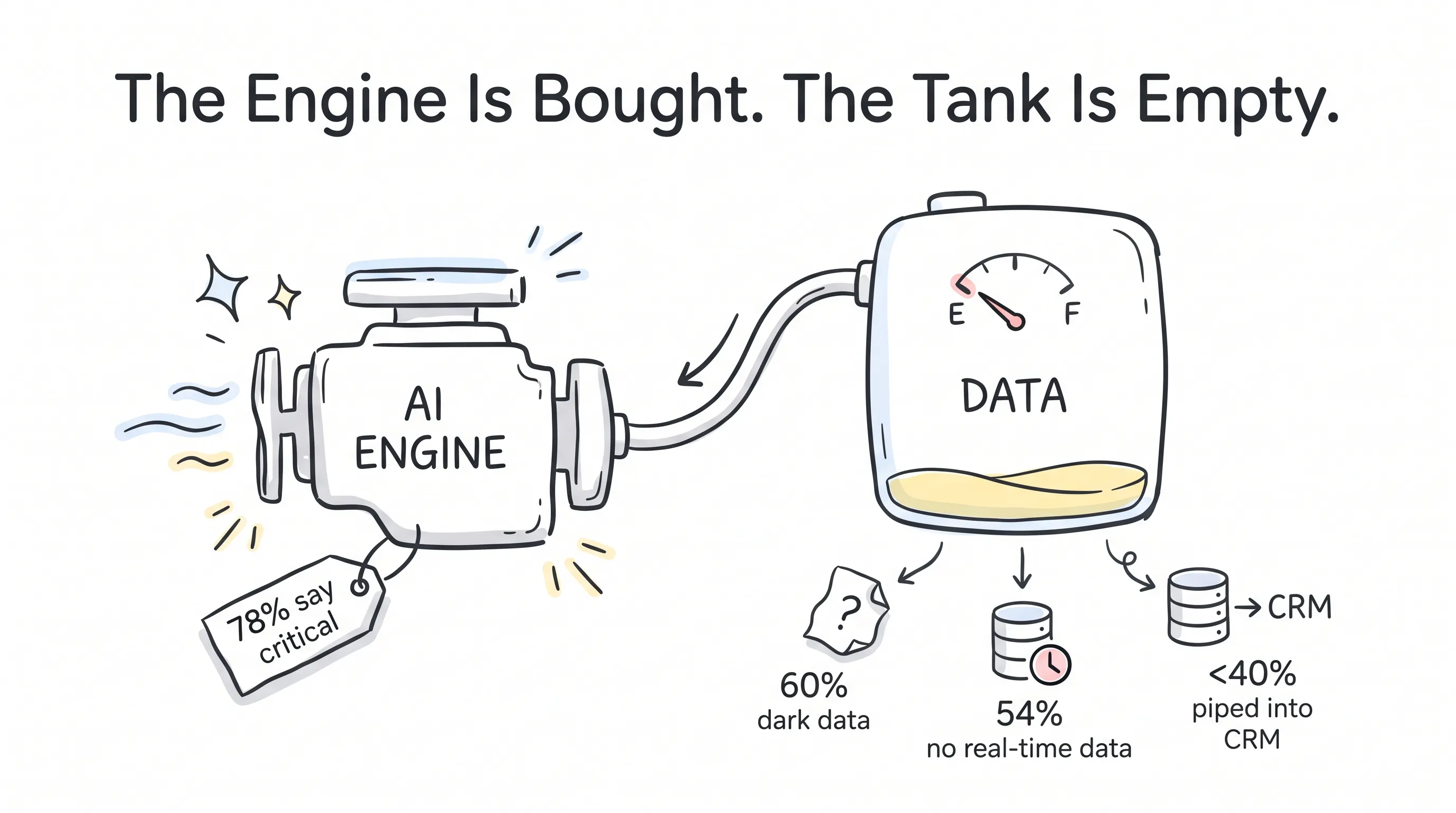
78% of businesses say AI is critical to keeping customers. But fewer than 40% actually pipe engagement data into their CRM or CX platforms. 60% sit on piles of "dark data" — collected, never put to use. 54% can't even get their hands on real-time data.
Let me translate: you've bought the engine. The fuel tank is empty.
Why is this so lethal? Because everything above runs on data — the personalization, the AI shopping agents, the prediction, all of it. However smart the AI, if you feed it five departments' worth of fragments, each hoarded separately, what comes out is a fragmented experience. The money is spent; the results never show.
So no, connecting your data isn't glamorous at all. But it is the foundation under every AI ambition.
The technology is ready. The data isn't.
Prediction Goes From Elective to P&L
Predictive analytics used to be, for most marketing teams, an elective course — "sounds great, not enrolling this semester."
Not anymore. Retail and e-commerce margins are being squeezed thinner and thinner, and prediction is now put to work on inventory management, dynamic pricing, customer lifetime value (CLV) estimates, and next-best-action recommendations.
Why the sudden requirement? Because the math is clear: predict one customer accurately — when they'll buy, what they'll buy, what price they'll pay — and you directly carry less excess inventory, run fewer discounts, and waste less ad spend. None of this is a vision slide. These are numbers that land on the P&L.
Of course, the old rule still applies: the ceiling of a prediction model is the ceiling of its data. Those with solid foundations run faster and faster. Those with shaky ones keep wondering why their predictions always fall just short.
The Rules for How Brands Get "Found" Have Changed Too
One last shift — and it takes us back to the coffee story from the opening.
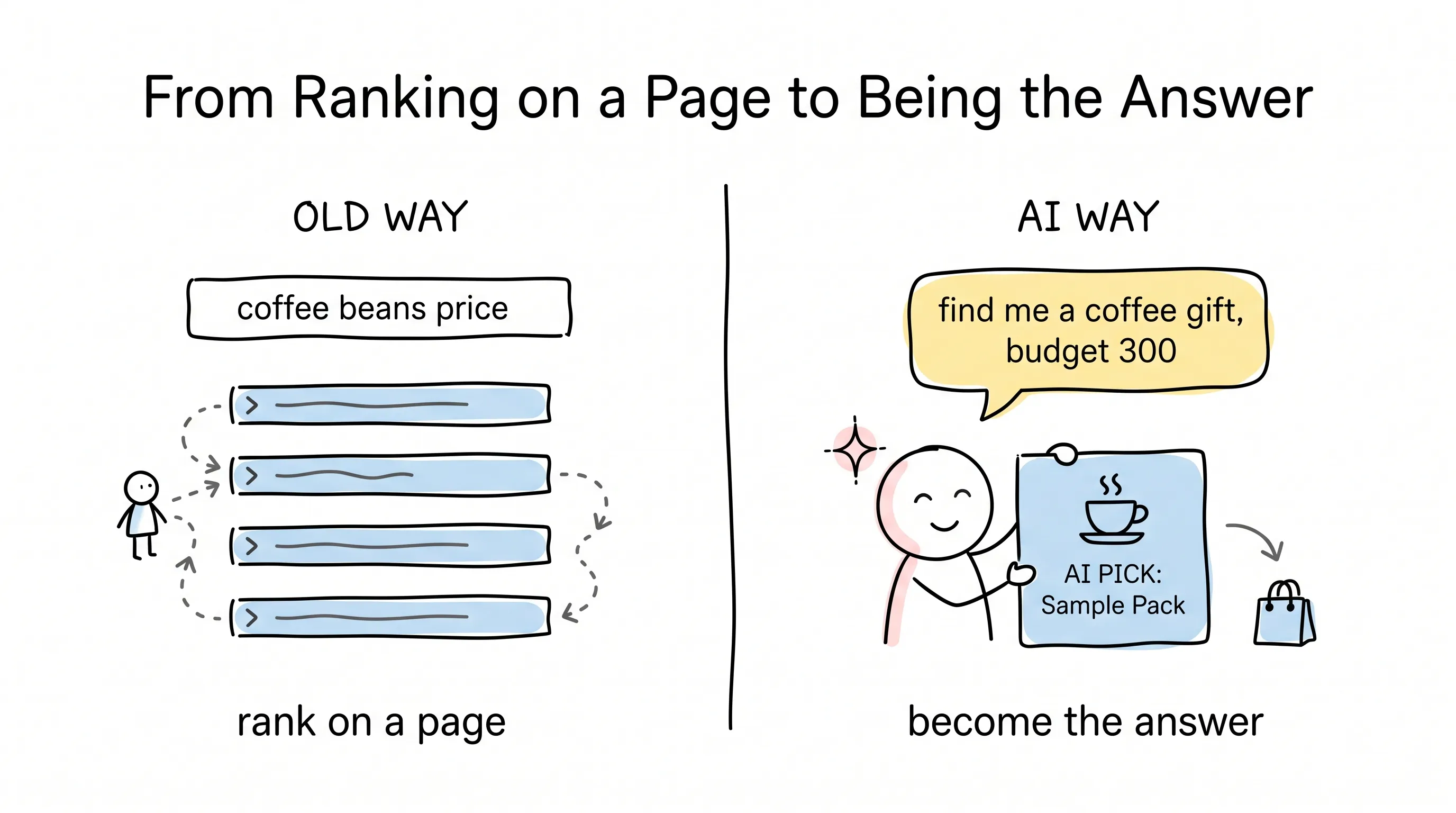
Consumers increasingly aren't typing keywords anymore. 34% already use AI to search for products, and 33% use AI to compare prices. What they say out loud has gone from "coffee beans price" to "find me a coffee that works as a gift for my elders, budget of 300."
When someone asks ChatGPT or Perplexity for a recommendation, what does the AI build its answer from? Structured product data, real and substantial reviews, and content that answers consumers' actual questions. Plenty of brand websites get bypassed entirely on this path.
So the game has changed. The old goal was ranking near the top of a search results page. The new goal is to become the answer the AI speaks in the conversation.
Brands with incomplete product data, thin reviews, and no answers to consumers' real questions will slowly turn invisible inside the discovery channels consumers increasingly rely on.
Finally, Back to That Cup of Coffee
That day, after the AI finished buying my coffee, I stared at the screen for a while.
The technology hurdle — the industry has basically cleared it. The real dividing line now sits on two unglamorous things: whether the data is connected, and whether the trust is real.
What separates the winners next isn't who has AI. It's who has wired up the data and made the trust real.
Here's wishing you become the brand that machines can read — and customers can trust.
Continue reading
Related articles

What Is GEO? How Your Brand Gets "Mentioned" in the Age of AI Search
An explainer on GEO (Generative Engine Optimization) for e-commerce and DTC brands: how it differs from SEO and AEO, why AI answers shape brand visibility, and eight practices covering question-focused content, consistent brand messaging, structured pages, external evidence, comparisons, and AI mention tracking.

AI Is Already Making Decisions for Your Customers. Are You on the List?
A learn article explains GEO (Generative Engine Optimization): why AI-generated answers now shape which brands customers see, and how SEO fundamentals, entity clarity, citable evidence, and monthly measurement affect visibility in AI answers.

Google Is Stuffing Ads Into AI Search: These Recent Stories Are Really One Story
A news roundup linking recent AI marketing stories—Google adding ads to AI Mode, Amazon's Ads Agent, ChatGPT image updates, a UK startup tracking brand mentions in AI answers, and an AI ransomware warning—arguing that control over ad data and visibility is shifting toward platforms.