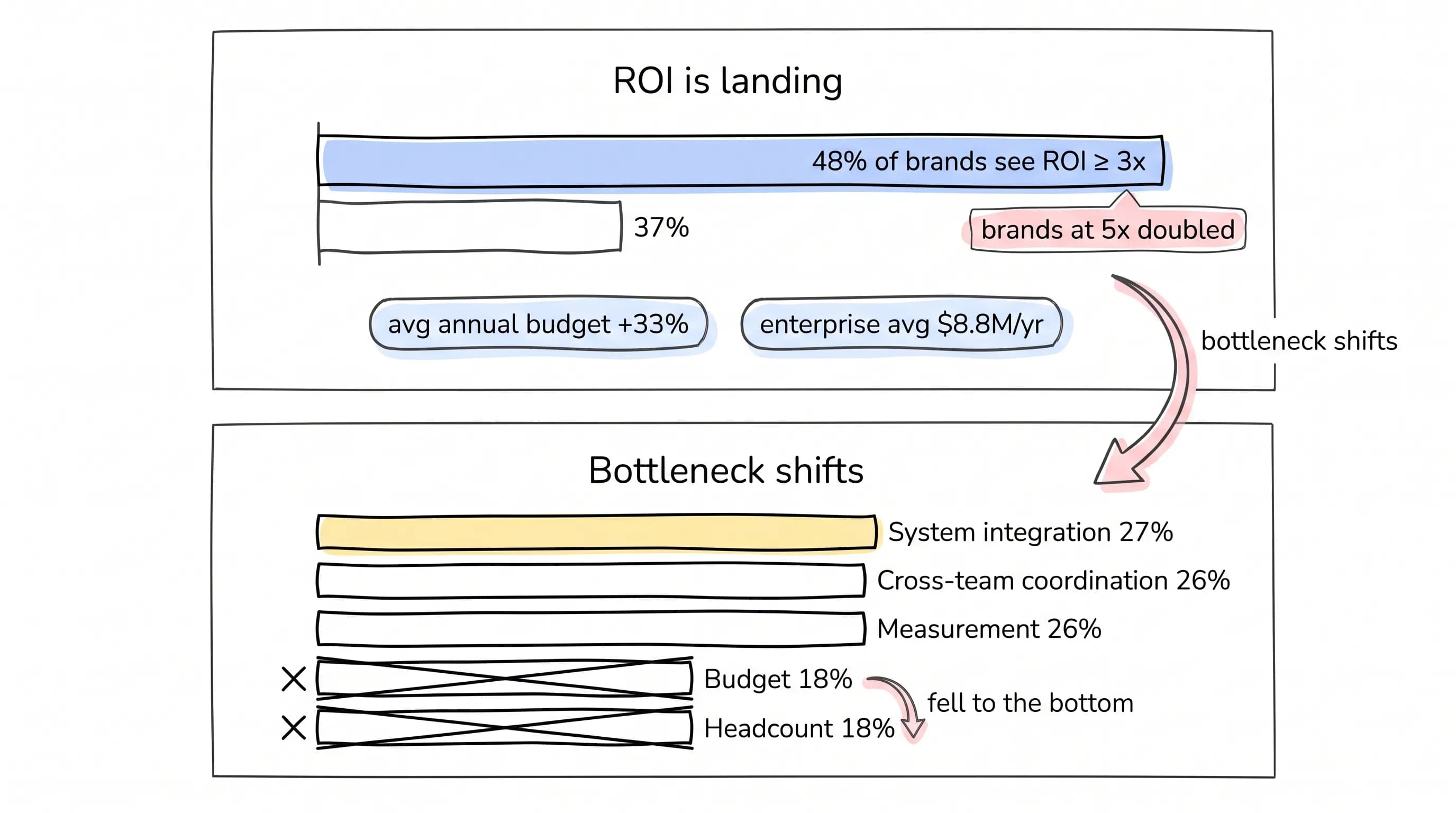
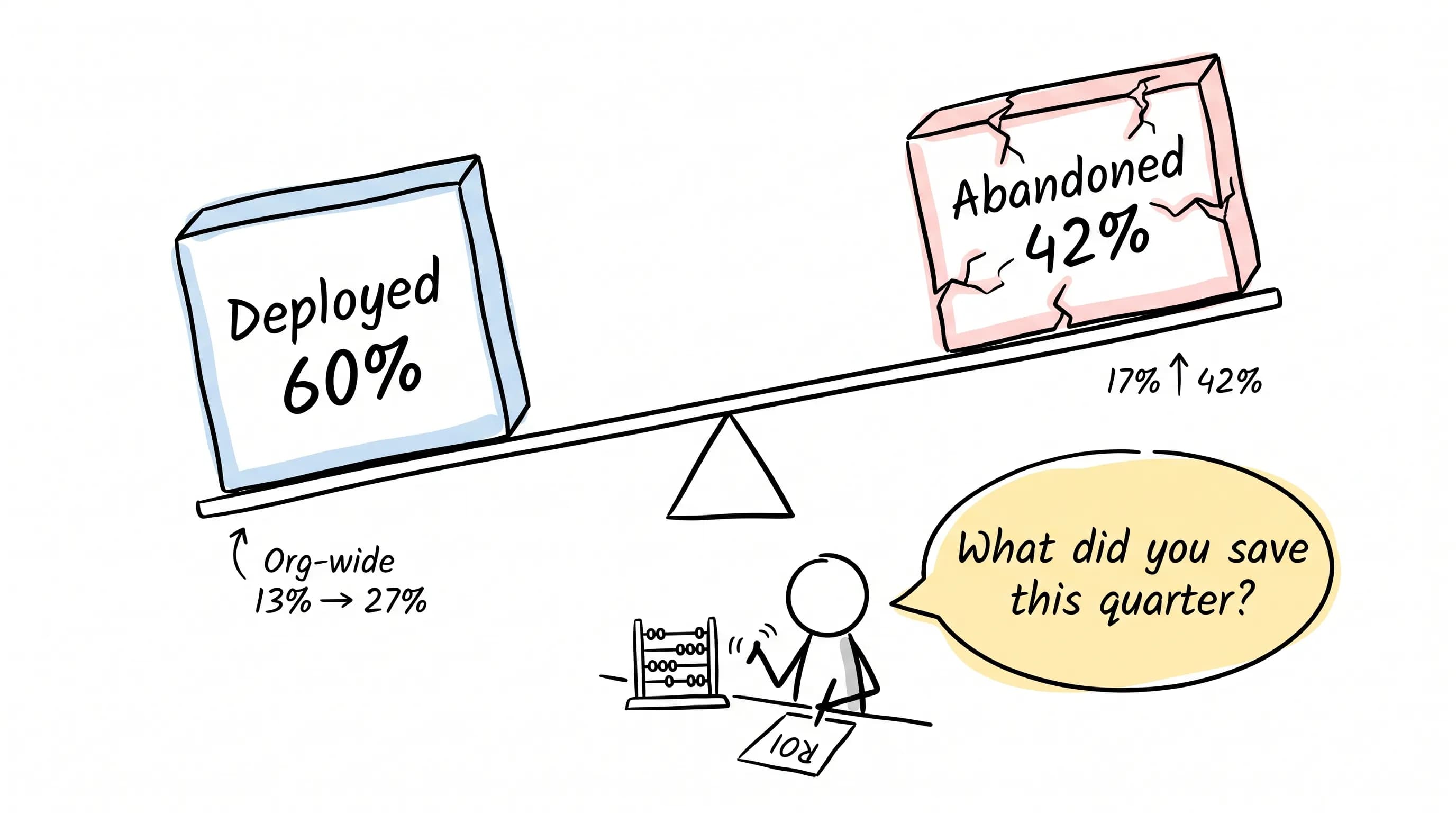
AI Marketing Daily · 2026-10-25
Daily briefing on nine AI marketing items: the IAB generative AI advertising playbook, a 16-vendor B2B selection list, Meta ads automation rollout guidance, cross-border TikTok and Amazon playbooks, and an academic study on AIGC localization, with cautions on unverified vendor-reported numbers.
This daily briefing organizes today's industry news into nine items — read the headline first, then graze the categories as you please. The IAB has turned the playbook for getting generative AI into advertising workflows into an actual handbook, covering everything from picking models and running use cases to measuring incrementality and building governance, in one sweep. On the same day, a selection map of 16 vendors, two playbooks for cross-border selling, and Meta's staged-rollout cadence for ad automation all landed on the table in succession — even an empirical academic study on AIGC localization made it in. Plenty of loose parts; what's missing is the assembly. For marketers, today is the day to fold these materials onto a single battle map, circle the two or three squares you can act on this week, and schedule the rest for after this quarter's retro.
🎯 Today's Headline
IAB steps in: a handbook that takes generative AI into real-world advertising
What happened
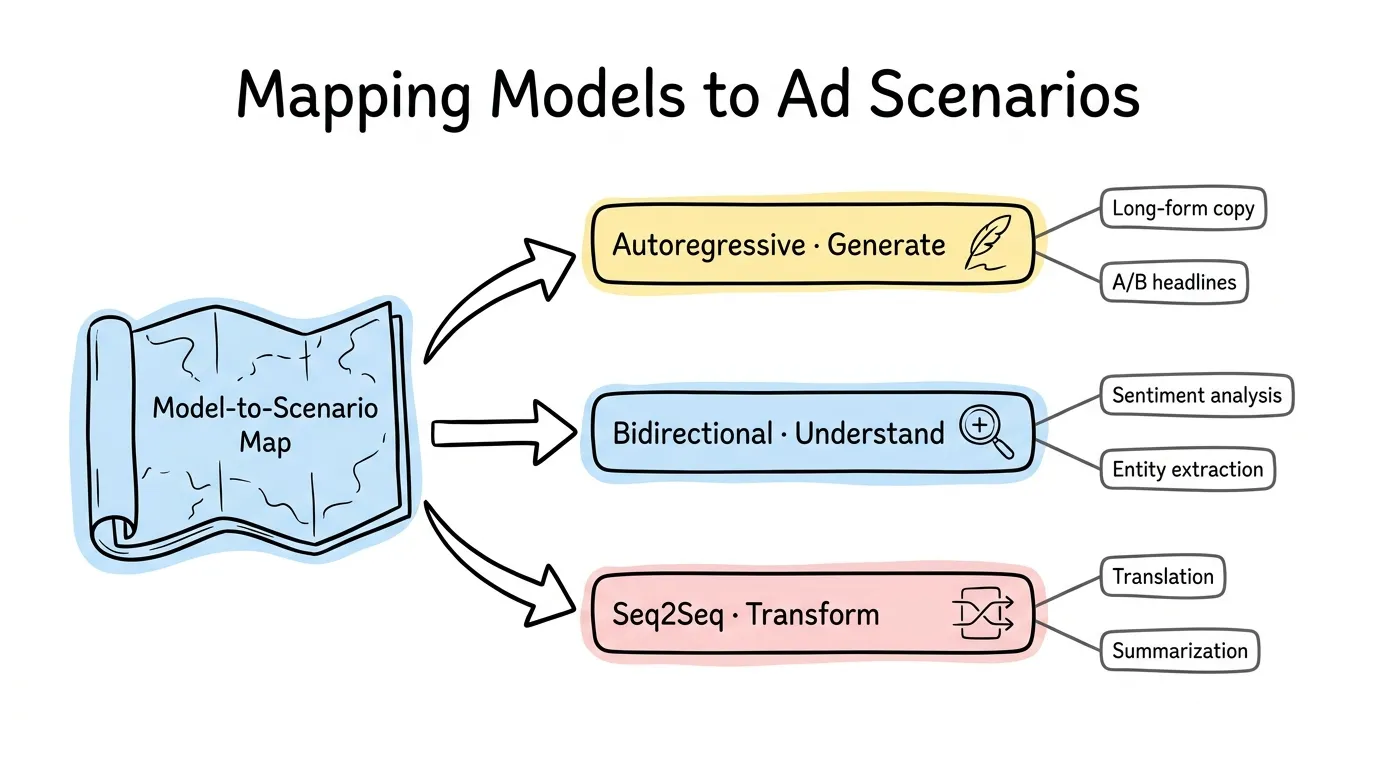
The IAB (Interactive Advertising Bureau) has published the Generative AI Playbook for Advertising, and what it does is refreshingly direct: it maps advertising scenarios one-to-one to AI models, telling practitioners which model to send to which job. The handbook sorts models into three families. Autoregressive transformers generate — GPT-4, Claude, Gemini, Mistral, and Grok all sit in this tier, used to write long-form copy, power chatbots, and mass-produce headline variants for A/B tests. Bidirectional transformers understand, with BERT and RoBERTa as the representatives, absorbing context through masked language modeling and excelling at classification, sentiment analysis, and entity extraction; the handbook cites Nike, which uses named entity recognition to track mentions of its own products and competitors on social media, adjusting PR and media-buying moves in real time. Sequence-to-sequence (seq2seq) models transform: Google's T5 unified multiple language tasks into a text-in, text-out format, and mT5 extends that to translation and summarization across 101 languages — handy for localizing cross-border creative.
The machine-learning chapter gives a three-piece kit. Supervised learning uses labeled historical data for sales forecasting and audience targeting. Unsupervised clustering handles audience segmentation and can generate synthetic features to slice the segments finer. Real-time creative optimization in live campaigns goes to reinforcement learning, using Multi-Armed Bandit and Thompson Sampling to pick creative online, replacing the slow rhythm of traditional A/B testing where you wait for a round of experiment to end before knowing the result.
Time-tested text-analysis methods are in the handbook too, and this part is especially practical for colleagues new to the industry — textbook content placed into an advertising context for the first time. Amazon uses naive Bayes and support vector machines for sentiment analysis, picking product problems out of reviews and fixing product pages; Facebook applies document classification to filter hate speech, continuously calibrated with millions of labeled posts; brands run LDA topic modeling on X to catch which topics are heating up, with sportswear brands adjusting their paid-media topics accordingly. On the visual question answering side, image-text alignment models like ALBEF can already answer which products appear in a given ad and whose logo got the exposure.
Why it matters
Before this, the question of how AI enters the advertising workflow had a different answer in every blog, and marketing teams starting projects lacked a unified ruler. The IAB's value is that it settled the question: a model-to-scenario mapping table, a tool evaluation checklist, and governance requirements, all made into something you can check off item by item in a review meeting. Tool evaluation comes with five dimensions: intended use and error tolerance; integration compatibility with DSP, CRM, and CMS; data compliance (copyright and PII); performance benchmarks; and switching costs plus talent reserve. This checklist can be copied straight into the procurement process, saving more than one round of wrangling.
What it means for marketers
At the role level, measurement teams see the fiercest change, and this part is also the easiest to overlook — most teams charge at the creative side first when adopting AI, leaving the measurement side empty. The handbook proposes using deep learning for causal inference, constructing control groups automatically to answer that old question: of this batch of conversions, how many did the advertising bring in — the ones that would never have happened without spending. Bayesian neural networks are also on the recommended list. The pre-launch stage gains forecasting power: before a seasonal campaign starts, you can estimate performance under different budget allocations and creative combinations, giving budget adjustments a basis to follow. For daily reporting, automated dashboards pull CTR, conversions, and ROI onto one chart, then write out the takeaways in natural language, freeing the team's hands from data-shoveling work.
The creative-side reminders are equally concrete. Dynamic creative optimization needs regular rotation of winning assets to ward off aesthetic fatigue; don't slice audience segments too thin — resources get diluted and messaging crosses wires; the budget forecasting section reminds people to periodically review the system's auto-rebalancing suggestions, so the system's hands don't move faster than your strategic intent. Content production gets six ready-made use cases: dynamic copy, visual assets (DALL-E, Runway and similar tools, batch-producing multi-angle variants against brand palettes and product shots), personalized messaging at scale (the Performance Max type of dynamic serving), e-commerce product descriptions, chatbots, and accessibility content. Every use case is marked with cautions: regulated industries need compliance rules built in, AI-generated imagery needs a consistent watermark, and outputs for high-risk campaigns still need human fine-tuning.
How to use it
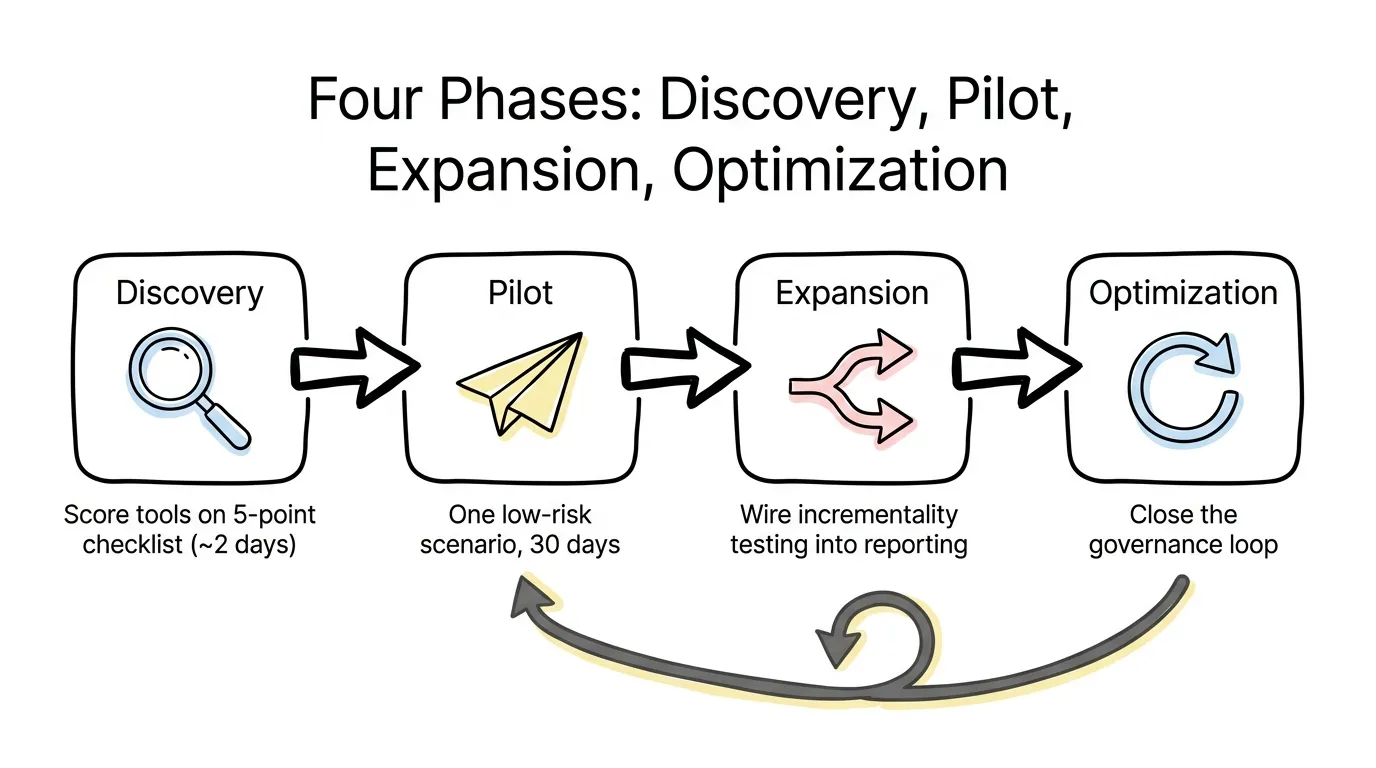
The handbook comes with a four-phase roadmap: discovery, pilot, expansion, optimization. My suggestion is to follow that rhythm. Step one, score the AI tools you currently use against the five-dimension checklist item by item — two days of work — and clear out redundantly purchased tools along the way; a common harvest from this step alone is cutting one or two idle subscriptions. Step two, pick one low-risk scenario for a thirty-day pilot; e-commerce product descriptions or email personalization both fit — the cost of error is low and whether it works is visible at a glance. Step three, wire AI incrementality testing into performance reporting, so the question of whether ads are worth it gets a number you can say out loud. Step four, close the governance loop against the responsible-AI checklist: bias-testing outputs, disclosing AI-generated content to consumers, removing sensitive personal information from training data, and forming a cross-functional governance team. The Sephora chatbot case in the handbook can be borrowed directly — recommend products, teach makeup, virtual try-on in one go, with conversion following the experience.
My take
The handbook's shortcomings must also be stated clearly: the PDF carries no explicit publication date, the upload path is January 2025, and the filename suggests a January 2026 edition; the examples stop at the GPT-4 generation, and Grok is still just beta. When citing, remember to fill in the latest model landscape yourself. But the framework itself is not picky about models — the models get replaced, and the mapping relationships still hold. It deserves a place in the team wiki, as the base draft for tool evaluations and governance actions; just update the appendix once a year.
🔗 Further reading: Read the full article
🏷 Industry Signals
Agent-to-agent advertising is coming; the KPI sheet needs rewriting first
At the ADWEEK House Possible fireside chat, InMobi's co-founder gave his judgment: in 2026 advertising is heading toward an agent-to-agent form. Consumer AI agents filter and compare on people's behalf, while brand AIs join the decision through conversational interfaces; the old linear funnel — see, click, land on the page — gets compressed into a single-layer interaction surface, where discovery, evaluation, and persuasion happen simultaneously. What marketers should optimize changes accordingly — machine interpretability and interaction quality rank ahead of visibility. Visual generative AI is making the first dent in high-value categories — apparel and home goods, categories that once required buyers to fill in the picture with their imagination; the moment try-on images and placement images appear, the conversion choke point loosens. The economic math has to be done too: running models per impression under billion-level impressions cannot bear the cost; the workable solution given in the interview is to subsidize token expenses with ad revenue and offset compute through interaction design, and publishers' early tests can already compute positive returns. The piece also ticks off five behavioral changes: research gets outsourced but does not disappear; advertising becomes guided conversation; personalization moves from crowd segmentation toward individual simulation; creative and performance teams merge; traditional attribution models fail. The provenance of this conversation should also be disclosed — a secondhand retelling by InMobi's co-founder, with the date noted on the page and the funnel traces at the end of the article discounting credibility; treat the judgments as directional signals, don't quote the numbers directly. The closing line is worth copying down: the winners are the fastest adapters, not the loudest voices.
💬 The actionable move is adding two new metric lines to the 2026 plan: cost per AI interaction and token efficiency. First dig out your existing campaigns and roughly calculate how big this expense is, then decide whether to follow. The attribution column needs redrawing too — AI-mediated journeys have no clear click trail, and legacy models breaking is a matter of when, not if. Organizationally, you can trial merging creative and performance teams this year; don't wait until agent traffic actually arrives to move.
🔗 Further reading: Read the full article
🏷 Tools & Selection
A list of 16 AI marketing companies — the starting point for B2B teams' vendor selection
In mid-October, Docket compiled a list of 16 AI marketing companies, divided into six groups by function. AI search and content agencies include NoGood, Omniscient Digital, and TripleDart; NoGood's AEO services cover ChatGPT, Gemini, Perplexity, Copilot, and AI Overviews; TripleDart's delivery runs on its self-developed Slate execution layer, with senior operators setting strategy. Creative and media agencies include Monks, Jellyfish, and Superside; Monks.Flow uses a squad of dedicated AI agents to connect strategy, production, localization, and delivery, running alongside the team as a managed service; Superside uses Brand Brain to learn each client's brand tone to steer briefs and output. Content and AI search visibility platforms include Jasper, Writer, and Profound; Writer lets administrators write style guides and approved terminology directly into voice profiles; Profound captures answers from real browser sessions to track brand mentions, rankings, and descriptions in ChatGPT, Perplexity, and AI Overviews — closer to real usage than statistics built on API outputs. Paid media and intent platforms include 6sense and Metadata.io; the former uses Signalverse to pool anonymous browsing and keyword-level intent signals, then stitches in CRM data, helping teams see clearly which accounts are researching and how far they've gotten; the latter has AI agents prepare audiences, assets, budgets, and experiments, leaving a human review gate before the money is spent — a clear division of labor between automation and the fallback. Marketing automation has HubSpot Breeze and Adobe Marketo Engage; on-site conversion has Qualified, Chili Piper, and Docket itself. The list also explains the agency-versus-platform tradeoff plainly: short on people or skills, find an agency; staffed up and wanting speed, buy a platform; the common arrangement is agencies build the system and platforms keep the daily routine. Jellyfish's three-piece set is an observation sample — Pencil generates assets, Now Next Soon simulates before launch, Share of Model tracks brand perception inside large models; creative and media are converging under one roof. The list's selection criteria are also stated openly: only companies serving B2B or enterprise marketing teams, requiring that AI genuinely does work in products and services, each claiming exactly one clear job, so you can match your problem to the right seat. The publisher is fairly honest too, declaring that it is on the list itself, that all descriptions come from vendor websites, and that prices and vendor-reported performance numbers were deliberately left out.
💬 The usage is: first write down the job you need to complete, then pick the group from the table — the "AI-powered" label itself carries no information. The list is assembled from vendor self-descriptions and the publisher is on it, so be sure to cross-validate a round before choosing a shortlist; what you save may be the three months of choosing the wrong supplier.
🔗 Further reading: Read the full article
Meta ads automation: don't switch all the rules on at once
A practitioner's piece on 2026 Meta ads AI automation splits the workflow into four stages: AI-generated creative, round-the-clock automated scaling and pause rules, bulk scaling, and integrated reporting plus a natural-language Copilot. The bulk stage grabs eyeballs: from generation straight through to launch, once one pipeline is set up, two hundred plus campaigns go live within two minutes, relying on asset production and deployment staying in the same system. What's truly valuable is the landing rhythm. The article suggests turning on only one high-certainty rule at a time, running it one to two weeks to confirm the behavior matches expectations, then adding the next one; start with creative generation — if it errs, worst case it just fails review, the lowest cost — then touch pacing and audience rules. Don't rush to delegate the reporting layer either: first spend a few weeks on manual comparison, contrasting the moves automation would make against the choices you would actually make, building trust on the data of your own account. The Q&A at the end also gives the fastest starting point: creative generation plus auto-pause rules — both have instantly visible returns and don't require touching the existing account structure. In the first month after launch, check the frequency and CTR trend lines daily; single-day spend, on the other hand, doesn't need watching — a rule that looks normal on day three may, by day ten, be quietly pushing budget toward fatigued creative angles. The article summarizes three typical mistakes: enabling all rules simultaneously, treating creative generation and automated rules as the same switch, and setting thresholds never to revisit them — when budgets or audiences change, old thresholds may in turn drag down results. It also draws the boundary: strategic decisions like targeting, offer, and budget allocation cannot be replaced by AI; what can be replaced is the mechanical labor between decision and execution. Even a few lines of changelog each week save enormous effort when tracing back problems.
💬 Media-buying teams can lift this staged-rollout cadence straight into the SOP: one rule, two weeks of manual comparison, written changelog. In the first month, shrink the daily check to five minutes looking at two curves, frequency and CTR; it intercepts far more crash accidents than the time it costs, and only afterward relax to a weekly rhythm — this is an iron rule.
🔗 Further reading: Read the full article
🏷 Cross-Border & Overseas Growth
The AI shelf for cross-border sellers: TikTok and Amazon, two playbooks
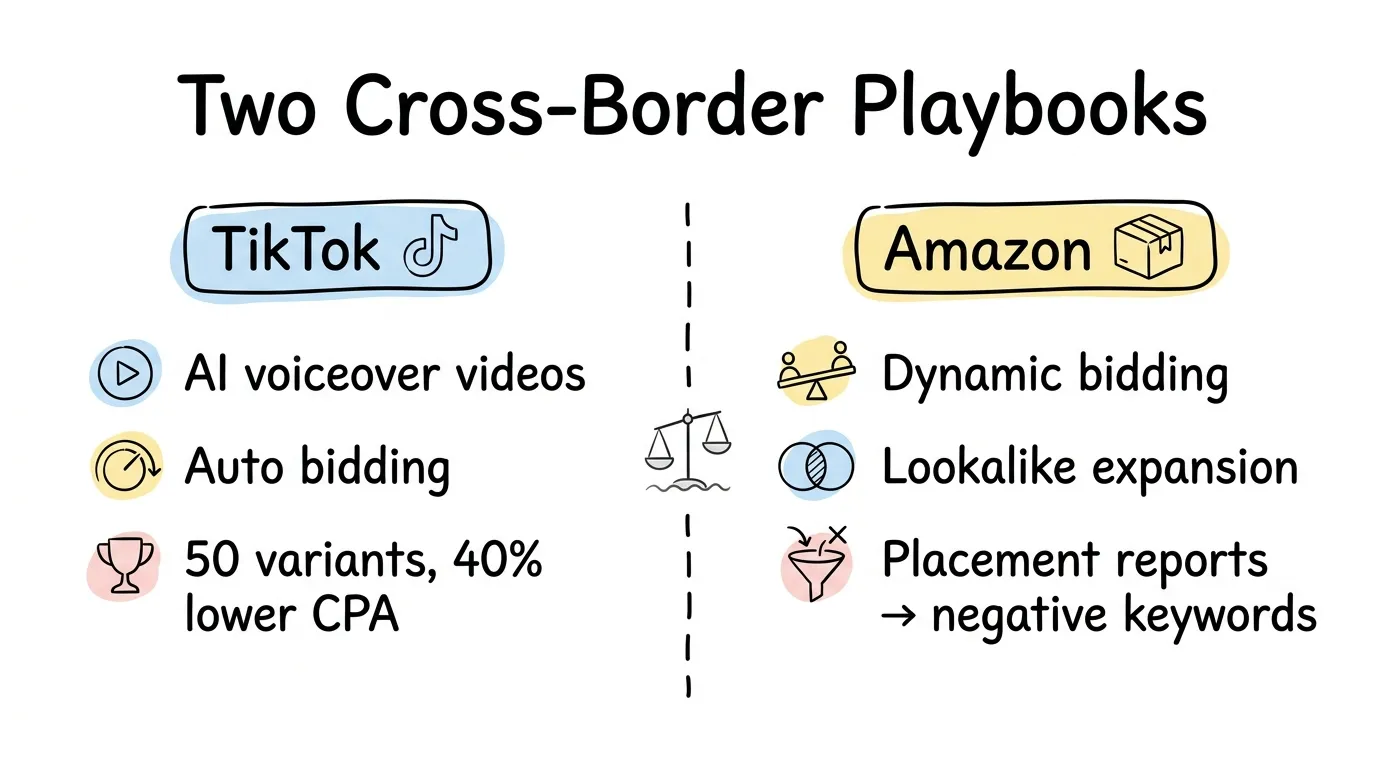
SGAIndex has released a 2026 hands-on AI guide aimed at cross-border e-commerce sellers, with the chain running from product selection all the way to inventory. At the selection stage, Google Trends, TikTok hashtags, and time-series models over historical sales (the piece names Prophet) do trend prediction — first confirm demand is climbing, then talk media spend. The TikTok playbook is a combo chain: Synthesia or HeyGen generates AI voiceover videos, Smart Performance Campaign bids automatically, and trending sounds and hashtags feed back into creative; an in-article case claims fifty creative variants handed to AI selection beat manual A/B with a 40% lower CPA. The Amazon side relies on dynamic bidding, purchaser-based lookalike expansion, and Sponsored Brands automated creative variants, then uses AI to parse placement reports into negative keywords. On the content side there's a multi-color product image example where click-through rate rose 25%; TikTok scripts are produced in the order of hook, pain point, CTA, and it can also simulate UGC reviews and attach an around-the-clock customer-service bot answering sizing and logistics questions. The pitfall list has three items: don't use AI images to misrepresent the physical product — that violates Amazon policy; beware training-data bias, with insufficient representation in the plus-size category; small budgets should start with free tools, don't pile up subscription fees right away. The piece also quotes a backdrop statistic: generative AI applications grew revenue 232% year-over-year between Q2 2025 and Q1 2026, adding over $4.4 billion — showing how hot the selling toolchain is. The guide's shortcoming is no first-hand data and no author background; treat the case numbers as leads.
💬 Cross-border teams can pick two to try this week: swap in multi-color product images to test CTR, and let AI scrape negative keywords out of placement reports. Don't step on Amazon's physical-product red line with images; before running fifty creative variants through AI selection, nail down the judging metric first, so you're not left at the end of a round with no idea what you picked on.
🔗 Further reading: Read the full article
Academic evidence: AIGC localization works, but with boundary conditions
This May, the International Journal of Computer Science and Engineering published a grounded cross-border e-commerce study (IJCS&E Volume 1, Issue 4, pages 67 to 76), using mixed methods to examine how AIGC localization enables scenario migration and drives consumer adoption: one dataset is multi-channel web-behavior telemetry, the other is cross-national panel data covering the US and Southeast Asian markets. AIGC localization here means two things done together: semantic adaptation governs whether the copy fits the local market, and visual-aesthetic transcreation governs whether images and interfaces match local eyes — both sides moving together counts as adaptation. The structural equation results have two layers. AIGC adaptation indeed compresses foreign consumers' psychological distance to some extent — the effect is positive; but the explained variance shows clear geographic heterogeneity, with the North America–Southeast Asia difference moderated by regional regulatory environments and digital literacy levels, so copying one market's playbook into another market doesn't necessarily hold. The implementation process isn't smooth either — early implementation showed sharp data fluctuations and localization language misalignment, and the authors' exact words were that the linear assumption of the pilot period encountered significant empirical friction; the conclusion is that multiple rounds of recursive language and culture calibration are needed, and running a template once doesn't pass muster. In other words, both budget and schedule need slack left for the calibration work. And there's that attribution reminder, not light in weight: conversion uplift may partially come from a novelty effect, and unobserved macro consumption shocks may also be mixed in — methodologically, you can't book the whole account to the algorithm.
💬 This paper's value is providing academic endorsement for localizing efforts; when citing, write the boundary conditions into the argument together, the budget application will be sturdier, and you avoid later accusations of overpromising. Also set yourself a rule: don't report pilot-period ROI directly as a steady-state conclusion; the novelty effect needs at least one full cycle of running before it can be stripped out.
🔗 Further reading: Read the full article
🏷 Cases & Field Rules
Numbers from five brand cases, plus a budget-tier table
A 2026 AI-marketing guide has gathered a batch of brand cases. L'Oréal's ModiFace and SkinConsult AI have cumulatively done over a billion virtual try-ons, with conversion rate rising to three times that of ordinary product pages. Sephora's Virtual Artist uses AR try-on to lower purchase hesitation. Cadbury used generative AI to make personalized video ads for small businesses during India's Diwali, reaching over 140 million people and lifting engagement 32%. Unilever's U-Studio predicts success rates before assets go live, cutting production costs 30% and halving the cycle. BuzzFeed used AI to expand quiz content output tenfold. Failure attribution is also systematized, listing three types: forcing automation onto processes you don't understand, biased training data, and missing success metrics; it also cites two old lessons — IBM Watson for Oncology and Amazon's hiring AI — as corroboration, with the remedies landing on clear goals, sufficient testing, and human oversight, which still read as valid today. The budget tiers by size are: small companies $500–2,000 per month, mid-size $5,000–15,000, large starting at fifty thousand dollars. The team evolution prediction says 2027 will need prompt engineers, analysts who understand machine learning, and AI ethics specialists. The implementation path is: first audit the repetitive tasks that can be automated, pick a single point for a ninety-day pilot, then spread horizontally once metrics are set — the same thinking as the staged-rollout cadence in the Meta piece. The deduction to disclose: all the numbers come from the vendors themselves, no third-party verification, the original attaches no cited sources, and the publisher is yet another AI agency awaiting verification — it can only be filed as a library of leads, nothing more.
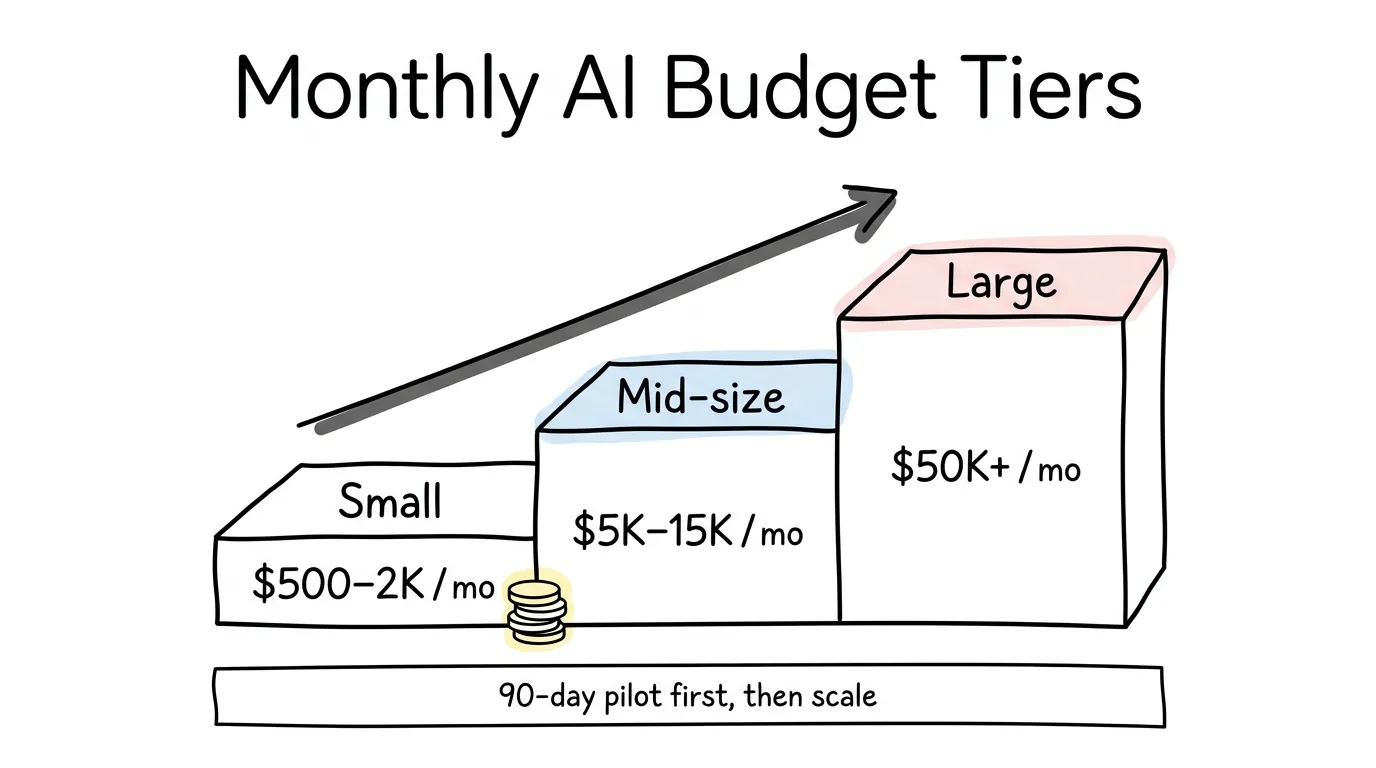
💬 Pour cold water first: before forwarding those dazzling numbers, check them against each brand's original disclosures before putting your signature on them. What can be used directly is the structure — the ninety-day pilot plus the budget tiers; take it back, fill in your own numbers, and it's one page of project-approval material. Paste the three failure-attribution columns into the project retrospective template, and run through them once before the next project starts.
🔗 Further reading: Read the full article
Generative AI for content marketing: four rules pressed into a one-page checklist
digi global tech wrote an overview of generative AI content marketing for small and medium businesses. The opportunities section lists five: capacity gains, personalization at scale, data-driven topic insight, cost efficiency, and content-format diversification. The risks section is likewise five: quality control cannot do without human gating, originality and copyright are doubtful, training-data bias, over-reliance on AI harming creative authenticity, and data-security compliance. Its best practices are four, and they are the part that can be executed directly: mandatory human review before publishing, treating AI as a collaborator not a replacement, compliant use aligned with brand values, and continuously following updates to AI-use and privacy guidelines. The more useful reminder in the piece: AI output may unintentionally reproduce existing works, and the editorial verification step cannot be saved — otherwise copyright disputes will come knocking. The SMB perspective is this piece's foothold: AI has pulled down the threshold of content capacity, and small teams can compete on even footing with deep-pocketed rivals by optimizing processes — provided the processes really have been optimized, the tool is only an amplifier. What deserves attention is that the piece funnels readers to its SEO services in multiple places, discounting its neutrality, and the viewpoints themselves carry little incremental value; its strength is a complete structure, suitable for zero-basis teams as an entry outline.
💬 The action is simple: press the four best practices into a one-page checklist and stick it into the content publishing process, placing the human review step in front of the publish button. What small teams save is rework time — at least half a day recoverable per week — and don't cut the copyright-verification item.
🔗 Further reading: Read the full article
Nine directions for AI-fication of social media — best used as a self-audit sheet
A panoramic piece on the AI-fication of social-media marketing spreads out nine directions: personalized distribution based on historical engagement; AI writing and design tools shoring up capacity; predictive analytics — judging which posts can go viral, predicting user churn, picking the best posting times, tracking sentiment in real time; customer-service bots answering customers around the clock to keep labor costs down; intelligent ad placement — rapid best-of selection among multiple creative variants, budgets automatically flowing to efficient channels, similar-audience expansion; AI-fication of influencer marketing — matching influencers by age, engagement rate, and content relevance, identifying fake followers, tracking results in real time; real-time tuning, with Facebook's AI automatically retiring poor creative; image recognition for brand exposure and UGC monitoring; and voice and conversational marketing. The author's landing point is leveling the field for small businesses: the ad ops, customer service, and insight capabilities that used to require big teams and high budgets can now be assembled with low-cost tools, and part of the capability gap between big firms and small squads has been closed. The influencer-marketing passage is relatively concrete: selecting influencers turns from the intuition of looking at follower counts into a measurable decision — first match by audience profile, then filter out fake followers, finally track interaction quality in real time; walk through the three steps and whether the budget has gone down the drain is clear at a glance. This article's shortcomings must also be disclosed: no data sources whatsoever, no publication date, prose that reads like a translated manuscript, and the site is a small agency — read all the content as common-sense restatement, don't cite it as fact.
💬 The most cost-effective usage is taking the nine directions as a self-audit sheet, scoring yourself item by item, marking what's already in use and what can be filled in. Adding two items is enough; look first at ad-variant best-of selection and fake-follower identification — these two show results fastest, and spreading across all nine ends up handling neither side well. After scoring, store this sheet in the team docs, and check progress against it at next quarter's retrospective.
🔗 Further reading: Read the full article
💡 Today's Synthesis
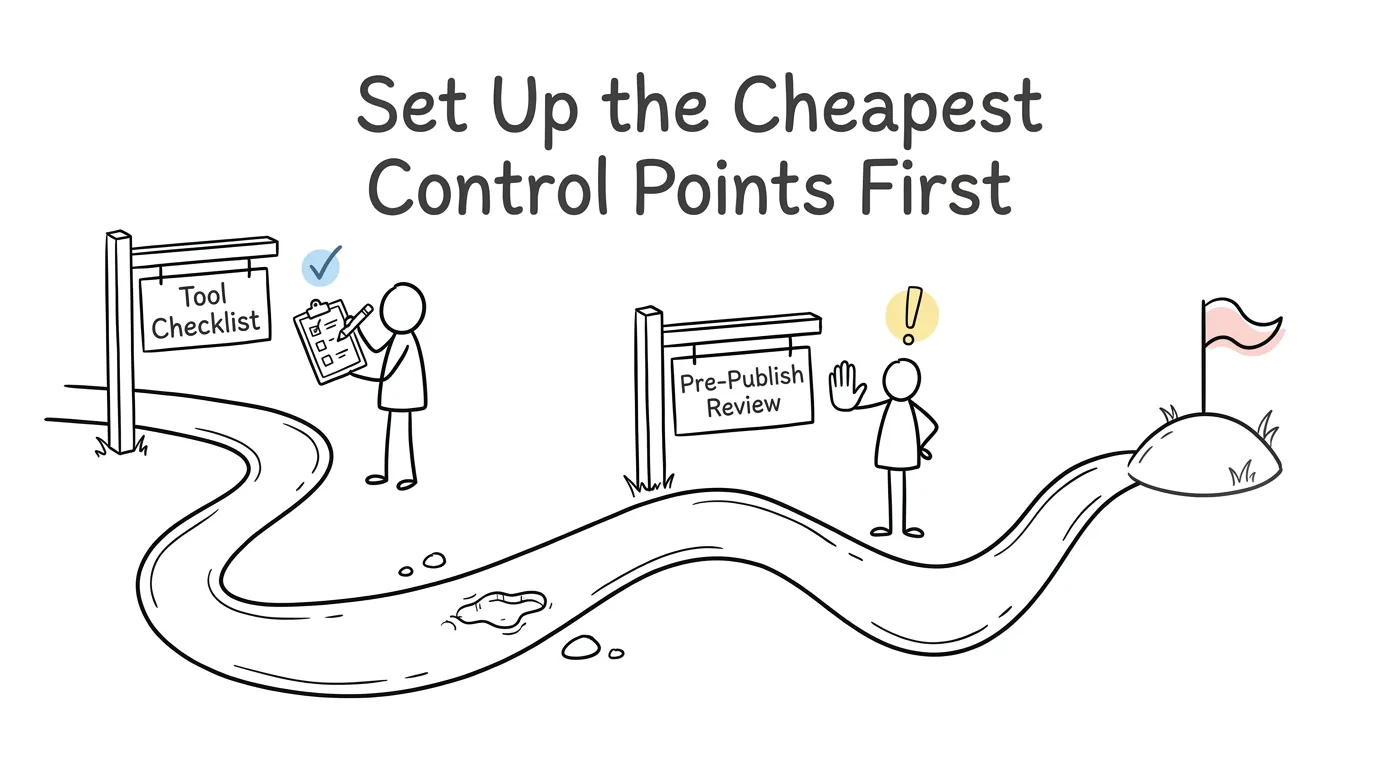
Putting today's nine items side by side, the center of gravity in AI marketing is shifting from experimentation to governance. The IAB writing the handbook with its own hands says the industry has reached the point where a unified language is needed — picking models, measuring incrementality, making disclosures all now have reference frames; the Meta automation piece talked about staged rollouts, the academic piece warned about the novelty effect, and the case collection enumerated failure attributions — the three materials are actually saying the same thing: what decides success or failure has changed; what's being compared is whose evaluation, measurement, and governance can keep up, and the days of competing over who bought which tool first are passing. The clustering of selection materials is another signal: vendors rushing to line themselves up on the shelf precisely shows buyers can no longer tell good from bad by labels — comparative reviews, checklists, and methodologies will keep appreciating in the coming months. The signal from the cross-border lane is the most direct: the revenue growth of generative applications and the hands-on playbooks are taking off together, but the academic paper in the same section coolly adds a sentence — the effect is moderated by markets and regulation, and the pilot data is flattered. Hot money and cool-headed evidence arriving on the same day is itself worth a note in the ledger. Looking one step forward, the agent-to-agent form of advertising is already being seriously discussed, and what will be tested then is the token cost account and machine interpretability — today's five-dimension tool checklist will need to grow one more column by then. This week's action suggestion is only one: stand up the two cheapest control points first — the evaluation checklist and the pre-publish review — the rest can still be caught up with; there's plenty of runway left.
Continue reading