
What Is GEO? Getting AI to Mention You When It Answers
An explainer on GEO (Generative Engine Optimization): how AI answers differ from traditional search, why citations matter, and six practices for making content easier for AI engines to find, understand, and cite.
A few days ago, I asked ChatGPT to look something up for me.
It didn't hand me ten links. It served the answer straight up — complete, smooth, with a few sources listed at the end.
I paused for a second. Because it hit me: search might genuinely be changing the game.
Think about it. For the past twenty years, we've done content by one logic only: make the search engine like me. Keywords, backlinks, rankings — clearing levels one by one, getting users to "click" their way from the results page into your site.
And now? A user asks an AI one question, and the AI just gives the answer. The link, gone. The click, gone too.
So how do you do content now?
First, let's get one concept straight.
What is GEO?
GEO, Generative Engine Optimization, put simply: make your content easier for AI search tools to find, to understand, and to want to cite in their answers.
ChatGPT, Gemini, Perplexity, and that AI summary at the top of Google results are all "generative engines."
How is this different from SEO?
Here's an analogy. SEO is opening a shop on the high street: bright sign, good location, passersby willing to walk in. GEO is getting the city's most trusted food critic to put your dishes on their recommendation list — unprompted.
Passersby drift away. A critic's word doesn't. For the restaurant that gets name-checked, business is a different animal entirely.
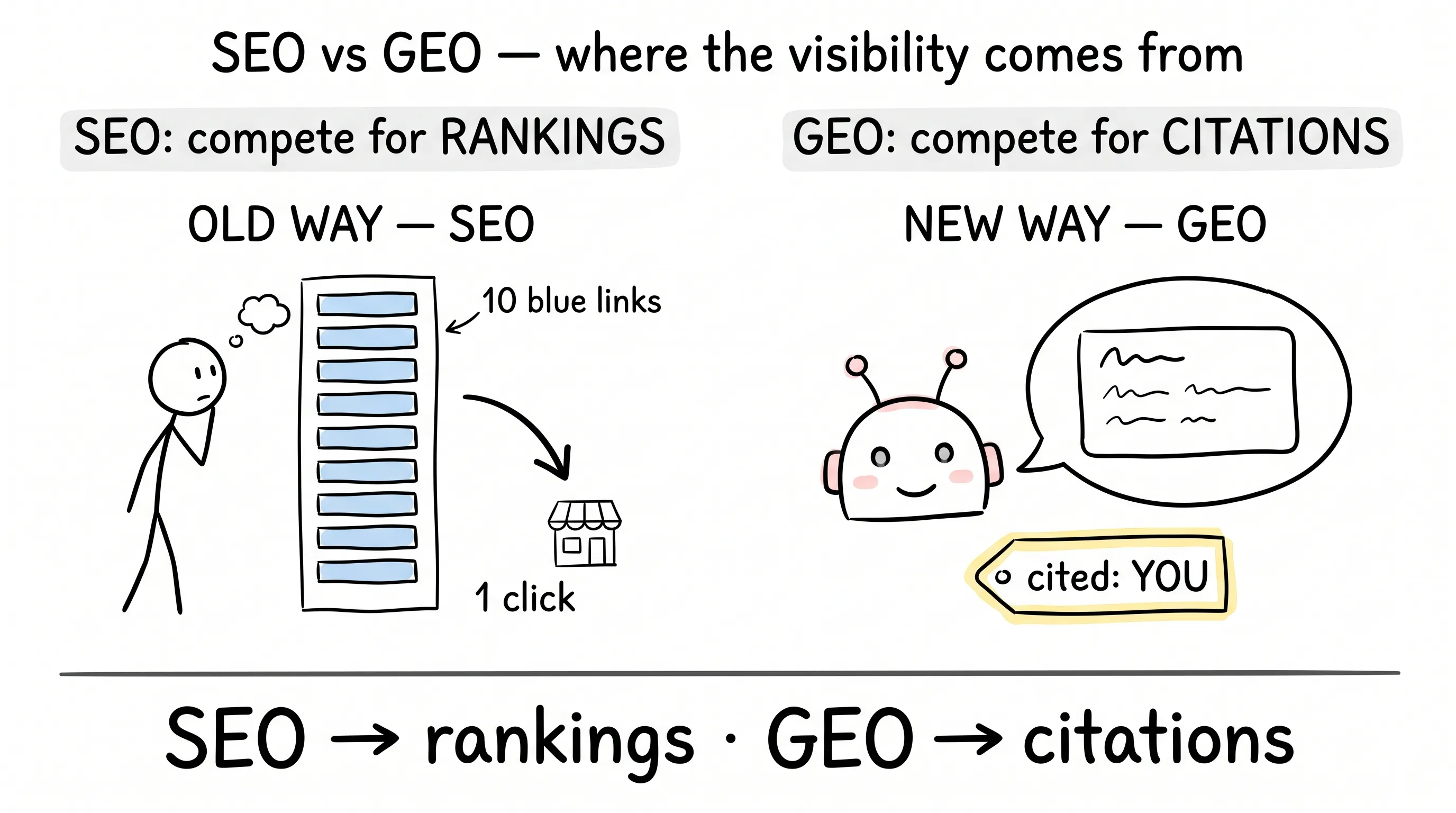
Yes — citation. That's what GEO competes for.
There's another term in the industry, AEO, Answer Engine Optimization. It's basically the same thing under a different name. Don't get hung up on the labels; remember the substance: SEO competes for rankings. GEO competes for citations.
Why Does This Matter Right Now?
Some will say: Google is still the king. What's the rush?
Fair. Google is still the king. BrightLocal's research shows Google still holds 61% of regular searches.
But look at these two numbers.
In GWI's survey, 31% of Gen Z said that when they go online for information, the thing they use most is AI platforms and chatbots.
G2 found that half of B2B software buyers now start their research by asking an AI chatbot — not by opening Google.
Half. That's no longer fringe behavior. That's a mainstream habit.
Add Siri in your pocket and Alexa in your living room, and you'll see it: people increasingly don't want to dig through links themselves. They want a ready-to-use answer, with credible sources attached.
So GEO is not here to replace SEO. It's an extension of SEO — the new homework content has to do, now that the world has changed how it asks questions.
Those who figure it out early get the head start. It's that simple.
So What Exactly Should You Do?
Let me boil the playbook down for you. Six things.
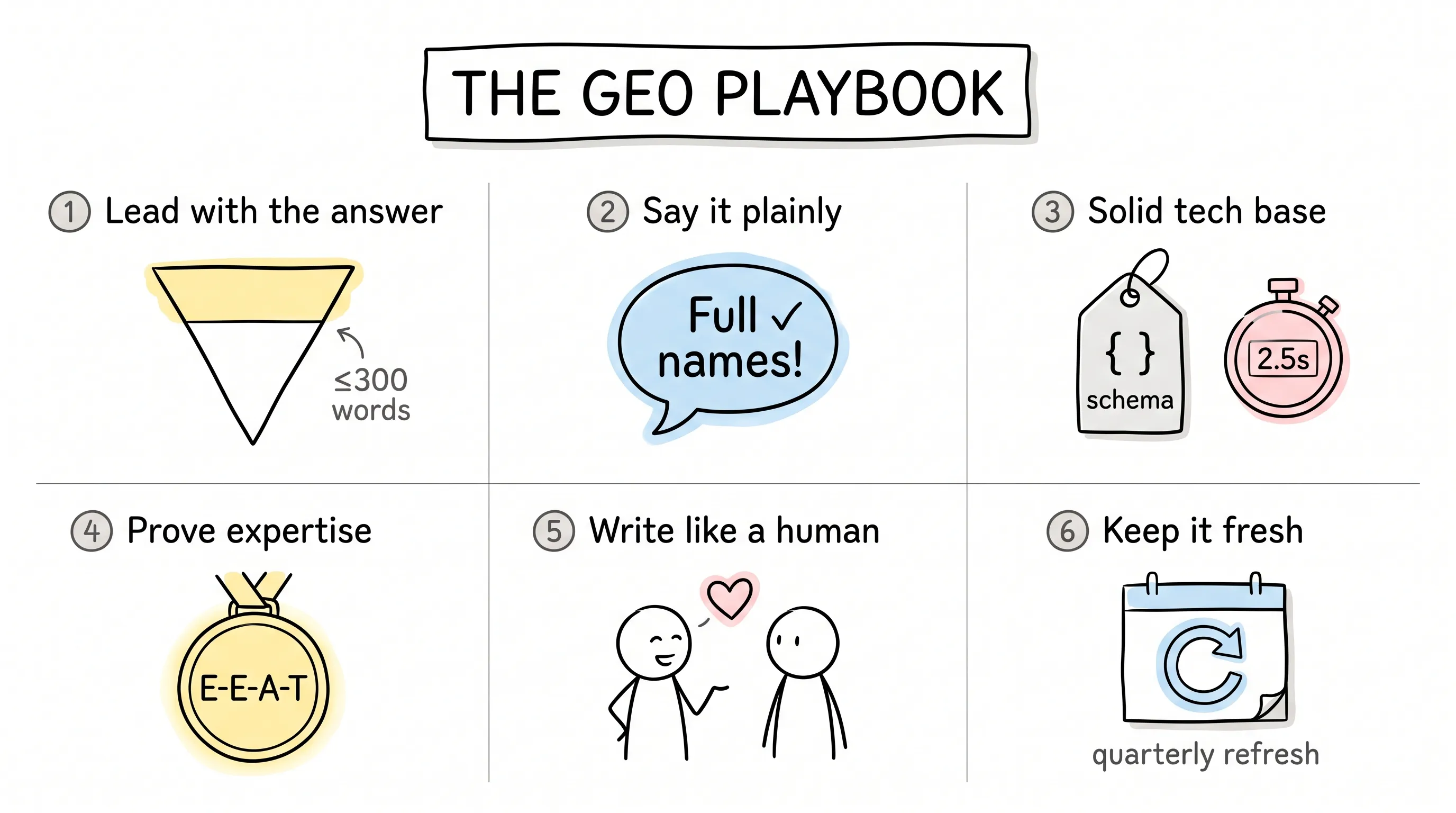
First, lead with the answer.
When AI crawls your content, it works like an editor reviewing submissions. It wants the point up front.
So in every section, state the answer in the shortest possible words first — ideally within 300 words — then unfold the details below.
Journalism has an old trick called the inverted pyramid: most important on top, supporting details underneath. Suddenly, in the AI era, this trick has become a necessity.
The self-check is simple: pull any paragraph out of your article and read it in isolation. Does it stand on its own and answer the question? If yes, you got it right.
HubSpot itself puts a "summary" at the top of its articles, doing exactly this.
Second, say things plainly. Don't make AI guess.
AI understands content by recognizing "specific people, companies, concepts." Write "the company released it in 2024," and the AI goes blank: which company? Released what?
You write: HubSpot released Content Hub AI in 2024. Full names, every single one.
A few easy habits: full name first, abbreviations after; explain a term the first time it appears; cut pronouns wherever you can; and call the same thing by the same name, front to back.
Vagueness is the number-one killer of citations.
Third, get the technical foundation solid.
Good writing only knocks on the door. The house behind the door has to be one the AI can enter and actually read.
Three things.
One: Schema markup. A bit of behind-the-scenes code that tells AI, in a language it reads at a glance, what this page is. Articles use Article, Q&As use FAQ, tutorials use HowTo, company pages use Organization — plus a Breadcrumb to show how the content relates. When you're done, test it with Google's Rich Results Test. Don't ship it with problems.
Two: speed and experience. Aim to keep page loads under 2.5 seconds, make mobile smooth, have HTTPS, keep navigation clear. To an AI, slow and messy means untrustworthy. Like search engines, it treats site performance as a trust signal.
Three: metadata. Give every image alt text; write title tags that are specific; use a natural-language description that says plainly what the page is about — keep it between 155 and 160 characters, and put numbers in when you have them. AI often relies on exactly this information to decide how to understand you — and whether to cite you.
Fourth, prove you're an expert.
Before citing you, AI judges one thing first: does this person actually know their stuff?
And the yardstick is an old friend: Experience, Expertise, Authoritativeness, Trustworthiness — E-E-A-T for short. Google's quality rater guidelines have always used it, and AI trains itself by the same standard.
How do you prove it? Put real credentials in author bios, with author Schema attached; tell the full story of the company on your official site; pick citations that are original, current, and have a clear accountable party — never pad with secondhand aggregator sites; date your content; publish your editorial standards.
But "trustworthy" alone isn't enough. You also have to be deep.
Semrush data: comprehensive, well-sourced in-depth content earns 77.2% more backlinks than shallow content. Research from Princeton and Georgia Tech is even more direct: content with charts, images, and video gets cited 40% more by AI.
In practice: build "pillar pages" around your core topics, then hang in-depth articles on the subtopics off them, all interlinked. Say the pillar is email marketing; beneath it, subtopics like segmentation, automation, deliverability, metrics, platform comparisons. Weave a web so AI can see your depth.
Amateurs skim the surface. Experts dig deep wells. AI cites the well-diggers.
Fifth, write like a human.
This one's counterintuitive: what AI loves to cite most is content that reads most like a person wrote it.
Because AI was itself trained on natural language, on conversation. If you write stiff and stack the jargon to the ceiling, it actually gets harder for the AI to understand you — and to cite you.
How to write it, then? As if you're explaining things to a smart colleague who doesn't know your industry: use "you" a lot, bring in your own experiences and judgments, explain the jargon that needs explaining, drop the insider slang wherever you can.
By the way — if you use AI to write your first draft, edit it yourself before publishing. The platforms say they won't penalize AI-generated content, but they're explicit about penalizing sameness. Without your examples, your data, your opinions, that article would read the same whoever wrote it. Why would anyone cite it?
Sixth, keep it fresh.
AI loves new. A 2024 study by the Content Marketing Institute found: companies that update weekly or more often get cited by AI 67% more than those updating monthly or less.
And content that hasn't been touched in over 18 months — no matter how good it was in its day — sees its chances of being cited fall off a cliff.
So put yourself on a schedule: every quarter, go through your key articles. Refresh the old data, add the new developments, update the date where you've changed a lot. This isn't grunt work. This is how you stay on AI's mind.
Three Pitfalls, While We're Here
One: stacking tactics without watching results. Use Google Search Console to track your visibility in AI summaries, monitor whether ChatGPT and Perplexity ever mention your brand, and pull a report every month. If you don't measure, you're flying blind.
Two: betting on some platform's secret trick. AI search moves too fast; today's clever hack may be dead tomorrow. Keep your eyes on the fundamentals: quality, structure, credibility. The edge comes from the grind, not the hack.
Three: always looking for shortcuts. In the end, AI rewards real value. Keep giving more, giving better, and it will keep citing you. A shortcut saves you a moment. It won't save you a lifetime.
Finally, Back to Where We Started
That afternoon, staring at the answer ChatGPT had served up and those lines of citations, one thing suddenly clicked for me.
The platforms change, the rules change — but what's underneath doesn't: whoever keeps delivering clear, credible, deep value ends up standing in the spot that gets chosen.
It used to be Google choosing you. Now it's AI choosing you on behalf of millions of users.
Who picks you doesn't matter. Deserving to be picked — that's what matters.
Start with your most important article. Make the change.
Here's to becoming, sooner rather than later, the one source AI can't do without.
Continue reading
Related articles

It's 2026: Stop "Buying" AI Tools for Your Marketing Team — Start "Hiring" AI Agents
This learn article explains how AI agents differ from standalone AI tools in marketing, outlines three agent categories — build-your-own platforms, CRM-native agents, and vertical tools — and covers use cases across SEO, social media, advertising, and reporting, plus criteria for choosing one.

What Is GEO? How Your Brand Gets "Mentioned" in the Age of AI Search
An explainer on GEO (Generative Engine Optimization) for e-commerce and DTC brands: how it differs from SEO and AEO, why AI answers shape brand visibility, and eight practices covering question-focused content, consistent brand messaging, structured pages, external evidence, comparisons, and AI mention tracking.

AI Is Already Making Decisions for Your Customers. Are You on the List?
A learn article explains GEO (Generative Engine Optimization): why AI-generated answers now shape which brands customers see, and how SEO fundamentals, entity clarity, citable evidence, and monthly measurement affect visibility in AI answers.