
The Next Patient May Never Open Google at All
A dental-marketing case study on how AI assistants answer local service queries without touching Google, covering lead costs, social content as ranking material, FAQ and review optimization, and ad budgeting.
A while back, I stopped by a friend's company. She runs Digital Floss, a marketing agency that serves dental practices.
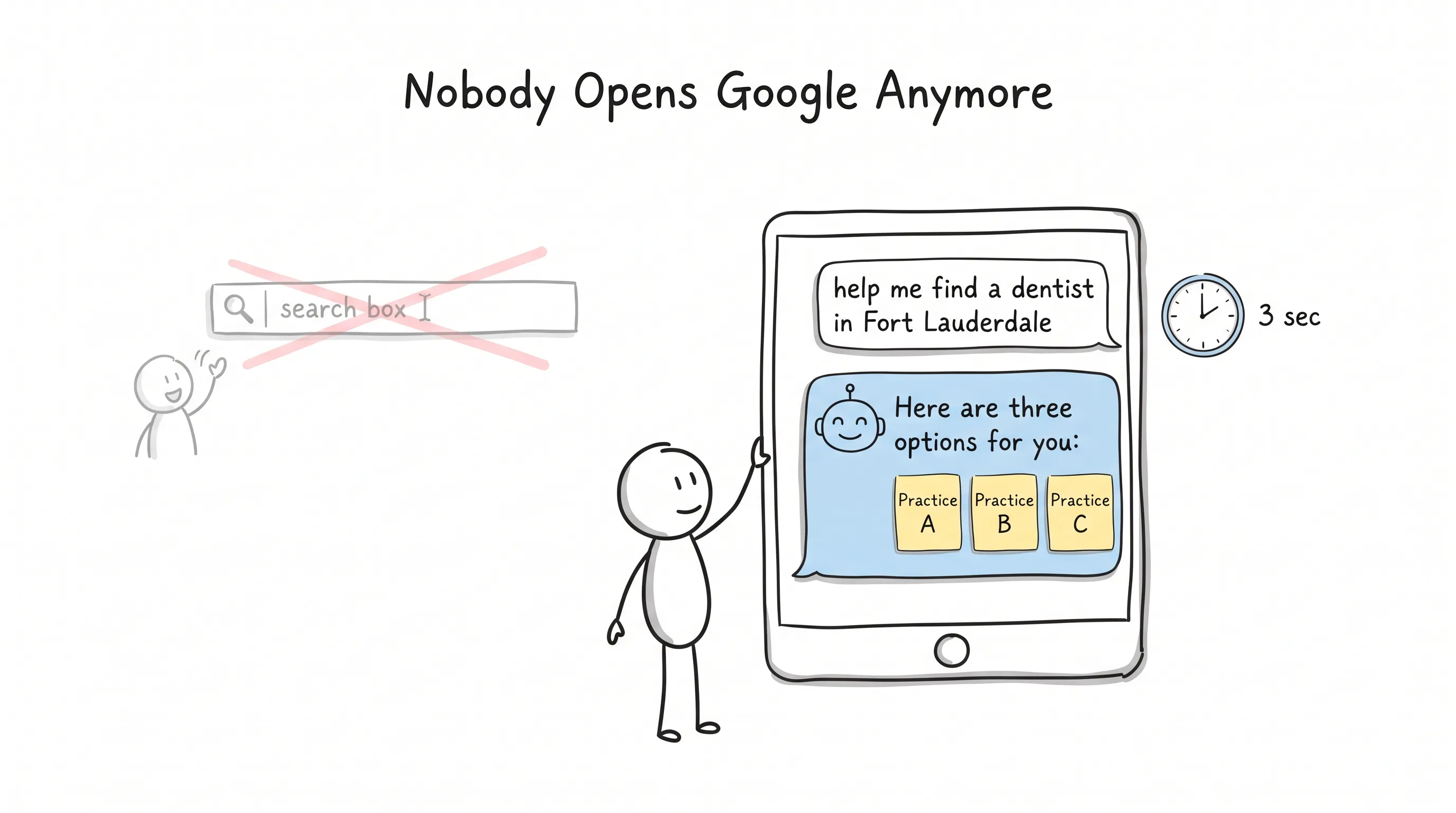
Halfway through our chat, she pulled out her phone, opened ChatGPT, and typed a line right in front of me: help me find a dentist in Fort Lauderdale.
Three seconds later, three practice names popped up on the screen.
I said, wait — did it go search Google?
She said, no. It didn't touch Google at all.
That one moment sent a chill down my spine.
Think about what this means. For the past decade or more, we've all taken one thing for granted: when you need something, you open a search box. Marketing for a dentist meant building a good website, ranking your keywords, and stocking up your ad budget. The rules were crystal clear.
Now, the place people ask first has changed.
Why Ads Keep Getting More Expensive
My friend noticed a pattern: a few years ago, $1,000 of Google ads would bring back a batch of leads; today, the same money brings back visibly fewer. The average cost of a single lead has climbed to around $130.
Why?
Her read is blunt: fewer people are going to Google, but the number of bidders fighting for placement hasn't shrunk, so the price per placement naturally gets bid up.
So where did everyone go? They went to ask AI. Three years ago, a need meant asking Google; now people ask everywhere. The places to search went from one to a whole pile.
How AI Recommends You
What's interesting is the way people ask.
You type into ChatGPT: help me find a dentist. It asks you back first: do you want a male or female doctor? Are you looking for someone who takes a particular insurance? Do you need someone who speaks Spanish?
Way warmer than Google, and way more thorough.
Once you've answered, it says okay, let me look. Then what does it do? First it scans websites. And here's the thing: ChatGPT isn't the only one scanning — Bing is scanning, and so is Google's own AI. If you rank well on search engines, AI gives you some credit for it.
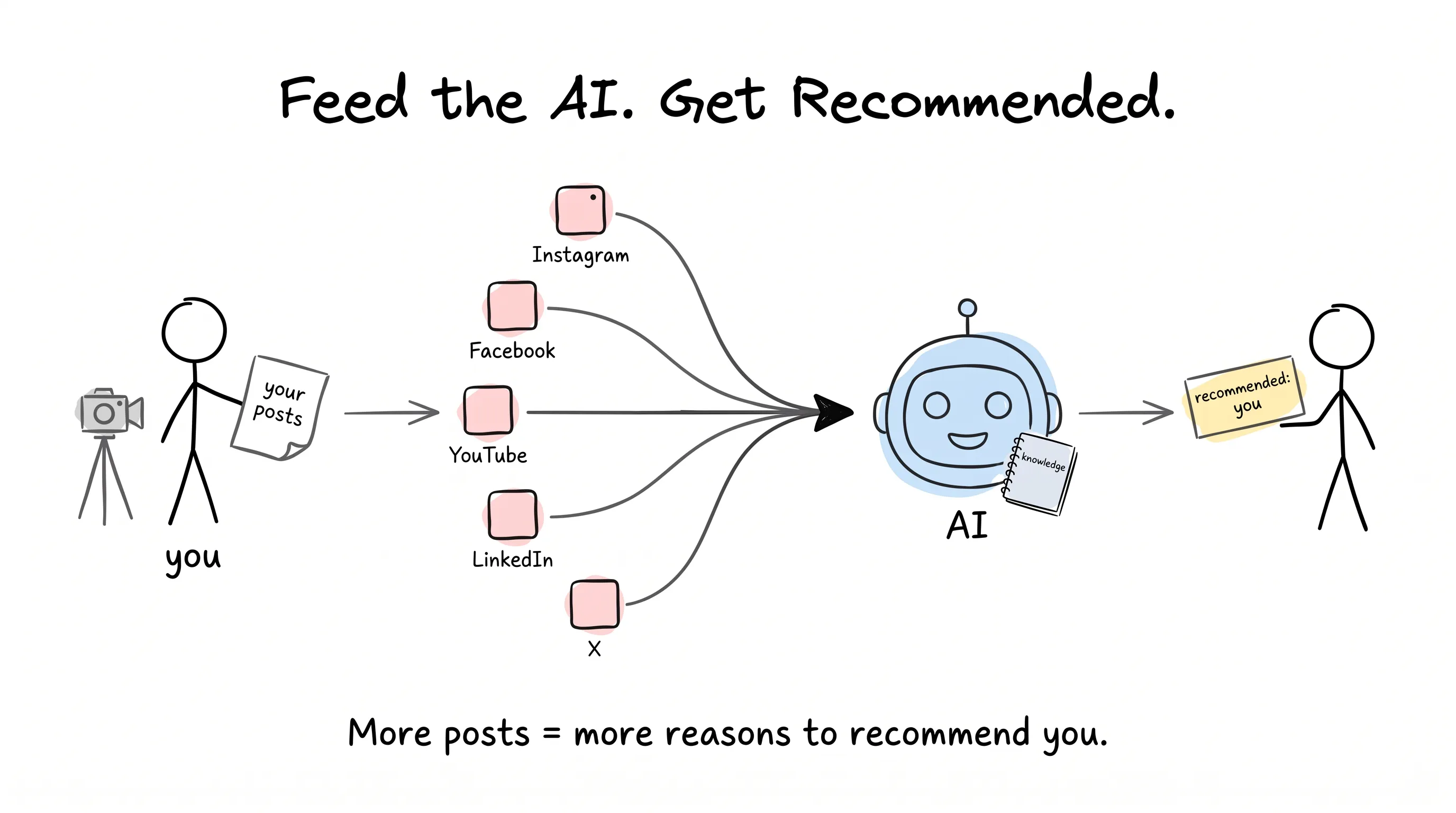
But after scanning websites, it isn't done. It then goes to LinkedIn, to Instagram, to Facebook, to X, to YouTube, flipping through them one by one.
That's why one line hits so hard: social media used to be "nice to have." Now, it is the algorithm itself.
Every post you publish on social media is a reason you feed the AI to recommend you.
The more posts, the more frequent the updates, the more platforms you cover — the more material the AI has on you, and the more likely it is to recommend you.
The Early Arrivers Eat the Next Several Years
This recommendation mechanism looks a lot like referrals among dentists.
Say you know a root canal specialist whose results are consistently good, and patients come back raving. You'll keep sending people to them. Now a new specialist shows up who says they're just as good. Would you switch? You wouldn't. Trust has already been built.
AI works the same way. Once it starts recommending you, it keeps recommending you.
My friend's own story is a living example. Back in the day, she was in Birmingham, probably among the first dentists to build a website — back when someone had to explain what a website even was. Eight years later, she ranked number one. Then, when Facebook took off, she was again the first to try its ads, and she racked up 50,000 followers, with 50 new patients a month coming from Facebook. She later turned her playbook into a course for local peers. They studied it hard — but couldn't catch up.
Why couldn't they? Her content volume was simply there. She moved first.
Now AI is going through a similar window. Large models iterate round after round, and each round rebuilds its knowledge base. If you get your content eaten up by these rounds of training, you may be remembered for years.
The Three Things That Decide Your Ranking
So what exactly gets looked at? She went back over her own clients who failed to rank, and nearly all of them were missing three things.
First, FAQ — Frequently Asked Questions. It matters because this is literally how people now ask AI: find a dentist who speaks Spanish, find a dentist who went to the University of Kentucky. So your website needs to answer plainly: do you speak Spanish? Yes. Every question asked, an answer given.
Second, reviews. Quantity alone isn't enough. Dozens of "this doctor is so nice" give the AI no detail to grab. You need reviews that say things like: he was incredibly patient, he knew exactly how to handle my troublesome tooth, and I wasn't nervous at my first visit. The denser the detail, the better it matches the questions people type when they search.
Third, content — Instagram especially. In July 2025, Google rolled out a major update: Instagram content started being indexed directly. Caption copy, words spoken in videos, locations — it all counts as search material. You might not update your website once a year, but on social media you can post several times a week. Do the math and the answer is obvious.
And two more small things that cost nothing. Go claim your Bing business profile — that's Microsoft's, and Microsoft is OpenAI's deepest-pocketed backer; plus Bing's indexing speed right now doesn't lag Google's. Then go claim Apple Business Connect: when iPhone users ask Siri, what they see is exactly that profile.
Honestly Running the Numbers, Three Times
In marketing, nothing loses people faster than abstract concepts — nothing wins them faster than arithmetic.
First calculation: is Google Ads still worth it? Yes. As long as people still use Google, keep running ads. But know your numbers: a lead runs about $130; if you want 10 new patients and assume half of your leads convert, do the multiplication and the budget becomes obvious. One more thing — stop running branded-keyword ads. Someone searches your name, and you pay to appear in front of them? That money is wasted.
Second calculation: Meta ads. She shoots one video per client — the doctor explains their philosophy, patients tell their stories. $400 in spend puts it in front of 40,000 to 60,000 people. Then run a lead ad with a bare-bones landing page that has exactly one button: Book an appointment. Leads run anywhere from $5 to $80, averaging around $30. And these people clicked through only after watching the video — the trust comes pre-installed.
Third calculation: geofencing (a digital fence drawn on a map — only people inside the circle see your ads). A doctor in New Jersey had a Colgate plant right next to the practice. Colgate employees' dental benefits were so generous they could barely use them all. So the fence was drawn straight around the Colgate campus, so employees scrolling on lunch break would scroll into this doctor's video.
What goes in the video? Patients saying: I went to three places, and all of them told me I didn't have enough bone for implants. Then I came here, they gave me a plan, and now I eat whatever I want again.
People who want a bargain watch a video like that and the mental math changes: even paying out of pocket, I'm going to this one.
Video doesn't run on logic. It runs on emotion.
One Brain, Not Five Buckets
She kept repeating one line: stop treating marketing as a bucket-by-bucket job.
Reviews in one bucket, website in another, social media in a third, ads in a fourth. Plenty of people buy it exactly that way, piecemeal. But in reality they all grow on the same vine: the same video goes to Instagram, to Facebook, to YouTube, to LinkedIn, to X, gets indexed by Google, then gets pinned to your website. And drop the stock-photo smiles on your site — put up your real doctors and your real patients.
If your brand aims to be a luxury department store like Neiman's, your website can't look like a dollar store.
As I was leaving that day, I asked her: in this shift, who's most exposed?
She said: the people who split marketing into separate jobs and pay for each one separately. Reviews handled by one vendor, website by another, social media by a third — three companies that never talk to each other, while the patient's eyes see three different versions of you.
On the ride home, I kept thinking about that search box. Or rather — that thing maybe shouldn't be called a search box anymore.
Whatever industry you're in, your next customer may truly never open Google. They'll open a chat window, ask in plain human words, and then trust the three names it gives back.
While it's still willing to listen to you, keep talking. Its memory is excellent.
Wishing you a spot among those three names.
Continue reading
Related articles

It's 2026: Stop "Buying" AI Tools for Your Marketing Team — Start "Hiring" AI Agents
This learn article explains how AI agents differ from standalone AI tools in marketing, outlines three agent categories — build-your-own platforms, CRM-native agents, and vertical tools — and covers use cases across SEO, social media, advertising, and reporting, plus criteria for choosing one.

What Is GEO? How Your Brand Gets "Mentioned" in the Age of AI Search
An explainer on GEO (Generative Engine Optimization) for e-commerce and DTC brands: how it differs from SEO and AEO, why AI answers shape brand visibility, and eight practices covering question-focused content, consistent brand messaging, structured pages, external evidence, comparisons, and AI mention tracking.

AI Is Already Making Decisions for Your Customers. Are You on the List?
A learn article explains GEO (Generative Engine Optimization): why AI-generated answers now shape which brands customers see, and how SEO fundamentals, entity clarity, citable evidence, and monthly measurement affect visibility in AI answers.