
What Is GEO? Your Next Customer May Decide Who to Buy From Without Clicking a Single Link
An educational article introducing GEO (Generative Engine Optimization): how buyers increasingly ask AI tools instead of search engines, how GEO differs from and complements SEO, and four content practices aimed at getting cited in AI answers.
A few days ago, a friend who runs a company took me out to dinner. Halfway through the meal, he started venting: his website traffic keeps sliding, he's spending just as much on SEO as ever, and his keyword rankings are still sitting comfortably on page one.
So I asked: where did the customers go?
He said he'd asked the new intern at his company. The intern said: "Hey boss, we just ask AI now — when we look things up, when we buy things."
I paused for a second. Then I realized this was a big deal.
The customer's front door has moved.
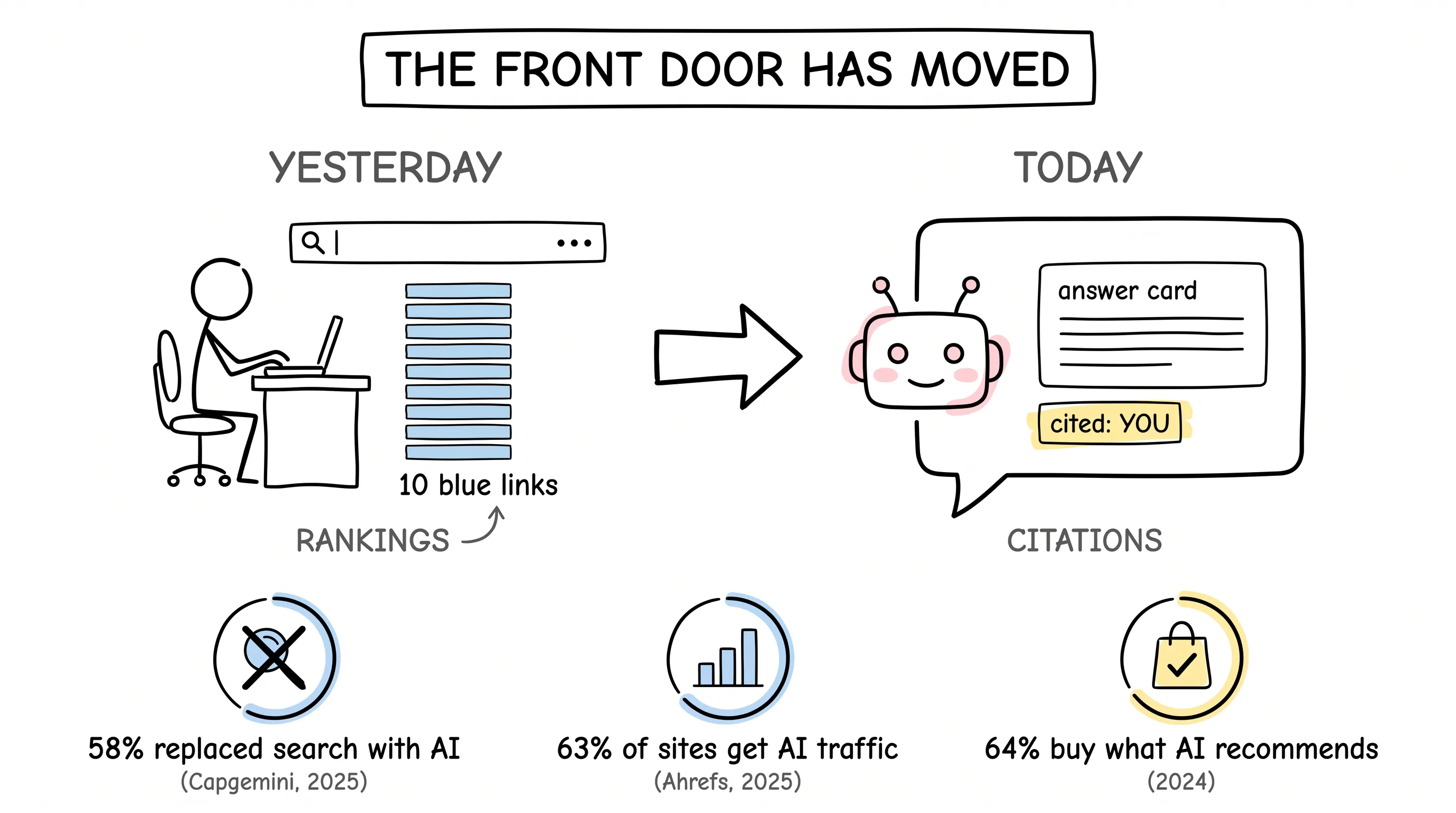
It used to be that when someone wanted to pick an e-commerce tool or choose a CRM, their first move was opening a search engine and digging through those ten blue links. Today, for a lot of people, the first move is opening ChatGPT or Perplexity and asking one question: which one is right for me?
You might think this is a game only a handful of geeks play. So let's look at a few numbers.
In 2025, Capgemini ran a survey: 58% of users have already replaced traditional search engines with AI tools when looking for products and services. Past the halfway mark.
Also in 2025, Ahrefs put out a stat: 63% of websites are already seeing traffic from AI search. In other words, ChatGPT and Perplexity have already shown up in most website owners' analytics dashboards — most people just haven't paid attention.
And here's the sharpest one. In 2024, Master.of.Code ran a study: 64% of users said they're willing to buy a product directly because AI recommended it.
Sit with that for a second. AI says which one is good, and more than six in ten people pay on the spot.
This isn't a trend forecast. It's happening right now.
What Is GEO?
GEO, Generative Engine Optimization.
Put simply: it used to be that you worked out how to get Google to rank you near the top; now you have to work out how to get ChatGPT, Perplexity, Gemini, Copilot and the like — when they answer a user's question — to mention you, cite you, recommend you.
Note that this isn't about tearing SEO down and starting over. It's a new craft that sprouted up next to SEO.
Here's an example. A user asks ChatGPT: what are some e-commerce data analytics tools suited to small teams?
The AI won't fling a row of links at you. It writes out an answer, names a few brands, and gives its reasons.
If the AI mentions you when it writes that answer — congratulations, you've been cited. Even if the user never once clicks through to your website, the scales of the purchase have already quietly tipped your way.
The contest used to be over rankings. Now it's over citations.
Why Is This Such a Big Deal?
Let me count three ledgers for you.
The first is the volume ledger. ChatGPT has more than 400 million weekly active users, with over 5.2 billion visits a month. Perplexity is climbing fast too — more than 50 million monthly visits and over 500 million queries a year. Behind every one of those questions is a person in the middle of making a decision.
The second is the future ledger. Gartner has predicted that by 2028, a quarter of traditional search will have shifted over to generative engines.
The third is the most painful ledger. If your brand never shows up in AI answers, then for a large share of users, you don't exist.
They ask AI, AI doesn't mention you, and they turn around and buy the one AI did mention.
You never even made the shortlist to be compared.
What Exactly Is the Relationship Between SEO and GEO?
A lot of people get nervous the moment they hear this: should we move the whole SEO budget over and go all in on GEO?
No.
Think about a restaurant. It used to fight for the priciest storefront at the busiest intersection, the bigger the sign the better. Now? Plenty of customers never leave the house — they just ask that friend who knows everything: where should we eat today? Whichever place the friend names, that's where they go.
You still want the storefront. But the friend's word of mouth has become the new battleground.
SEO is the storefront: you rank at the top of the results so users click in.
GEO is the word of mouth: AI names you in its answers, and users remember you without ever clicking a link.
Let me lay out how the rules differ on these two battlefields.
The keywords have changed. We used to build content around short phrases like "best CRM"; now users ask: "What CRM suits a one-person company?" What AI wants is content that can answer a specific question — not a page stuffed with keywords.
The hard currency has changed. SEO's hard currency is backlinks — whoever has the higher domain authority wins. GEO's hard currency is whether the content itself is trustworthy, whether it deserves to be lifted into an answer. Some people call this "trust embedding." Put plainly: does the AI believe you or not.
The bar has changed too. For an article to show up in a Perplexity answer, it doesn't need to load in half a second — it just needs to answer the question well.
The scoreboard has changed. SEO measures where you rank; GEO measures in what capacity you appear in AI answers, and how many times you get mentioned. When AI cites you, users trust you. This is brand authority in a new form.
So no, SEO isn't dead. It just no longer decides life and death on its own.
How Do You Get AI to Mention You?
This is the most actionable part. I'll walk through four moves.
Move one: speak like a human.
AI reads content differently from people. It converts your text into a set of "semantic coordinates," then checks how close those coordinates are to the question the user asked. In math terms, these are called embeddings (turning text into numbers a machine can compare) — you don't need to remember the term, just the takeaway: the more your writing reads like a direct answer to the user's question, the closer those coordinates get.
Compare these two.
You write: "We provide a one-stop e-commerce data analytics solution." The AI gets this sentence and has no idea which answer to slot you into.
You write: "If you run an online store and want to know which product sold best yesterday, open the dashboard and the real-time numbers are right there — no exporting to Excel." Now the AI knows: when someone asks about e-commerce data analytics, this one belongs in the answer.
Specific, clear, and pointed at the user's actual question.
Move two: turn yourself into a clear entity.
AI understands the world as a set of distinct concepts: names of people, names of products, industry terms. It does not recognize vague phrases like "our product."
So use your full name. Spell out who you are, what you do, who it's for, and why it's worth it. And wherever possible, show up in the places AI reads while it learns: wiki-style knowledge sources, industry media, third-party reports. The more you appear there, the firmer the AI's impression of you.
Move three: weave a web around one theme.
AI doesn't read just one article of yours — it looks at what your entire site is saying. Take one theme, write a set of pieces on it from different angles, and link them together; only then can the AI confirm: this outfit is a genuine expert in this field. The more focused the theme, the thicker the trust.
Move four: produce original material.
AI loves citing "the source": original reports, exclusive data, real human expert judgment. Run a small industry survey, assemble a set of numbers nobody else has, and the odds that AI cites you when answering related questions jump by a wide margin.
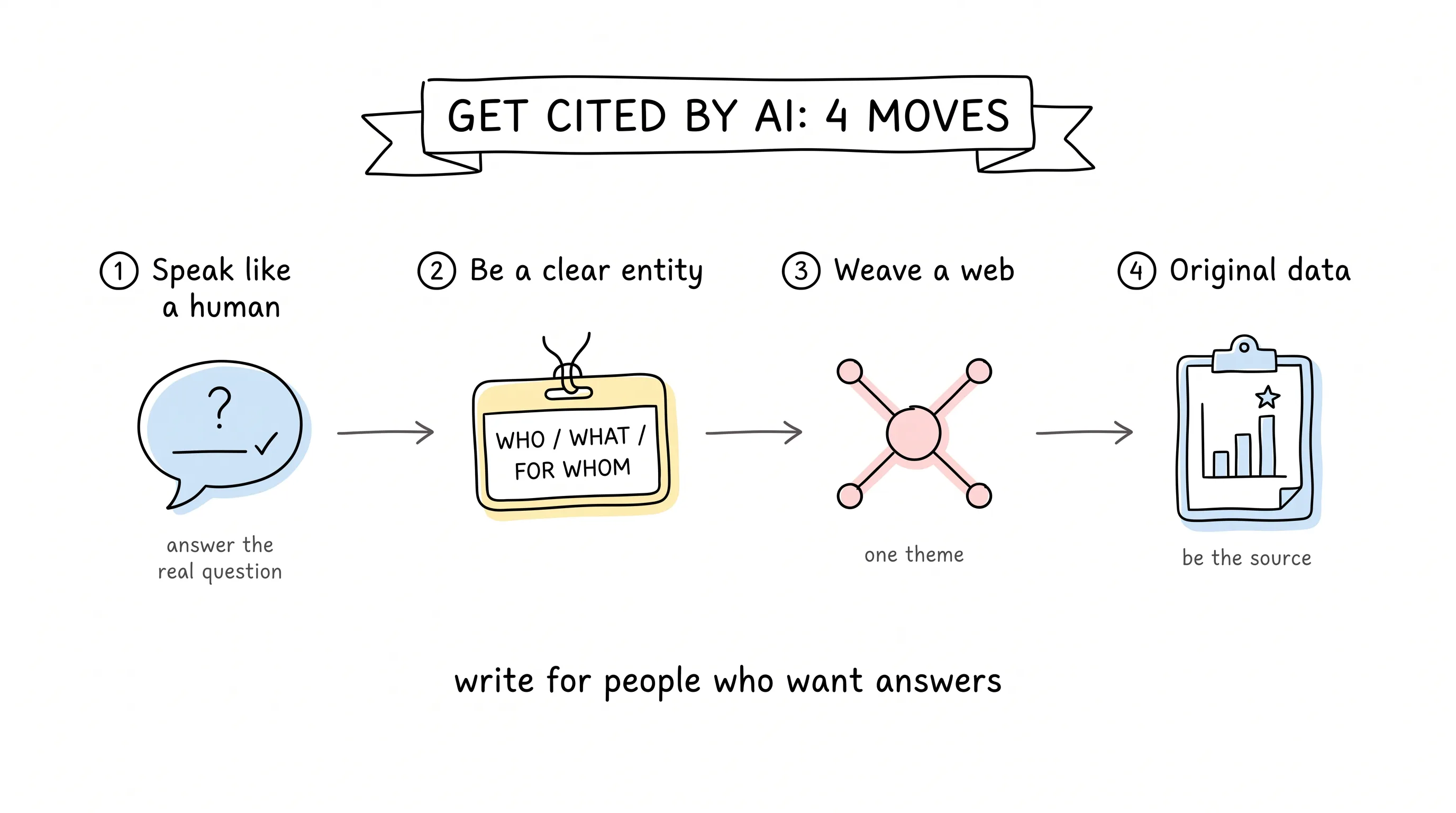
All four moves boil down to one sentence: write your content for "people who want answers," not for "machines that want rankings."
By the way — how do you check whether any of this is working? There's no mature toolset on the level of Ahrefs yet, but you can start with the crude method: keep a running list of the questions users would most likely ask AI, put each one to ChatGPT and Perplexity in turn, and see whether you show up in the answers. Revise your content, run the questions again, watch what changes. As for quantifying it: the sessions coming from AI tools in your analytics, the clicks in your server logs, matched up against conversion data — piece those together and you've got a report card.
Finally, Back to My Friend
After that dinner, he went back and had his team do exactly one thing: put themselves in their customers' shoes, list the 20 questions customers would most likely ask AI, then ask them one by one — watching how AI answered, and whether it mentioned him.
He said that one move alone made it crystal clear where he and his competitors stood in AI's eyes.
We used to joke that on the internet, nobody knows you're a dog.
Now the line needs rewriting: if AI's answer doesn't mention you, you don't exist.
So stop asking "should we do GEO?" That question is already out of date.
The question to ask is: Your customers are already saying your name in front of AI today. Is AI speaking up for you?
Here's to your brand being the answer.
Continue reading
Related articles

It's 2026: Stop "Buying" AI Tools for Your Marketing Team — Start "Hiring" AI Agents
This learn article explains how AI agents differ from standalone AI tools in marketing, outlines three agent categories — build-your-own platforms, CRM-native agents, and vertical tools — and covers use cases across SEO, social media, advertising, and reporting, plus criteria for choosing one.

What Is GEO? How Your Brand Gets "Mentioned" in the Age of AI Search
An explainer on GEO (Generative Engine Optimization) for e-commerce and DTC brands: how it differs from SEO and AEO, why AI answers shape brand visibility, and eight practices covering question-focused content, consistent brand messaging, structured pages, external evidence, comparisons, and AI mention tracking.

AI Is Already Making Decisions for Your Customers. Are You on the List?
A learn article explains GEO (Generative Engine Optimization): why AI-generated answers now shape which brands customers see, and how SEO fundamentals, entity clarity, citable evidence, and monthly measurement affect visibility in AI answers.