
Stop guessing. Whether AI cites you can actually be verified
A learn article explaining why AI citations are hard to observe and how to verify whether generative engines mention your brand, covering structured content, schema, E-E-A-T, fan-out queries, and a repeatable testing routine across ChatGPT, Gemini, and Perplexity.
Let me ask you a question first.
When was the last time you searched for your own company's name in ChatGPT?
Don't answer yet. First, think about what the search turned up.
It may have gone like this: AI politely walked through your industry, casually mentioned a few brands. Yours wasn't among them.
Or maybe it was. Who knows.
My guess is, most people have never tried. Content marketers spend every day figuring out how to get AI to cite them, yet rarely turn around and check: did AI actually cite me?
That's what we're talking about today.
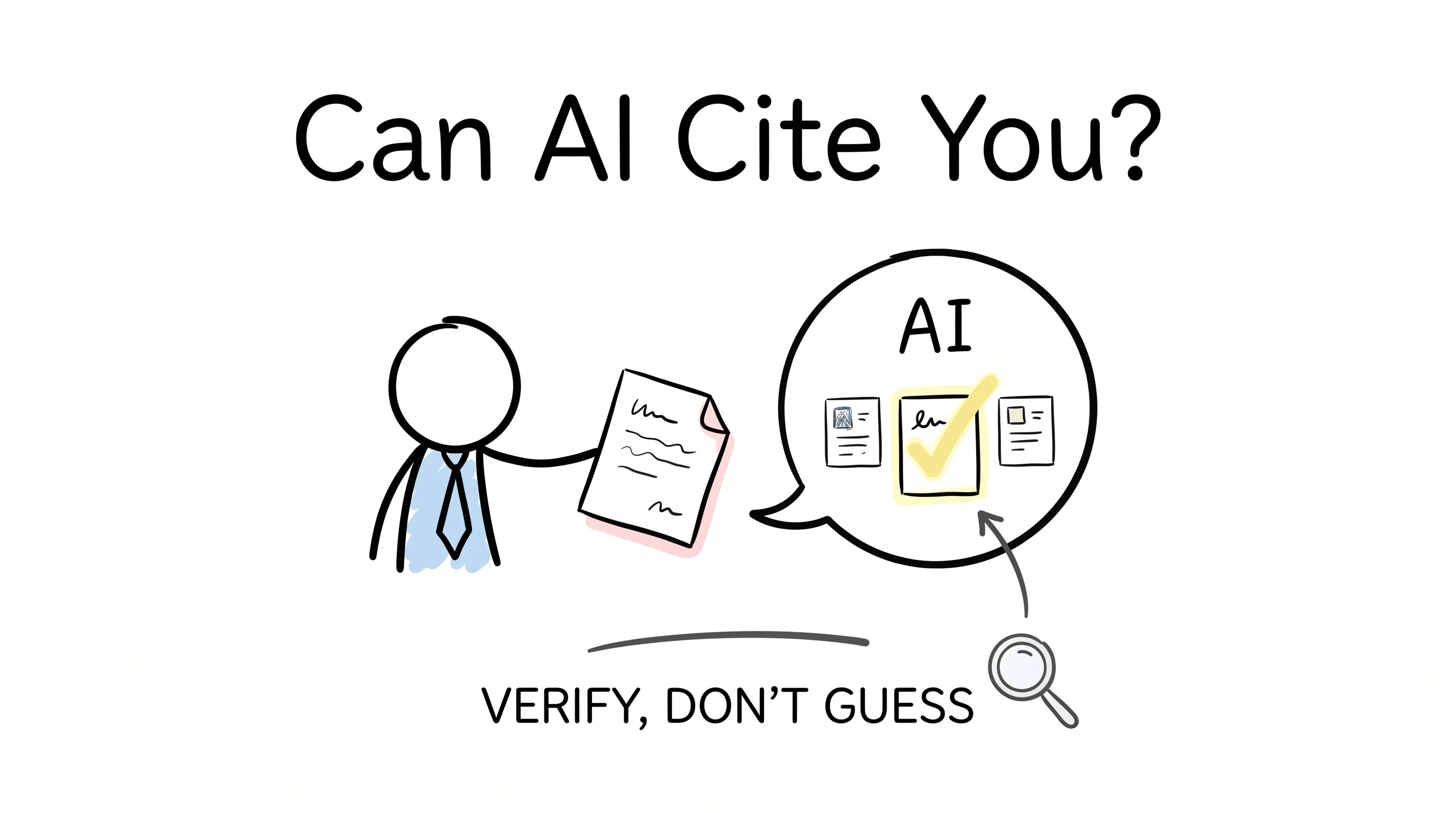
What makes this so tricky?
The trouble is, it's a black box.
After two decades of practice, SEO is a fully mapped territory. Where does your keyword rank? Number 7. What's your click-through rate? 2.3%. The data sits in your dashboard, rising and falling in plain view.
What about GEO (Generative Engine Optimization)?
You ask AI a question, it hands you an answer. Who it cited, who it didn't, and why it cited them — it won't tell you a word of it.
It's like submitting a paper, but the teacher never publishes the scores, never publishes the rankings, and only, when you happen to pass by, reads one of your paragraphs aloud to someone else.
The only way you can confirm anything is to walk into the teacher's classroom and see whether he still reads you.
You can't control what AI says. But you can control what AI reads.
So what's within your control?
First, get your paper in order
What does "in order" mean? It's the first thing AI sees after it gets your content.
Generative engines have a peculiar trait: they don't really "read" an article, they "understand" it. They first need to work out which entity a passage is about, how it relates to everything else, and which sentence carries the point.
The clearer your structure, the less effort it takes to understand you, and the better your odds of being picked.
So how, specifically?
The most basic layer is schema markup. You take the structure of your article and label it once more in a language machines can read, telling AI: here's a question, here's an answer, here are the steps. It's like attaching a table of contents when you hand in your homework.
One layer up: FAQs and tables. The daily job of a generative engine is "summarizing," so write your content in the form it finds easiest to summarize: short sentences, bulleted points, crisp subheadings. A ready-made table is often lifted straight into the AI's answer.
There's another layer called coverage. Here's a term for it: fan-out.
What is fan-out?
When AI receives a question, it doesn't just look up that one sentence. It breaks the question apart into ten more specific questions, and goes hunting for answers to each.
You ask for "the best hotel in London," and behind the scenes the AI may simultaneously be checking: which ones are four-star, which ones have meeting rooms, which ones sit along the Tube.
Then here's the question: for those broken-out questions, does your content have answers?
If not, you're out of the running for that round.
So don't fixate on a single primary keyword. Write out and answer, in advance, all the "follow-ups" around that keyword. After the user asks "the best hotel in London," the next line is most likely "which one has a meeting room." If you've prepared even that question, the AI can keep thinking of you at step two and step three of its answer.
As for how to dig up "what people ask next," tools like AlsoAsked and Answer the Public exist precisely for this.
Facts are worth more than opinions
One layer deeper still, and we reach the hard currency of content.
When AI picks its sources to cite, there's a fundamental operation underneath: judging whether what you say is credible.
What does credible mean?
Your numbers have sources. Your citations come from legitimate outlets. Your information is fresh. And the person writing has a real name and face — who he is, what he's done, why he's qualified to speak on this. Google gave this whole bundle a name: E-E-A-T. In plain language: has experience, demonstrates expertise, carries authority, can be trusted.
Think about it: AI does the filtering on the user's behalf. If it cites an unreliable source, the embarrassment is its own.
So it naturally favors content that "can show its receipts." It's the same as writing an academic paper: cite properly, keep the data checkable, be a real, verifiable author — only then will reviewers let you through.
The most counterintuitive thing of all
There's one thing many people still haven't made the mental switch on.
Back in the SEO days, everyone fought for the number-one spot in search results, fought for the featured snippet. Why fight for it? For the click. The user sees the snippet, clicks through — that's traffic.
And now?
In AI search, the snippet may be the destination. The user reads the AI's answer, the problem is solved, no click.
Zero click.
Then why fight for the snippet at all?
Fight to be cited. Before, that snippet came with a link attached, and your goal was to get people to click it; now that snippet may itself be part of the AI's answer, and your goal is to get people to see your name and adopt your framing.
Before, the snippet was your billboard. Now, the snippet is the answer itself.
Once you see this, you understand why so many GEO moves look identical to SEO — good content, good structure, good reputation. But the scoring rubric has been swapped out for something entirely different.
So how do you verify?
Back to the question we opened with. With all this content effort, has AI actually cited you?
Don't guess. Go verify.
The method isn't complicated.
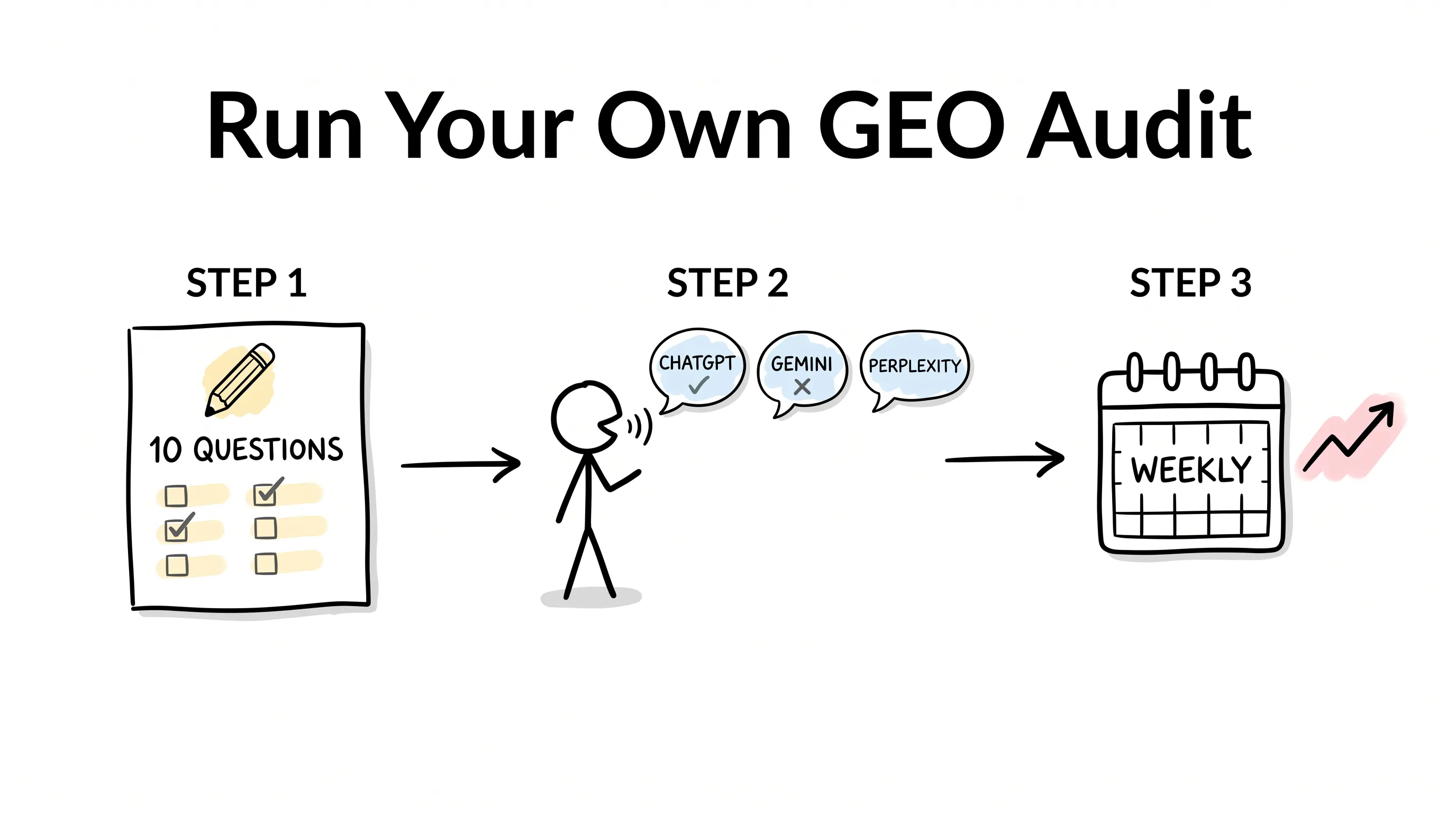
Step one: write out a set of questions. Note — not the questions you'd want to ask, but the questions your customers genuinely ask. From the vaguest to the most specific, list about ten.
Step two: ask them, one by one. Run them all through ChatGPT, Gemini, and Perplexity. Record three things: did the answer include you? Which of your products did it mention? Which page of yours did it cite?
Step three: after a while, ask again. AI's answers aren't carved in stone; they change. Better or worse — only repeated testing will tell.
What this routine really does is turn superstition into experiment: fixed questions, fixed times, recorded results.
Tools built for exactly this job have already appeared on the market, watching the major AI channels for you: how many times your brand gets mentioned, and in what tone.
You don't even need to buy a tool right away. One spreadsheet, a dozen or so questions, run every week. Keep it up for a month, and you'll know "how AI sees you" better than the vast majority of your competitors.
Finally
Tonight, or tomorrow morning, pour yourself a coffee, open ChatGPT, and search your company's name.
See what it has to say about you.
If it's accurate, you should be glad. If it's inaccurate, you should be even more glad — glad that you started verifying today, rather than waiting for the day a customer cheerfully repeats the story AI made up about you.
No visible citation doesn't mean you can't verify. Turn superstition into experiment.
And here's wishing you never have to hear, from a customer first, how AI describes you.
Continue reading
Related articles

What Is GEO? How Your Brand Gets "Mentioned" in the Age of AI Search
An explainer on GEO (Generative Engine Optimization) for e-commerce and DTC brands: how it differs from SEO and AEO, why AI answers shape brand visibility, and eight practices covering question-focused content, consistent brand messaging, structured pages, external evidence, comparisons, and AI mention tracking.

AI Is Already Making Decisions for Your Customers. Are You on the List?
A learn article explains GEO (Generative Engine Optimization): why AI-generated answers now shape which brands customers see, and how SEO fundamentals, entity clarity, citable evidence, and monthly measurement affect visibility in AI answers.

Google Is Stuffing Ads Into AI Search: These Recent Stories Are Really One Story
A news roundup linking recent AI marketing stories—Google adding ads to AI Mode, Amazon's Ads Agent, ChatGPT image updates, a UK startup tracking brand mentions in AI answers, and an AI ransomware warning—arguing that control over ad data and visibility is shifting toward platforms.