
Cross-Border E-Commerce, and How AI Is Recalculating the Books
An educational overview of how AI applies to cross-border e-commerce, covering customs paperwork, logistics routing, inventory forecasting, personalized recommendations, and around-the-clock customer service, plus pitfalls around cost, data privacy, and system integration before adoption.
A while back, a friend of mine who runs a cross-border e-commerce business took me out to dinner.
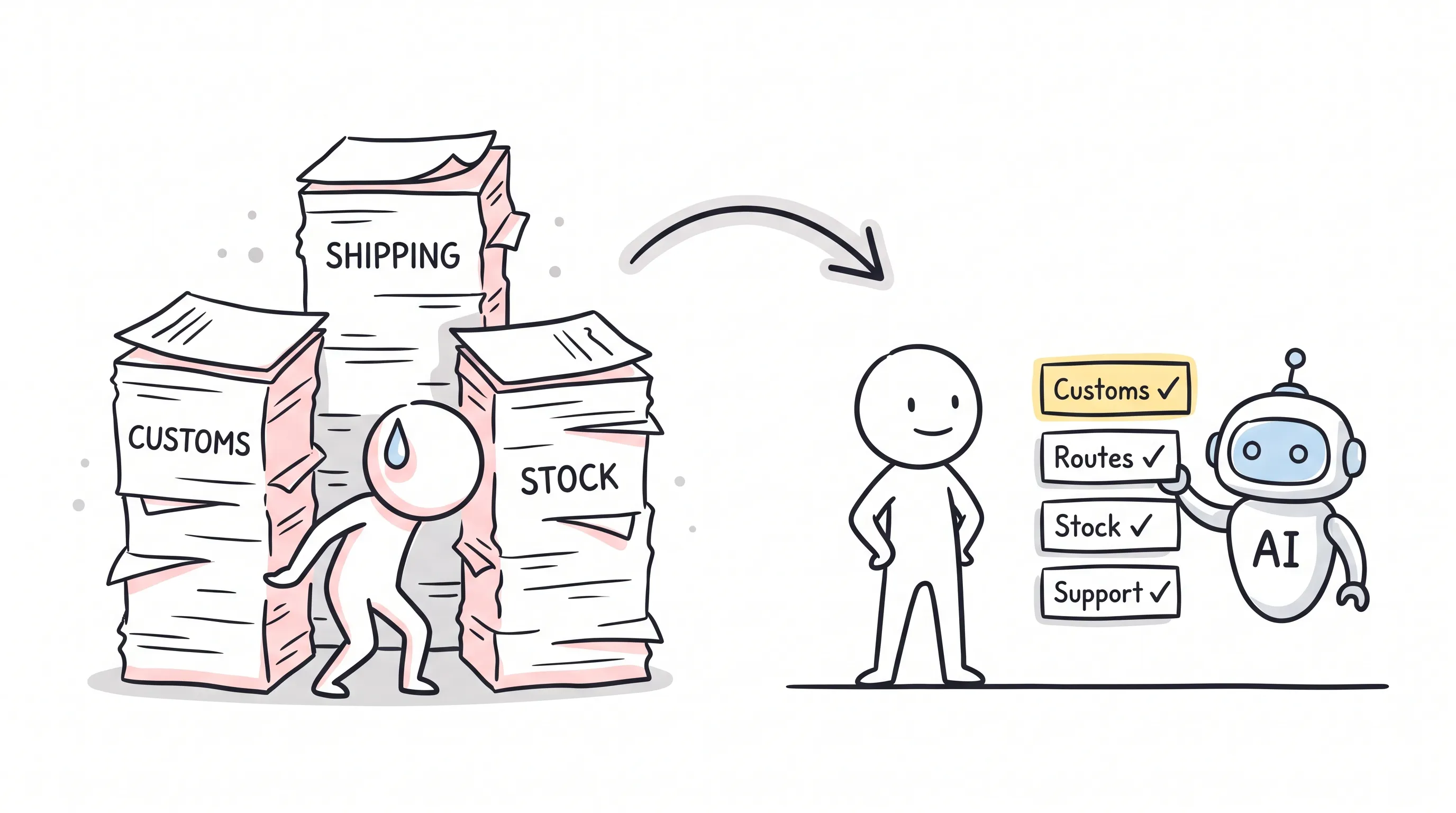
Before the dishes had even arrived, he was already pouring out his troubles. A shipment of goods was stuck at customs — a full week, hadn't moved an inch. His customer service team was drowning: buyers from every timezone in the world messaging in shifts, and there simply weren't enough hands to reply. Worst of all was the inventory: his Europe storefront had piled up stock so long it was practically growing mold, while his US storefront was running out of stock every single day.
Then he said something that stuck with me: I didn't lose to selling. I lost to everything around the selling.
I asked him, so what are you going to do?
He said, I'm going to bring in AI.
Well, that's a topic I know well. What exactly can AI do for cross-border sellers? Today, let's go through this ledger line by line.
First, Get Clear on Where the Difficulty Lies
Cross-border business is hard in exactly two places.
The first is that the chain is too long. From your warehouse to a consumer overseas, a product has to clear customs, fill out paperwork, calculate taxes and fees, pick a shipping route. Every single link costs money, costs time, and hides a trap.
The second is that the touchpoints are too scattered. A customer browses your online store one minute, your mobile app the next, then wanders into a physical shop. Your products, your prices, your service have to look identical through every door.
So what is omnichannel? Omnichannel means that no matter which door a customer walks in through, they see the same store's goods, the same prices, the same service.
Sounds easy. In practice, you quickly learn that either of these two problems, left to humans watching over it alone, is simply more than people can watch.
So the question becomes: can AI actually carry it?
My judgment: yes — and it grabs the handle exactly where it matters most.
The Back-Office Ledger: AI Does the Math Faster Than You
Let's start with the back office.
First stop, customs. Filling out customs declarations and calculating tariffs is the most grinding, unforgiving chore in cross-border trade. The rules change constantly, and every word of them is money. AI can fill out the paperwork and calculate the taxes automatically, turning three days of work into three minutes.
Second stop, logistics. Once a package ships out, which route it takes and which carrier handles it used to be decided on gut feel and experience. AI digs through historical data: this lane is fast but pricey, that one is cheap but always late — then it runs the numbers for you and picks the combination that's both fast and cheap.
Third stop, inventory. How much will sell, how much should you stock? This is the question that keeps every cross-border seller up at night. Stock too much and you tie up capital; stock too little and you lose orders. AI reads your sales trends, customer behavior, even weather and holidays, to predict the next wave of demand.
A sharper prediction means less excess stock and fewer stockouts. Don't underestimate this. One stockout can cost you more than a single order — it can cost you the reputation you painstakingly built in that market.
And there's one more thing that's easy to overlook: visibility. Where your goods are at sea, how much is left in the warehouse — you can see all of it in real time. When something goes wrong, you fix it immediately, instead of finding out when the angry buyers start yelling.
The Front-Office Business: AI Can Handle Your Customers
The back office saves you money. The front office makes you money.
Take recommendations. What a customer has browsed, what they've bought — AI remembers all of it. The next visitor who opens your store sees a homepage stocked not with the same one-size-fits-all bestsellers, but with the things they're most likely to want.
Take ad targeting. Who to advertise to, what to advertise — AI segments by audience preference, so your money goes to the people most likely to respond.
Take checkout, too. Many people think checkout is a purely mechanical process, but AI can work there as well: predicting what a customer will want next and handing them a personalized offer or bundle along the way.
All of these point to the same word: personalization.
What is personalization? Personalization means a thousand customers walk into your store and see a thousand storefronts, each one prepared just for them.
And then there's customer service. An AI service agent is online around the clock, across every timezone, answering common questions in seconds. And your human staff? They handle the genuinely complicated disputes. Better still, the AI gets smarter with every conversation — what it couldn't answer today, it may answer tomorrow, faster and better.
For a cross-border seller, this one is practically a must-have. Your buyers are scattered across a dozen timezones; you can't hire a dozen shifts of support staff.
But Don't Reach for Your Wallet Just Yet
By now, are you itching to go out and buy yourself some AI?
Slow down. There are three pitfalls, and you should see them clearly first.
The first pitfall is money and time. Systems take deployment, processes take settling-in, and all of it is expensive. When choosing a vendor, look for whoever can actually get implementation done for you, not whoever has the flashiest demo.
The second pitfall is data. For AI to understand your customers, it has to consume their data. How that data is stored and used — every country's privacy regulations have their own say. Step over the line here, and the money you saved may not cover the fines.
The third pitfall is integration. You already have an inventory system and an order system in place. If the new AI tool can't plug into them, then no matter how clever it is, it's an island — cut off from everything else.
AI is a helper, not a magic pill. Fill in these three pits before you adopt it, and only then does it get the chance to save you money.
So How Do You Actually Start?
Four pieces of advice.
One: when choosing a platform, choose one built for cross-border. It should translate automatically, handle multiple currencies, and understand every country's tax compliance. However good a general-purpose tool is, without cross-border knowledge, using it is like scratching an itch through the boot — you never quite get to it.
Two: use AI analytics to truly understand your customers. What they've bought, what they've browsed, how long they lingered — the data is all sitting there; the only question is whether you know how to use it. Only when you understand them can you talk about personalization.
Three: hand your supply chain to AI for automation. Inventory, shipping, fulfillment — automate whatever can be automated. Keep the goods always where they should be, and the money always spent where it should be spent.
Four — and this is the one most easily overlooked: once you've adopted AI, keep watching it. Regularly review the results, and fix whatever isn't working. AI is not an appliance you buy and forget. It's more like a horse you have to walk every day.
Finally, Back to That Dinner
A few days ago, I saw that friend again.
On the customs side, the new system files the declarations automatically, and stuck shipments are visibly rarer now. The chatbot works the night shift, and his team finally gets to sleep through the night.
He said something pretty interesting to me: I used to think AI was a toy for the giants. Now I realize it's actually a whole team of people only giants could afford — the customs brokers, the inventory planners, the data analysts, the night-shift crew — packed into one piece of software, billed monthly.
I'm not sure where this AI wave will ultimately take cross-border commerce. But one thing I'm quite sure of:
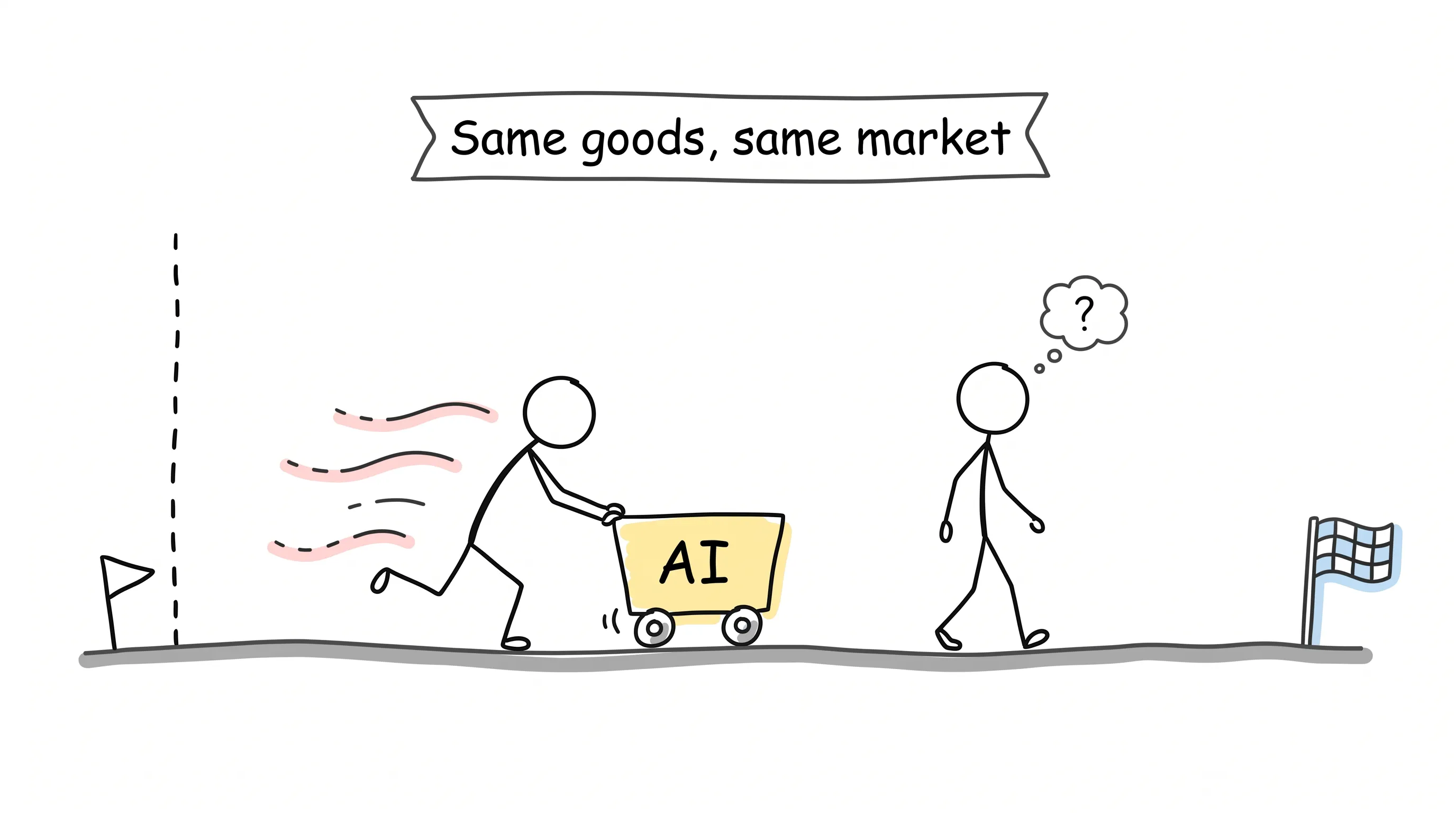
Same goods, same market — the seller who uses AI simply runs faster than the one who doesn't.
Here's hoping you get that horse out and moving soon, too.
Continue reading
Related articles

What Is an AI Marketing Agent? From "Using AI" to "Delegating to AI"
A learn article explaining what an AI marketing agent is, how it differs from rule-based automation, and which repetitive tasks such as lead qualification, reporting, and campaign monitoring can be delegated while humans keep key decisions.

Marketing Automation Is Shifting from "You Do It" to "You Say It"
This article explains how marketing automation is shifting from rule-based platforms that merely execute toward AI agents that plan, create, publish, and review campaigns, covering delegable tasks, underlying technologies, tool categories, adoption steps, and risks such as privacy and automating without strategy.

When AI Does the Creative, Mistakes Come in Batches Too
A learn article on the risks of using generative AI for marketing creative across brand, legal, compliance, and operational layers, with case examples and seven practices for review, rights clearance, documentation, and vendor governance.