
The AI Marketing Fight Isn't Won by Whoever Owns the Most Tools
An essay arguing that AI marketing is won by understanding buyers, not by owning the most tools. It explains how AI answers and search reshape visibility, why teams should build AI literacy before buying tools, and covers writing, video, and website use cases, common pitfalls, and trends such as AI agents.
A while back, I had dinner with an old friend who works in marketing. He sat down and sighed: this year he carved a chunk out of his budget and threw it all into AI. Article output tripled — but traffic didn't rise, and inquiries actually fell.
He asked me: am I using the wrong tools?
I said: you may be misreading the exam entirely.
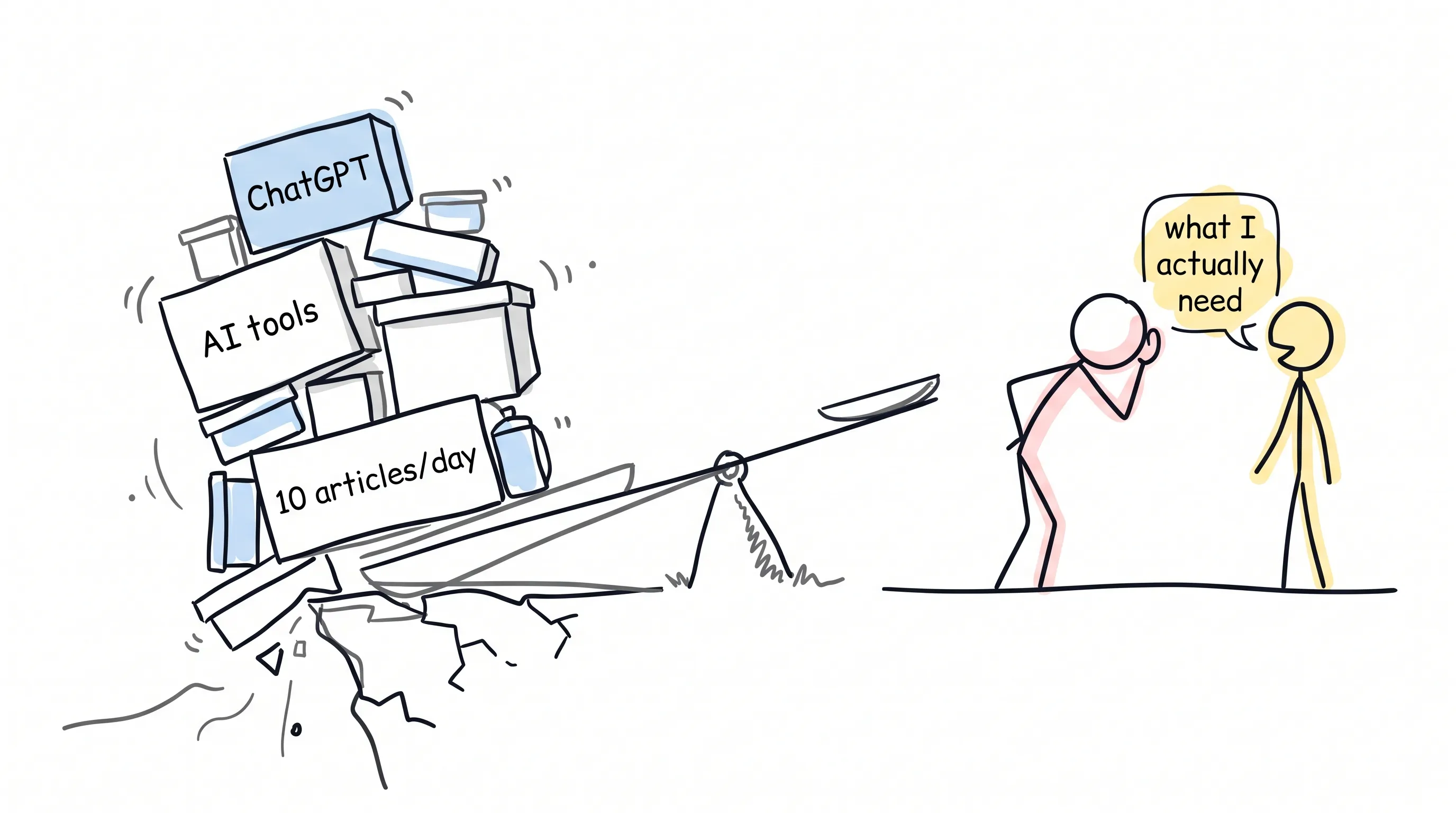
This exam was never about who owns the most tools. It's about who understands their buyers best.
What do I mean? Let's take it layer by layer.
First, a fact that's only half-acknowledged
What is AI for marketing?
The picture most people hold in their heads: articles written in seconds, images generated in one click, a chatbot bolted onto the website. That's all correct — but it's only half.
The other half, the half that's actually valuable, is invisible to your customers. A meeting assistant that logs every sales call automatically. A system that files away the shared drive for you. A business process document that finally got written. Buyers will never know these things exist, yet every piece of outward-facing work gets better because of them.
So don't open with "what can AI write for me?" Ask this first: can AI take over the repetitive, tedious, nobody-wants-to-do-it work inside my team?
The answer is usually: yes — and faster than you'd think.
Search has already changed
Let me read you a few numbers.
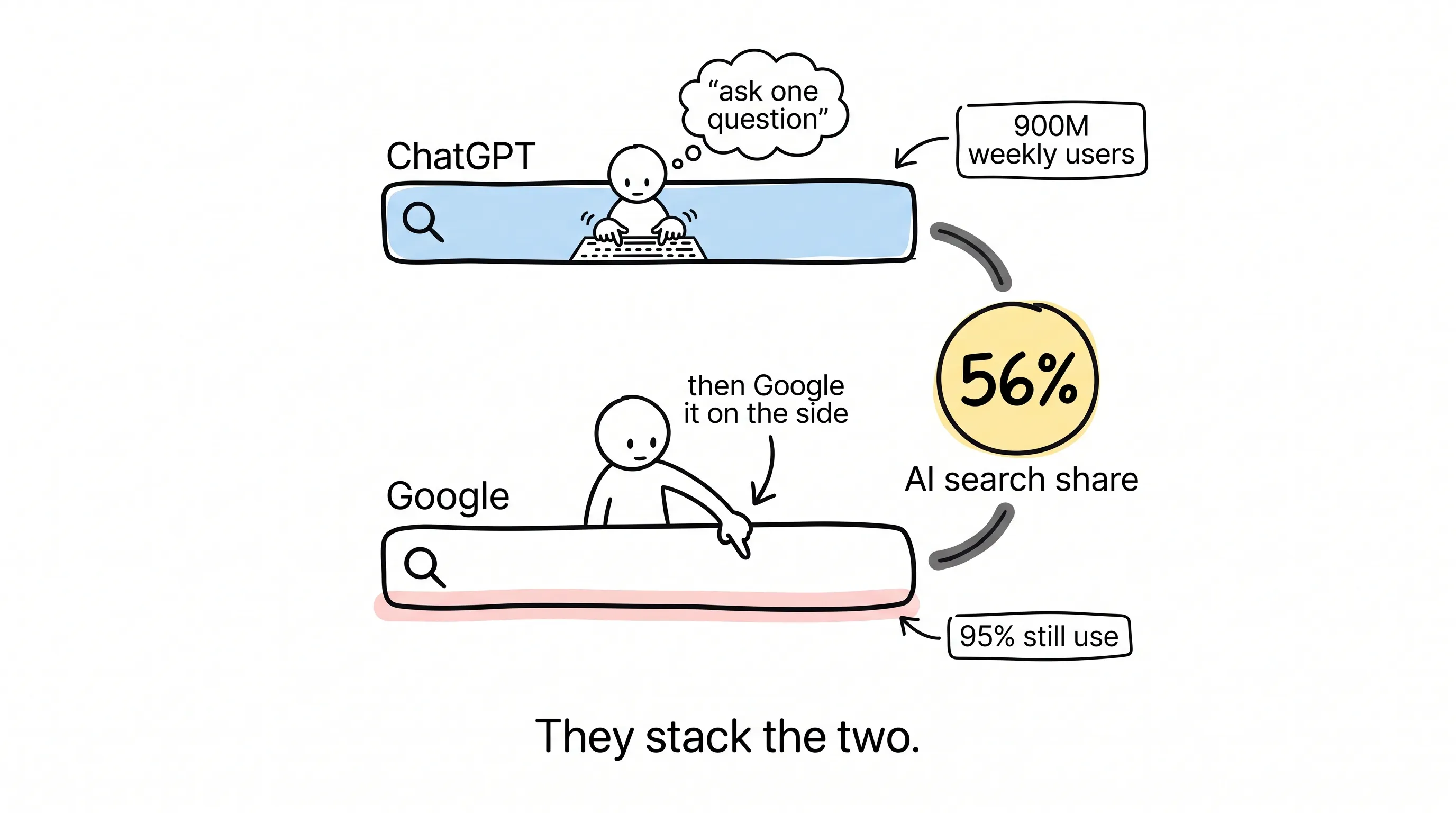
ChatGPT has 900 million weekly active users. AI search now accounts for roughly 56% of global search volume. And yet at the same time, 95% of Americans still use traditional search engines.
See the point? Buyers didn't "move house" from Google to AI. They stack the two. They ask ChatGPT one question, then Google it on the side. Whoever's information shows up wherever people look — that's who wins.
The traditional search results page stopped looking like it used to as well. Earlier this year, AI Overviews were already showing up in nearly half of all searches, and on mobile they can take over half the screen. For many searches, the buyer gets a complete answer before ever seeing a blue link.
That's why marketing people keep getting dizzy over three acronyms lately. What's SEO? Getting your web pages to rank near the top of the search results page — the old craft. What's AEO? Getting your content into places that hand back direct answers, like AI Overviews and voice assistants. What's GEO? Getting generative engines like ChatGPT, Gemini, Claude, and Perplexity to cite you in their answers.
The three terms get argued over endlessly, but honestly the distinctions mostly blur into one point: wherever an AI is making recommendations on someone's behalf, you have to show up there.
And the playbook has changed. The old stack-keywords-and-game-the-algorithm routine is dead. Now, when Google and the various AI engines pick content, they all watch one thing: E-E-A-T (Experience, Expertise, Authoritativeness, Trustworthiness). In plain terms, it wants to know whether you've actually done the thing, or whether you copied it from somewhere online.
In practice that comes down to four moves. Write headlines and subheads the way buyers actually ask — they're typing whole sentences into AI chat now. Keep your structure clean: subheadings, bullet points, FAQs, readable by humans and machines alike. Put your real name on it, with a real bio, plus first-hand cases and your own data. Help the buyer decide first; brag later.
And there's one more thing most companies have never checked.
Before an AI recommends a company, it looks at far more than the few posts on your website. Review sites, social accounts, business directories, news coverage, third-party citations — it stitches together every corner of your presence on the web. The industry calls this the reputation graph.
Here's an analogy. AI is like a new front-desk receptionist. When a guest asks "is this company reliable?", it doesn't make things up — it goes and flips through every record you've left behind. Three companies with near-identical service quality: the one whose name, address, and phone number match across the entire web, the one with the freshest and fullest reviews, is the one it recommends. A stale microblog post from 2012 linking to the wrong website, an outdated phone number in some yellow-pages listing — every one of these chips away at your score.
SEO used to be a contest over rankings. Now the contest is: will you be summarized, mentioned, recommended?
If AI won't put you in the answer, buyers will never see you. You weren't pushed to page two — you were never on the test.
Where to start? Build literacy first, not a shopping spree for tools
So what do you do? My advice may disappoint you: don't rush off to study tool lists.
Tools turn over every year. Products hyped to the sky last year may vanish this year. But the ability to use AI well never goes out of date.
Step one fits in one sentence: treat AI as a collaborator, not a generator.
A generator hands you a finished product; you take it as-is, and everything you produce looks the same. A collaborator thinks with you, drafts with you, revises with you, polishes with you — and what you get is sharper work and a smarter team.
How do you actually practice this? Pick one or two platforms, that's enough — don't get greedy. Then spend one week asking it questions only inside domains you genuinely understand. Your industry, your customers, the work you do every day. Notice where it gets things right, where it hedges, where it starts fabricating with a completely straight face.
The moment you catch it talking nonsense about something you know inside and out — congratulations. You've just acquired the most valuable instinct there is: knowing when to trust it and when to stop it.
By the way, a lot of teams find their biggest gains have nothing to do with writing articles. Straighten out your internal workflows first — automated meeting notes, file archiving, writing down the processes nobody ever documented. This is the foundation. If the foundation is shaky, no tool will build you a decent house. Same logic: if you haven't clearly written down your ideal customer profile and your brand voice, whatever AI generates is guaranteed to be all over the place.
Once you've trained this properly, every person on the team has exactly three identities in front of AI.
As an editor: treat every AI output as a first draft; edit it until it's accurate and sounds like you, then feed your feedback back like you would to a colleague. As an engineer: you don't need to code to build prompt templates and assemble your own go-to assistants. As an iterator: test, record, review — whatever fails, write it down and route around it next time.
Dare to try, dare to fail, dare to start over. The teams with nothing to prove move fastest.
Down to the actual work: writing, video, your website
Writing — the category with the most traps. AI can produce ten articles a day, but why on earth would you publish ten?
My view: what you feed in sets the ceiling on what comes out. If you want AI to write something different, first go interview the person in your company who knows the business best, turn the recording into a transcript, and feed that to Claude or ChatGPT. Real input is what produces real output. Ask AI to play-act an expert, and all you'll get is something that already exists everywhere online.
Let AI handle outlines, interview questions, first drafts. That final pass before publication — a human must do it, personally.
The same goes for video. The tools genuinely get better by the day: drafting interview outlines, writing scripts, structuring long videos. But if you haven't made it truly absorb your tone — or your on-camera subject's tone — the output has one defining flaw: it doesn't sound like you. It sounds like AI.
Your website is the third battleground, and it's different in kind. Here AI stops being your production tool and becomes the thing your buyers interact with every day. AI customer service on the site, self-serve tools that let visitors compare prices and plans on their own, personalized recommendations built into your CRM — these are all off-the-shelf capabilities now.
Especially the self-serve tools. Today's buyers want to research thoroughly, compare carefully, and assemble a shortlist before they ever talk to a human on your side. Still hiding your pricing, still gating every piece of information behind a form, still routing every question through a salesperson? Buyers turn around and walk next door.
What's actually in the toolbox
Still, you deserve a map. On the market today, four general-purpose platforms cover most marketing work.
Claude: strongest at long-form writing and structured analysis. Projects and Skills keep a project's context alive over the long term, and it's the best at protecting your brand voice when editing long documents. ChatGPT: smooth for everyday writing, brainstorming, and image generation; custom GPTs are good for building reusable workflows. Gemini: if your whole team lives inside the full Google suite, copy-paste stops being part of your life. Perplexity: for research and verification — it cites a source for every claim, which makes it excellent as your fact-checking layer.
Image generation has improved astonishingly fast these past two years. Nano Banana 2 is currently recognized as the strongest, and it's built into Gemini for free; ChatGPT's Images 2.0 is good enough for batch-producing marketing assets; for enterprise-grade copyright assurance, look at Adobe Firefly; for posters with lots of text and precise layout demands, hand it to Ideogram.
Video is the biggest dividend most teams collected this year. Descript lets you edit a video the way you'd edit a transcript — especially smooth for podcasts and explainer videos. OpusClip slices long videos into shorts. HeyGen and Synthesia do digital-avatar translation and dubbing; HeyGen covers more than 175 languages.
Oh, and one more thing — the most underrated investment of all: meeting-notes tools. The likes of Fellow, Granola, Otter, and Fireflies turn every meeting into a searchable knowledge base, automatically. Unremarkable on the surface, but the entire team benefits.
That's the map. Don't memorize it; it'll change within a few months anyway. What you've never lacked is a map. What you've lacked is the ability to read one.
What to steer clear of: six traps
AI can do brilliant things — provided you use it with restraint. The six traps below all look tempting.
One: mass-producing garbage. Fifty articles a day feels satisfying. But what you're pouring into your own site is bland, repetitive, careless material. Readers skim once and leave, then go straight to your competitor. More isn't better. Better is better.
Two: full automation, zero humans. When every email and every reply smells like a machine, the buyer is standing in front of a vending machine — cold, mechanical, free to walk away at any moment. People, in the end, want to deal with people.
Three: being too clever. Using AI to stuff keywords and game search algorithms may nudge your numbers up for a while. But platforms like Perplexity and Google now reward real answers and real clarity. You can't bluff your way into long-term trust.
Four: publishing without review. AI is a good starting point, but it can't read the room. Empathy, tact, a feel for human nature — a human has to guarantee those. Skip human review, and a blowup is only a matter of time.
Five: personalizing with dirty data. AI is exactly as smart as the data you feed it is clean. Take stale, incomplete data and do "thoughtful service" with it — call someone the wrong name, push the wrong product — and one awkward moment becomes a collapse of trust, and it spreads twice as fast.
Six: chasing trends without a strategy. New tools pop up daily, each claiming it will change the industry. Before you put one into your workflow, ask: which of my problems does this solve? No answer? Put it down.
How do you tell whether AI is already quietly working against you? Here are a few signals you can actually see in the numbers. Your scheduled email blasts keep going out while open rates slide all the way down. Support tickets and complaints start featuring "wrong name, wrong product" gripes. The marketing-side metrics all look gorgeous — sends, article counts, sessions all rising — but lead quality and closed deals just won't move. And the last one stings the most: you're scaling up the campaigns, not the business.
Going forward, watch five things
Tools change, platforms change. The real masters aren't the people who adopted the most AI first — they're the ones who know what to watch.
First: AI agents. These don't just answer questions — they do work. Give one a goal, and it will browse websites, fill out forms, request quotes, book times, and place orders on its own. Imagine this: your next customer arrives because their AI came to comparison-shop for them. It doesn't wander. It arrives with a task. If your website can't clearly show pricing, services, process, and credentials, it turns around and leaves. So your site has to be readable by humans — and usable by machines.
Second: "AI employees." Automated workers configured on existing platforms vary wildly in quality. My advice is plain: interview it the way you'd interview a human candidate. A detailed job description, rigorous testing, a formal onboarding. It's suited to supporting roles — basic analysis, reports, that kind of thing. The final call, the gatekeeping, the accountability for mistakes — those stay human.
Third: advertising inside AI platforms. ChatGPT and Perplexity have both started running ads. The formats are still shifting and the performance data is thin. You don't need to jump the gun — but you do need to read the table in advance: are your buyers even on these platforms? When a sponsored slot slips into an AI answer, will users trust it?
Fourth: hyper-personalization. You already enjoy it every day: Netflix guessing what you'll want to watch, Spotify building a playlist for exactly one person. This capability will soon show up in home services and B2B platforms alike. The shelf life of generic copy is visibly shrinking.
Fifth, and the one I most want to say: AI has made strategy more important, not less.
When anyone can generate a beautiful 1,500-word article in ten minutes, the article itself is no longer the moat. What are you actually trying to say, to whom, and why is it worth reading — that is the question left on the exam. Without that thinking, you're not accelerating your marketing. You're accelerating your noise.
Back to my friend
After dinner I talked with him for another half hour, and in the end I gave him three pieces of advice — I'll pass them to you too.
Build literacy first; talk tools later. Set rules for your team: what data may go into AI, and what absolutely may not; whether employees' photos and names can be used by AI needs to be spelled out in advance so nobody gets blindsided. For the first pilot project, don't pick what the boss considers most important — pick what the team finds most annoying. Start from the work everyone wants to hand off, and AI's value becomes instantly visible and tangible; everything you roll out afterwards goes smoother.
Three months later we met again, and he never mentioned tools. He talked about how his team's meeting notes finally write themselves, and how, since the self-serve quoting tool went live on the website, every prospect who comes in asks nothing but serious questions.
You see the difference? Tools are for using. Trust is what you earn and keep over time.
AI does the work for you — but what wins your buyers is always what's genuinely yours: your customer stories, your first-hand data, your own scars.
Here's to thinking one step ahead of everyone else in this shift, and to wasting half as much money doing it.
And here's to your buyers finding you first, no matter which AI they ask.
Continue reading
Related articles

It's 2026: Stop "Buying" AI Tools for Your Marketing Team — Start "Hiring" AI Agents
This learn article explains how AI agents differ from standalone AI tools in marketing, outlines three agent categories — build-your-own platforms, CRM-native agents, and vertical tools — and covers use cases across SEO, social media, advertising, and reporting, plus criteria for choosing one.

What Is GEO? How Your Brand Gets "Mentioned" in the Age of AI Search
An explainer on GEO (Generative Engine Optimization) for e-commerce and DTC brands: how it differs from SEO and AEO, why AI answers shape brand visibility, and eight practices covering question-focused content, consistent brand messaging, structured pages, external evidence, comparisons, and AI mention tracking.

AI Is Already Making Decisions for Your Customers. Are You on the List?
A learn article explains GEO (Generative Engine Optimization): why AI-generated answers now shape which brands customers see, and how SEO fundamentals, entity clarity, citable evidence, and monthly measurement affect visibility in AI answers.