
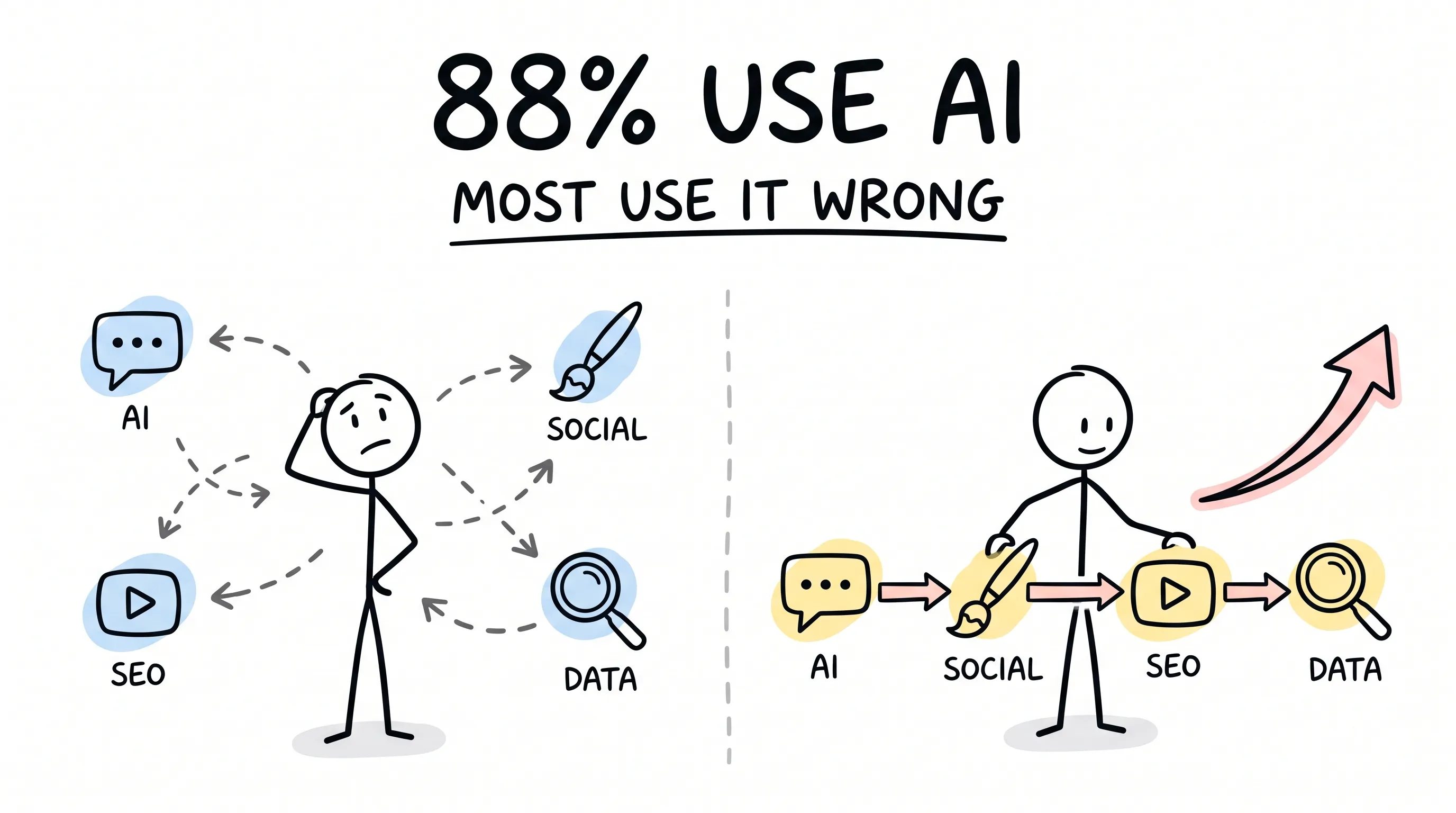
88% of Marketers Are Already Using AI. Most Teams Are Using It Wrong.
An overview of AI marketing tools, covering four tool categories, common adoption pitfalls like disconnected data, and how chaining tools into a workflow delivers more value than buying tools individually.
A few days ago, I had dinner with a friend who handles marketing at a consumer goods company.
We hadn't been seated for three minutes before he let out a sigh.
I asked what was wrong.
He said, "Man, this year we're spending more than double what we spent last year on AI tools. ChatGPT, Jasper, Midjourney, Runway, plus some data analytics platform whose name I can never remember. Everyone on the team uses them, and no one will admit they can't."
I said, that sounds great.
He said, great my foot. We're producing more content, but readership hasn't grown. We're launching ads faster, but conversions haven't risen. A dozen-plus tools sit there, each with its own data, none of it connecting to anything else.
Good grief. Isn't this the portrait of most marketing teams today?
More tools bought, less value delivered.
Why?
First, Let's Get the Terms Straight: What Are AI Marketing Tools?
So what are AI marketing tools?
Put simply: marketing software that uses artificial intelligence to do work for you, help you make judgments, and even make decisions on your behalf. Writing copy, generating images, editing video, finding keywords, monitoring data, answering customer service — all of it counts.
You might ask: how is this different from the marketing software of the past? There was plenty of marketing software (martech) before.
The difference is huge.
Traditional marketing software runs on "you set the rules, it executes." You build an automation flow: if a user opens the email and doesn't click the link, send the second email three days later. It follows the rule to the letter, and it would do so for a hundred years without wavering.
AI tools run on "it learns by itself." It looks at the data, spots the patterns, and adjusts on its own.
The difference shows up in four places.
Automation: hand off the numbingly repetitive work — building campaigns, pulling reports.
Personalization: it used to be one letter sent to ten thousand people; now you can write ten thousand letters for ten thousand people.
Prediction: will this user churn next month? Will this deal close? It gives you a rough answer first.
Generation: copy, images, video — on demand, instantly.
Put those four together, and the game of marketing changes.
Why Did This Suddenly Become So Urgent?
Because everyone is using it, and it's producing results.
Over the past year, several surveys of marketers worldwide have landed on nearly the same conclusion:
About 88% of marketers are already using AI tools. And 76% of them use them specifically to write content and produce copy.
93% say AI has made them faster at producing content.
75% say AI has given them a real competitive edge, especially in personalization, campaign optimization, and decision speed.
And here's a set of numbers I particularly like: many teams have seen marketing ROI improve by 5% to 15% after adopting AI.
Think about what that means.
It means "knowing how to use AI" stopped being a bonus long ago.
It's the passing grade.
When 93% of people say AI has made them faster, speed is no longer an advantage. When everyone is fast, being fast means you're standing still. So what's the competition about now? About who slows down less, and who goes deeper.
What Categories of Tools Are Actually Out There?
Open any AI tools ranking and you'll face a dense wall of dozens of names. Enough to make your head spin.
Don't panic. If you sort them out, there are only four big categories.
Category one: the makers.
Responsible for actually "creating" things. For writing copy, ChatGPT and Jasper lead the way; for images and video, Midjourney and Runway; plus those specializing in SEO content, helping you structure articles and lay in keywords. This is the most crowded category — and the most overrated. Because when everyone has them, everyone's output looks the same.
Category two: the finders.
Responsible for getting what you make in front of the right people. SEO tools help you dig up keywords and read the search results page; social media tools help you schedule, chase trends, and turn one piece of content into ten versions for ten platforms; email tools help you figure out which subject lines work and what time of day gets the highest open rate.
Category three: the data readers.
Responsible for telling you "is this working or not." Predictive analytics, audience segmentation, attribution models — they translate a pile of messy raw data into plain language. Chatbots belong somewhere near this category too: they handle customers while quietly accumulating data.
Category four: the connectors.
Marketing automation. The first three categories each do their own thing; this one connects them: how the workflow runs, how it plugs into your CRM, how the customer lifecycle is managed.
On its own, each category works. But the real value lives in that "connect" in category four.
More on that later.
How to Choose? Ignore the Feature Lists. Look at the Interfaces.
Many bosses pick tools by opening comparison articles, pulling up a feature checklist, and ticking boxes one by one.
Once the boxes are ticked and the tools are bought — then what? Then they lie quietly on the procurement list.
When choosing AI tools, features are never the first thing to look at. These are:
Can your budget buy back returns that match it?
Can your team size sustain the complexity of this stack? A five-person team running twenty tools isn't progress. It's suicide.
What is your actual use case? Content, analytics, or automation? Think it through before you act.
And the most important one: can it connect to the systems you already run?
Here's a number for you: 62% of teams get stuck on "the tools can't exchange data with each other."
62%.
Which means the pain point for most teams isn't "this tool's features aren't strong enough." It's "these tools don't recognize each other."
So my advice is one sentence: before choosing a tool, check whether it can talk to what you already have. If the interfaces don't connect, it doesn't matter how many features it has — it's decoration.
What's Actually Valuable: Chaining Tools into a Pipeline
At this point we can answer the opening question: why buy a pile of tools and see no improvement?
Because the tools are loose in bulk.
What's a workflow? It's taking those loose tools and wiring them into a line that runs on its own.
Here's an example.
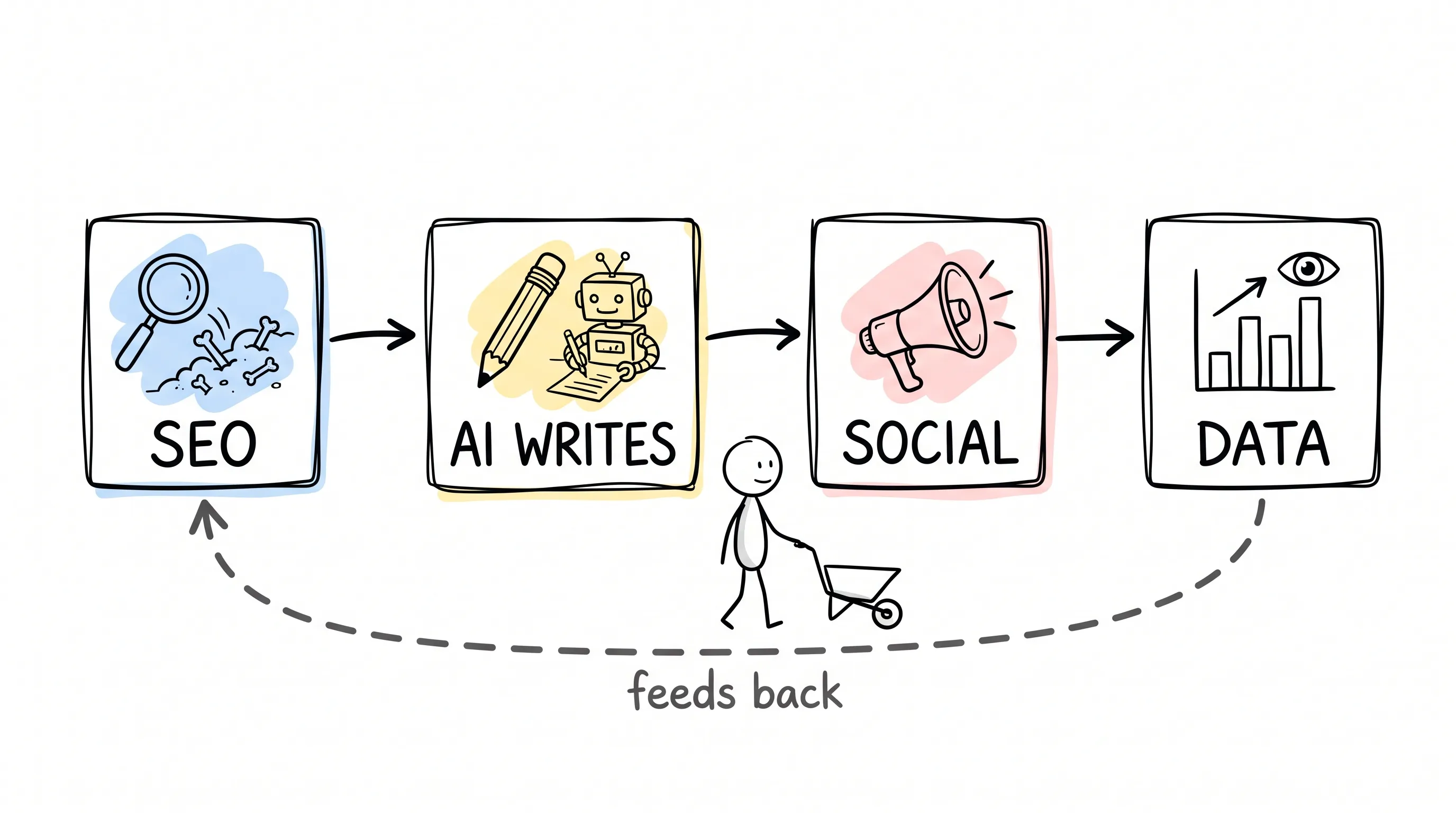
A typical content marketing cycle can now run like this: SEO tools dig first — what keyword opportunities are worth writing about this week? Found some. Hand them to generative AI for the first draft, the images, the assets. Then social media tools take over: scheduling, distribution, reformatting per platform. Once it's out, analytics tools watch the numbers — which piece performed, which flopped — and feed it back to guide the next round.
One line, running from "spotting the opportunity" to "optimizing the iteration."
Isn't this just a factory? Each standalone tool is a skilled worker. The workflow is the production line. Without the production line, it doesn't matter how many workers you hire — you have headcount, not capacity.
Many teams' AI transformation stops at "hired a roomful of workers."
So Where Are the Pitfalls? Three of Them.
First, data that doesn't flow. Covered earlier — 62% of teams are stuck here. However smart the AI, if you feed it fragmented data, you get fragmented insights out.
Second, using it too shallowly. One particularly striking finding in the research: nearly everyone uses AI, but very few teams have woven it into how they actually work. What do most teams use AI for? Touching up copy, brainstorming titles. It's like buying a machine tool and only using it to sharpen pencils.
Third, over-reliance. The more smoothly AI writes, the more everything starts to sound the same. You use the models everyone uses, feed on the data everyone has, write the angles everyone writes — why would readers remember you?
So in practice, whether this whole thing works usually comes down to how it's managed and how it's embedded into your processes. Anyone can buy the tools. The process is the moat.
One Step Further Ahead
So what happens next?
I believe the biggest change is this: AI will go from "assistant" to "operator."
Today's AI shows you the dashboard, and you press the buttons. Next-stage AI works like this: you set the goal, and it executes and adjusts on its own. You no longer stare at the backend every day; your only job is to say clearly what you want.
The second change: the boundaries between text, images, and video will blur completely. One campaign — copy, assets, and video generated in sync, tested in sync. The distance from idea to launch keeps shrinking.
The third change: personalization down to the "individual." It used to be by segment — a thousand people, one version. Going forward it adjusts in real time, and what each person sees was written for that one person alone.
The fourth change concerns you and me alike: AI search is changing how people "discover" things. When the answers come from AI, signals like a brand's share of voice and authority become more valuable than ever. The lines between SEO, content, and PR will keep blurring too.
Back to That Dinner
I saw that friend again recently.
He told me he cut three tools, then wired the remaining ones together: SEO finds the topics, AI writes the drafts, social media distributes, the data flows back. Four steps. It runs.
He said the number of tools didn't grow — it shrank — but the leads generated by content this quarter were up 30%.
See, the problem was never "not enough AI tools."
The real advantage isn't whether you use AI. It's how well you use it.
Teams that treat AI as infrastructure run faster and faster. Teams that treat it as a shortcut get left behind by the infrastructure.
Here's wishing your team gets out of the "buying tools" anxiety early, and into the solid ground of "building processes."
Continue reading
Related articles

It's 2026: Stop "Buying" AI Tools for Your Marketing Team — Start "Hiring" AI Agents
This learn article explains how AI agents differ from standalone AI tools in marketing, outlines three agent categories — build-your-own platforms, CRM-native agents, and vertical tools — and covers use cases across SEO, social media, advertising, and reporting, plus criteria for choosing one.

What Is GEO? How Your Brand Gets "Mentioned" in the Age of AI Search
An explainer on GEO (Generative Engine Optimization) for e-commerce and DTC brands: how it differs from SEO and AEO, why AI answers shape brand visibility, and eight practices covering question-focused content, consistent brand messaging, structured pages, external evidence, comparisons, and AI mention tracking.

AI Is Already Making Decisions for Your Customers. Are You on the List?
A learn article explains GEO (Generative Engine Optimization): why AI-generated answers now shape which brands customers see, and how SEO fundamentals, entity clarity, citable evidence, and monthly measurement affect visibility in AI answers.