
AI Marketing Daily · 2026-11-03
No new model launches today.
No new model launches today. Of the seven items in this briefing, four are surveys and data, three are about tools and platforms — and the throughline is singular: the money for AI marketing has arrived, but value realization and governance haven't caught up. CreatorIQ's annual report delivers record ROI benchmarks, while two data sets from HubSpot and SEO.com present the other side: only 1% of companies have recouped their generative AI investment. If you do just one thing today, audit both the AI tool stack your team runs on and your compliance processes.
🎯 Today's Headline
CreatorIQ Annual Study: Nearly Half of Brands See 3x-Plus Creator Marketing ROI, Bottleneck Shifts from Budget to Infrastructure
CreatorIQ has released its seventh annual Global State of Creator Marketing report, fielded by Sapio Research, surveying more than 2,000 brand and agency marketers across 17 industries and 9 countries (US, UK, France, Germany, Netherlands, South Korea, Italy, Saudi Arabia, UAE), with a margin of error of roughly 3 percentage points — first-tier sample size and continuity among industry surveys of this kind. The data shows creator marketing is now delivering: 48% of brands report 3x-or-better ROI, up from 37% last year; the share reporting 5x returns has doubled. Spending is scaling up in step: average annual budgets grew 33% year over year, and enterprise brands invest an average of $8.8 million a year, 28% more than the year before.
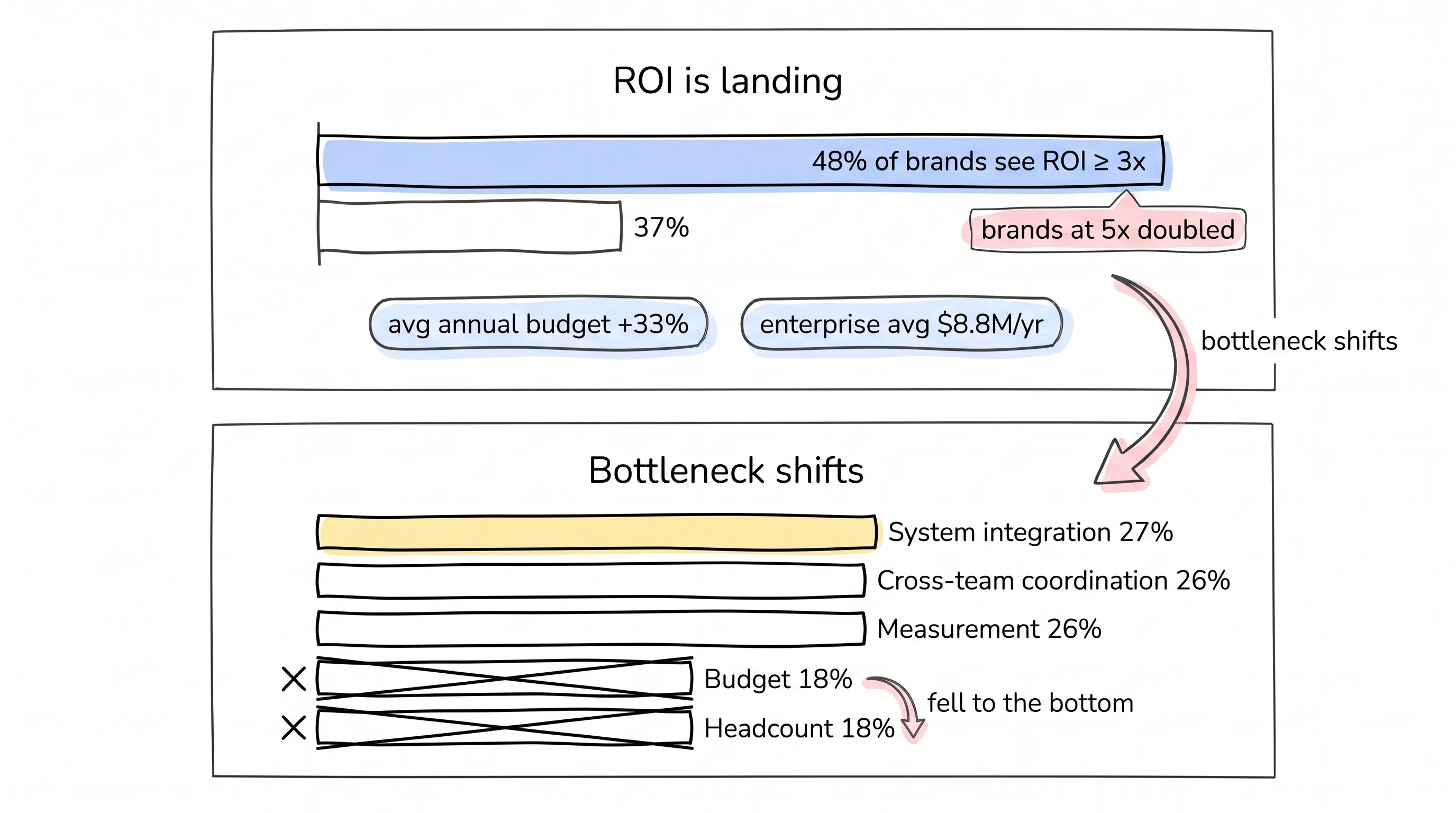
The shifting obstacle list carries its own signal. For years, the industry's number-one bottlenecks were budget and headcount; this year both fell to the bottom of the list, each cited by just 18% of brands. Topping it now is integrating creator marketing data and workflows across systems at 27%; cross-team coordination and measurement each came in at 26%. All three are operational challenges — the exact shape of the problems any mature channel eventually faces. In other words, the exam question for creator marketing has shifted from "should we invest?" to "how do we manage it at scale?" — the signature gear change of an industry entering maturity.
CEO Chris Harrington's read is that creator marketing has matured to the point where budget and headcount are no longer the constraints — infrastructure is. He added something blunter: trust has shifted from institutions to individuals, and the brands that moved first to capture that shift are scaling faster than they could build their own systems. Behind that line is a change in the industry's stage. When a channel is still proving itself, the contest is over who dares put money in; when nearly half of brands can report 3x returns, the contest is over whose systems run smoother. The winners treat creator marketing as a primary channel run with operational-grade management, turning trust into a repeatable growth engine rather than a string of one-off campaign bets. What does operational-grade management actually mean? Budgets have a consistent methodology, assets have a library, permissions have tiers, and performance has attribution — miss any one of the four, and scale turns into chaos.
Three data sets in the report are worth checking line by line against your own team. The first is about convergence: 92% of paid media practitioners already use creator content inside paid placements, and boosting creator posts with paid spend is the single highest-ROI move in the report — 38% of brands picked it. Yet budgets are also going independent: the share of incremental budget coming from paid media dropped from 64% last year to 52%, while net-new budget rose from 33% to 38%. Channels are converging; the ledgers are splitting apart.
The second is about AI's two faces. Among brands with budget growth, 41% say AI efficiency gains fed their budgets — nearly matching net-new budget as a funding source; but 45% say AI has made day-to-day operations more complex, against only 38% who find it simpler. And 44% of brands name AI-generated content, AI influencers, and missing disclosure as the biggest threat to trust in creator marketing.
The third is a portrait of the highest-return brands. Among 5x-ROI brands, 63% say AI has added complexity, versus just 42% of 1x-ROI brands; the former rate brand safety and risk management as a top priority at 73%, the latter at 57%. The best-performing brands' first task is driving efficiency across brands and regions, while the slower movers are still hunting for new creators. Complexity is a byproduct of scale — the winners build infrastructure for it rather than routing around it.
On to actions — three things you can start this week. Use this data as the benchmark for next year's budget pitch: your creator ROI may not hit 3x, but 48% of your peers are above it, and that's the most weighty comparison you can put in front of leadership when asking for incremental budget. If your returns are still in the 1x tier, the report also hands you a gap list — start with brand safety and risk management processes, which 73% of high-return brands treat as mandatory. Write system integration, not added headcount, into next year's top ask; when evaluating tools, prioritize whether they can connect data with your existing marketing systems, and straighten out your measurement methodology at the same time, since measurement still ties for the second-biggest obstacle at 26%. And if you're already running paid media but haven't systematically amplified creator content, fill in the boost step first — it's the single highest-return move in the report, it works creator assets you've already paid for, and its marginal cost is the lowest you'll find.
One last note on stance. This is CreatorIQ's own press release — it sells creator marketing infrastructure and serves more than 1,300 top brands and agencies, so the data naturally tilts toward the "you should buy a system" conclusion. Note the source's position whenever you cite it. But the directional finding is corroborated by another item in today's briefing: MarTech tools have surpassed 14,000 while utilization has fallen to 49% — the problem really is in how systems are used, not how many tools exist. The conclusion is credible; the independent verification before any purchase is not optional.
🔗 Further reading: Read the full article
🏷 Industry Data
HubSpot Survey: 91% of Marketing Teams Already Use AI; Three Barriers Stall at Privacy, Training, and Tool Sprawl
HubSpot's AI Trends for Marketers report on its blog draws on a survey of more than 1,000 marketing and advertising professionals worldwide, updated September 2026. The verdict: AI is past its experimental phase. 91% of marketing leaders confirm their teams use AI at work, 82% of marketers or their companies have purchased automation tools for staff, and 66% of organizations have built internal AI tools specifically for their marketing teams. Globally, 66% of marketers use AI on the job.
Adoption hasn't stalled, but the barriers sit in plain view. 42% of marketers hesitate to adopt new tools over data privacy concerns, 39% are stuck on the training and time investment, and 35% complain there are too many similar tools that don't talk to each other — adding one more only complicates the workflow another notch. On attitudes: 65% of marketers want AI kept as an assistive tool while warning others against over-reliance, since consistency and bias problems remain unsolved.
The usage details get more granular. Image and design generators (the DALL-E, Synthesia variety) rank first at 40% usage, chat assistants like ChatGPT, Gemini, and Copilot follow at 39%, and smart video/audio editing tools come third. By channel, email leads as the task marketers most often hand to AI at 50.77%, text-based social content sits at 50%, and long-form blog posts at 47%; all three channels show returns, with 67% of social users and 68% of long-form blog users reporting at least some positive ROI. Generative AI touches text content for 52% of users; broken down, 53% use it for content quality checks (spelling, accessibility, rewriting suggestions), 50% for first drafts of marketing copy, 48% for images, another 48% for market research and information synthesis, and 41% for automating DMs and conversational marketing. All told, marketers save 1 to 2 hours a day with AI. Yet only 4% let AI write entire pieces — most use it for inspiration and outlines. One number worth flagging: 46% are only half-confident in their ability to spot errors in AI output. At the organizational level, 50% of marketing leaders say their company supports employee AI use at least to some degree, 30% discourage it, and 20% simply have no policy; among leaders who have invested in AI, 75% report positive returns and only 4% negative ones. The forward-looking predictions round out the picture: 65% of marketing leaders plan to keep increasing AI and automation investment, 65% of marketing directors believe most software will have AI built in by 2030, and 67% of marketers believe that by 2030 most people will work with generative AI the way they now use search engines.
The regulatory map comes in three flavors. The US still has no federal AI legislation; the EU AI Act imposes hard constraints on transparency, bias, and high-risk applications; China requires companies to register AI models with the government. For multinationals, that means AI marketing practices that run fine in the US may be outright banned in other markets — locked out of major markets entirely. And even if you only do business in the US, don't celebrate early: consumers are pushing back. Coca-Cola's 2024 AI Christmas ad was lambasted by viewers as a creepy dystopian nightmare, criticized on both counts of rough visuals and sidestepping human creators. The report's fix is transparency — label AI-involved content outright, the way many media outlets note the degree of AI involvement at the top or bottom of a piece.
💬 Hold the 35% figure up as a mirror to your own tool stack: cutting the redundant tools that don't talk to each other saves more time than buying one more subscription. Multinational teams should split compliance strategy by market — run any AI content launching in the EU past the AI Act's disclosure requirements first. Don't force your way through on the consumer side; proactively label the degree of AI involvement. Spending on explanation up front is cheaper than PR cleanup afterward.
🔗 Further reading: Read the full article
SEO.com Stats Cheat Sheet: 88% of Marketers Use AI Daily, Only 1% Have Recouped Their GenAI Investment
SEO.com has compiled more than 50 AI marketing statistics, updated August 2026, each with its original source attached. Market size: AI in marketing reached $47.32 billion in 2025, is projected to top $107.5 billion by 2028, and carries a 36.6% CAGR from 2024 to 2030; the generative AI market overall stood at $62.75 billion in 2025 and is projected to hit $356.05 billion by 2030.
The starkest stretch of the whole compilation is how badly adoption and returns have decoupled. 88% of digital marketers use AI daily, and 92% of companies plan to invest in generative AI within three years — yet only 1% of companies have fully recouped their generative AI investment. The capability gap is the main culprit: 70% of marketers say their employer provides no generative AI training, 43% admit they don't know how to maximize AI's value, and 39% don't know how to use it safely. The execution layer is running ahead of the management layer: the number of employees handing at least a third of their workload to generative AI is three times higher among practitioners than among managers.
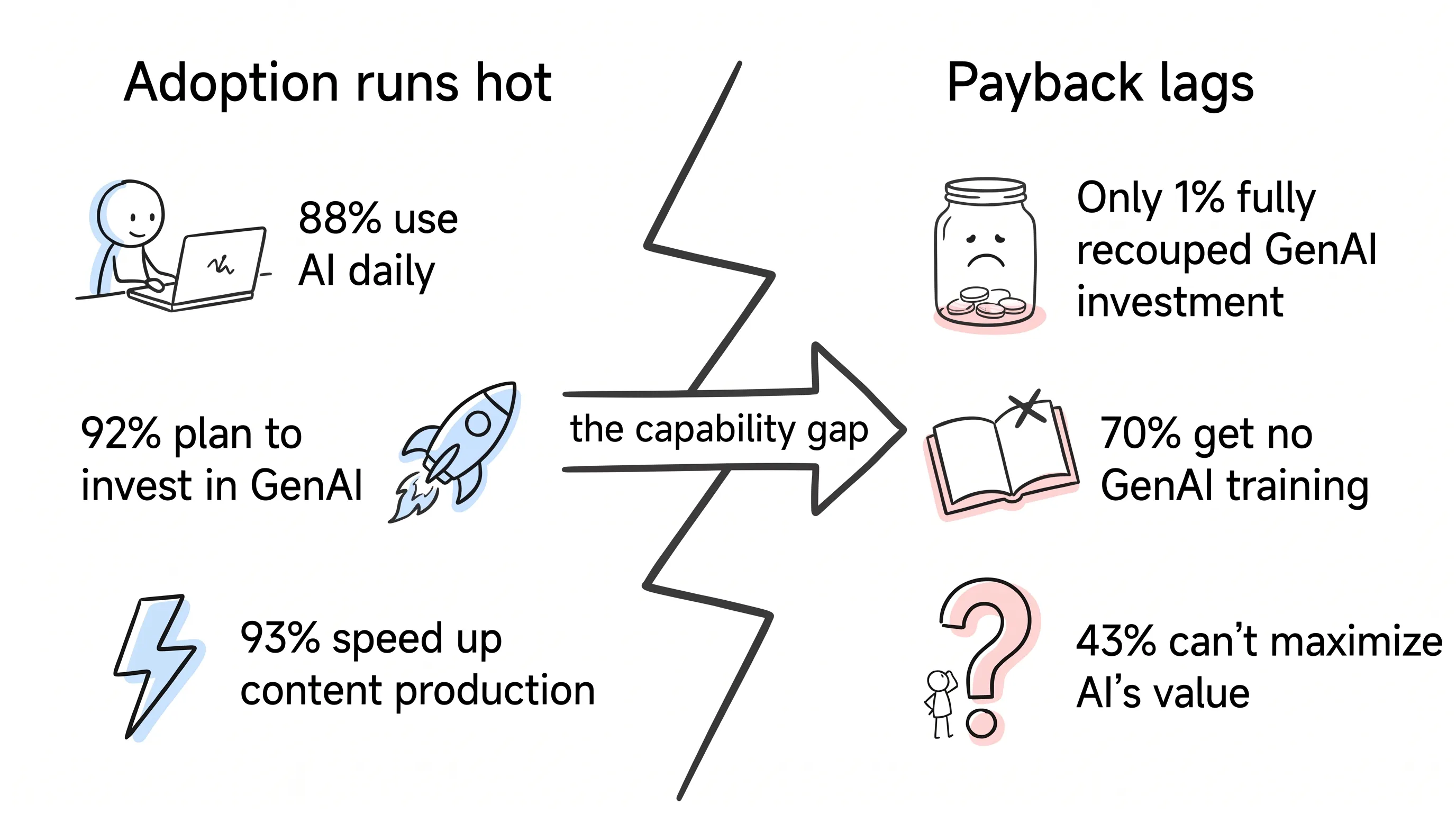
The performance numbers are just as strong: 93% use AI to speed up content production, 90% to accelerate decision-making, 81% credit AI with brand-awareness and sales lift, 83% say it frees up time for strategy and creative, 75% see lower costs, and 74% of US marketers say AI makes their work more enjoyable and helps them beat budget targets. On the risk side, 49.5% of companies harbor data privacy or ethics concerns, 43% are put off by AI content's inaccuracies and bias, 35% worry about cost, and 30% of US and European marketing and advertising professionals see generative AI as a risk to brand safety and a vector for misinformation. A few forecasts belong in next year's planning: Gartner expects 30% of outbound marketing messages from large organizations to be AI-generated, and 75% of employees' work to shift from production to strategic tasks; McKinsey reckons that by 2030 as much as 30% of work hours could be automated by AI, driving 12 million new occupational transitions, with low-wage roles hit 14 times harder than high-wage ones.
💬 The right way to use this cheat sheet is as an arsenal when writing proposals — but before citing, trace each figure back to the original source it attaches, and never forward secondhand numbers raw. The 1% payback stat has the most punch: put it on the table yourself in internal AI budget reviews, then follow with your training plan — far more credible than a growth story alone. Teams short on training should lead with the 70% figure to request dedicated budget from leadership; for the 43% who don't know how to get more out of AI, the fix is to distill internal use cases and prompt templates into a shared library — curate once, and the whole team benefits.
🔗 Further reading: Read the full article
🏷 Marketing Tools
Adobe Named a Gartner B2B Marketing Automation Leader for the 15th Straight Year; MCP Interfaces Become a Must-Have
On its official blog (October 27), Adobe announced its 15th consecutive year as a Leader in the Gartner Magic Quadrant for B2B marketing automation platforms, and used the report's lens to lay out five market shifts: agents are turning from assistants into teammates, with AI graduating from ghostwriting to goal-driven audience planning, journey building, and campaign tuning while humans keep approval rights; marketing platforms must be reachable from any AI surface, making direct connection of ChatGPT, Claude, and Copilot to the MAP via MCP servers a must-have; the unit of orchestration is shifting from the individual lead to the buying group; buyers are starting to discover vendors through AI answer engines; and Gartner's 2026 survey shows 59% of B2B CMOs rank effective AI integration as their top strategic priority.
Adobe's framing: the window buyers leave vendors for exerting influence is narrowing. By the time a buyer identifies themselves, the AI-assisted research is long done, opinions have hardened, and colleagues in the decision circle have already been pulled in. The cost of waiting keeps climbing, and marketing systems must be able to read everything known about the person, the account, and the whole buying group — then judge and execute the next step on their own.
On the product side there are two paths. Existing Marketo Engage customers can adopt Marketo Optimizer and Qualifier without buying a CDP: both run on the Marketo data foundation, using AI reasoning plus a continuously updated semantic story layer to orchestrate marketing, decide next-best actions, and pull lead, account, and buying-group journeys into one thread. Qualifier merges inbound lead qualification and outbound prospecting into a single agentic workflow, filling the stretch between demand generation and pipeline. Enterprises needing deep data unification, identity resolution, and multi-CRM support take the Journey Optimizer B2B plus Real-Time CDP B2B route, with the companion account intelligence dashboard flagging spiking accounts using first-party intent data.
Among already-shipped capabilities, the Marketo MCP Server deserves its own callout: it exposes more than 100 platform capabilities to Claude, ChatGPT, and Copilot while preserving existing permission governance, so teams can build agents that run workflows outside the Adobe ecosystem. There's also a built-in data governance agent, triggered by webhooks within smart campaign flow steps, that cleanses, enriches, and bot-filters leads before they enter nurture flows — alongside a workflow agent for campaign orchestration and a data agent handling program quality checks, lead imports, and data standardization. CX Enterprise Coworker lets teams build and maintain workflows and analyze data in Marketo using natural language. On the content side, the AI Assistant Content Accelerator generates email variants, images, and headlines in bulk, without training Azure OpenAI on customer data; the new email designer, embedded Adobe Express quick edits, dynamic conversations scored as warm or cold, automatic webinar-to-blog conversion, Salesforce sync monitoring, and ad-hoc reporting that's 5x faster on large data sets are all live as well.
💬 This is vendor content — verify the MQ conclusion against the original report before citing, but the market read is worth absorbing outright. On your next B2B tool evaluation, put MCP openness on the scoring sheet: platforms that connect directly to your existing Claude or ChatGPT workflows save you a layer of glue code and the maintenance hours that come with it. Existing Marketo users should trial Optimizer first — don't rush to buy a separate CDP just for orchestration; and switch on the data governance agent's bot filtering at the import stage right away, a free step that lifts the quality of your existing database a notch.
🔗 Further reading: Read the full article
Reddit List: 25 B2B AI Tools in Seven Categories — the Value Bottleneck Is Usage Strategy, Not Tools
A post on Reddit's r/MktgSupermarket organizes 25 B2B AI tools into a seven-category list, each with its differentiated positioning. CRM: HubSpot Breeze AI (AI embedded in an all-in-one CRM), Pipedrive AI (lightweight CRM with AI email drafting), Braze (enterprise multi-channel engagement). ABM: Demandbase (full-funnel ABM, 150M+ contacts), 6sense (500B+ intent signals monthly), Tofu (multi-channel ABM orchestration), Mutiny (website personalization for target accounts), Keyplay (ICP modeling). Sales intelligence: Clay (100+ data sources with AI enrichment), Cognism (GDPR-compliant verified contacts), Warmly (person-level visitor identification), Koala (free-tier intent data). Content: Jasper (brand voice at scale), ContentShake AI (Semrush data plus AI writing), Writesonic (dual SEO and GEO optimization), Averi, Copy.ai. Outbound: Instantly.ai (450M+ verified contacts), Intercom Fin (support bot with 13M+ conversations handled), Lavender (SDR email coach). Automation: Gumloop (no-code hookup of LLMs into your toolchain) and Zapier AI Actions (AI steps inside existing workflows). Emerging: UserLed, Valona, Postiv AI.
One credibility note: the author runs a marketing directory site and appends the site's link at the end of the post — this is traffic-driving content — but the list itself carries no commercial ties to the tools listed.
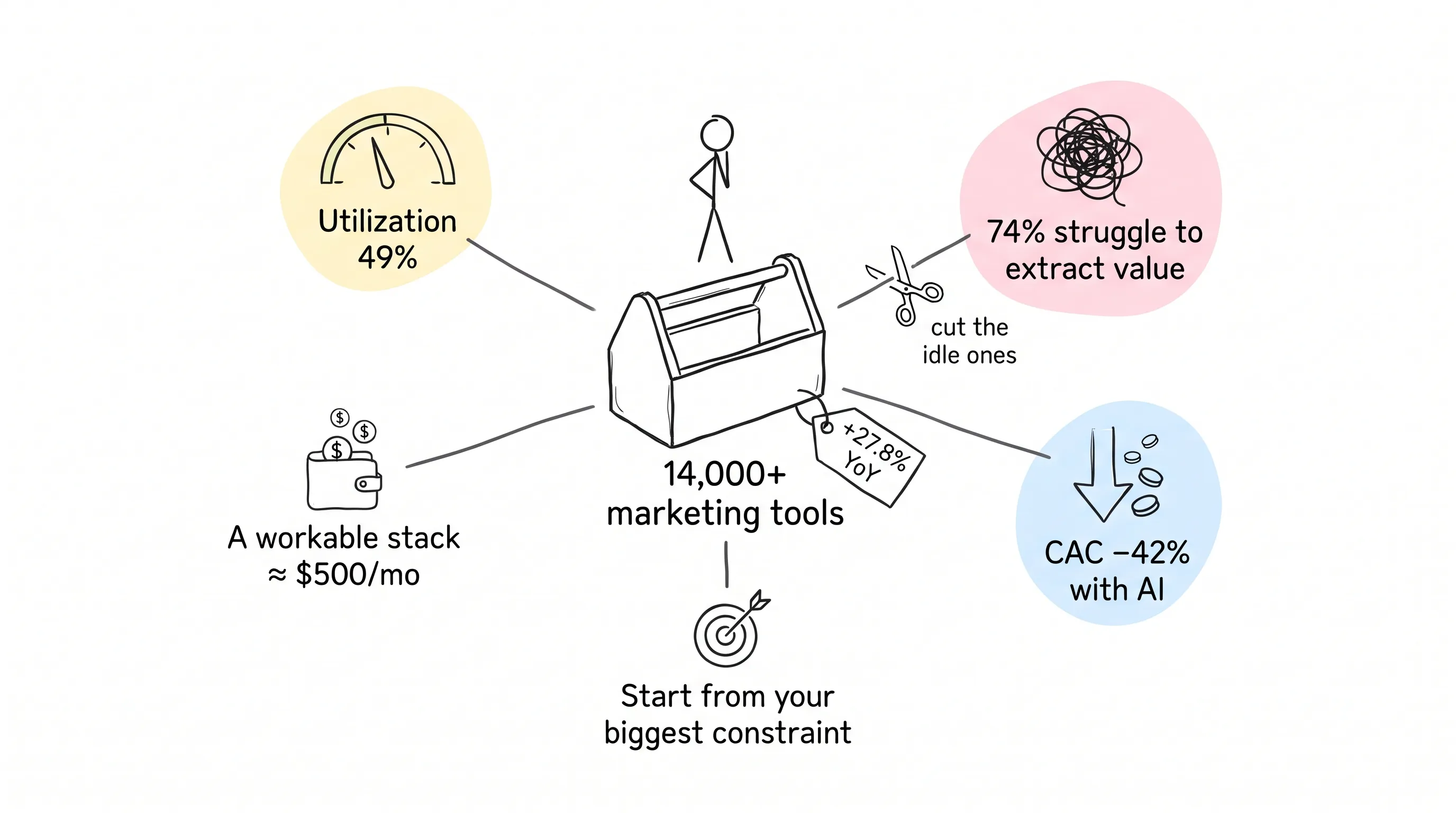
The background data is more informative than the list itself: MarTech tools have surpassed 14,000, up 27.8% year over year, while utilization has fallen to 49% — meaning half the paid tools sit idle. Companies using AI see customer acquisition costs averaging 42% lower, but 74% of companies struggle to extract real value from their AI investments. The author's selection advice is to start from your biggest constraint: lacking steady content, start with content tools; have content but can't identify in-market accounts, put money into intent data; poor conversion on sales conversations, then look at coaching and intelligence tools. A workable AI marketing stack can be assembled for $500 a month. GEO (optimization for AI search citations) is flagged as a major trend, with several content tools already optimizing for both traditional SEO and AI citations.
The comments section contributes one high-quality counterpoint: small teams shouldn't pick a best-of-breed tool in every category. Six or eight tools each doing their own thing with nobody stitching them together — the real bottleneck is execution time. Consolidate around a single execution platform: you sacrifice per-tool polish, but the manual shuffling you eliminate is the true source of ROI. The same commenter spends the latter half plugging their own agency's platform, but the argument itself holds.
💬 Read the comments before copying the list. For teams with monthly budgets under $20,000, rather than picking the best in each of seven categories, first calculate the total glue cost — the manual shuffling and breakpoints between tools are what eat the hours. Follow constraints-first in selection: this week, write down your single biggest constraint before deciding what to buy. GEO can go into next quarter's pilot; several tools already support it, and the trial-and-error cost is low.
🔗 Further reading: Read the full article
Zeta Launches Voice Marketing Agent Athena: Governance Built In — No Approval, No Launch
As covered by MarTech, Zeta Global unveiled at its Zeta Live! conference in New York a natural-language AI agent, "Athena by Zeta," which taps Zeta's data cloud and contextual intelligence through voice plus an adaptive interface — officially branded as superintelligent. VP of Product Roman Gun demoed a live conversation with Athena on stage, asking about marketing spend, performance, and recommendations, while the Zeta Marketing Platform dashboards shifted in step with each question; answers, decisions, and predictions appear directly in the working interface, eliminating the friction of toggling between reports and tools. It's the successor to ZOE, Zeta's first-generation assistant, which could handle natural-language dialogue but had no adaptive interface — Athena adapts to the user's goals, style, and decision-making habits.
The governance design is the part of this launch most worth studying: Athena ships with built-in safety mechanisms that respond to security challenges in real time and validate AI outputs, and nothing goes to production without guardrails and a marketer's approval. The agentic suite unveiled alongside it includes Zeta Answers (an intelligence framework that turns insights into action, built on proprietary data sets and an identity graph), the Agentic App Suite, Advisor (converts goals into AI plans and optimizes KPIs in real time), Workflows (multi-agent orchestration from data ingestion to campaign launch), Simulator (pre-launch cross-channel strategy forecasting and testing, with results aligned to attribution models), and Insights (conversational analytics). Zeta expects Athena to eventually coordinate multiple agents and evolve into an intelligent operating system for marketing.
💬 The launch is about a year old — past its shelf life as news, but valuable as a benchmark. Its governance design is worth copying outright: every AI output must clear human approval before going live, and outputs are validated before release — which speaks directly to the AI trust threat that 44% of brands in today's headline worry about. Check whether the AI features on your own platform have an approval gate; if not, add one this week. It costs far less than one public blowup.
🔗 Further reading: Read the full article
🏷 Compliance & Governance
A Tech Lawyer Maps AI Marketing Compliance: Up to $53,088 per Non-Compliant Email
Analytics Vidhya carries an AI marketing legal and compliance guide written by tech lawyer David Abraham, who likens AI's role in marketing to an intern: it can carry the heavy load, but it will break things. The regulatory map has three blocks. GDPR requires that when AI processes customer data you explain why it's used, how, and with which tools; users can demand deletion of their data at any time; violations carry fines up to €20 million or 4% of global revenue — and it applies whether or not the company is inside the EU, as long as it reaches EU consumer data, with California's CCPA as its US counterpart. CAN-SPAM governs commercial email: subject lines, headers, and body must be truthful, unsubscribe must take effect immediately, and you only send to those who have consented. Litmus's survey shows 34% of marketers write email copy with generative AI like ChatGPT — magnifying the risk of misleading subject lines and non-compliant content slipping into email, with fines up to $53,088 per violating message. The EU AI Act requires that customers be told when they're interacting with AI or synthetic media, covering generated images, cloned voices, deepfakes, and virtual influencers who don't exist in reality, with penalties on the same scale as GDPR and CAN-SPAM.
On ethics it offers three pillars. Inclusivity: bias in training data gets copied verbatim into ad and content output, triggering public backlash and even fines, and long-running violations call for retraining models, adjusting prompts, or switching to tools with stronger moderation. Bias elimination: bias comes from three layers — data, algorithms, and humans — and training on male-skewed ICP data will keep producing material aimed only at men; xAI's Grok being accused of carrying Musk's viewpoints into its answers is a case study in human bias. Transparency: disclose AI-generated content, explain why targeted ads are pushed at you — the deeper the AI involvement, the clearer the disclosure must be.
The four practical moves are where the money is. Get explicit consent: IAPP data shows 68% of consumers worry about online privacy and 57% see AI as a major threat; the baseline is spelling out AI uses on your privacy policy page, obtaining consent before collection, adding double confirmation before data is used, re-requesting consent periodically with an easy opt-out at any time — while making it simple for people to delete, or request deletion of, their own data. Use secure platforms: free tiers of ChatGPT, Perplexity, and Gemini have data-sharing terms on by default, so customer data can enter training sets and even surface in answers given to other users; the advice is to move to paid tiers with sharing disabled, or process marketing data in private environments like Snowflake. Before adopting any new tool, check its security white paper, privacy policy, and vendor reputation. Audit AI outputs regularly: stand up a content review group, write an AI usage SOP (spelling out which words are off-limits and which voice is non-negotiable), retrospectively review published content, and route new tools past legal before launch. Review regulatory updates quarterly — in Europe, watch GDPR and the EU AI Act first; in the US, mind state-level laws.
💬 The first two of the four practical moves can land this week: switch the free-tier LLMs your team is using to paid versions with data sharing off, and write AI usage into your privacy policy page. That 34% figure says your email almost certainly already has AI in the loop — add a manual subject-line review before sending, far cheaper than eating a $50,000-scale fine afterward. Put compliance on the calendar as a quarterly task; don't wait for something to break before you fix it.
🔗 Further reading: Read the full article
💡 Today's Big Picture
Set the seven items side by side and today's signals align: the money is flowing in, value is hard to realize, and governance is the gap.
The money is flowing in. In the CreatorIQ report, annual creator marketing spend is up 33%, and enterprise brands invest $8.8 million a year; the market sizing in SEO.com's compilation is compounding at 36.6% a year toward the hundred-billion mark. At the budget level, nobody asks anymore whether to use AI.
Value realization is another matter. Only 1% of companies have recouped their generative AI investment, MarTech utilization has slid to 49%, and 74% of companies can't extract real value from AI — three numbers pointing at the same conclusion: the input-output bottleneck sits in systems and usage, in tools that don't connect and training that never happened. CreatorIQ swapped the top obstacle from budget and headcount to system integration; HubSpot's 35% of respondents grumbling about tool sprawl describe the same thing. Different survey methodologies, and — unusually — the same conclusion.
Governance is today's most underrated thread. 44% of brands see AI content as the biggest threat to creator marketing trust, 42% of teams hesitate to adopt new tools over privacy concerns, and the regulatory map differs completely across the US, EU, and China. Zeta building approval gates into its product and Adobe baking governance agents into its workflows show vendors have started patching this layer for you — but policy, SOPs, and human review are your own house's work, and nobody can do them in your place. The oldest of the seven items (the compliance guide, published this past February) is actually the one to read first, because the fine figures are in force every single day.
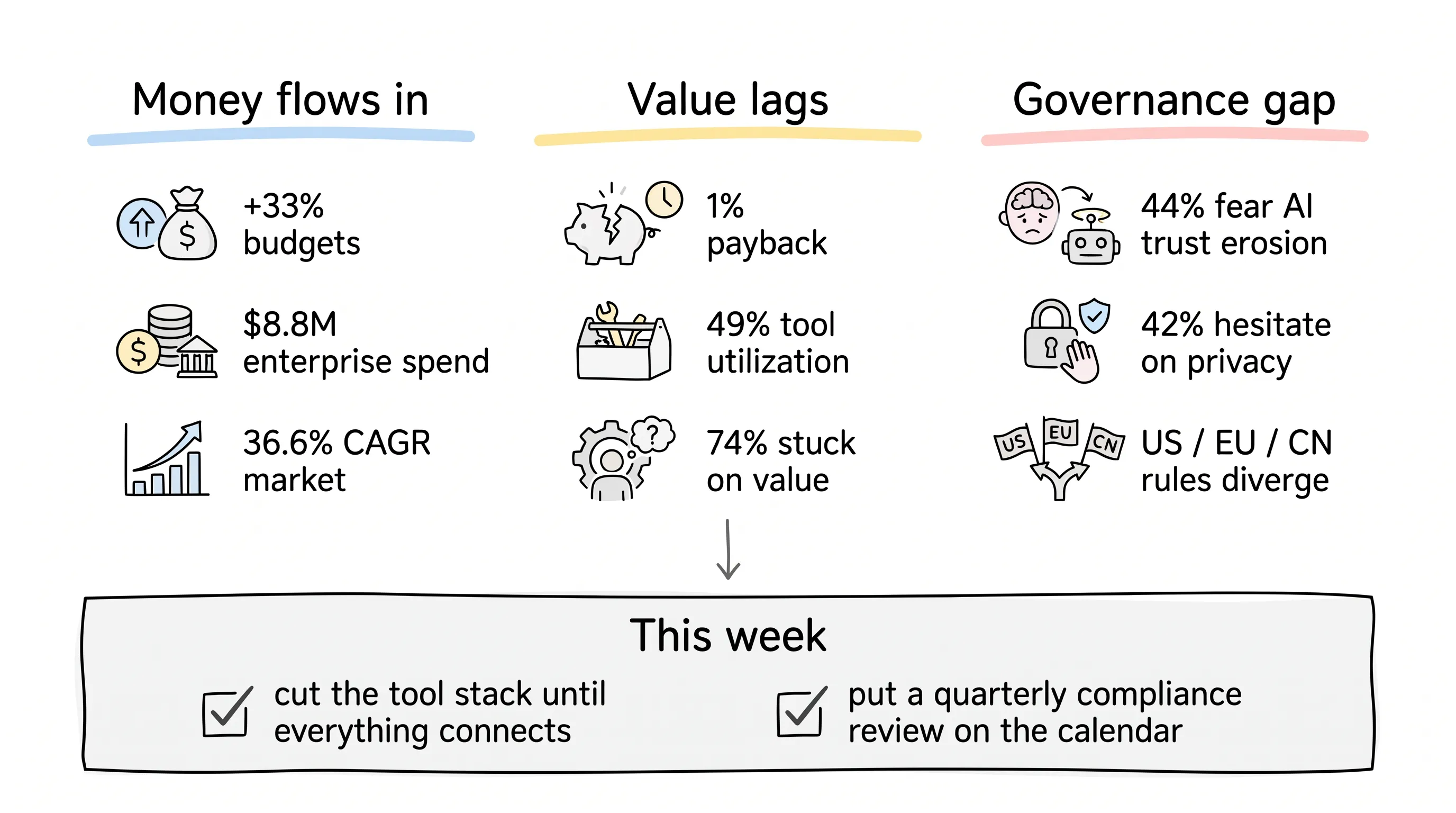
Down to one action: within the next week, finish two things — cut your tool stack down until everything connects, and put a quarterly compliance review on the calendar. The infrastructure race has begun; the teams that shore up governance first will pay one less round of tuition next year. One final note on how to read this: four of today's seven items are vendor or platform surveys of their own (CreatorIQ, HubSpot, SEO.com's compilation, Adobe) — directionally credible, methodologically biased. Before anything goes into a proposal, trace it back to the original report; never pass off a secondhand summary as evidence.
Continue reading
Related articles
AI Marketing Daily · 2026-10-31
Today's protagonist is measurement.
AI Marketing Daily · 2026-10-25
Daily briefing on nine AI marketing items: the IAB generative AI advertising playbook, a 16-vendor B2B selection list, Meta ads automation rollout guidance, cross-border TikTok and Amazon playbooks, and an academic study on AIGC localization, with cautions on unverified vendor-reported numbers.
AI Marketing Daily · 2026-10-19
Today's theme is doing the math.