
60% of Companies Now Use Generative AI — Yet 42% Are Killing Their Projects
A commentary on an October 2025 451 Research survey of 1,006 enterprise respondents, covering rapid generative AI adoption alongside rising project abandonment, and discussing hurdles such as budget, trust in accuracy, and skill shortages.
A few days ago, I was leafing through a report. I turned to one page and froze.
That page said this: how many companies have cut their AI initiatives off midway — most of them, gone.
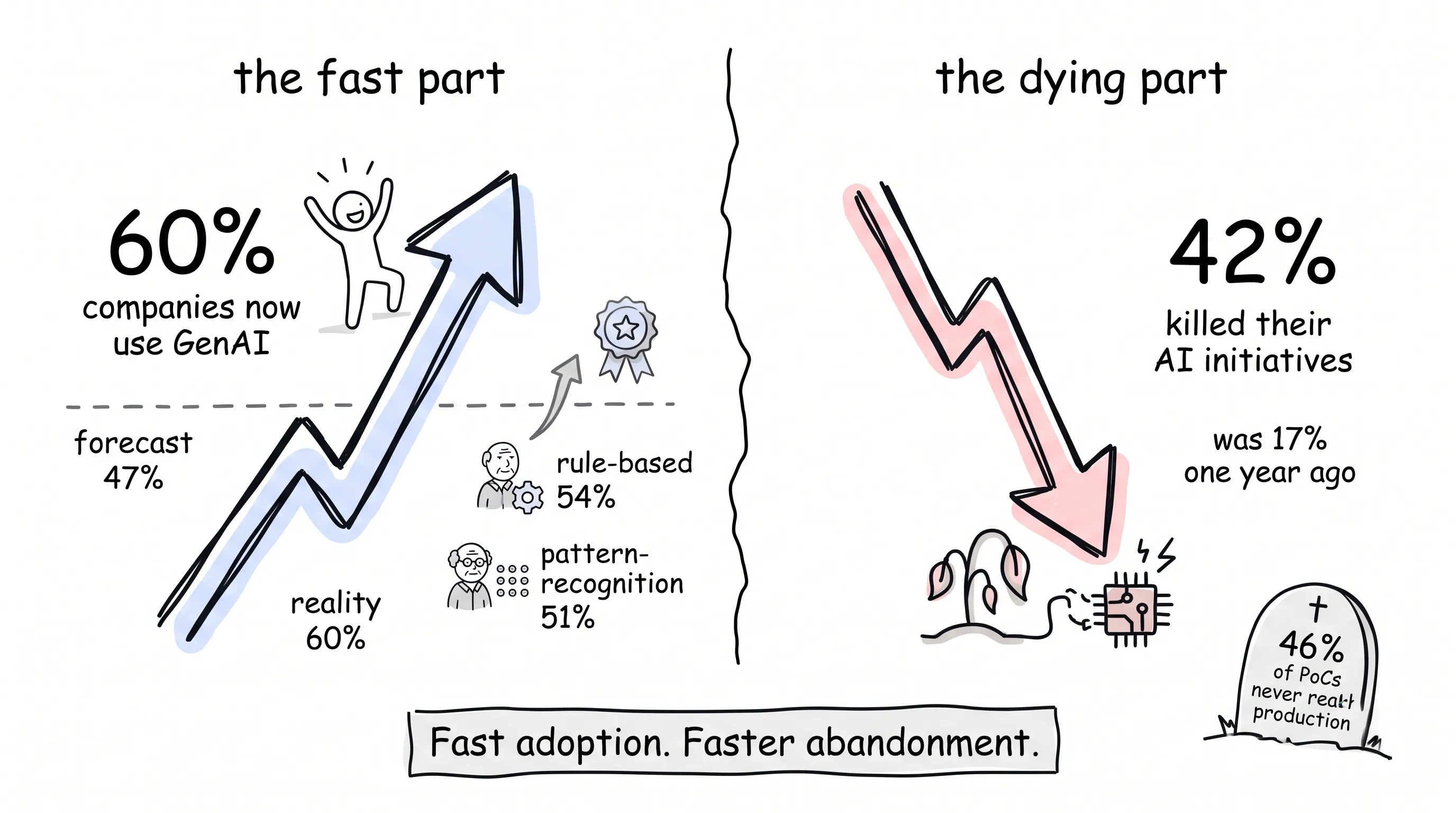
The answer was 42%. In the previous survey, that number was 17%.
In a little over a year, it has more than doubled.
The report comes from 451 Research, part of S&P Global Market Intelligence, published in October 2025, based on a survey of 1,006 enterprise respondents. It asks one question: what does generative AI actually look like inside companies today?
I finished it, and my feelings in two words: deeply conflicted.
On one side, AI is spreading faster than even the most optimistic forecasts. On the other, projects are dying faster than anything else.
And these two things are happening at the same time.
Let's take them one at a time.
First, the fast part. How fast?
Let me quiz you. Back in late 2023, a survey asked companies: by Q4 2024, what share of you expect to be using generative AI tools?
The companies answered: 47%.
Then, at the end of 2024, someone actually counted: 60%.
That's 13 percentage points over.
Keep in mind — this was the companies' own forecast, and these forecasts tend to be inflated; nobody wants to look like a laggard in front of the boss. Yet even the inflated forecast got overtaken by reality.
Now a comparison that's even more interesting. Meet the old guard of enterprise AI: rule-based models, used by 54% of organizations; pattern-recognition models, 51%. Among companies investing in AI, what's the deployment rate for generative AI?
60%.
A rookie that only went mainstream with ChatGPT in late 2022 has, in just over two years, overtaken both veterans.
Drilling into specific use cases: 63% of AI-adopting companies have pushed AI into IT operations, and 45% use it in customer experience processes. Marketing hasn't been idle either — compared with the previous survey, the share of marketing processes using AI rose 7 points.
Telecom is moving even faster. The share of telecom companies expecting to fully integrate generative AI into their organizations by the end of 2025 is up 18 percentage points from the year before. 51% of telecom companies plan to use AI-assisted coding, versus an all-industry average of 38%.
An IT manager in financial services said in an interview that the company made a sharp strategic turn and set up a brand-new AI team with one job: find the places in the business where money can be made, and shove AI into them.
Impressive.
Now, the dying part. How do they die?
If adoption is this fast, what's the cost?
Back to that opening number: 42% of companies have abandoned most of their AI initiatives. On average, 46% of each company's proof-of-concept projects never make it into production at all.
Build ten prototypes, and four and a half never make it.
Why does this happen?
Think about it. What was the mood in the industry in 2024? Everyone was terrified of falling behind. Vendors made sweeping promises: generative AI is transformative — adopt it or be left for dead. Executives couldn't sit still. Budgets got approved, teams got formed, tools got rolled out company-wide, and some companies went straight to pushing AI into customers' hands.
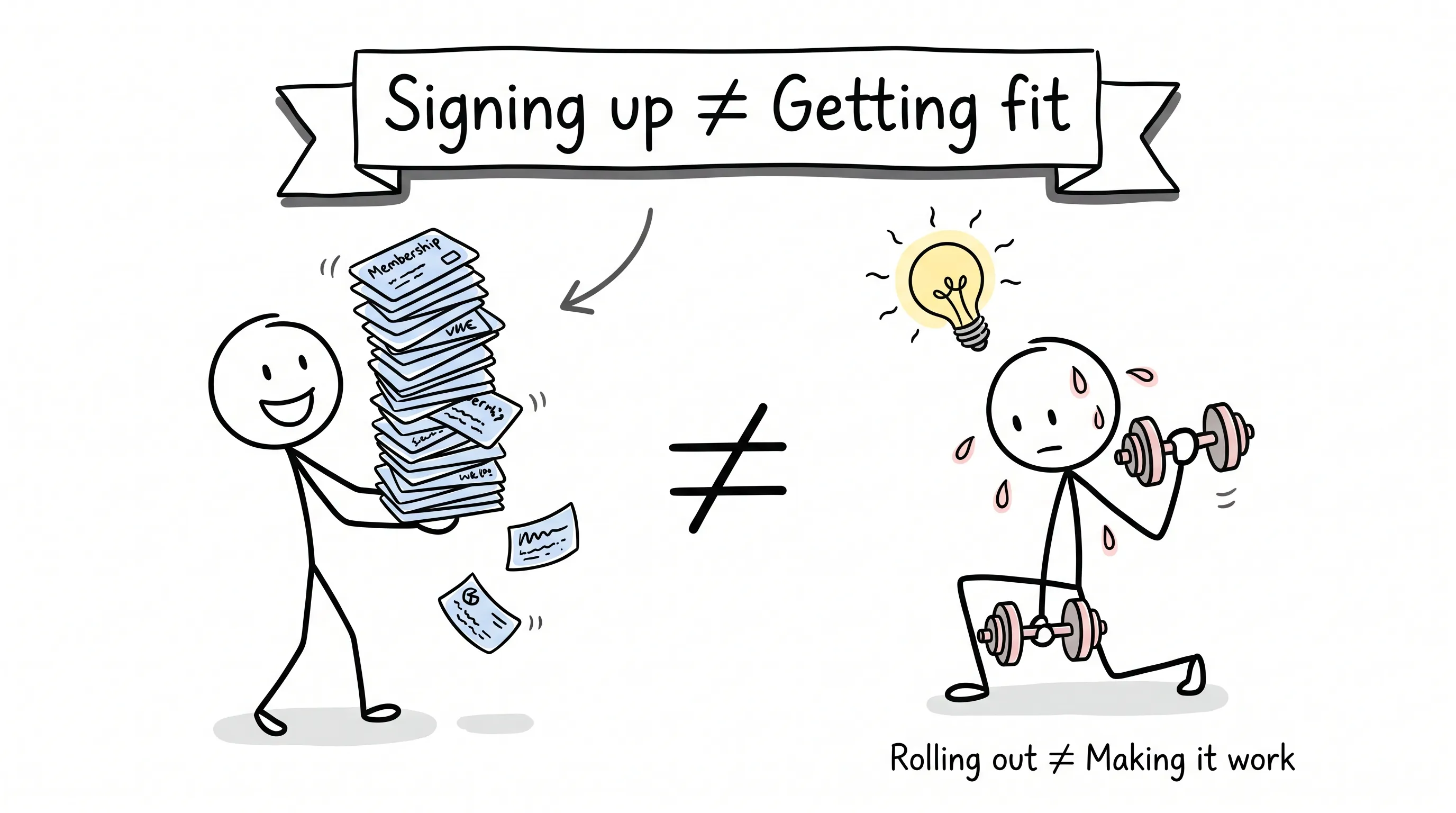
It's exactly like joining a gym.
The salesperson says: sign up, and you'll become a better you. So everyone rushes to sign up. But signing up and getting in shape are two different things.
Same with AI. Between rolling out the tools and running the value out of them lies a river. Plenty of companies swim halfway across before discovering they never learned to swim in the first place.
Where do companies with high failure rates go wrong? The report has a comparison I find especially worth reading.
Companies with below-average project failure rates consider an average of 4.9 factors when selecting AI projects: Is the data sufficient? Will compliance hold up? How big is the risk?... Those with above-average failure rates? Only 4.2. Those who check data availability: 54% of the first group, 42% of the second.
Just a few tenths of a factor's difference. But that sliver of difference is exactly what decides whether a project lives or dies.
And here's a counterintuitive finding: how fast you push a project has nothing to do with whether it succeeds. Push as hard as you like — urgency doesn't make projects succeed.
So what's the rush for?
One manufacturing respondent put it bluntly. His team spends every day hitting the brakes on AI targets handed down from executives, because the math doesn't work: you pay for an AI product whose returns are no better than free ChatGPT — how does that deal make sense?
There's another kind of resistance too. A software-industry executive said a good number of people in his company oppose AI with almost religious fervor — refusing to use it for writing code, refusing to add it to products.
Troubling.
And this resistance carries real costs. Companies with above-average failure rates are 77% more likely to list reputational damage as a concern, 41% more likely to cite customer resistance, and 36% more likely to cite employee resistance.
Put plainly, plenty of companies never got clear on two things: where AI should actually be used, and how to sell that value to the people expected to use it every day.
Tools were imposed, not planted. A pressed-down seed doesn't sprout.
Is value showing up? Yes — but unevenly
So the AI projects that are actually running — have they turned in a report card?
They have. But it's a strange-looking report card.
The good news first. Among companies using generative AI, 47% say it created tangible value over the past 12 months by "making data" — that is, generating synthetic data for testing, analysis, and training. Beyond that, more than a third of companies have also tasted real gains in data visualization, process automation, content summarization, content creation, customer interaction, employee training, and code assistance.
On average, each company is seeing value in 5 areas.
Now the other side of the ledger — and this one stings.
Of 7 enterprise goals — operational efficiency, customer satisfaction, employee satisfaction, revenue growth, cost management, risk management, sustainability — 46% of companies say: not a single one of those goals has seen a "strong positive impact" from generative AI.
Those getting strong positive impact on most of the goals: just 19%.
And the trend line is heading down. The share of companies acknowledging generative AI's positive impact is falling across every metric: revenue growth, 76%, down from 81% last round; cost management, 74% versus 79%; risk management, 70% versus 74%.
By all rights, this shouldn't be happening. Conventional wisdom says the longer you run a technology, the better you know it — moving from experiment to production should get smoother and smoother.
Instead, it's going backward.
And the KPI picture is more conflicted still. Companies are measuring more KPIs than ever — measurement rates for metrics like risk exposure, model accuracy, and process efficiency all rose more than 6 points in a year. But more measurement isn't buying better results. On metrics like risk exposure, fewer companies now rate their projects "very successful." On revenue impact, system availability, project cost, and energy consumption, performance is actually deteriorating.
So where's the problem?
My own read comes down to a phrase: broad but shallow.
Generative AI is a generalist — it can get a foot in every door, which makes it look valuable everywhere. But valuable everywhere usually means barely valuable anywhere. For most companies, what's missing isn't more use cases; it's the resolve to slam their weight onto the few scenarios that truly matter.
Three hurdles
The report ranks the difficulties companies face. The top two are tied at 29%: not enough budget, and not trusting AI's accuracy.
The budget hurdle ranked only fourth in the previous survey; this round it sprinted to the top. Why? Because the moment you move from pilot to scale, software costs, hardware costs, and electricity bills all come out of hiding. Money flows out, results stay murky, and the ledger gets harder and harder to read.
The trust hurdle runs deeper.
Generative AI is a probabilistic model. The birth defect of a probabilistic model is this: it states things with total confidence, and you have no idea which parts are true. The share of respondents who distrust AI predictions, or trust them only grudgingly, is higher than it was back in 2023.
One detail I find fascinating: precisely because they don't quite trust probabilistic models, companies are turning back to rule-based AI — the old-school AI that runs on pre-written rules and logic, rigid in structure, but able to explain every step it takes. 36% of respondents believe rule-based AI will be fully integrated into their organizations within 12 months. Fully integrated today: just 20%.
Well, well. The new AI has just sent the old AI back to the exam hall.
A mid-level manager in retail said their due diligence today is more rigorous than on any project they've ever run, for one reason only: the sheer terror of confidential data leaking out through AI.
The third hurdle is people.
How bad is the talent shortage? One in five companies says cybersecurity skill shortages directly caused project cancellations or failures; 32% say it forced them to cut project scope, stretch timelines, and shrink value delivered. More than three-quarters of companies admit they're short-staffed across the board — from end users and data governance to cloud infrastructure, software development, and machine learning.
The tools change daily, and what people know can't keep up. That's the widest gap of the moment.
One software-industry respondent said: executives want AI to write code directly, but 30% of what AI writes is wrong. "We're not at that level of maturity yet."
From "have it" to "can do it"
In 2024, the fashionable line was that the world had split into two kinds of companies: the "haves" who used AI, and the "have-nots" who hadn't boarded. Executives fought desperately to squeeze into the first camp.
Now the story has changed.
Getting on the bus is only the first gate. The real dividing line has become "can or cannot": can you actually make AI produce value? The winners are "can"; the losers are "cannot."
451 Research has a companion piece, studying what the "can" companies did right. This one is about where the "cannot" companies got stuck.
Stuck where? Cost, privacy, trust, skills, user resistance — and the most fundamental one of all: never figuring out where AI should be used in the first place.
The report's judgment about what comes next strikes me as clear-eyed: the sales pitch for generative AI needs a rewrite. No more big words like "disruption" and "revolution." Talk real return on investment; talk cases that actually ran in concrete scenarios. The technology itself is heading toward "specialization" — no longer expecting one big model to conquer the world, but building small, precise models for specific tasks and specific workflows, embedding them into applications and data. Only then do the numbers finally add up.
And yet, for all these hurdles, decision-makers say they'll keep pushing forward over the next 12 months.
Why?
Because there's no way back on this one. The tools are already here. Your competitors are already here. Your customers are already being served by AI. Stopping is the biggest risk of all.
Finally
After finishing this report, I kept coming back to that gym analogy.
The ones signing up will always outnumber the ones getting fit. But you can't conclude from that that gyms are worthless. Signing up for more cards doesn't help; you have to be clear about what to train, how to train, and how many times a week.
Same with AI.
Rolling it out is not the win. Making it work is.
Here's hoping you not only sign up — but actually get fit.
Continue reading
Related articles

What Is an AI Marketing Agent? From "Using AI" to "Delegating to AI"
A learn article explaining what an AI marketing agent is, how it differs from rule-based automation, and which repetitive tasks such as lead qualification, reporting, and campaign monitoring can be delegated while humans keep key decisions.

Marketing Automation Is Shifting from "You Do It" to "You Say It"
This article explains how marketing automation is shifting from rule-based platforms that merely execute toward AI agents that plan, create, publish, and review campaigns, covering delegable tasks, underlying technologies, tool categories, adoption steps, and risks such as privacy and automating without strategy.

When AI Does the Creative, Mistakes Come in Batches Too
A learn article on the risks of using generative AI for marketing creative across brand, legal, compliance, and operational layers, with case examples and seven practices for review, rights clearance, documentation, and vendor governance.