
No One Is Linking to You, and AI Has Already Remembered You
A learn article on how AI-driven search shifts brand visibility from backlinks to third-party mentions in communities like Reddit and Quora, why AI trusts external references over self-promotion, and three steps: audit mentions, answer community questions, and restructure site content for AI readability.
A few days ago, I was going through a search-industry statistics report when two numbers stopped me cold.
In the period starting mid-2023, traffic to Reddit rose 603%. Quora rose 379%.
Think about what that means. A forum and a Q&A community, growing like that — while plenty of company websites that had carefully done their SEO were actually losing traffic.
Why? Because the place where people ask questions has changed.
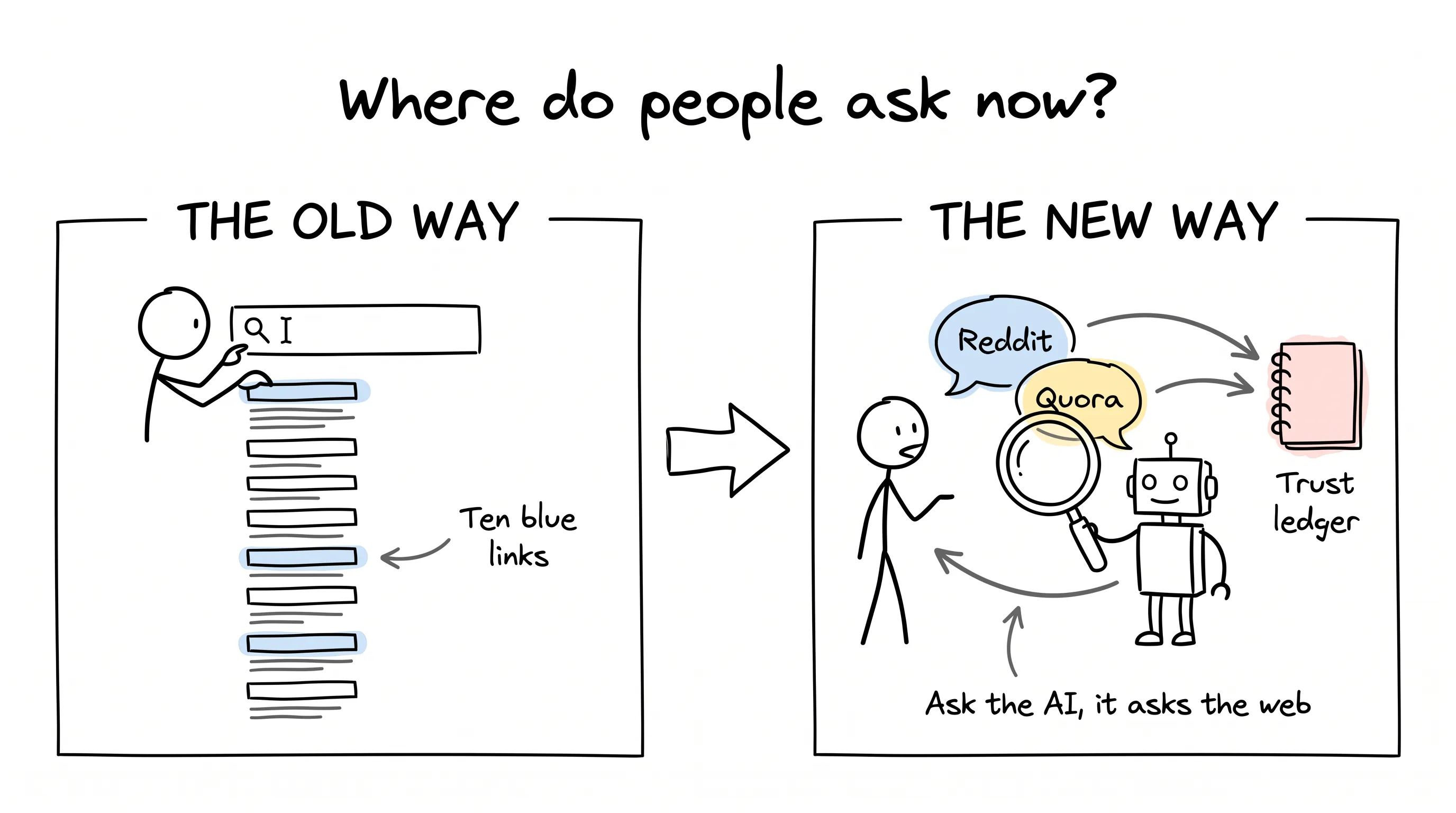
It used to be: you had a question, you went to a search engine, typed in a keyword, and paged through ten blue links. Now, when you have a question, you just ask an AI. ChatGPT, Perplexity, Google's AI Overviews. And before an AI can answer you, it first has to ask around the whole web: how do people actually answer this question?
And the places it asks around in most are the communities with real conversations.
So here's the question: when the AI finishes its rounds, whose name is it repeating?
That's something everyone in marketing should think through carefully.
AI Picks Winners Like an Old Accountant Auditing the Books
Let me give you an analogy.
AI chooses content the way a very cautious old accountant does. Being loud cuts no ice with him; he only accepts receipts. And what are the receipts? They're how people across the web talk about you.
Your website copy was written by you — of course you'd sing your own praises. An answer from a stranger on Reddit, a disinterested share on Quora — those are third-party testimony. You say you're reliable, and the old accountant puts a question mark next to it. Ten unrelated people all say you're reliable, and he writes it into the books.
That explains those two numbers. To answer questions, what AI needs most is real conversations. And who holds the largest stockpile of real conversations? Forums and Q&A communities. So content from Reddit and Quora got crawled in bulk, and their traffic surged.
To put it plainly: in the eyes of AI, one mention from someone else is worth ten of your own boasts.
Even a Passing Mention Counts
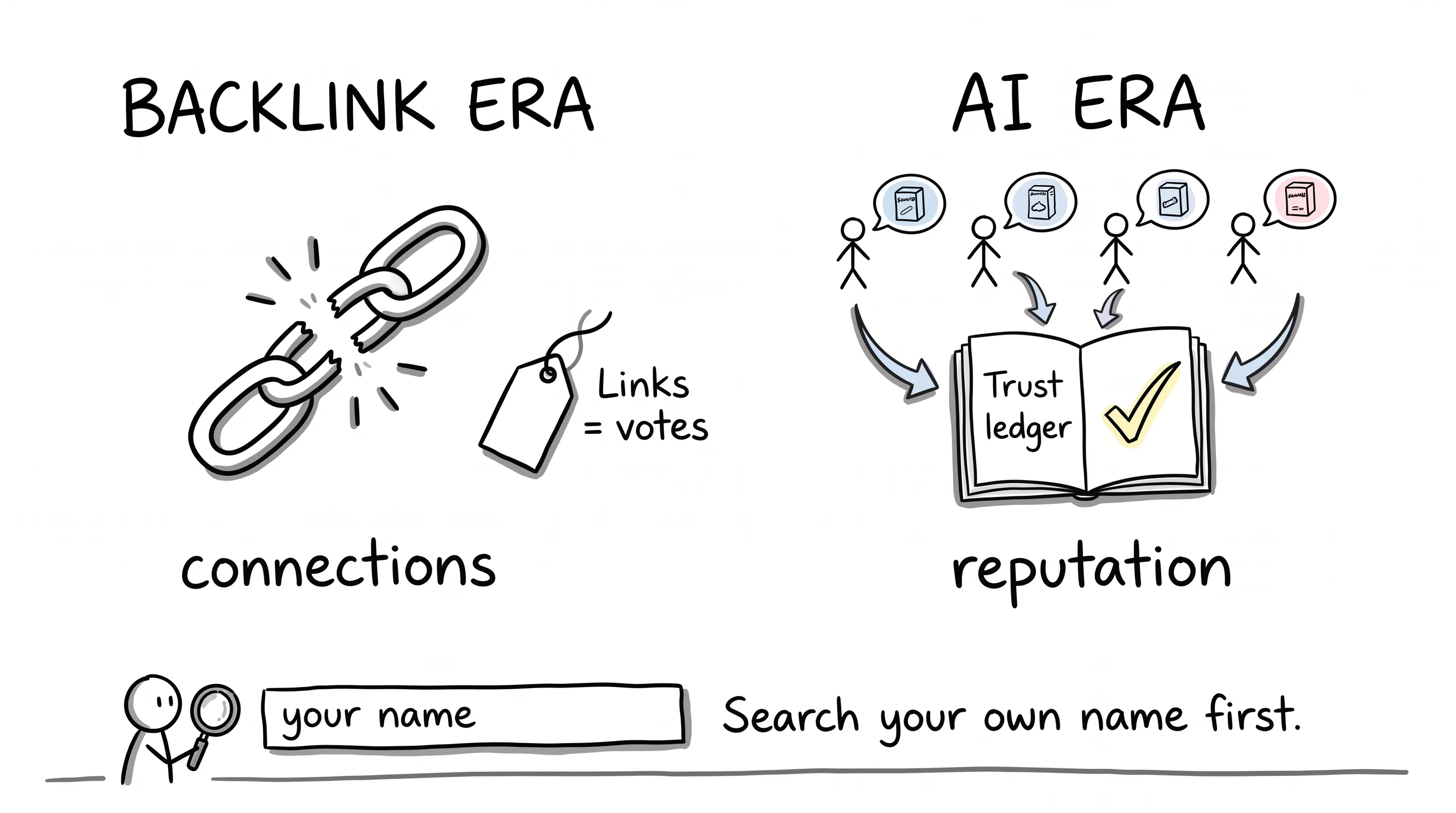
SEO used to be all about backlinks. When another site linked to you, that counted as one vote. No links, nothing else you did mattered.
The game has changed. When AI keeps your books, it doesn't look at whether you have links. A commenter in a community mentions your product name in passing, without linking anywhere — it still gets recorded in the AI's trust ledger.
Is that a good thing or a bad thing? I'd say a very good thing. Links take negotiation, exchange, money. Being mentioned has a far lower bar. A small company can't afford media placements, but if it earnestly answers a hundred professional questions, it can build a reputation all the same.
The backlink era rewarded connections. The AI era rewards reputation.
That said, look at the other side, and this cuts both ways: when people say bad things about you, that counts too.
So the first thing to do is remarkably plain: go search for your own name and your product names — in search engines and across the communities. See who's mentioning you, whether it's praise or criticism, and whether what they say is accurate. Find something negative, deal with it promptly. This step costs nothing, yet the overwhelming majority of companies have never done it.
Two Cases With Numbers That Actually Add Up
Talking through the logic isn't enough, so let me show you two real ledgers.
A translation company called Geneva Worldwide, which provides video remote interpreting, didn't try to do everything at once. They focused on a single key page, rewrote the content so it was clearly structured and readable by both humans and AI, then fine-tuned it bit by bit to match how AI summarizes information. The result: their exposure in AI summaries went up, and so did inquiries from potential clients.
Another team, The Search Initiative, ran a program for an industrial client. Three steps: first, put monitoring on AI-channel traffic to establish the baseline; second, add structured data and reshape the content so AI could easily cite it; third, expand the content across every format — text, images, and video. The result: traffic from AI channels grew by roughly 2,300%, and the client landed rankings for about 90 AI-summary keywords.
2,300% — think about that. Twenty-three times over. Back in the SEO days, a 20% gain in a year was reason to pop the champagne.
My first reaction to numbers like these: impressive! My second reaction: this window won't stay open forever.
Three Things You Can Do Right Now
-
Audit your own reputation. Search for your name, log every place you're mentioned, and record the good and the bad alike.
-
Pick one or two communities you genuinely understand, and answer questions there in earnest. Note: answer questions, don't post ads. Ads get deleted; expert answers get picked up by AI.
-
Restructure your website content so it's easy to lift and reuse. Bullet points, short paragraphs, common Q&As front and center. AI breaks down content differently than humans read it — it likes information with clean edges.
None of these three things is hard. What's hard is starting today.
In Closing
Back to those two numbers at the start: 603%, 379%.
Where did the traffic go? To the places with real conversations. What does AI trust? The sum of everywhere a brand has been seriously mentioned across the web.
We used to say reputation is a slow variable — you can't rush it. Now AI has turned it into a fast variable: every sincere answer you've accumulated may be relayed, word for word, to a customer the moment they ask an AI.
The algorithms keep changing. Trustworthiness never has.
Here's to you being the name that AI, after asking around, comes back with — the one it calls "reliable."
Continue reading
Related articles

It's 2026: Stop "Buying" AI Tools for Your Marketing Team — Start "Hiring" AI Agents
This learn article explains how AI agents differ from standalone AI tools in marketing, outlines three agent categories — build-your-own platforms, CRM-native agents, and vertical tools — and covers use cases across SEO, social media, advertising, and reporting, plus criteria for choosing one.

What Is GEO? How Your Brand Gets "Mentioned" in the Age of AI Search
An explainer on GEO (Generative Engine Optimization) for e-commerce and DTC brands: how it differs from SEO and AEO, why AI answers shape brand visibility, and eight practices covering question-focused content, consistent brand messaging, structured pages, external evidence, comparisons, and AI mention tracking.

AI Is Already Making Decisions for Your Customers. Are You on the List?
A learn article explains GEO (Generative Engine Optimization): why AI-generated answers now shape which brands customers see, and how SEO fundamentals, entity clarity, citable evidence, and monthly measurement affect visibility in AI answers.