
AI Marketing Daily · 2026-11-12
AI Marketing Daily for 2026-11-12 rounds up 12 items: a MarTech headline on platform attribution vs incrementality testing for paid-channel budgets, a composable martech roundtable, AI influencer discovery and regulation news, and a GEO-vs-SEO debate, with cautions on older sources and vendor-claimed figures.
The two items worth your time today both come from MarTech: one explains why platform attribution sends budget toward phantom efficiency — down to the exact numbers for setting thresholds — and the other delivers the composable martech consensus on hybrid architecture, with four principles you can copy straight into an internal checklist. The influencer beat is lively today: AI-powered creator discovery, French legislation, and an Accenture acquisition, three stories that together sketch where regulation and capital are heading in this space. Twelve items in all today, with a few older pieces mixed into the pool — I've marked the years, so check the labels before you cite anything.
🎯 Today's Headline
Platform attribution is crediting phantom efficiency: incremental testing plus AI can show where every dollar of budget actually goes
On November 11, MarTech ran a commissioned piece by growth lead Efe Uduigwomen, who currently heads international user growth at Inkitt, previously did growth marketing at Remitly, and specializes in experimentation, measurement, and AI-augmented strategy. The article takes aim at the two metrics every media-buying team lives by: CAC and ROAS. They only record conversions that happen after an ad runs, and never ask how many of those conversions would have happened anyway. Channels that hug the point of sale — branded search, retargeting, some affiliate programs — post beautiful low CACs on the dashboard, but most of what they capture is existing demand; meanwhile, the channels that look expensive may be reaching new customers who would never have found you otherwise. The author offers an everyday scenario: branded search reports a $15 CAC and paid social reports $60, and the dashboard makes the choice look obvious — but if brand-term searchers were already on their way to checkout, the true acquisition cost of the former could be several times higher. He also cites a case he lived through: two channels looked nearly identical in the performance report, yet once their incremental impact was measured, they called for completely opposite budget decisions.
On the numbers, the author lays out two contrasts pointing in opposite directions. One branded-search incrementality test showed that cutting roughly ninety percent of the spend barely dented new-customer acquisition — after the pause, organic search absorbed the demand, meaning the ads were actually cannibalizing the brand's own free traffic. A Google conversion-lift study on non-brand search, by contrast, measured 55% incremental conversions — evidence strong enough to justify accepting a higher CAC and spending more. Two subtypes of the same channel delivering opposite verdicts is precisely the point: efficiency numbers alone can't answer the budget question. The article lays out the difference between the two measurement approaches in a comparison table: platform attribution records the conversions that follow an ad, inherently giving credit to channels close to the sale, and its main risk is booking demand that would have converted anyway as ad-driven wins; incrementality testing measures the conversions the ad actually caused, at the cost of requiring careful test design and enough volume before a result can be read. The decision metric changes accordingly, from CAC and ROAS to incremental CAC. And branded search isn't forever increment-free: when competitors bid on your brand terms, defensive spending still has value.
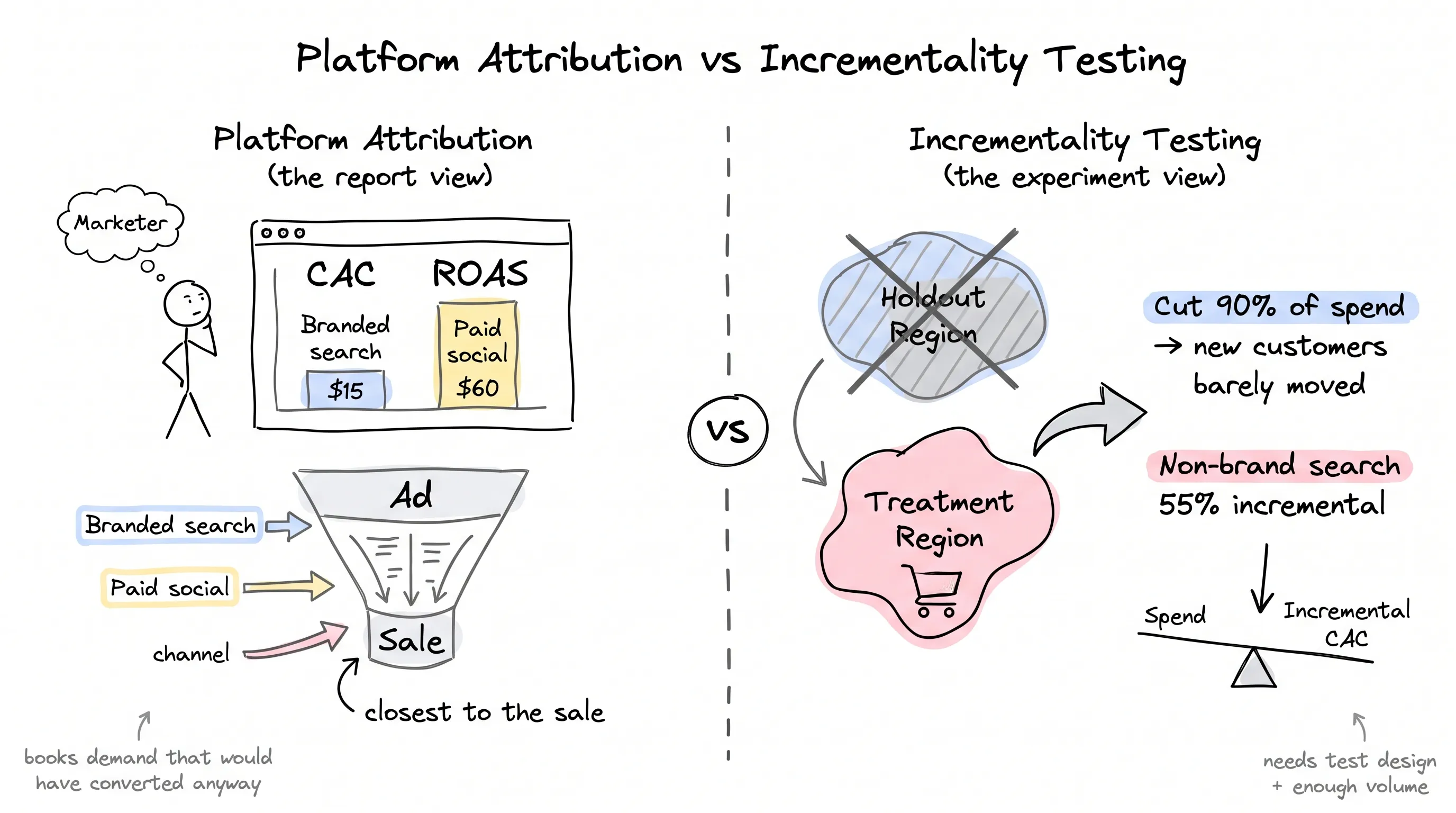
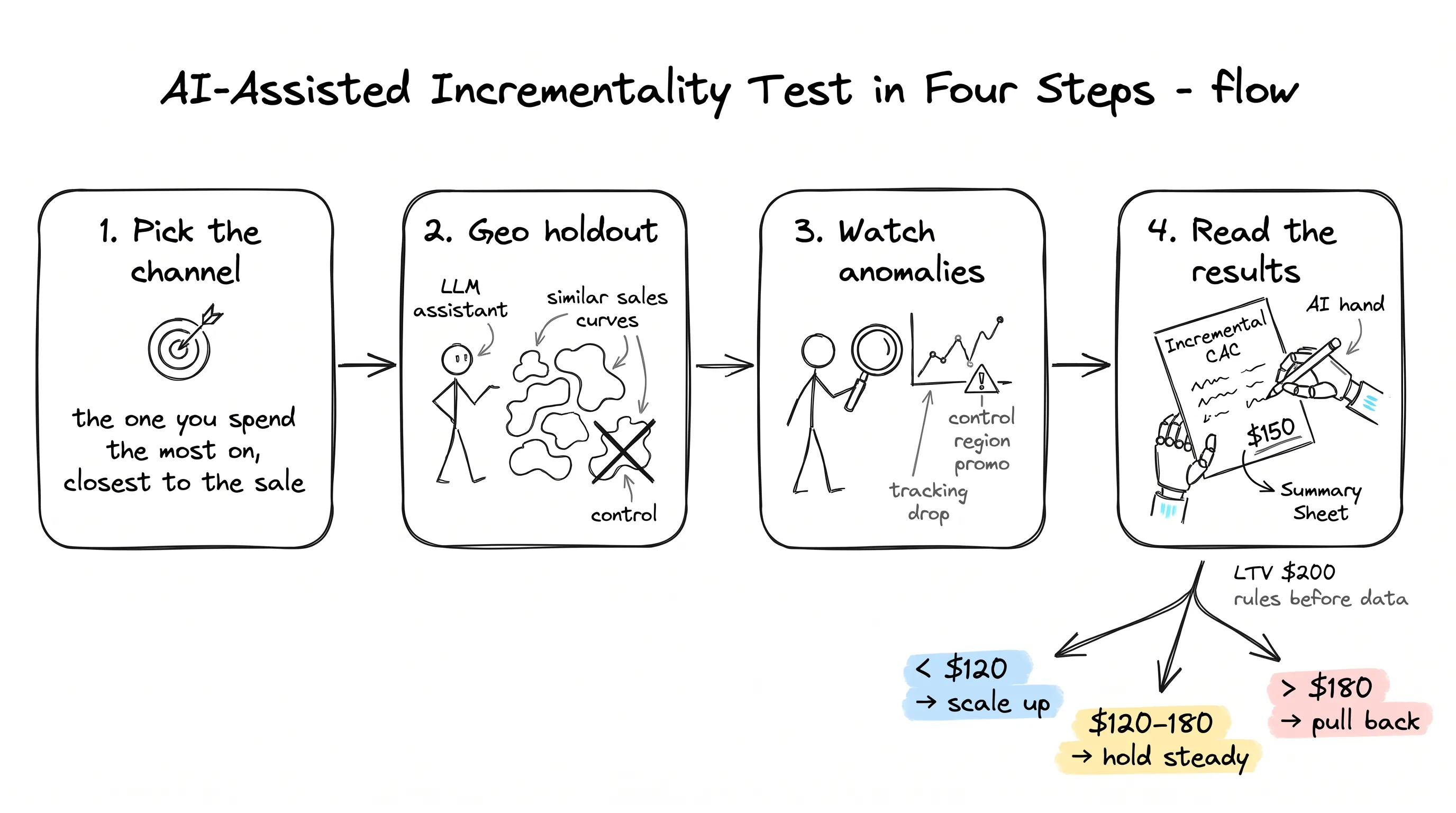
What makes this matter is the foundation of decision logic. The default budget-allocation habit is to add money to whichever channel looks good on paper, and platform attribution systematically over-credits close-to-sale channels while under-crediting demand generation — so money keeps flowing from the places that create demand to the places that harvest it. For small and mid-sized tech companies, every dollar spent harvesting existing demand is a dollar taken away from reaching new customers, and that difference decides whether growth can keep compounding. The author rewrites incrementality testing from a data-science-team exclusive into an AI-assisted, executable workflow: use ChatGPT or Claude to analyze historical sales data and find markets with similar sales curves by region to serve as geo holdout control groups; have the same assistant estimate the test cycle and sample size, then write and explain the analysis code; while the test runs, watch for anomalies — a control region suddenly running a promotion, your event tracking dropping conversions for several days straight — because catching problems early can rescue a test you'd otherwise have to rerun; and once the test ends, auto-draft the readout, compute incremental CAC against a pre-set threshold, and slice by market, audience, and campaign to pick the next segment worth testing. Small teams without a dedicated analytics function can run this measurement too.
For marketers, the implications come down to two concrete changes. First, move the decision rule up front: set the threshold before the test starts. The article's example: with a customer LTV of $200, scale up if incremental CAC comes in below $120, hold steady between $120 and $180, and pull back above $180. Rules before data forestalls the after-the-fact interpretation game, where every reading conveniently favors you. Second, switch the review lens from CAC and ROAS to incremental CAC, so every report has to answer one question: how many new customers would we lose if this money stopped? On the tooling side, Meta's GeoLift is open source, and platforms like Haus have packaged the whole workflow into software.
You can start this week. Pick one channel — the one you spend the most on and the one closest to the sale — have an LLM use historical data to select a few regions with similar sales curves, randomly hold out one group as the control, and run it for two to four weeks. While it runs, have the AI watch for data anomalies daily; when it ends, have it draft the readout and turn the technical analysis into a summary finance and leadership can actually read — then verify the attribution conclusions and the math yourself before setting budget. The article is blunt about the caveat: correlation is not causation. Conversions spiking in exactly the spend week might just be seasonality, a price change, a competitor's move, or measurement error — the experimental design itself is the source of causal evidence, and AI only handles analysis and interpretation. And don't forget conditions change: a channel that passes its test today may see its incrementality decay once spend scales up, so retest regularly to keep up. Let each round of testing accumulate into evidence, and after six months, budget meetings will feature far fewer gut-feel shouting matches.
Incrementality testing isn't a new concept — the methods and models already exist. Where this piece adds value is execution cost: AI takes over the grunt work of finding controls, watching for anomalies, and drafting readouts, while judgment stays in human hands. This kind of measurement used to be the preserve of big companies with data science teams and specialist vendors; the gap is being closed by AI tools. If your team is being led around by the nose by CAC numbers, read this one first today.
🔗 Further reading: Read the full article
🏷 Marketing Tools
MarTech conference roundtable: the composable martech consensus lands on hybrid architecture, and full rebuilds got doused with cold water
The roundtable notes from November's MarTech conference were published on November 11, and they hand teams currently re-evaluating their stacks a surprising answer: the right way to land composable martech is a hybrid architecture. A central data warehouse pulls in customer data and core business logic, specialized execution tools plug in on top and swap out as needed, and keeping legacy systems that still work is nothing to be ashamed of — it's a mark of architectural maturity, not a roadmap debt. Hybrid is the destination choice; any compromise is incidental. The roundtable is equally candid about the price of composability: power shifts to the buyer, and so does the work. You need to name an internal product owner to manage data flows, dependency maps, and cost governance, because runaway warehouse queries quietly inflate the bill; the engineering team must understand marketing intent, or they'll wire up the wrong fields even with flawless code. Anchor vendor selection to verifiable business outcomes: define the data fields you need starting from specific campaign use cases, build measurement and revenue-attribution baselines at the blueprint stage, and let measured performance do the talking in renewal negotiations. In the AI era, the agility that composability buys is the ability to pilot fast and swap fast; when validating a vendor's AI capability, only support already live in production counts — roadmap features don't. Critical assets like identity resolution and consent management must stay in your own hands; in the end, a brand has to fully own its customer experience.
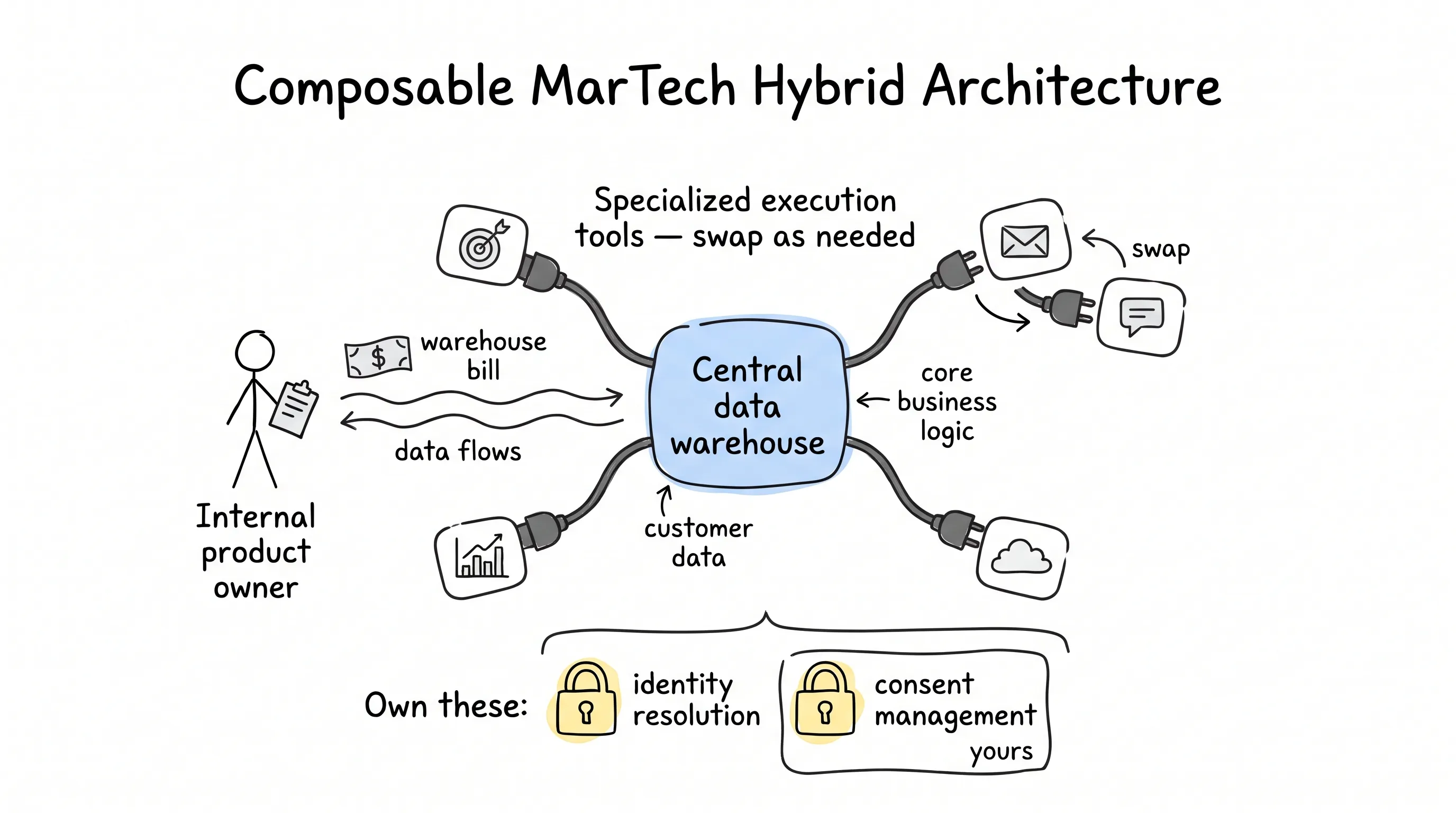
💬 A move MarTech leads can use this week: first take stock of which data assets you must own yourself, then decide which execution tools to open up for swap-at-will replacement. At the next vendor demo, ask straight out for production-environment cases — that one question filters out most of the sales pitch. Put the warehouse bill on the monthly review list too, and don't wait for Finance to ask. If your team has no product owner, settle that role first before talking re-architecture.
🔗 Further reading: Read the full article
Regie.ai rounds up 15 B2B sales tools: use it as a catalog, not a shortlist
Regie.ai has published its 2026 roundup of B2B sales software, covering 15 tools across CRM (Salesforce, HubSpot, Pipedrive), sales engagement (Outreach, Salesloft), conversation intelligence (Gong), data and intent (ZoomInfo), video (Vidyard), and scheduling (Chili Piper) — with its own product listed first, and AI agents taking over the SDR's heavy lifting as the headline pitch. Some of the interspersed stats are worth a look: Gong's State of Revenue AI 2026 claims 87% of US companies have brought AI into revenue operations, with AI shifting from assistive tool to trusted decision participant in revenue teams; the consensus bar for B2B purchase decisions has climbed to 9–13 stakeholders, pushing CRM and sales engagement platforms to sell collaboration and full-touchpoint recording as features; Chili Piper cites a 9x higher likelihood of converting inquiries followed up within 5 minutes, and Apollo claims users save an average of 12 hours a week and grow meeting volume 75% — all vendor-sourced numbers. At bottom it's an SEO-style vendor listicle, with the statistics serving the marketing narrative.
💬 Treat every number as vendor narrative and trace it back to the original report before citing. The category map has real value; its weight in tool selection is exactly zero. Colleagues doing GTM tool research can use it as the starting point for a landscape map, then turn to independent evaluations and trial data for actual budget decisions. One more signal to note in passing: AI agents taking over SDR work has become the master narrative of these roundups, and sales-team role design deserves a head start on that thought.
🔗 Further reading: Read the full article
A generative AI playbook for e-commerce teams: AI drafts, humans guard the facts
On November 9, The Learning Studio released a 3-minute primer video on four uses of generative AI in e-commerce marketing: product description generation, product and lifestyle imagery, first drafts for ads, email, and social, and per-audience personalized copy. Its risk warnings are more specific than most beginner content: AI will invent product features, so every product description must be fact-checked line by line; false claims, plagiarism, bias, mistranslation, misleading imagery, and privacy issues are all on the list — and publishing at scale scales the errors right along with it. The furniture-store new-launch example runs a human-AI division of labor: AI produces the drafts and the variants, humans own product facts, price promises, legal compliance, and brand consistency. Personalization presupposes properly consented customer data; the same product can be presented differently to students, working professionals, and parents. The video's stance is clear: AI's biggest value is in assisting, not in unattended publishing. Speedups, broader testing, translation, and format consistency all hold up — but the gatekeeping must stay human. The content is extremely shallow, the channel has just 3 views, and the page embeds affiliate links — it only works as a skeleton for teaching material.
💬 Shallow, yes — but that line about scaling the errors along with the publishing deserves the first line of your onboarding page. If you're onboarding an e-commerce team, copy its risk checklist straight into the publishing SOP and save yourself one painful lesson. Copy the division-of-labor bit too: drafts to AI, facts and compliance to humans. The rest of the paragraphs are skippable.
🔗 Further reading: Read the full article
Cross-border content strategy for the Google AI era: right direction, and yes, it's an advertorial
ToDetect, a browser-fingerprinting vendor, published a piece on cross-border marketing after Google AI reshaped the content ecosystem. The framework-level advice is standard-issue: content quality first, keyword stuffing and outright copying of others' content get down-ranked, Google's evaluation system weighs authority, usefulness, and personalization more heavily; localize for your audience; structured long-form; long-tail keywords; real cases and engagement signals; multi-channel distribution. What it calls AI-friendly content boils down to a three-piece set: real cases, engagement signals, and clear structure. The piece ends with a tool comparison table (Google Analytics, SEMrush, Ahrefs, Mailchimp, Canva, Google Ads); its descriptions of its own capabilities are entirely self-reported. The problem is at the evidence layer: the touted case of 120% traffic lift and 40% conversion lift has no client name, no dates, and no way to verify, and the whole piece funnels toward the company's own browser-fingerprint and invalid-traffic detection product — a textbook advertorial.
💬 Strip out the ad and the checklist skeleton that remains is usable — teams producing content for overseas markets can run it as a self-audit. Ignore the case numbers outright. The more worthwhile move: install AI-citation monitoring on your own site to see whether your content surfaces inside generated answers, paired with a monthly long-tail question coverage check — that beats reading any advertorial.
🔗 Further reading: Read the full article
🏷 Influencers & Social
HypeAuditor co-founder in conversation: finding influencers is becoming a one-sentence job
On his podcast, Neal Schaffer talks with HypeAuditor co-founder Alex Frolov, starting from the company's origins: 54 machine-learning datasets powering Instagram fake-follower and fake-engagement detection, winning trust through transparency before expanding the product line. The conversation lays out a three-stage chain for AI-assisted influencer marketing: discovery upgrades from keyword-and-hashtag search to natural-language persona descriptions — say you want a female dermatologist creator and a candidate list comes back — with platforms racing to ship conversational discovery interfaces; the outreach stage uses AI to personalize and scale its touches; and tracking uses AI to monitor campaign performance and tune ROI. Frolov's take: LLMs are turning every software interface conversational. The industry backdrop: influencer marketing grows about 20% a year — steady growth, not a boom. Host Neal Schaffer adds an observation of his own: he was discussing AI influencer marketing in a 2019 book manuscript, and the technological gap from that era to the post-ChatGPT one is enormous — yet the throughline, that AI augments rather than replaces the influencer marketer's judgment, hasn't changed. The conversation was published in September 2024; both the products and the model ecosystem have iterated several times since, so listen with that discount applied.
💬 The core judgment holds more than a year later: what AI replaces is the grunt work of screening and outreach — which creator to pick is not a call to hand to the model. The smallest move you can make this week: write your creator-selection criteria as a natural-language prompt, run it through an LLM for a round of candidates, then verify audience profiles and fake-follower data by hand. It costs half a day and saves the two-to-three weeks you used to spend combing lists; an outreach template built the same way, personalized, is worth a trial run too.
🔗 Further reading: Read the full article
France puts influencer liability into law, the UK's ASA counts virtual influencers: do your compliance homework before overseas campaigns
A July 2023 report from the International Bar Association (IBA) maps the global regulatory patchwork of influencer marketing, quoting named lawyers from several IBA committees. In June 2023 France passed Europe's first law giving influencers legal status, aimed straight at dangerous dieting, cosmetic-medicine promotion, gambling promotion, and counterfeit hawking, with violations carrying up to two years in prison, a €300,000 fine, and a ban from the profession; the DGCCRF, France's consumer-protection watchdog, got direct fining authority, and industry lawyers expect that how fast the industry cleans up its act will decide how hard the penalties land. The UK's ASA (Advertising Standards Authority) goes further: an influencer isn't defined by follower count and doesn't even need to be human — an AI avatar qualifies. The main gap is weak enforcement of the Consumer Protection Regulations 2008, and the DMCC Bill will authorize the CMA to fine directly. AI cuts both ways here: regulators are scaling enforcement with machine learning while deepfakes fabricate influencers for non-compliant stunts, and accountability headaches grow for brands and influencers alike. The EU's DMA/DSA and Australia's misleading-information rules fill out the rest of the puzzle; brands running influencer campaigns must check disclosure and ad-labeling obligations jurisdiction by jurisdiction. The source is 2023 content; subsequent French enforcement and the EU AI Act's implementation aren't covered, so verify current statutes before citing.
💬 Before running European influencer campaigns, build a jurisdiction-by-jurisdiction checklist of disclosure duties and ad labeling; on the France list, focus on the product-category red lines for shoppable content, and write disclosure and labeling obligations into influencer contracts as clauses. Virtual-influencer projects should prepare their AI-identity disclosure line in advance — don't wait for a platform or a regulator to define it for you. The source is old, but the framework is a ready-made compliance baseline.
🔗 Further reading: Read the full article
Accenture acquires Superdigital: the consulting giant keeps bolting social and influencer capacity into its machine
A Business Wire release (republished via Yahoo Finance, August 2025): Accenture has acquired Superdigital, a US social-media and influencer agency — a 40-plus-person team founded in 2013 — folding it into Accenture Song to strengthen end-to-end social services spanning community strategy, content, commerce, and measurement; the deal value wasn't disclosed. It continues Accenture Song's acquisition cadence — Unlimited, Work & Co, and SOKO came before — as social and influencer creative capacity keeps getting absorbed into the consulting system. The management-quote narrative is AI reshaping marketing and social sitting at the intersection of brand building, community, and performance, with influencer marketing and short-video native creativity called out as the target's headline capabilities. Standard press-release fare, complete with forward-looking-statement caveats: no independent analysis, no financial detail, limited day-of information value — its value as an industry signal outweighs its news value.
💬 Read it as an industry signal, not as news. Big consultancies keep acquiring social and influencer capacity, which tells you brand budgets are migrating toward social as the first touchpoint — and once the agency side consolidates, the client's negotiating room shrinks. The brand-side response is to hold onto data and asset sovereignty; don't let full-service retainers quietly walk off with first-party assets. Small and mid-sized agencies need to be clear about where they stand, too — pure execution capacity is the first thing to get acquired or replaced.
🔗 Further reading: Read the full article
🏷 Industry Data & Trends
The two faces of AI marketing adoption: 42% of organizations aboard, four flameouts lined up
A survey piece in Vanderbilt Business Review (a student publication, October 2025 issue) assembles a set of citable figures: McKinsey's survey has 42% of organizations already using generative AI in marketing or sales functions; SurveyMonkey says 88% of marketers use it daily; and the AI marketing market is projected to grow from $47.3B in 2025 to $107.5B by 2028. The upside exemplar is Klarna, estimated to save about $10 million a year in marketing costs by generating imagery and creative content with AI, with the freed-up attention redirected to higher-order work — the author locates the payoff in liberated human capacity. The risk-side case library is complete: Lego's Ninjago AI images drew criticism, Coca-Cola's 2024 AI Christmas ad flopped, Google's Olympics ad Dear Sydney got pulled, and Toys R Us's Sora brand film sparked controversy — the shared lesson is that skipping human gatekeeping and emotional warmth triggers the backlash. It closes with three defensive principles: AI content always passes human review, covering bias, sensitive topics, and brand consistency; humans own key judgment while AI handles drafts and data assembly; and disclose AI use transparently to consumers to protect trust. All figures and cases come from secondhand reporting; no proprietary method; medium depth.
💬 Trace every number to its original source before citing, but as a one-page AI risk brief for management, this is enough — the four cases conveniently cover the different flameout types: imagery, ad film, emotional storytelling, brand film. This week, turn the second principle into a process document specifying which materials must pass human review after AI drafting, so the next post-mortem doesn't discover that nobody was standing guard.
🔗 Further reading: Read the full article
The GEO-replaces-SEO debate: the community split is itself the answer
A year-old r/content_marketing thread preserves an early, ground-level split on the GEO question. The OP summarizes LLM citation preferences: semantic depth over keyword stuffing, TLDR and FAQ structure, topical authority, crawlability, content freshness, and natural long-tail questions. Top comments agree that structure and update frequency help with getting cited by AI, while the pushback from veteran practitioners is just as blunt: this is SEO-haters pushing an agenda, and search engines can't be built on publishers' self-promotion. The comments also include a brand using its own LLM monitoring tool to corroborate the correlation between GEO and brand citation rates — the tool tracks brand mentions inside ChatGPT and Claude, which makes it self-interested evidence, to be weighed with caution. The original post has been deleted; anonymous opinions are mixed with vendor self-promotion, so the sample's credibility is limited. The more balanced conclusion: GEO and SEO evolve in parallel — being a source that AI trusts matters, but it won't wholesale replace search optimization.
💬 Don't rush GEO into your OKRs; build a baseline first: pick ten target questions, ask the mainstream models, record whether your brand gets mentioned, and retest monthly. GEO budgets without a baseline mostly get spent on vibes. The structured upgrades — TLDR, FAQ, long-tail questions — overlap heavily with SEO work, so fold them in as you go; a standalone project is premature. The community split is its own reminder: when a new buzzword appears, find the opposing view before you judge.
🔗 Further reading: Read the full article
Email AI personalization penetration at 50%: a statistical anchor worth keeping
In the press release for a paid Research and Markets report (August 2024), the only item worth recording is a figure from Ascend2's July 2023 survey: 50% of marketers already use AI for content personalization, the highest-penetration AI use case in email marketing. Email itself is the high-ROI channel B2B marketers prefer, and AI's improvements concentrate in three areas: revenue driving, campaign efficiency, and customer engagement. The report says enterprise marketers' planned use cases and desired platform AI capabilities are spread across four charts; the article gives no details. The rest of the release is a table of contents, a chart list, and a roster of interviewed executives (Acquia, Brevo, Insightly, Persado), with no report conclusions; the survey data is now more than three years old — any citation must carry the year.
💬 Old number, still useful: keep it as a penetration benchmark for internal reporting. If your team hasn't gotten AI personalization running yet, you're two years behind the market, not six months. Start with behavior-triggered sequences — cheaper and faster to show results than full personalization; A/B it on one win-back sequence first, then roll it out. The entry point for B2B email personalization is actually close at hand: put the industry and job-title fields to work, and you're already a notch above batch-and-blast.
🔗 Further reading: Read the full article
A 2023 list of AI marketing applications — what's left of it today
A May 2023 blog post from UK agency sevenseven lists ten categories of generative-AI marketing applications: content production, personalization, ad creative, email, chatbots, predictive analytics, social listening, SEO, UX optimization, and market research. The cited data points include Google's claims that AI-personalized email lifts average CTR by 14% and conversions by 6%, and that AI-optimized content lifts engagement 50%; the original attaches no verifiable sources — unsourced citations, plain and simple. It closes with a judgment drawn from Google I/O 2023: showing up in generative results will be key for e-commerce sites. The technical frame of reference stops at the GPT-4 era, two generations behind; the five concerns (privacy, authenticity, de-personalization, ethics, job impact) each get a response that turns the worry into a differentiation opportunity — more talking points than argument. The top of the piece states it was created in May 2023 and is positioned as evergreen content.
💬 Use this one as a writing skeleton, not a data source. The ten-category list still works nicely as a team-coverage self-check: whichever category nobody owns is next year's gap. Its generative-search prediction did land early, though — direction calls outlive technical details, and that's the general trick for reading old material: keep the frame, toss the numbers.
🔗 Further reading: Read the full article
💡 Today's Big Picture
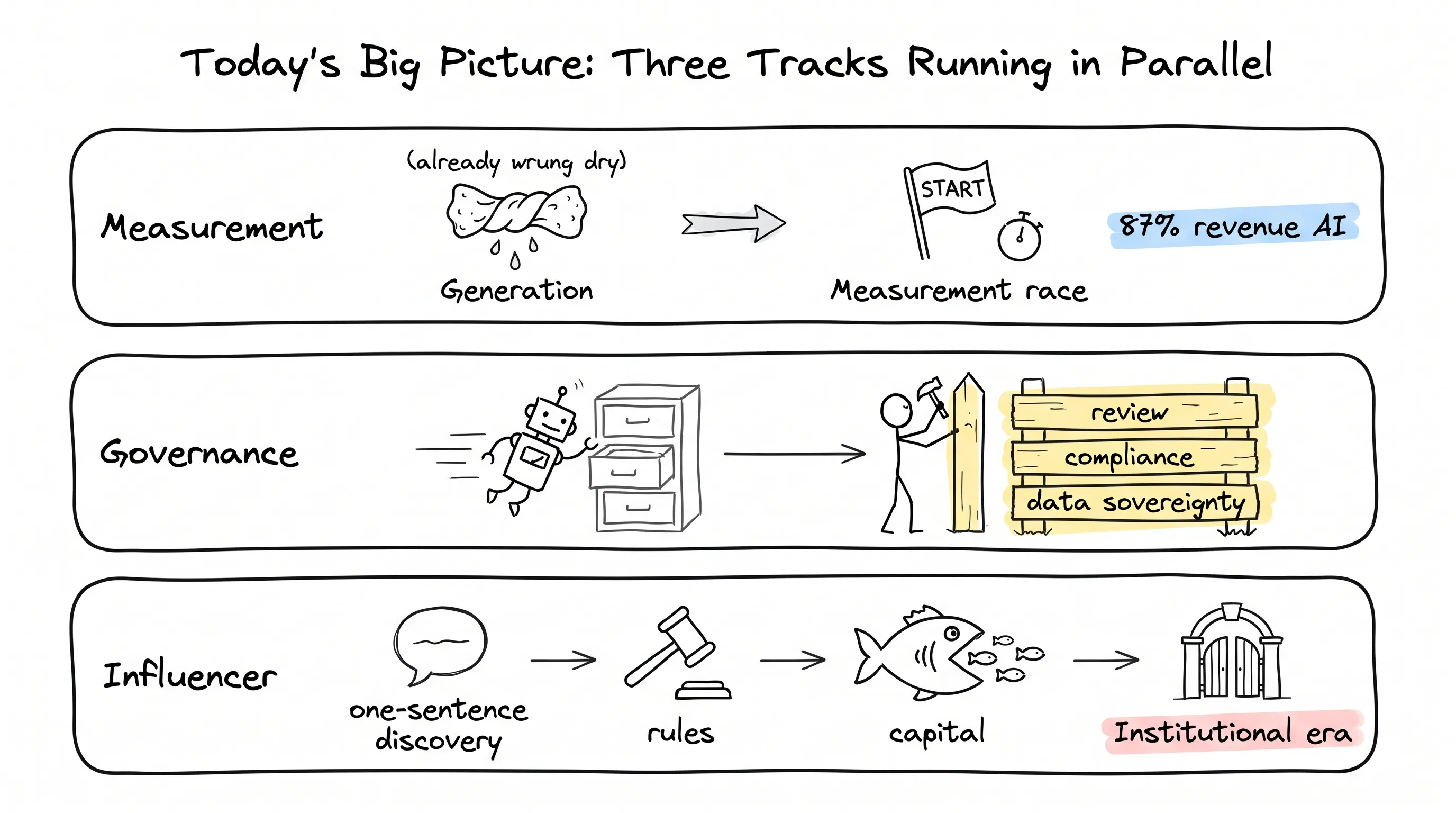
The 12-item candidate pool is what the tightened quality gate let through, and four items are still 2023-to-2024 vintage — a signal worth logging in itself: AI-marketing content supply is inflating, and editorial value is shifting from helping you find content to culling it for you. What's genuinely new clusters in two places: measurement and governance. On measurement, the headline rewrites incrementality testing as a workflow small teams can actually run; Gong's 87% figure shows AI has entered revenue operations' regular headcount; and the email stat reminds us that AI personalization was already standard equipment two years ago — today's passing grade sits well past the entry level. Three sets of numbers sketch one line: the generation side has been wrung dry, and the measurement side is where the race is only starting. On governance, the composable martech hybrid-architecture consensus, France's influencer law, and the four brand flameouts all point at the same thing: AI is entering the marketing stack faster than control mechanisms are being built, and whoever closes the gaps in review, compliance, and data sovereignty first is the one who gets to step on the gas. The flameouts share one more trait: they all happened in emotional and narrative territory, while tool-like applications stayed safe — which hands you a ready-made line for drawing AI use boundaries. Read together, the three influencer items make an interesting picture: tools are turning creator discovery into a one-sentence job, regulators are writing rules for virtual influencers and shoppable conduct, and capital is folding execution capacity into the big firms. With all three lines running in parallel, the space is moving from its frontier phase into an institutional era, and the early-mover bonus window is shorter than you'd think. Today's reading plan: read both MarTech pieces in full, file the influencer-compliance piece as your overseas-campaign reference, archive the older items into the library, and cite none of the data directly. Yesterday you may have been worrying about finding enough material; today the question has become whether you're ruthless enough in what you cut.
Continue reading
Related articles
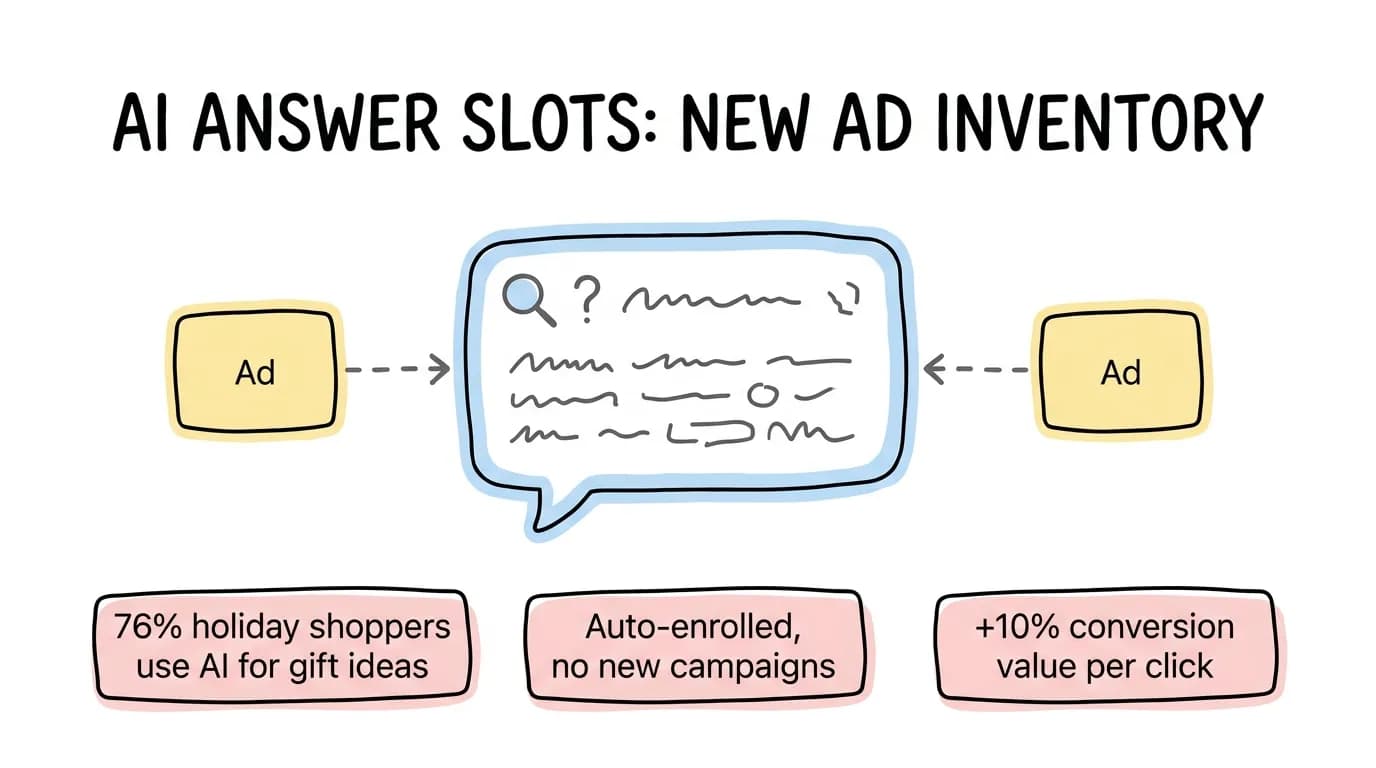
AI Marketing Daily · 2026-11-22
AI Marketing Daily for 2026-11-22 rounds up 20 items led by Microsoft opening Bing AI Overviews to ads and Google expanding AI Mode ads to ten countries, plus GEO guides, ad automation delegation guidance, AI Overviews CTR data, and a legal-risk checklist for AI-generated creative.
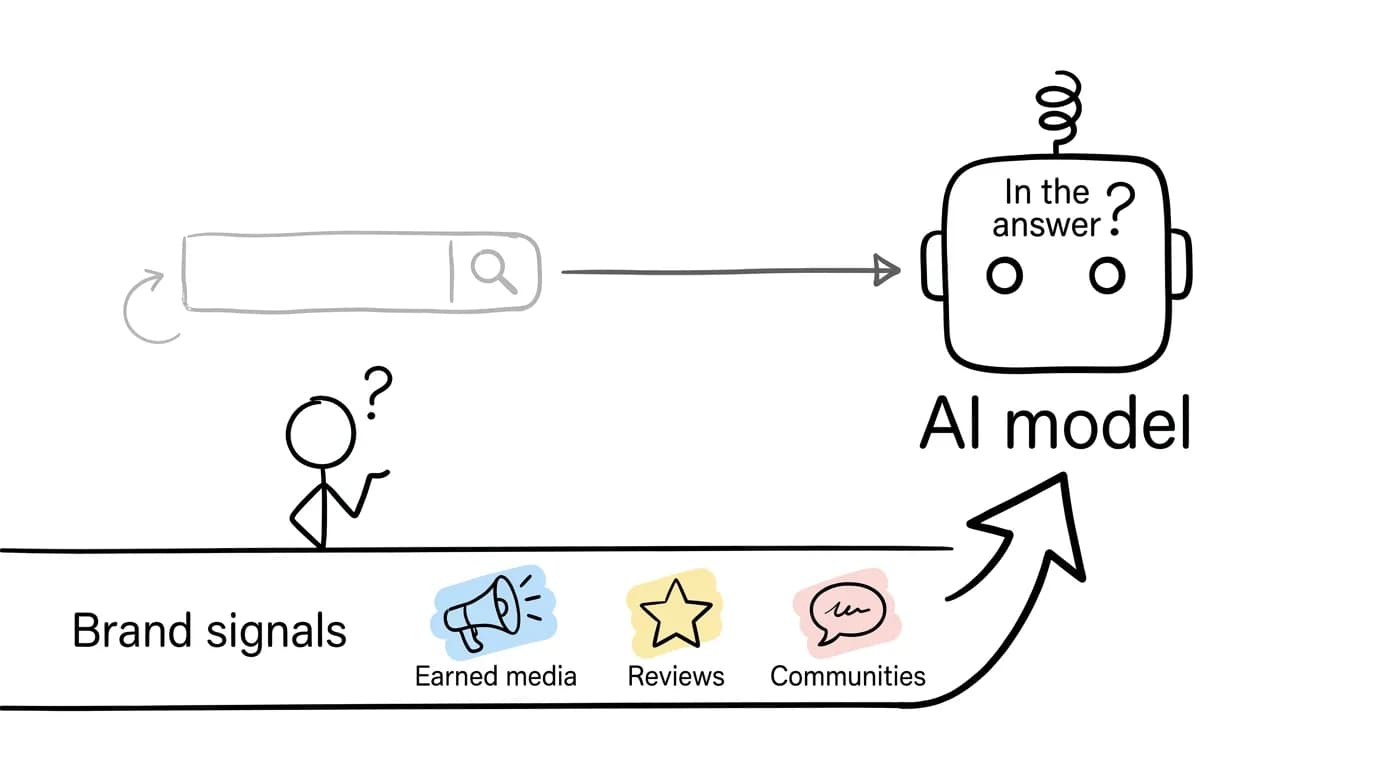
AI Marketing Daily · 2026-11-21
A November 21, 2026 AI-marketing daily covering AI search visibility, GEO methods, Google AI Mode ads expanding to ten countries, Meta's pre-Black Friday changes, agentic shopping, and industry adoption and ROI data.
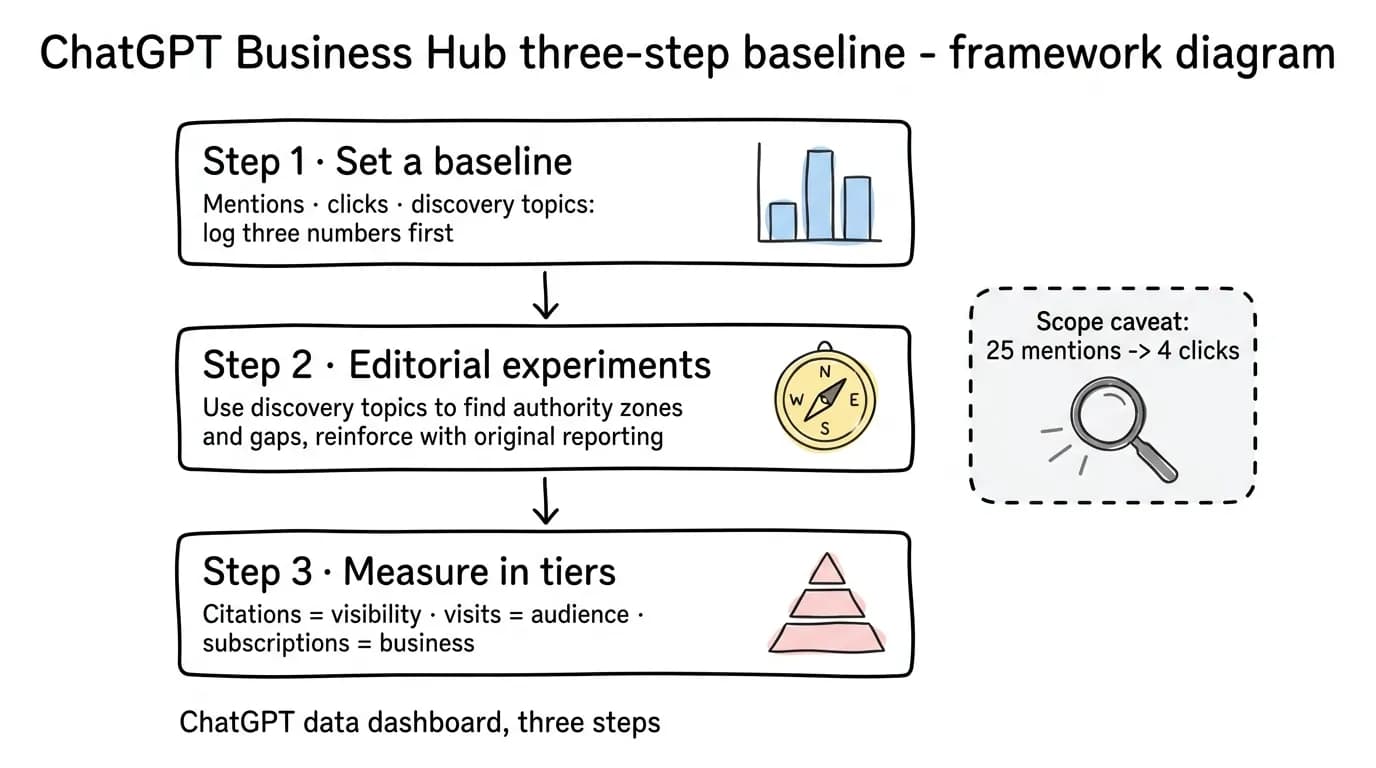
AI Marketing Daily · 2026-11-20
AI Marketing Daily for 2026-11-20 rounds up 19 items centered on measurement: OpenAI's ChatGPT Business Hub dashboard, EU rules for agent-mediated purchasing, Meta pausing four AI terms, and B2B data on shortlists and the dark funnel, each with action advice.