
Generative AI Is Here: Are Marketers Doing More Work, or Less?
An educational overview of generative AI for marketers: what it is, where it fits in marketing work, and how Google's AI-generated search answers change content visibility, with notes on privacy, authenticity, ethics, and jobs.
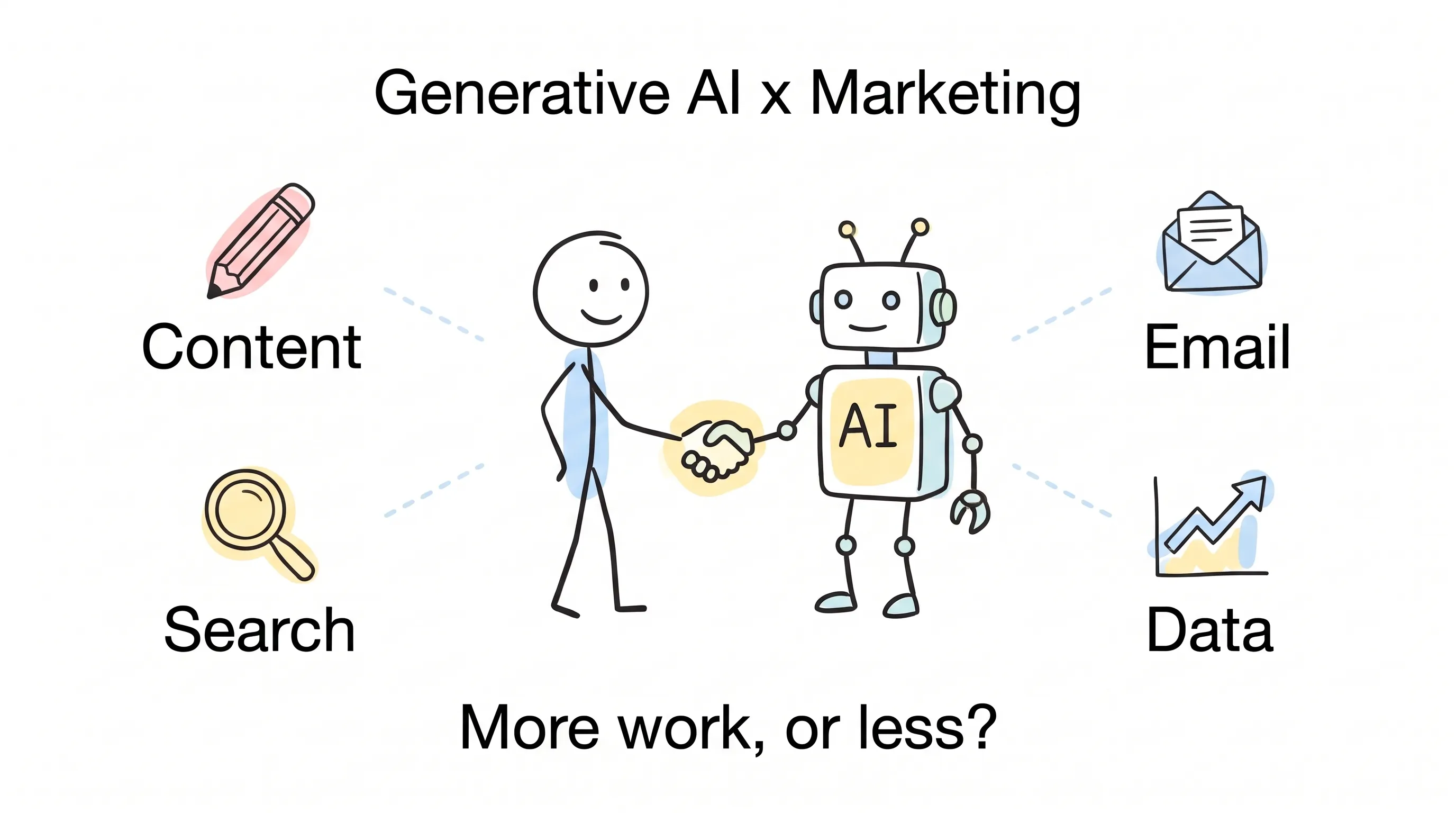
A few days ago, a marketing director at a brand sent me a message asking a very typical question: the boss made the call in a meeting — the marketing department is going all-in on generative AI. He panicked and asked me what this thing actually is, and whether it might one day replace him too.
I told him: don't panic. This question starts with the basics — what exactly is generative AI?
So What Is Generative AI?
What is generative AI?
Put simply, it's a class of AI that can create something out of nothing. It first learns patterns from vast amounts of data, then produces brand-new things following those patterns.
Here's an example. Feed an AI ten thousand pieces of music by a certain composer. It learns that composer's chord progressions and melodic habits. Then you say: go ahead, write something new. It can write a piece that composer never wrote — but that sounds exactly like something he would have written.
That's generative AI.
The same applies to marketing. It reads every piece of copy you've ever run, your user data, your viral posts — then generates new ad copy, new product descriptions, even a full marketing plan.
OpenAI's GPT-4 is the representative of this class of models. The technology behind it is deep learning — "deep" refers to the number of layers in a neural network. The more layers, the more complex the patterns it can learn, and the more convincing the output.
What Problems Does It Actually Solve?
Think about it: what are the two things a marketing team struggles with most?
First, what do users actually want? Second, not enough hands — content can't be produced at scale.
Generative AI goes straight at both.
It can digest massive amounts of consumer data, chewing through users' preferences, interests, and behavior, and handing the insights back to you. Then, based on that understanding, it produces personalized content for different audiences at scale.
Before, writing ten thousand different emails for ten thousand people was unthinkable. Now, it's table stakes.
Google published a set of data: companies using AI for personalized email saw click-through rates rise an average of 14%, and conversion rates rise 6%.
Don't underestimate that 6%. Marketing is often a business built on a series of small gains like that one.
What Can It Take On in a Marketing Department?
Let me sort it into four buckets of work.
One: writing content. Blogs, social posts, product descriptions — these highly standardized tasks go to AI, freeing people up to think strategy.
Two: managing relationships. Personalized email, chatbots that are online around the clock. Chatbots can answer questions, make recommendations, and even do some cross-selling along the way.
Three: reading data. Predictive analytics, social media monitoring, competitor research. Feed it past sales data and it can help you anticipate the next consumer trend; scan the whole web for brand mentions and it can flag a shift in the wind the moment it happens.
Four: fixing the experience. Search engine optimization (SEO), website and app usability. Where users get stuck, which buttons nobody clicks — AI sees it in finer detail than you do.
Four buckets, running through the entire marketing workflow.
Where Exactly Did Google's Move Cut Deepest?
This story starts with the 2023 Google I/O conference.
That year, Google put generative AI into search. When a user asks a question, Google no longer just throws out a page of blue links — it directly understands the complex question and gives a neatly organized answer.
For users, that's a blessing. For people who run websites, the game changed.
Why? Because users may read the AI's answer and leave — without ever clicking through to any site. Whether your business is inside Google's AI answer has become more important than ever.
Google itself has given a set of data: content optimized with AI drives 50% more engagement than traditional content.
The numbers may not always be precise, but the direction is clear: content has to be more relevant and more useful to become visible to the AI. Your website has to be visible to the AI first — only then do users get the chance to recognize you.
Five Concerns, One at a Time
Of course, every coin has another side. Five concerns come with generative AI.
Data privacy. AI needs data — a lot of it. The answer? Make data compliance a bottom line. The stricter the rules, the more customers trust you.
Content authenticity. AI-written content is getting harder to tell from human-written. My advice is blunt: label it whenever labeling is required. Hiding it only costs you trust if discovered; owning it openly earns respect.
The human touch. Some worry AI will make marketing cold and impersonal. Quite the opposite. Hand the repetitive work off to AI, and people are freed up for strategy and creativity — the parts that genuinely need humans.
Ethics. Can AI be used to manipulate users? No. Write your values into your AI usage guidelines — use it to help users, not to scheme against them.
Jobs. This is the one people panic about most. AI will indeed take over some repetitive work, but it also creates new jobs: marketers who understand AI, analysts who can interpret AI conclusions. What's truly valuable now is judgment and creativity.
Have you noticed? Behind every one of these five concerns stands an opportunity.
How to Start?
Two steps.
Step one: find a capable partner. There are already plenty of digital marketing agencies specializing in generative AI — from choosing tools to building workflows, having a professional walk you through the first pass is far faster than figuring it out alone through trial and error.
Step two: don't let yourself fall behind. This field moves fast — stop following it for a few months and you're already behind. Read a few reliable sources regularly, like TWIML AI Podcast, TechCrunch's AI section, and MIT News's artificial intelligence section. It doesn't take much time, but it keeps you oriented to where the wind is blowing.
Finally
Back to the friend who panicked at the start.
My answer to him: don't treat AI as a rival coming to take your job. Treat it as the new intern in your department — the one who never asks for overtime. It writes the first drafts, you review and approve; it runs the data, you make the judgment.
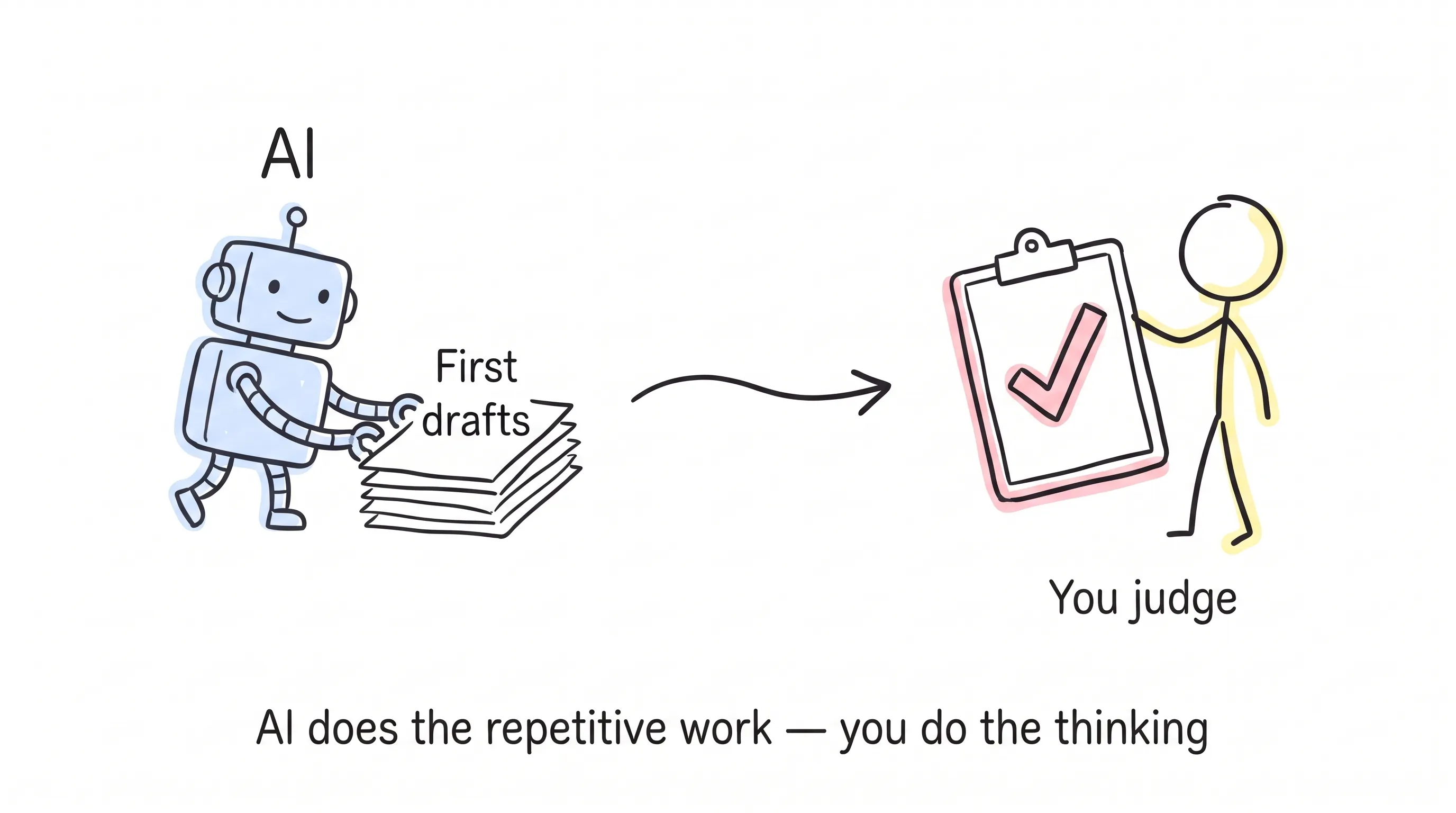
The more it does, the more time you free up for thinking about the big things.
What eliminates marketers is never AI — it's the marketer who uses AI.
I hope you get this "new colleague" working smoothly for you, sooner rather than later.
Continue reading
Related articles

What Is GEO? How Your Brand Gets "Mentioned" in the Age of AI Search
An explainer on GEO (Generative Engine Optimization) for e-commerce and DTC brands: how it differs from SEO and AEO, why AI answers shape brand visibility, and eight practices covering question-focused content, consistent brand messaging, structured pages, external evidence, comparisons, and AI mention tracking.

AI Is Already Making Decisions for Your Customers. Are You on the List?
A learn article explains GEO (Generative Engine Optimization): why AI-generated answers now shape which brands customers see, and how SEO fundamentals, entity clarity, citable evidence, and monthly measurement affect visibility in AI answers.

Google Is Stuffing Ads Into AI Search: These Recent Stories Are Really One Story
A news roundup linking recent AI marketing stories—Google adding ads to AI Mode, Amazon's Ads Agent, ChatGPT image updates, a UK startup tracking brand mentions in AI answers, and an AI ransomware warning—arguing that control over ad data and visibility is shifting toward platforms.