
AI in Marketing Can Save You 70 Million a Year — or Wreck Your Brand in One Ad
An analysis of how AI is reshaping marketing, covering reported efficiency gains alongside brand-safety failures such as Lego, Coca-Cola, and Google ad backlashes. It stresses human review of AI-generated content, clear human-AI division of labor, and transparency with consumers.
A few days ago, a friend who runs a marketing department asked me out for coffee. The first thing out of his mouth as we sat down: "My whole department is on AI now — image generation, copywriting, data crunching. It's scarily fast."
I said, congratulations.
He gave a wry smile: "But I can't shake the feeling that the ground under my feet is a little shaky."
Shaky how? He didn't say. But I think I have a pretty good idea.
Today's article is about getting to the bottom of it: where the opportunities in AI-driven marketing are, where the pitfalls are, and — most important of all — what to do about it.
1. First, Look at the Numbers
Marketing is an industry that lives off data by nature. The only difference used to be that the data was crunched by humans, and slowly. Now AI has taken over the job.
A McKinsey report says roughly 42% of companies are already using generative AI in their marketing and sales functions. SurveyMonkey's survey is even more direct: 88% of marketers use AI every single day. They use it to write content; they use it to research and make decisions.
And the market size? In 2025, the global AI market stands at about $47.3 billion. By 2028, it's projected to reach $107.5 billion. More than doubling in three years.
Think about that. This is no longer an "efficiency tool."
This is an engine swap. Same car, all-new engine.
2. The Money Is Real
Some people say the AI cost savings are hype.
They really aren't. Let me tell you a true story.
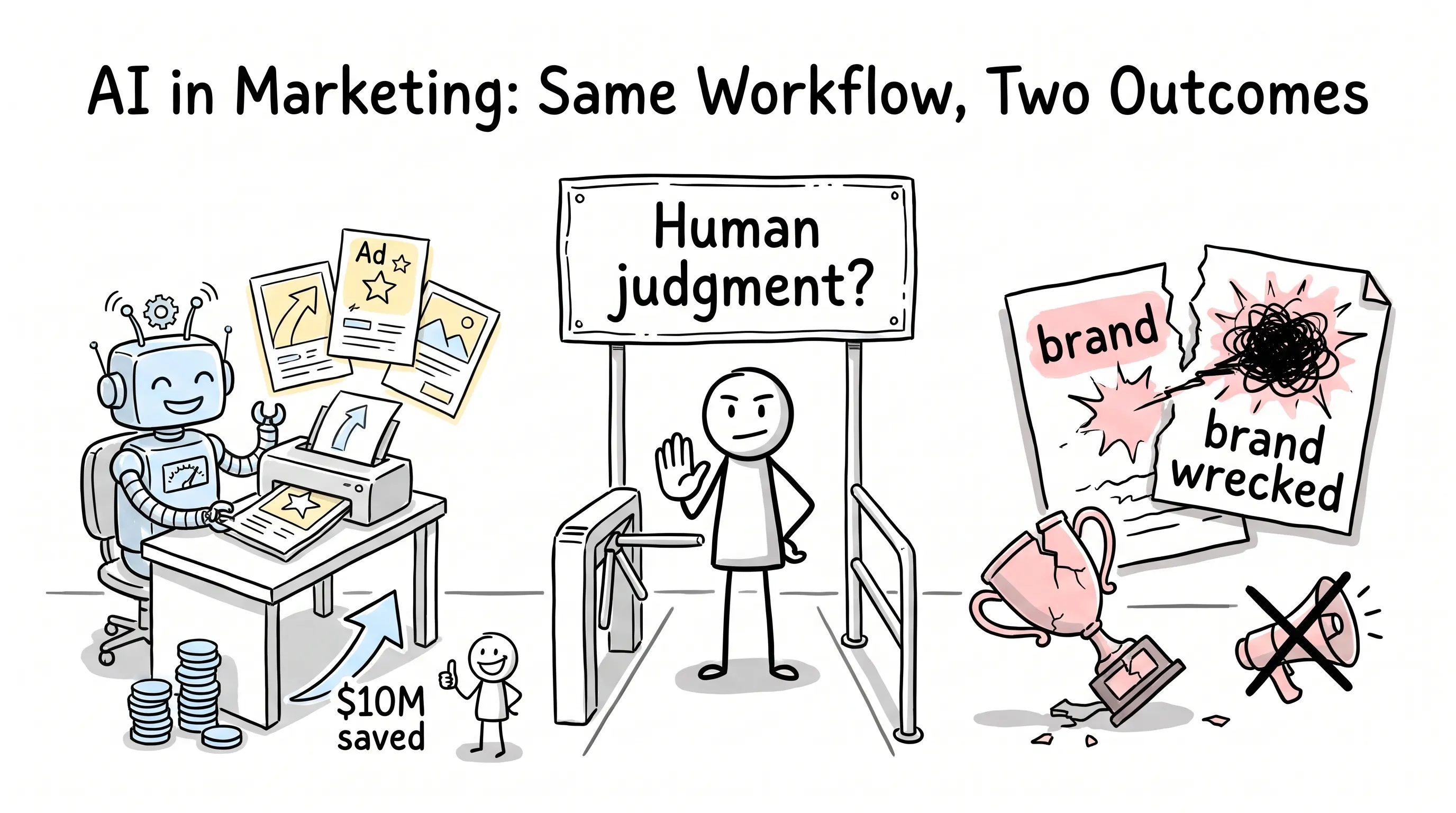
Up in the Nordics, there's a buy-now-pay-later (BNPL) fintech company called Klarna. Its marketing team used AI to generate images and creative assets, and over the course of a year, saved an estimated $10 million in marketing spend.
Ten million dollars. Just from generating images and making creative assets.
What's more worth pondering is where that money came from. A lot of people worry about AI taking jobs, but look at Klarna's ledger: the bulk of the savings did not come from cutting headcount. It came from pulling people out of repetitive work. The image generation went to AI, and people went to do the work AI can't do — judgment, strategy, the places that actually require a brain.
Right? Tools do the tools' work, people do the people's work, and productivity goes up.
3. But There's Always Another Side
The other side of saving $10 million is that AI can also lose you your whole brand in one go.
Let me tell you a few true stories. None of them are distant history — all within the last couple of years.
The first: Lego. Lego used AI to produce a batch of Ninjago promo materials, and consumers exploded — a chorus of angry voices. The execution was too sloppy; it looked fake at a glance.
The second: Coca-Cola. For the 2024 holiday season, Coca-Cola used AI to remake its classic 1995 ad "Holidays Are Coming" — the one with red trucks filling the streets and that warm, cocoa-scented nostalgia. Longtime customers on social media weren't buying it: no human warmth, none of the creativity of the original. Meant as an homage to a classic, it ended up trashing it.
The third: Google. That same year, during the Olympics, Google made a 60-second ad for NBC's broadcast called "Dear Sydney," about a father using Gemini to help his daughter write a letter to her idol, the track star Sydney McLaughlin-Levrone. The point was to show off what AI could do. Instead, the whole internet tore into it: a letter from a daughter to her idol — something that heartfelt — and you delegate it to AI? The backlash was so fierce that Google pulled the ad from the broadcast outright.
The fourth: Toys"R"Us. At the 2024 Cannes Lions festival, they used OpenAI's Sora to make their first-ever brand video. The internet's verdict was unanimous: something indefinably off about it, missing the warmth a brand story is supposed to have.
Four stories in, do you notice the pattern? They all failed the same way:
It wasn't that the AI wasn't capable. It was that nobody vetted the output before it went out the door.
Brand reputation takes years to build and one ad to demolish.
4. And Then There's Another Ledger: Ethics
Beyond the faceplants, there's an argument that never ends.
On one side are the artists: AI-generated images and designs are taking work from people who live by their craft. They trained for over a decade — on what grounds does a model replace them with one click?
On the other side are the companies: the costs are sitting right there, savings are savings, and for jobs like image generation, AI really is cheaper.
Both sides have a point. Honestly, there's no standard answer here. But the fact that the word "balance" exists tells you both pans of the scale can hold weight. Every company has to do this math for itself — and do it with a clear conscience.
5. So What Should You Actually Do?
Back to the friend from the opening. I later figured out what his shakiness was about: he had treated AI as an accelerator, but never as a teammate.
Here are three pieces of advice. Not many, but every one of them was paid for by someone else's tuition.
First, treat AI as a partner, not a stunt double. Anything AI-generated must pass through human eyes before it goes live: Is there bias? Is anything offensive? Does it fit the campaign's goals? Does it match the brand's voice? Not a single one of these gates can be skipped.
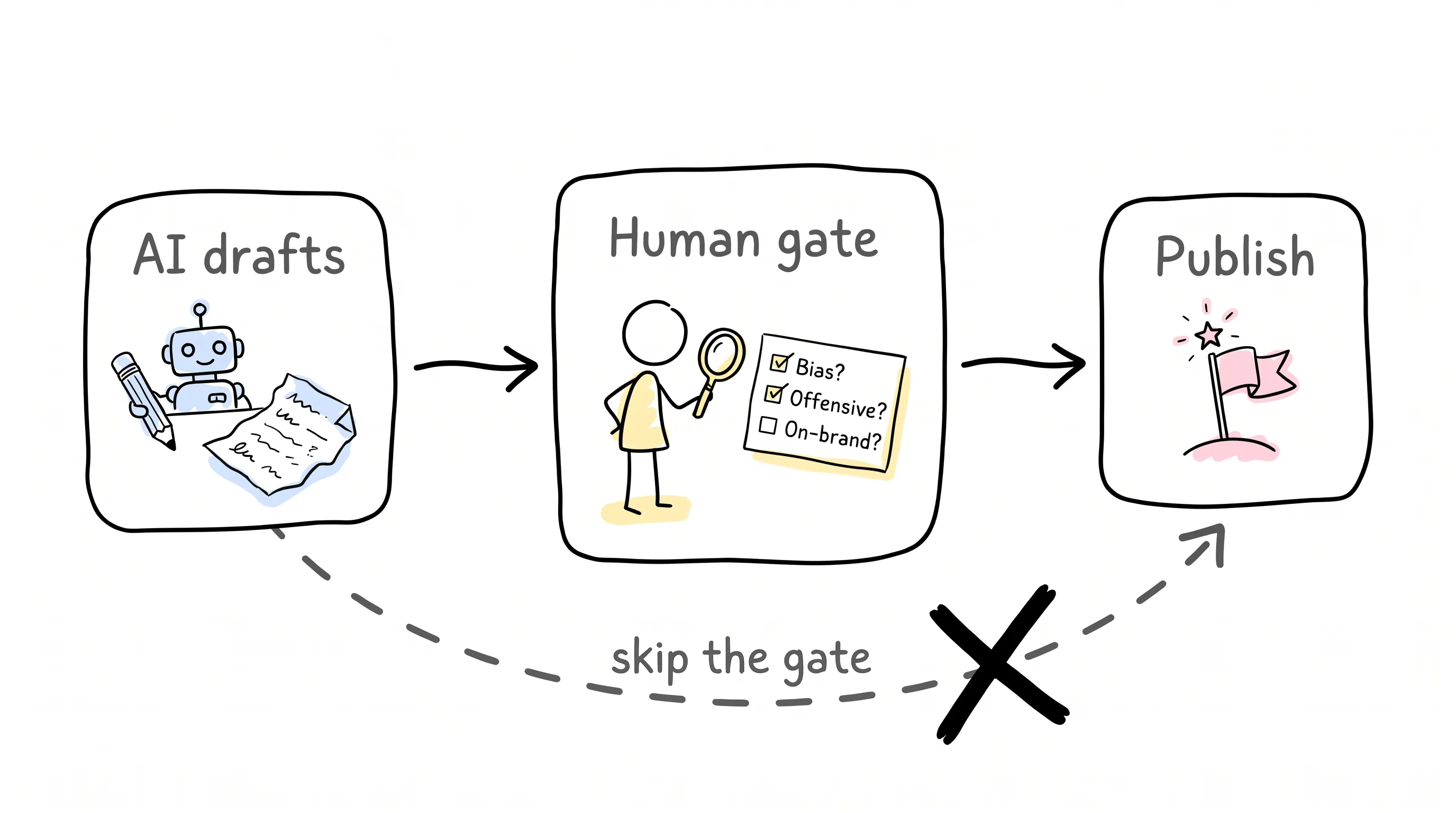
Second, keep the division of labor clear. AI does the routine: drafting, organizing data, first drafts. Humans do the hard part: critical thinking, creativity, brand personality. Never do it the other way around. And above all, guard against one thing: people getting lazy and outsourcing their thinking to AI too.
Once thinking is outsourced, the human is finished.
Third, be honest with consumers. If you used AI, say so openly. The trust that candor buys is worth far more than hiding it. Flip it around — keep it under wraps, get found out, and you'll get a fresh taste of the backlash Lego and Google swallowed.
Final Words
AI is rewriting the marketing business with one hand, but it can't cure every disease. The companies most likely to wreck their brand are the ones that rush in with nobody watching the door.
There is a way to save $10 million. There is also a way to wreck your brand. And often it's the very same workflow. The difference comes down to one thing: whether human judgment is still in the loop.
Here's to a great partnership with your AI. And may your ads never have to be pulled overnight.
Continue reading
Related articles

It's 2026: Stop "Buying" AI Tools for Your Marketing Team — Start "Hiring" AI Agents
This learn article explains how AI agents differ from standalone AI tools in marketing, outlines three agent categories — build-your-own platforms, CRM-native agents, and vertical tools — and covers use cases across SEO, social media, advertising, and reporting, plus criteria for choosing one.

Did the Money You Spent on AI Marketing Ever Come Back?
A guide to measuring AI marketing ROI across three layers: ad reports, sales pipeline, and the financial ledger. Covers metrics such as ROAS and CPA, eight dashboard metrics, industry benchmarks, and common measurement mistakes.

How to Pick a Creative Automation Platform: First, Figure Out What These Eleven Actually Do
A learn article sorts eleven creative automation platforms — including Bannerflow, Celtra, Smartly.io, and Storyteq — into four functional groups and proposes five evaluation questions covering publishing reach, automation depth, ease of adoption, team fit, and verifiable evidence.