
Your Sales Team Doesn't Need More Tools. It Needs the Right Fifteen.
An educational guide that walks through a B2B sales stack stage by stage, profiling fifteen tools for prospecting, outreach, call analysis, CRM, scheduling, e-signatures, and software review research.
Last week I had coffee with a friend who runs sales at a mid-size B2B software company. He opened his laptop and showed me his team's tool list.
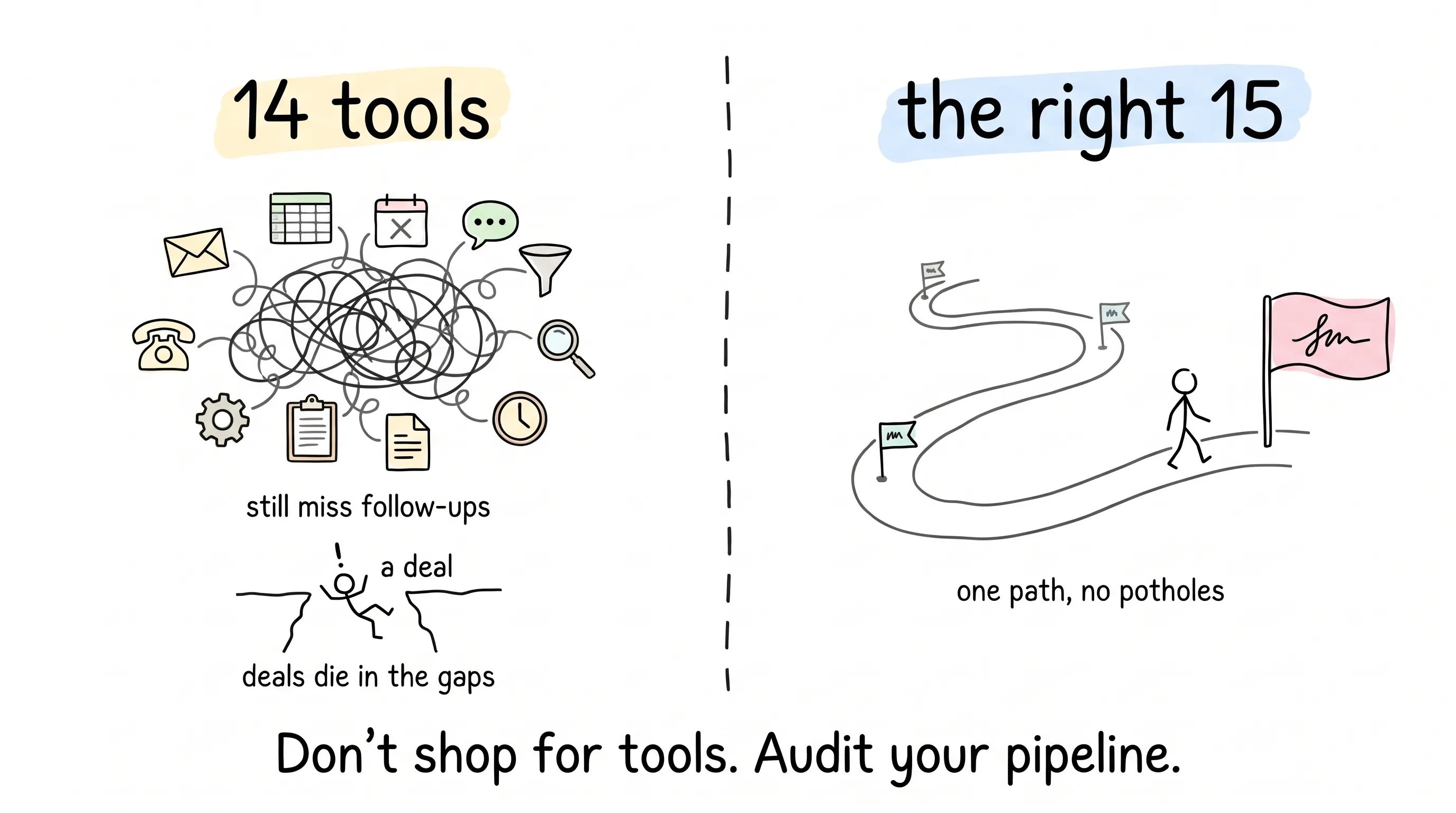
Fourteen tools. I counted.
"Fourteen," he said, "and somehow we still miss follow-ups."
Then I asked him one question: "Which one of these actually closes deals?"
He went quiet.
That conversation stuck with me, because I keep seeing the same thing. B2B sales teams in 2026 are not starving for software. They're drowning in it. Tools sprawl across the stack, workflows gather dust, and deals die quietly in the gaps between systems.
So let me ask the real question. What is a sales stack, actually?
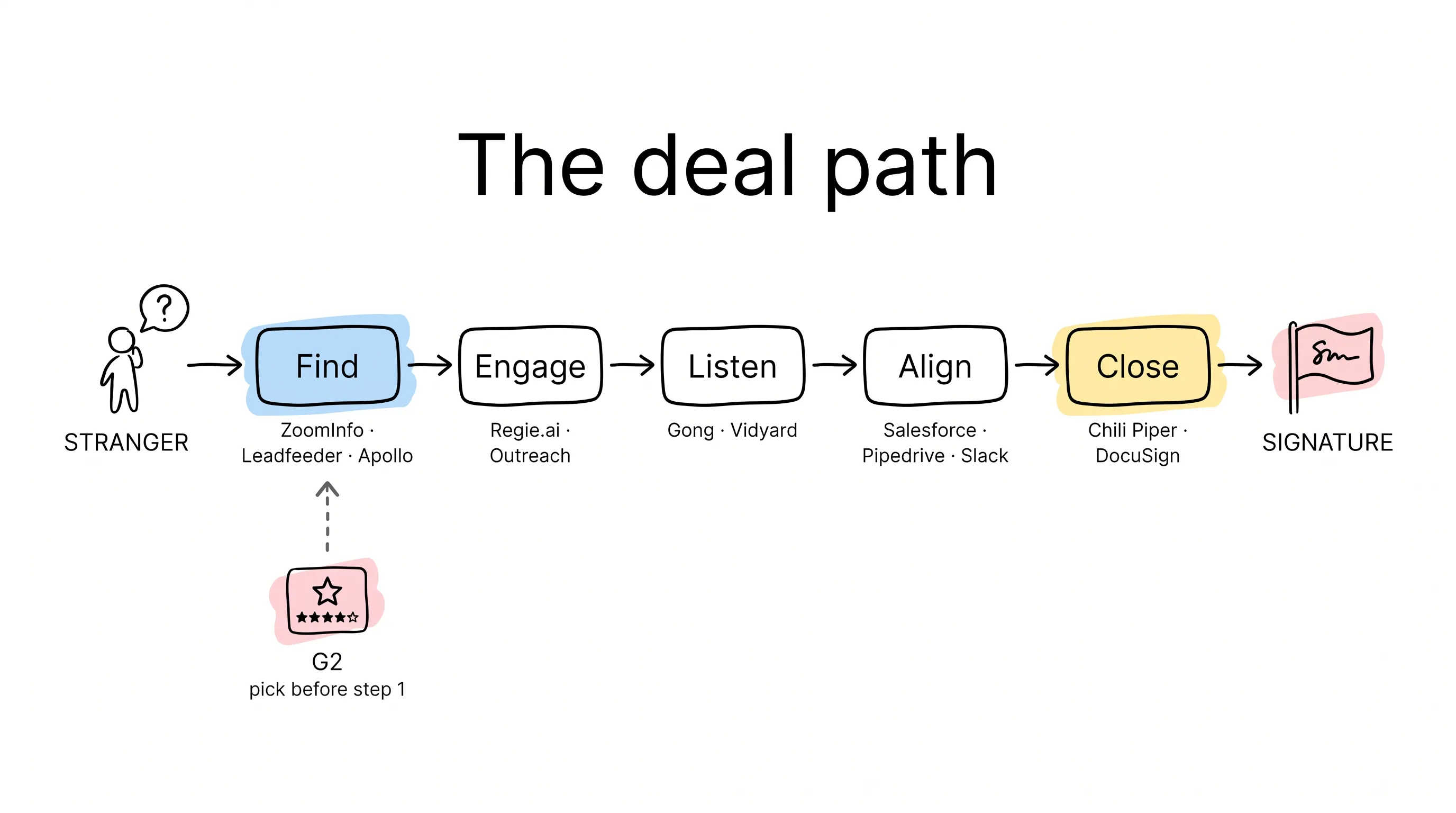
A sales stack is the path a deal walks, from stranger to signature. Every tool either paves that path or puts a pothole in it.
Once you see the stack this way, choosing software stops being a shopping trip and becomes an engineering problem: where does the path break, and which tool fixes that break?
Let's walk the path, stage by stage. I'll show you the fifteen tools I'd actually keep on a team this year, and why each one earns its seat.
First, know who to call
Nothing happens in sales until somebody calls the right somebody. So start there.
ZoomInfo is the big map. Company data, contact data, intent signals — it tells you who is out there researching something like what you sell, right now. Instead of guessing who might care, you get a list of people already acting like they care. That alone sharpens targeting and lifts conversion.
Leadfeeder works from the other side of the fence. It watches who visits your website and tells you which companies they belong to. Think about what that means: a prospect read your pricing page twice this week. That's not a cold lead. That's someone raising their hand — quietly. Leadfeeder hands you the name, your CRM gets the context, and your rep calls a warm lead instead of a cold one.
Apollo.io bundles the whole outbound motion into one platform, which is why startups love it. Contact database, targeting, engagement, CRM sync, all under one roof. The numbers its users report are worth underlining: a 75% jump in meetings booked, and roughly 12 hours per rep per week pulled back from admin work. Twelve hours! That's a day and a half, every week, handed back to actual selling.
One warning, though. A bigger database doesn't fix a bad message. Which brings us to the next stage.
Second, start conversations that don't sound like robots
Here's the uncomfortable truth about outbound in 2026: buyers can smell a template from across the internet.
Regie.ai attacks the problem with AI agents that do the grunt work — researching leads, drafting messages, deciding when to follow up. Its workflows adjust timing, wording, and priority based on how prospects actually engage. And it keeps the CRM clean, so every touch stays on-brand. Reps stop spending their mornings hunting leads and stitching together sequence emails, and start spending them in conversations. For account executives, prospects arrive ready to talk, so nobody burns an afternoon on dead ends. Marketing keeps its touchpoints consistent without policing anyone.
Pair Regie.ai with ZoomInfo and you close the loop: ZoomInfo tells you who's worth chasing, Regie.ai handles the chasing. You widen your reach without growing headcount. That's the kind of math a CFO smiles at.
Outreach and Salesloft are the two big names in structured sales engagement, and they exist for the same reason: when follow-ups live in inboxes and spreadsheets, they get dropped. Both put the whole cadence — templates, tasks, tracking — in one place, synced to your CRM, so every interaction is logged and every rep knows what happens next. Honestly, the difference between the two matters less than the decision underneath: stop letting follow-up discipline depend on human memory.
HubSpot Sales Hub folds CRM and engagement into a single system, which removes a whole category of sync headaches. Email tracking, meeting scheduling, task automation. Companies using it have reported a 25% lift in click-through rates and a 60% rise in leads coming from social channels. One customer, EvaluAgent, saw leads and conversions both climb after moving onto it. And because the interface doesn't fight you, reps actually use it — which is half the battle with any software ever shipped.
Third, hear what buyers are actually telling you
Most teams fly blind on their own sales calls. They win a deal and don't fully know why. They lose one and blame pricing.
Gong is the coach in the room. It records and analyzes your conversations, surfaces what's working, flags coaching moments, and warns you when a deal is quietly going sideways. Gong's own State of Revenue AI 2026 report put a number on the shift: 87% of U.S. companies now weave AI into revenue operations. When nearly everybody is doing it, the question is no longer whether to listen to your calls. It's whether you're listening better than your competitor.
Vidyard fixes a different kind of blindness: the written pitch nobody reads. It makes recording and sharing personalized video painless, and its analytics show you who watched what, and for how long. Video emails keep beating plain-text emails on response rates — and the reason isn't magic. A face builds trust faster than a paragraph. If a prospect watched your three-minute demo twice, you don't need a crystal ball to know when to call.
Fourth, keep the whole machine honest
Tools don't close deals. Teams do. But only if everyone sees the same picture.
Salesforce is still the reference point in CRM, and for good reason: automation, reporting, analytics that tell you where the pipeline actually stands. Here's a number every B2B seller should keep somewhere visible — a buying decision now typically needs consensus from 9 to 13 stakeholders. Nine to thirteen! No single rep can hold nine people's concerns in their head. Your CRM has to be the shared memory, and Salesforce is built to be exactly that: individual performance goes up, and the team pulls in one direction.
Pipedrive is the lighter answer. A CRM designed around the pipeline view, so a rep can see every deal's stage at a glance. Its 2026 releases keep layering in goal tracking and stronger reporting. For smaller teams that found Salesforce heavy, this is the one that gets used rather than resented.
Slack is the connective tissue. Deal channels, instant answers, integrations that pipe CRM alerts straight into the conversation. One recent case study found a team running Slack alongside their CRM lifted collaboration efficiency by 30%, and quarterly revenue followed. When a buyer pushes back at 4:58 p.m., the answer can't wait for tomorrow's standup.
Fifth, close without the friction
Two of the dumbest places deals die: the meeting that never gets scheduled, and the contract that sits unsigned.
Chili Piper kills the first. It routes inbound leads and books meetings automatically, straight into calendars, so scheduling stops being a five-email negotiation. The stat here is almost unfair: respond to a lead within five minutes of their inquiry and they're nine times more likely to convert. Nine times! A lead is hottest in the first few minutes after raising a hand, and every minute of delay cools them down. Chili Piper makes five minutes the default instead of a heroic exception.
DocuSign kills the second. Send, sign, manage — electronically, in hours instead of weeks. Nobody celebrates an e-signature tool. But go count how many deals in your history sat for two extra weeks waiting on a PDF. That's the real invoice.
And one tool for choosing all the tools
How do you pick any of the above with confidence? Ask the people who already did.
G2 aggregates real user reviews of business software, which turns tool selection into something more honest than a vendor's landing page. Two numbers matter here: 85% of buyers weigh the volume of reviews when deciding, and businesses that respond to reviews — the glowing ones and the angry ones alike — are 89% more likely to get chosen. Sit with that second number for a second. Engagement builds trust, in public, where every future buyer can see it. Use G2 as a buyer. And if you sell software, take notes.
So what do I tell my friend?
Same thing I'll tell you. Don't shop for tools. Audit your pipeline.
Walk one deal from stranger to signature. Find where it stalls — nobody to call, no reply, no insight, no sync, no signature. Then pick the tool that fixes that break, and only that one. ZoomInfo plus Regie.ai to find and engage. Outreach or Salesloft for cadence discipline. Gong for the truth about your calls. Salesforce or Pipedrive for shared memory. Chili Piper and DocuSign for the finish line. G2 before any of it, when you're still deciding.
The market in 2026 isn't waiting, and neither is your competitor's stack. But here's the part people forget: software doesn't create revenue. Removed friction does.
May your follow-ups never drop, and your five-minute window always be caught.
Continue reading
Related articles

What Is an AI Marketing Agent? From "Using AI" to "Delegating to AI"
A learn article explaining what an AI marketing agent is, how it differs from rule-based automation, and which repetitive tasks such as lead qualification, reporting, and campaign monitoring can be delegated while humans keep key decisions.
If AI Can Write the Copy, What's Left for Social Media Marketers?
A long-form guide on how AI reshapes social media marketing work, covering content creation, advertising, listening, community management, and data interpretation. It argues that AI accelerates production while humans keep strategy, judgment, review, and accountability.
Your Next Customer Might Not Be Human: What Changes — and What Doesn't — in B2B Marketing, 2026
A long-form analysis of 2026 B2B marketing predictions covering AI agents joining buying decisions, visibility in AI answers, email filtering, trust, and first-party buying signals.