
Lawmakers Worldwide Are Racing to Regulate Influencers. The Hardest One to Regulate May Not Even Be Human
A learn article on how regulators worldwide are tightening influencer rules — the UK ASA's broad definition that covers virtual humans, France's 2023 law with fines and prison terms, and EU and Australian developments — and on the accountability gap when AI-generated virtual influencers replace real people.
A while back, I was scrolling short-form videos and came across a livestreamer selling lipstick.
Crisp video quality, flawless skin, a smooth script. Halfway through, it finally hit me: this was a virtual human. Not a real person — something AI made.
My first reaction was: wow, the technology really is that good.
My second reaction was: if regulators ever wanted to go after her, how exactly would they?
Don't dismiss this as some distant hypothetical. Over the past couple of years, legislators and regulators around the world have had the influencer business in their sights. Some are issuing fines; some are drafting laws.
Let's start with the harshest of the bunch.
What Counts as an Influencer? The Regulators' Answer Is Broader Than You'd Think
In the spring of 2023, the UK's Advertising Standards Authority (ASA) put out new guidance devoted specifically to influencers.
So what counts as an influencer?
By the ASA's definition, if you're active on social media and talk to your followers about products, services, or experiences, you're an influencer.
Note: there's no follower-count threshold. A million followers qualifies. Ten thousand qualifies. Five hundred probably does too.
The more interesting part is what comes next: an influencer doesn't have to be a person.
It can be a pet. It can even be a virtual human.
Think about what that means. It means that in the regulators' eyes, what gets regulated is influence itself. Whether that influence sits behind a real face, a cat, or a stretch of code — irrelevant.
Where there's influence, there's accountability.
France Gets Serious: Two Years in Prison, €300,000, Plus a Ban From the Profession
Now look at France.
In June 2023, France passed a law aimed squarely at influencers. It was the first time in Europe that the role of "influencer" was written into legislation.
Who does this law go after?
The high-exposure minority — the top-tier bloggers whose endorsements blow up in their faces, who run scams, who push counterfeits.
What exactly does it cover? For example, egging followers into dangerous weight loss, cosmetic surgery, or excessive gambling — plus selling fake goods.
How steep are the penalties?
For most violations: up to two years in prison and a €300,000 fine. In serious cases, the influencer can also be banned from the profession — temporarily or permanently.
€300,000 is more than two million Chinese yuan. What a single sponsored post earns might not cover one fine.
What's more, the law handed France's Directorate General for Competition Policy, Consumer Affairs and Fraud Control (DGCCRF) tougher powers: it can now fine influencers directly and issue formal notices.
There's one detail that deserves a closer look.
In December 2022, the DGCCRF fined Amazon €3 million, on the grounds that the platform had dragged its feet on fixing contract terms that were unfair to sellers. Amazon refused to accept it at the time and said it would appeal.
What does this have to do with influencers?
Practicing lawyers in France spelled it out: the regulator was sending a signal. From here on, if an influencer is slow to clean up their act, or sluggish in responding to regulatory notices, a similar penalty could land at any moment. This "we'll see how fast you fix things before we fine you" logic is written plainly into Article 13 of the law.
Make an example of a giant first, then use that precedent to keep the whole industry in line.
A very French move.
The Most Unwitting Offenders: Not Scammers, Just Careless
You might say: fine, I don't scam anyone, I do my endorsements honestly — surely I'm in the clear?
Not necessarily.
There's a kind of violation called the unwitting violation. Failing to mention key information, for instance. Or talking the results up.
Here's an example. A face cream — some people genuinely do see results from it. But those results may only appear under a particular skin type, a particular sleep schedule, a particular way of using it. If the blogger leaves out those caveats, the ad can count as misleading.
The information is true; the conclusion it produces is misleading. And this happens all the time.
How heavy are the consequences? Misleading content, at the light end, lands you inside a regulatory framework; at the heavy end, someone sues you in court for violating consumer protection law. And the defendant isn't just the blogger — the platform can get pulled in alongside.
So don't assume you're safe just because "I never faked anything." What regulators and courts look at is: after reading it, do readers come away misled?
Everyone Is Playing Catch-Up, but at Different Speeds
In Europe, beyond France, there are two more major laws at the EU level: the Digital Markets Act and the Digital Services Act. The latter took effect in February 2024, and among other things it covers illegal content, advertising transparency, and disinformation.
Over in Australia, the government released a consultation paper in June 2023, planning to give the Australian Communications and Media Authority (ACMA) new powers aimed squarely at false and misleading information. Media lawyers there put it bluntly: the general laws do reach influencers, but there are still gaps.
And the UK? The most textbook case of all.
The UK isn't short of laws. The consumer protection regulations from 2008 were already enough on paper. What's missing is enforcement. So the rules got broken — then what? Pursuing a claim costs too much, and enforcement can't reach.
So the fix at the time was a new bill: give the Competition and Markets Authority (CMA) the power to fine directly, without the detour through the courts. By the pace of things in 2023, the bill looked on the verge of becoming law.
Have you noticed? Each regulator plays its hand differently, but the direction is the same: drive down the cost of regulating influencers, and drive up the price of breaking the rules.
Now Comes the Really Hard Part: AI
And then, the genuinely interesting part.
The regulators themselves are using AI. The ASA has been applying machine learning to step up its enforcement, and efficiency has genuinely improved.
But the coin has another side.
AI and deepfakes can conjure a "person" out of thin air. An influencer, no less. And then use that fake influencer to do what a real influencer wouldn't dare: skipping ad disclosures, making false claims, selling counterfeits.
When something goes wrong, who gets fined?
A human influencer at least has an identity; the fine has somewhere to go. A virtual persona generated from nothing, deleted on a whim, face swapped at will — where exactly do you send it?
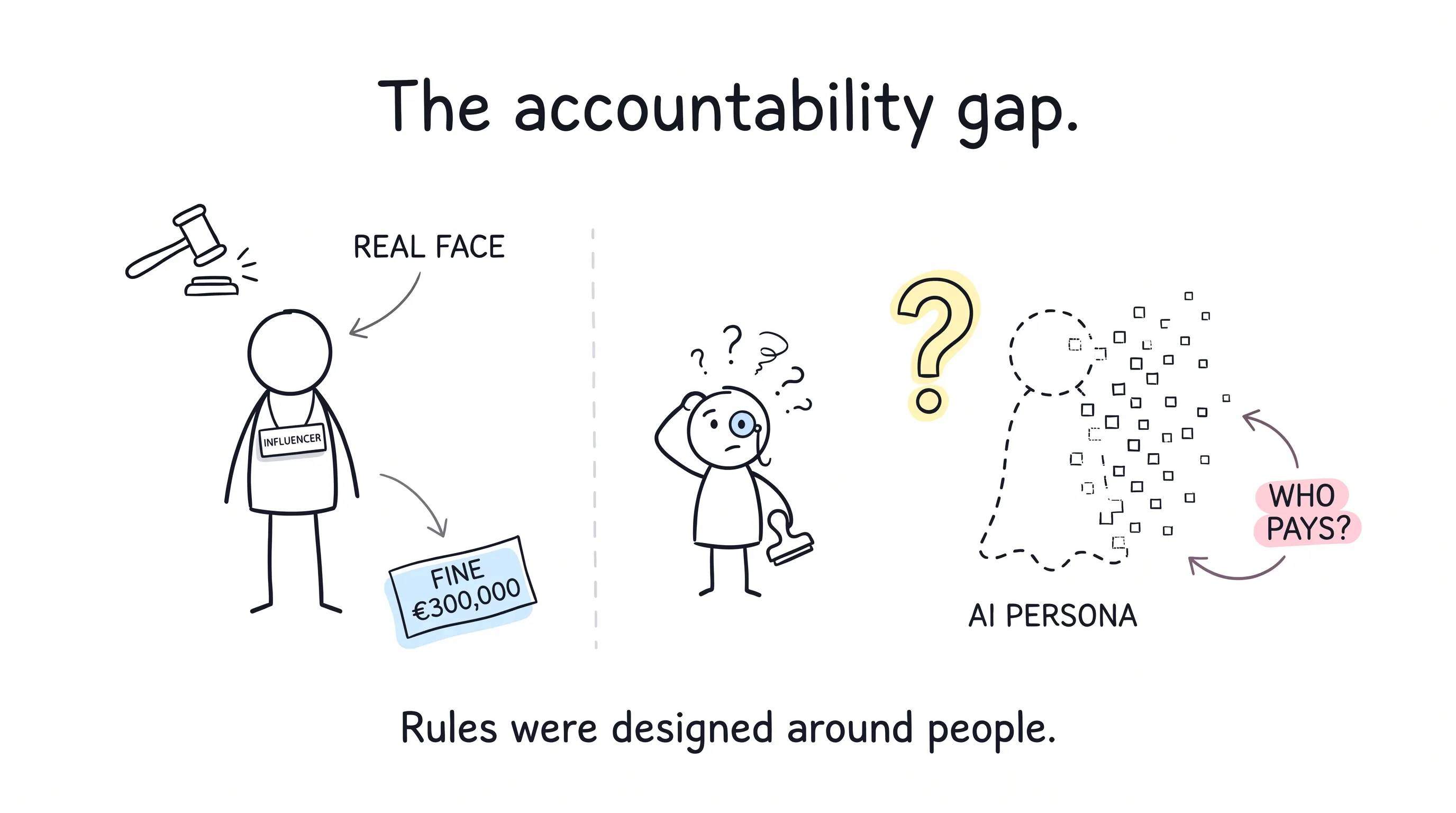
The rules were designed around "people." But the influence they're meant to govern no longer necessarily comes from a "person."
Back in 2023, a lawyer in London warned about precisely this: on one side, regulators using machine learning to speed up; on the other, fabricators using AI to manufacture people. That tests the regulators and the regulated at the same time.
Three years on, looking back, that warning hasn't gone stale — it has only cut deeper.
A Few Closing Words
Back to the lipstick-selling livestreamer from the opening.
She may have no business license, no real identity — maybe no "she" at all. But her influence is real.
Influence is accountability. Regulators around the world are nailing that principle into the law, one fine, one prison term, one industry ban at a time.
What AI changes isn't the principle. It's what the responsible party looks like.
If you're in this line of work, remembering one line is enough: The account can be virtual. The accountability can't be dodged.
Here's wishing that you're always the one the rules protect — never the one the rules are chasing.
Continue reading
Related articles

When AI Does the Creative, Mistakes Come in Batches Too
A learn article on the risks of using generative AI for marketing creative across brand, legal, compliance, and operational layers, with case examples and seven practices for review, rights clearance, documentation, and vendor governance.
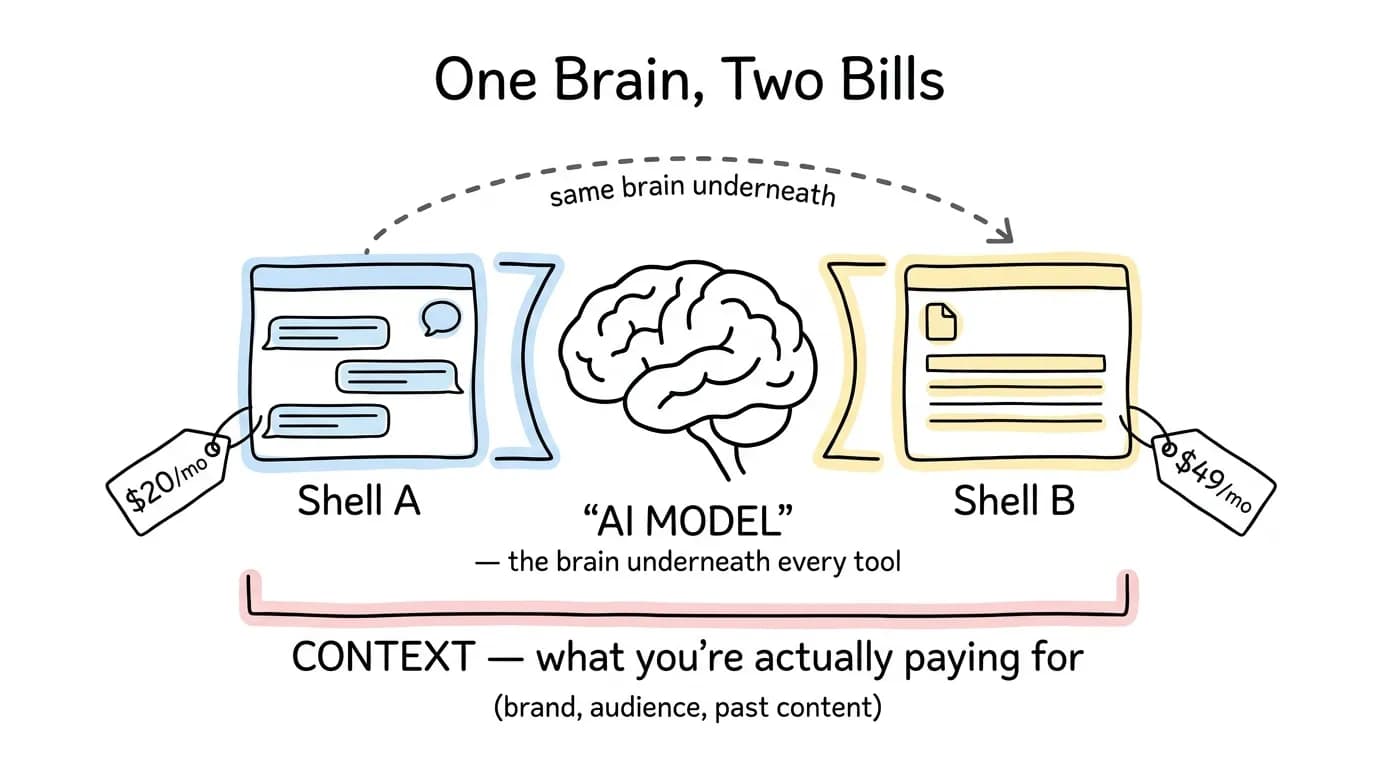
Which AI Should Your Startup Actually Use for Marketing?
A startup marketing guide explaining the difference between AI models and tools, sorting tools by job (writing, research, design, leads, email, video ads), and outlining a 30-day test plan for choosing them. It also covers generative engine optimization and budget trade-offs.
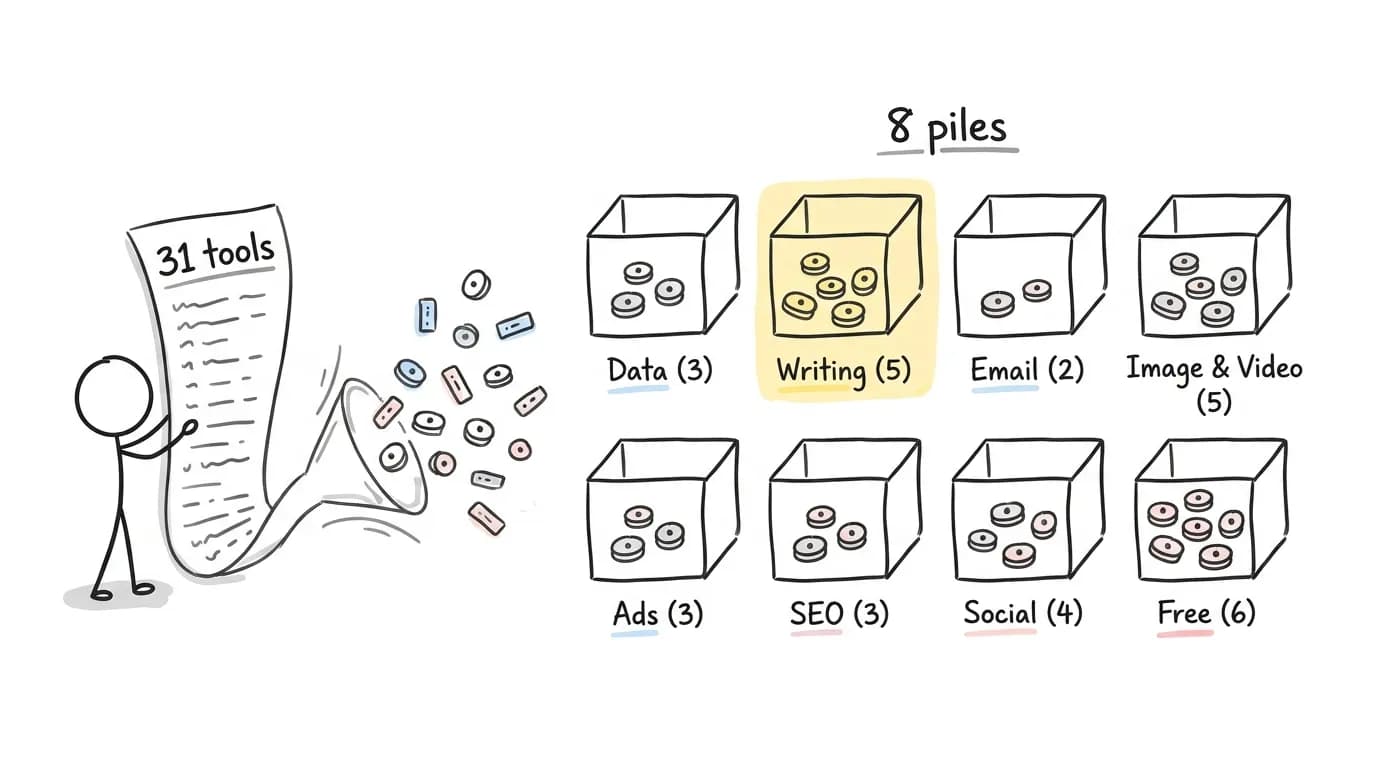
31 AI Marketing Tools, Reviewed One by One: How Exactly Should You Spend the Money?
A review of 31 AI marketing tools grouped into eight categories, covering data, content, email, video, ads, SEO, social, and free options, with guidance on choosing one strong tool for your most frequent task and testing free tiers first.