
What Can AI Actually Do for B2B Email?
A learn article on how AI is changing B2B email marketing: content personalization tops a cited 2023 Ascend2 survey of AI use cases, platform vendors are reworking the email workflow, and the piece argues AI amplifies both sound and flawed email practices.
Imagine you're running marketing for a B2B company.
At the quarterly review meeting, the boss asks: how's customer acquisition cost looking? You're not exactly thrilled to report the numbers. Trade shows deliver less every year, ads keep getting more expensive, and audiences are savvier than ever. Run through the channel list again and again, and the one that's still quietly producing leads turns out to be the least sexy of all.
Email.
Plenty of people look down on it. But when it comes to ROI, email has always been one of the most reliable, highest-performing channels in B2B marketing. Why? Think about how B2B deals actually get done. Not through one big splash, but through hundreds — even thousands — of moments of staying top of mind, over a year or two. Your customers don't visit your website every day, but they open their inbox every day. And if you don't claim that space, someone else will.
So here's the question. This old channel — what can AI actually change about it?
Let me start with a survey. In July 2023, a research firm called Ascend2 asked a group of email marketers: where do you use AI the most?
Take a guess.
Writing subject lines? Drafting copy? Picking send times? None of those. The number one answer is content personalization. 50% of respondents are using it.
What does content personalization mean?
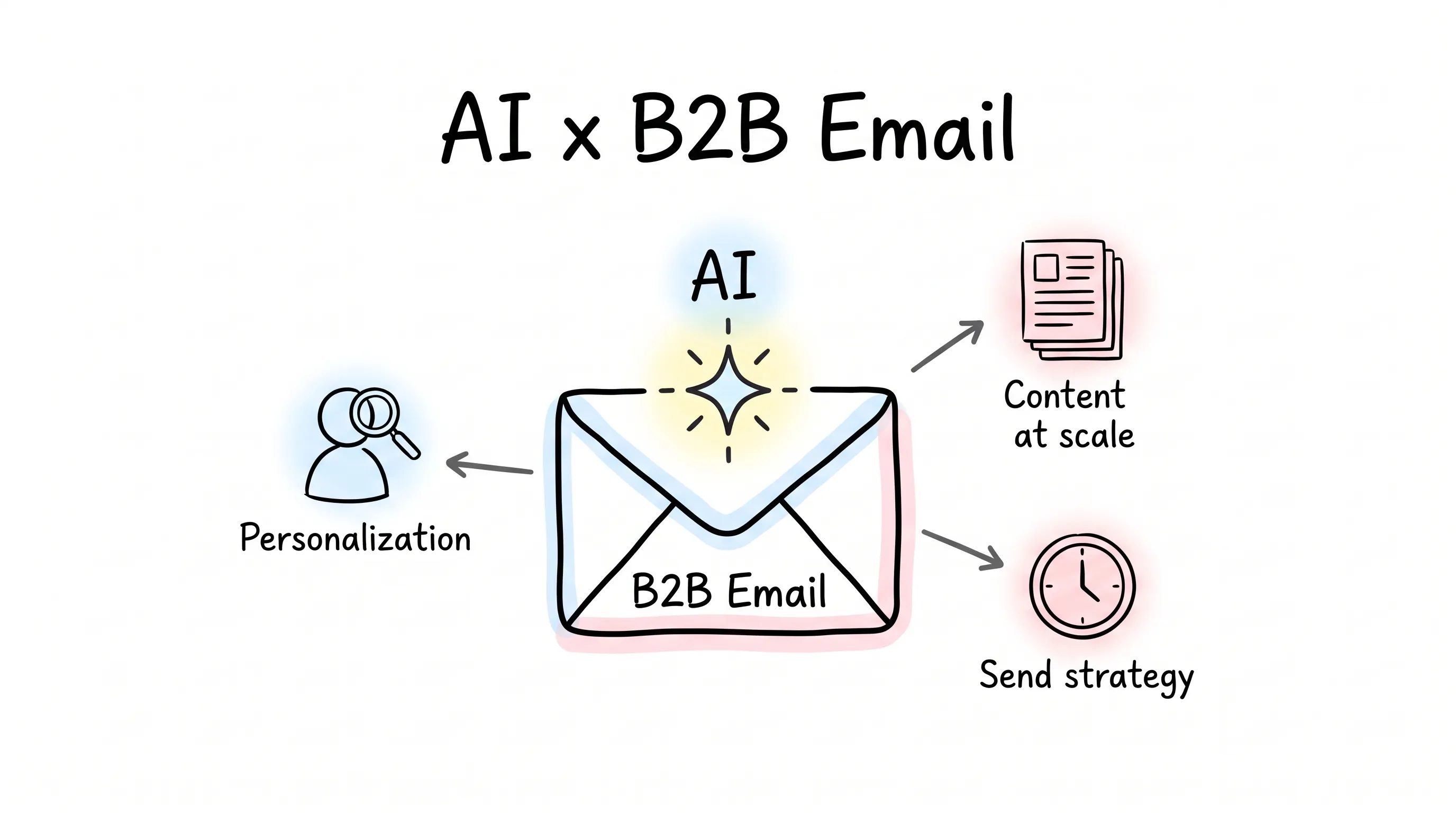
Put simply, the same email sent to 1,000 people should ideally have 1,000 versions. The CFO opens it and sees the cost section first; the technical lead opens it and sees the integration section first. The principle isn't complicated — the hard part is execution. In the past, you'd have to edit each one by hand, and there was no way to keep up, so everyone sent the same email. Now AI has knocked that barrier down. That 50% figure is really the speed at which that barrier came down.
Personalization is just the first stop. If you look at the several rounds of 2023 surveys together, you'll see enterprise marketers want to cram AI into every step of the email workflow: what content to write, what assets generative AI should produce, what time to send, what smart features the platform should give them. From production to delivery, the whole pipeline is changing.
Run the numbers. Writing a single nurture email used to take half a day, from topic to layout to send. 52 weeks a year, two emails a week — that's over 500 hours of work. After AI takes over most of the repetitive labor, what do you do with the time you save? Spend it on strategy, on meeting clients, on figuring out what the next email should say. Machines do the grunt work; people do the judgment work. That's the right place for AI in email marketing.
It's not just the tools that are changing — the companies behind email marketing platforms are all making the same bet. Acquia, Brevo, Insightly, Persado — when executives at these platforms were asked about AI around 2023, their judgment was nearly unanimous: it will rewrite the way this industry works. The toolmakers are all accelerating. If you're still sending emails the way you did three years ago, the gap will only keep widening.
But there's always another side to the story.
Amid all the talk about AI, those platform executives almost always add the same line: the fundamentals of email marketing cannot be lost.
What are the fundamentals?
Keep your list clean — don't buy contacts. Make your content valuable to the customer — don't just talk about yourself. Send with a rhythm — don't bombard. These sound like common sense. They are common sense. They were common sense 20 years ago, and they're still common sense today.
So why, in the AI era, do we need to preach the fundamentals more than ever?
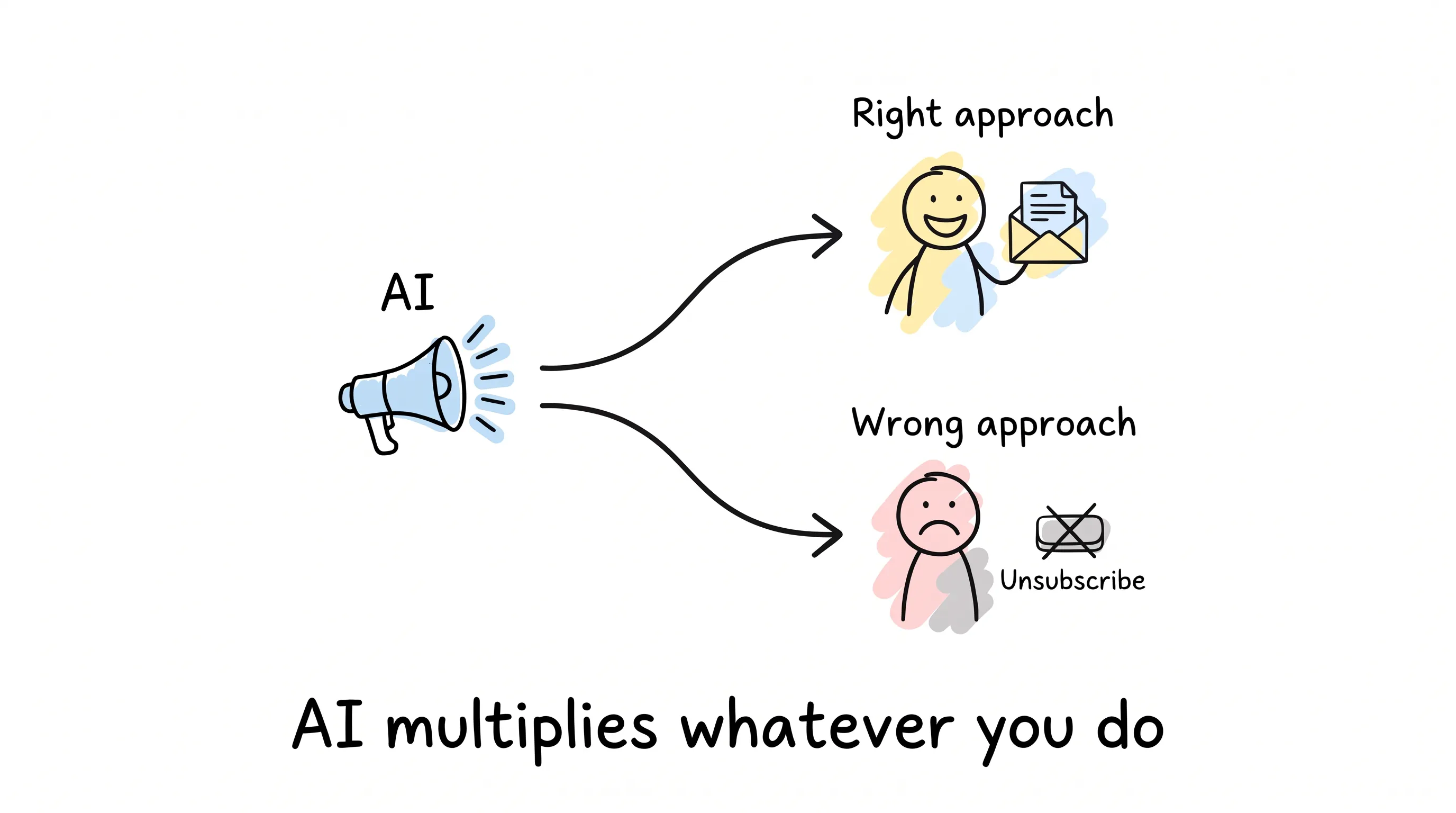
Because AI is an amplifier. If your approach is right, it multiplies your efficiency several times over. If your approach is wrong, it multiplies your mistakes just as fast. 1,000 emails that annoy people will do more damage to your sender reputation than 100, and get customers to hit unsubscribe even faster. Mistakes used to mean nothing worse than low efficiency. Now they're a disaster at scale.
So, back to that quarterly review meeting.
My advice is one sentence: take AI, use it for personalization, for content production at scale, for send strategy — hand over all the repetitive work. Then spend the time you save on the thing AI can't replace: figuring out what your customers actually care about.
The stronger the tools get, the more they test the people using them.
Here's hoping your next email gets opened — not deleted with one click.
Continue reading
Related articles

What Is AI Marketing Automation? It Starts With a 40-Point Gap
A learn article explaining what AI marketing automation is: how learning-based systems differ from rule-based automation, how AI decisioning optimizes message, channel, and timing choices, what data it depends on, and where it applies across the customer lifecycle.

Marketing Automation Is Shifting from "You Do It" to "You Say It"
This article explains how marketing automation is shifting from rule-based platforms that merely execute toward AI agents that plan, create, publish, and review campaigns, covering delegable tasks, underlying technologies, tool categories, adoption steps, and risks such as privacy and automating without strategy.

Rankings Are Taking a Dive, Customers Are Sprinting Ahead: This November, I Re-Ran the Numbers on AI Search
A learn article on how AI search reshapes marketing measurement, covering reported mismatches between rank-tracking tools and live Google results, ChatGPT's business profile test, single-page visitors as high-intent leads, and CRO plus GA4 tracking verification practices.