
The $15 CAC Channel May Cost More Than the $60 One
A while back, a friend of mine who runs a SaaS company invited me to dinner. Halfway through the meal, he pulled out his phone and showed me his ads dashboard.
A while back, a friend of mine who runs a SaaS company invited me to dinner. Halfway through the meal, he pulled out his phone and showed me his ads dashboard.
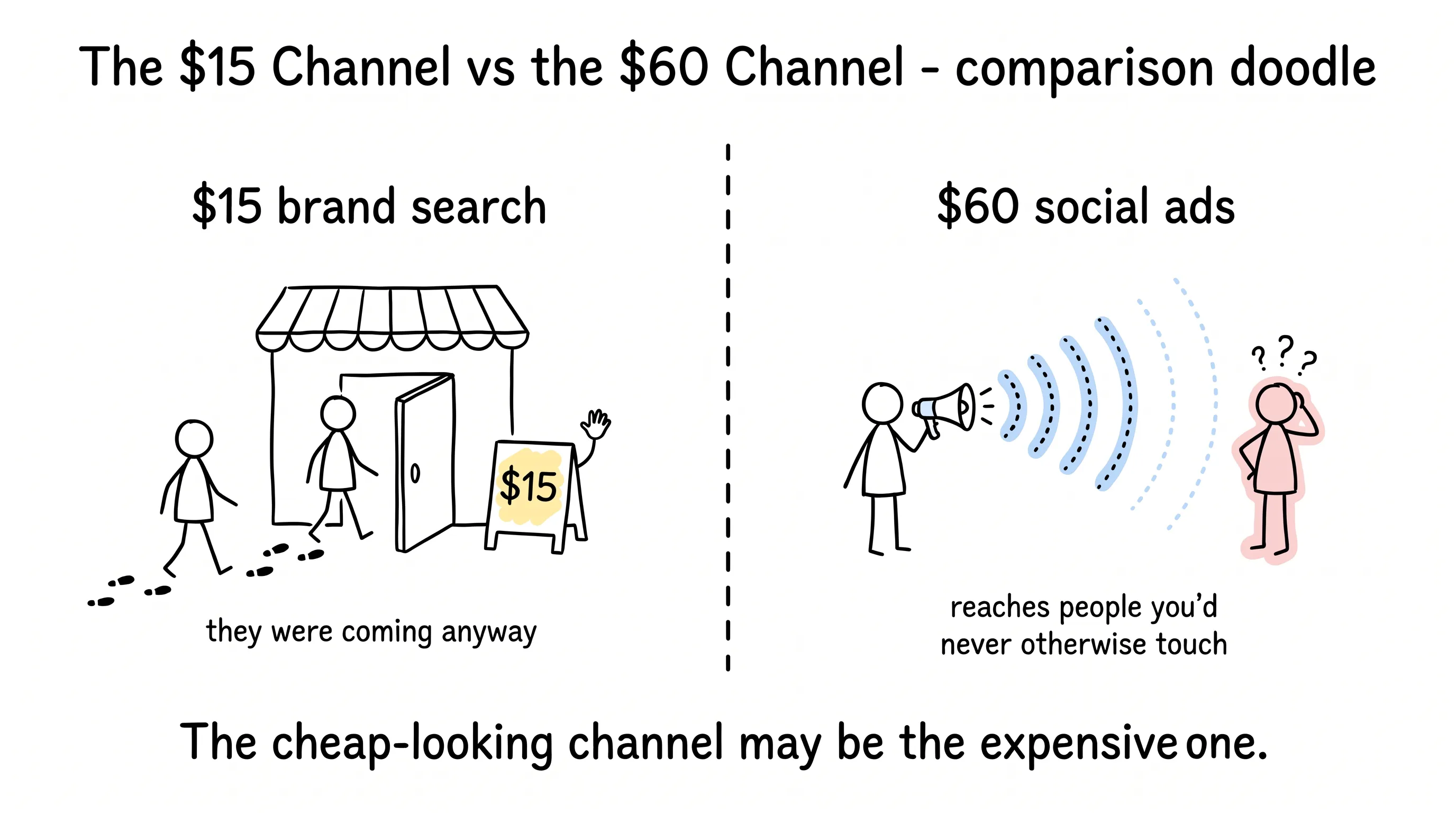
He pointed at a column of numbers, clearly delighted: "Look — our brand-keyword ads bring in customers at just $15. The social ads next to it? Sixty. That's a fourfold difference."
"Next quarter," he said, "I'm cutting the social budget entirely and moving it all into brand keywords."
I didn't jump in right away. I asked him one question first: those customers you win through brand search — if you weren't running those ads at all, would they still have shown up and bought?
He went quiet.
After thinking it over, he said: "Probably, yes. They're people ready to buy — they've already typed in our brand name."
And that's exactly where the problem lies.
What Is Customer Acquisition Cost, and What Does It Actually Count?
What is CAC?
It's the money you spend, divided by the number of customers you bring in. Fifteen dollars — one division and you're done.
Practically every marketing team tracks this number. But it has a huge blind spot: it treats "catching customers" and "bringing customers in" as the same thing.
Think about it. When someone searches for your brand name, what state are they in? They almost certainly already know you, and they're already planning to buy. Your ad pops up at that moment, and they place the order.
So tell me: did the ad bring that customer in, or did it just catch a sale that was already happening?
The report doesn't care. All the report sees is: the ad was running, the deal closed. Credit goes to the ad.
That's how you end up with such a backwards situation: the ad that looks cheap is actually expensive, and the ad that looks expensive may genuinely be a bargain.
That $15 on brand keywords looks cheap. But if those customers would have come anyway, then the money didn't really "win" many extra customers. Spread the ad spend across just those few incremental customers, and the true cost per head may be several times higher.
Flip it around: that $60 social ad may be reaching people you'd never otherwise touch — genuine new customers. Spread out that way, it might actually be the better deal.
How do you tell the difference? There's a method built for exactly this: incrementality testing.
What Is Incrementality Testing?
Put simply, it's asking one question:
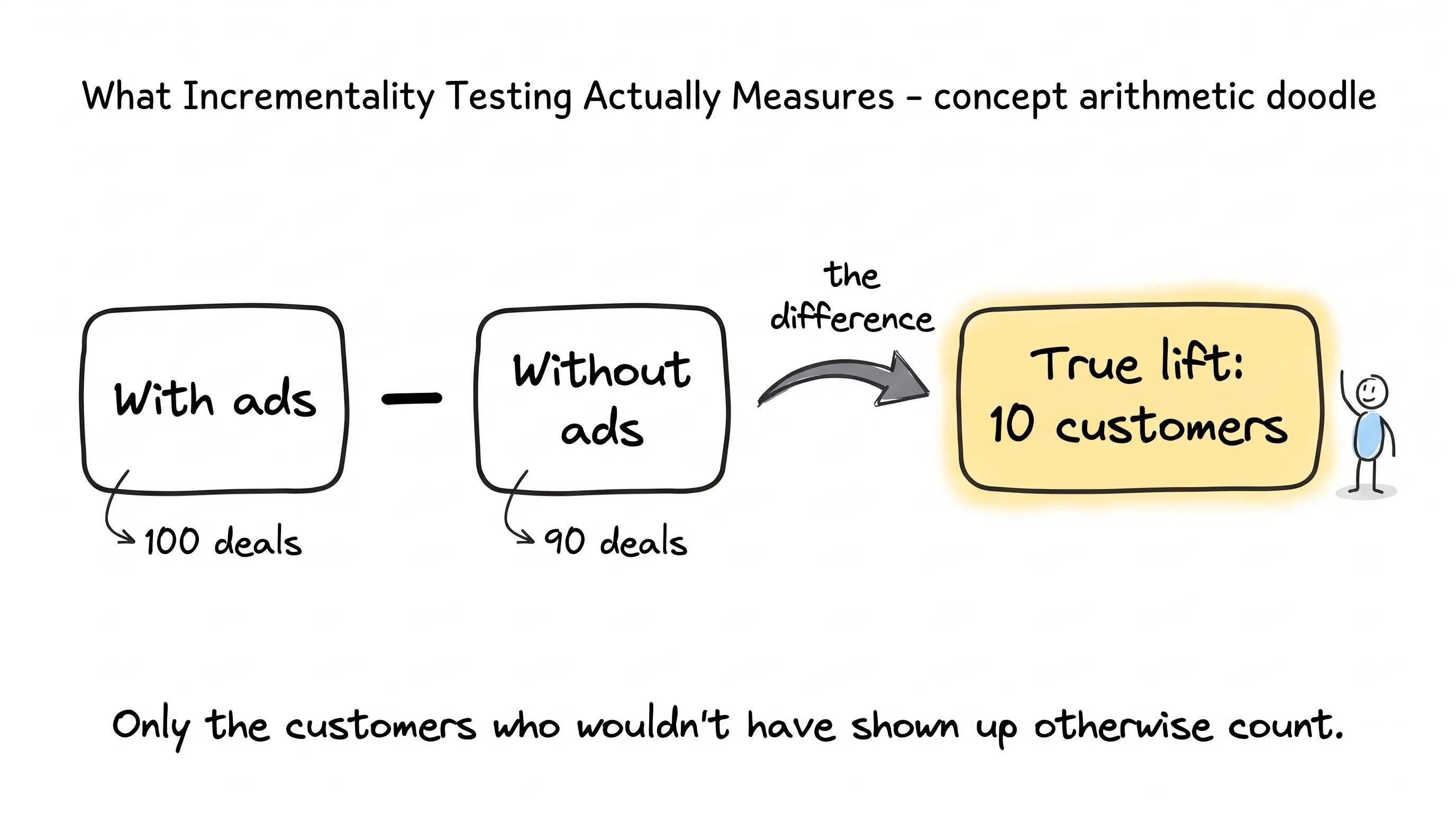
With the money spent versus not spent, how much does the customer count change?
Say you run the ads and close a hundred deals. What if you didn't run them? If ninety deals would have closed anyway, the ads' true contribution is just ten customers. That extra ten — that's the incremental lift.
How do you know what would have happened without the spend? You run an experiment.
Google has run experiments like this. Two of them, with completely opposite conclusions.
Brand search ads: they cut spend by roughly ninety percent, and customer acquisition barely moved. Along the way they discovered something they hadn't realized before — those paid ads had been cannibalizing their own organic search traffic. The moment the ads stopped, customers found the company through organic results on their own.
So why keep paying? Cut.
What about non-brand search ads? A conversion lift study from Google put the lift at 55 percent. Which means the ads really were conjuring up demand — conversions that would never have appeared otherwise. Based on that, the team accepted a higher customer acquisition cost and poured in more money. Later, new customers did grow, just as the experiment predicted.
Same broad category of channel: one deserved the axe, the other deserved more investment. A CAC report could never tell them apart. An incrementality test makes it crystal clear.
Of course, don't turn these conclusions into law. Brand search isn't useless forever — if a competitor starts bidding on your brand name and intercepting your customers in the search results, brand-keyword ads suddenly have defensive value. And an ad that tests as effective today may lose its edge as you pour more and more money in; everyone runs out of buyers eventually.
So retest on a regular schedule. Every so often, ask again:
Without this money, how many customers would we lose?
That question lets you pull the plug decisively on one side and double down with confidence on the other.
Set the Rules Before You Run the Test
One more thing — this one is critical, and plenty of teams stumble right here.
Before you run an incrementality test, first decide what you'll do once the results are in.
Why?
Because once the numbers come out, people start bending the story around them. If the numbers look good, everyone wants to make them sound even better; if they look bad, someone will always find a way to argue "let's wait and see." If you haven't set the rules in advance, what you get isn't evidence — it's a vote.
How do you set the rules? Three steps.
Step one: make the question specific. Do you want to know "did this ad bring in customers who would never have come otherwise," or "if we pour in more money, can it still produce enough new customers?" Different questions call for different experimental methods. It might be a platform-run lift study, or a geo-based split test with some regions as controls. Each approach has its weaknesses: some take a long time, some need enough volume to detect a clear lift, and in some, the control and treatment groups leak into each other. Know the trade-offs before you start.
Step two: write down, in advance, what counts as "good." The most practical yardstick is incremental CAC: money spent, divided by the customers you genuinely gained. Compare that number against the value of a customer.
Let's run the numbers with an example. Say a new customer is worth $200 to you over their lifetime. The team could agree up front: incremental CAC under $120, scale up; between $120 and $180, hold steady; above $180, cut.
Lay down the rules before the numbers arrive, and nobody gets to make a gut call once they do. What should shrink, shrinks. What should grow, grows. What's genuinely murky, keep testing.
Step three: execute by the rules, and accumulate. Every round of testing teaches you a little more about where the money belongs. Six months in, your budget is no longer the product of whoever argues loudest — it's stacked up out of evidence.
Where Can AI Help?
At this point you might be thinking: I get the logic, but running experiments is a hassle. Designing the test, preparing the data, monitoring progress, writing the analysis — how is a small company supposed to afford a data science department?
This is precisely where AI has become most practical lately.
Start with experiment design, the biggest time-saver. You can simply ask ChatGPT or Claude to dig through historical sales data across your markets and find a few whose sales curves look alike. Once they look alike, one can serve as the treatment region and one as the control, and your geo-based split test has a foundation. It can also estimate how long the experiment needs to run, and how much volume each group needs before a meaningful lift becomes visible. And for the analysis code, it can write it, then walk you through it line by line.
Want something more rigorous? There are open-source tools, like GeoLift from Meta, built specifically for this kind of geo-based experiment. And if you'd rather not bother, platforms like Haus have packaged the whole workflow into software.
Next, monitoring the data. While an experiment runs, AI can review the numbers every day and flag you the moment something looks off: the control region suddenly spiked in sales — was there a local promotion that week? Conversion data dropped for a few days — did the event tracking break? Catch problems like these early, and you won't have to rerun the whole experiment.
Finally, writing up the results. Once the test is done, have it draft the report: how much lift, how wide the confidence interval, what the incremental CAC came out to — then check each against the thresholds you set in advance. Did anything cross the line? It can also break the results down by region, audience, and creative, and pick out the ideas worth testing in the next round. And beyond that, translate all that technical detail into a few sentences your CFO and your boss can actually understand.
But there is one thing I have to warn you about.
Anything AI calculates, a human must verify.
Don't cut this corner. Suppose conversions jump the week an ad campaign goes live — AI will very likely hand the credit to the ad. But the real cause might be the season, a price change you made, a competitor's stumble, or simply an error in the data.
Did the ad bring these customers in, or would it have happened anyway? That question, AI cannot answer. Only a clean experiment can. AI helps you compute faster, watch more closely, and write more smoothly — but the judgment about cause and effect has to stay firmly in your own hands.
Back to That Dinner
In the end, my friend didn't cut social.
He cut the bulk of his brand-keyword spend and moved the savings into channels that reach new customers. His budget didn't grow by a single dollar, yet new customers started coming in faster.
For a small or mid-size tech company, every dollar spent catching customers who were coming anyway is a dollar not spent reaching customers you'd never otherwise reach. Pile up that difference day after day, and it decides whether your growth snowballs or stands still.
This kind of testing used to be a privilege of big companies — the ones who could afford a data team and paid testing services. Now the barrier has come down.
Ask a clear question, run a clean experiment, do the math honestly, and then act according to the rules you set in advance.
Every dollar you spend should buy you a customer who wouldn't have existed otherwise.
And may every dollar of your ad budget go toward a genuinely new customer.
Continue reading
Related articles
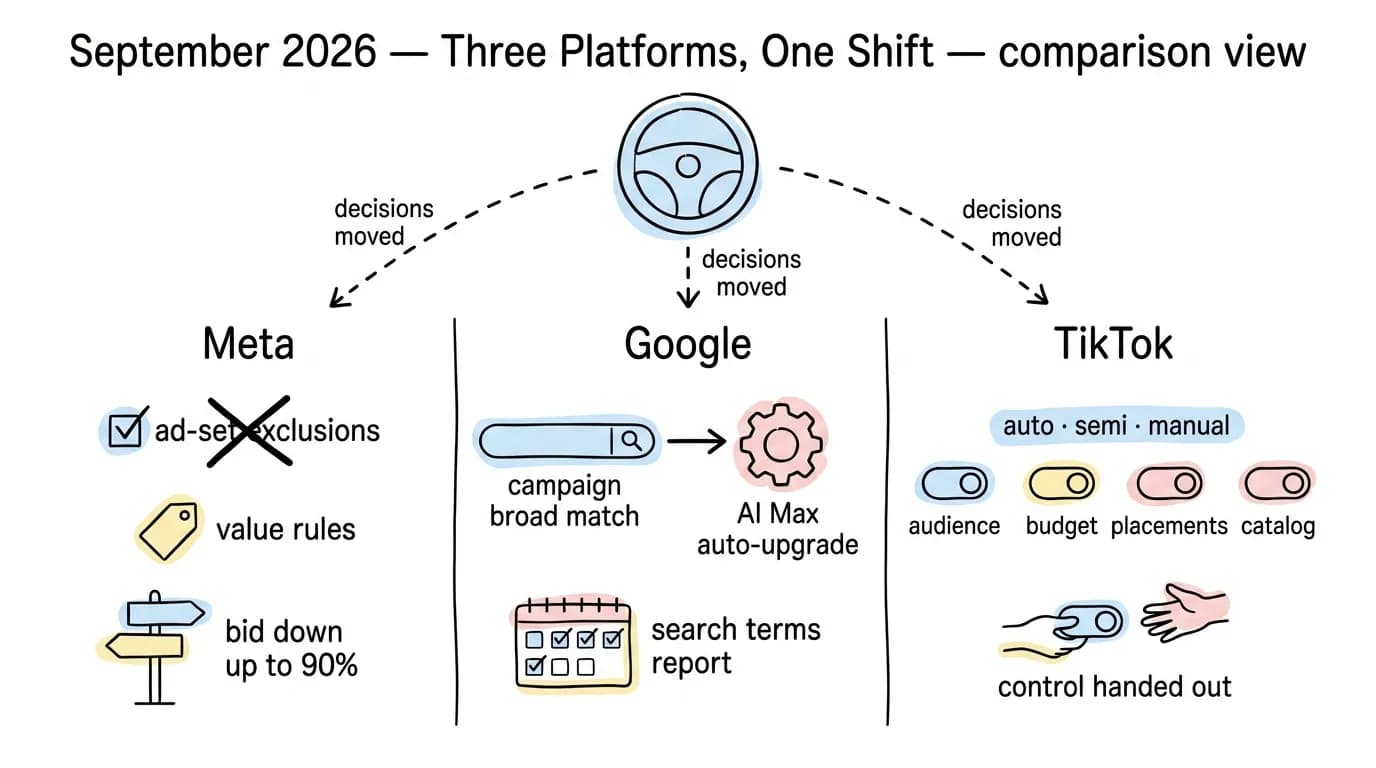
In September, Three Platforms Took Away Part of Your Steering Wheel
A few days ago, I went through everything the three big ad platforms did in September 2026. And I noticed a remarkably interesting coincidence.
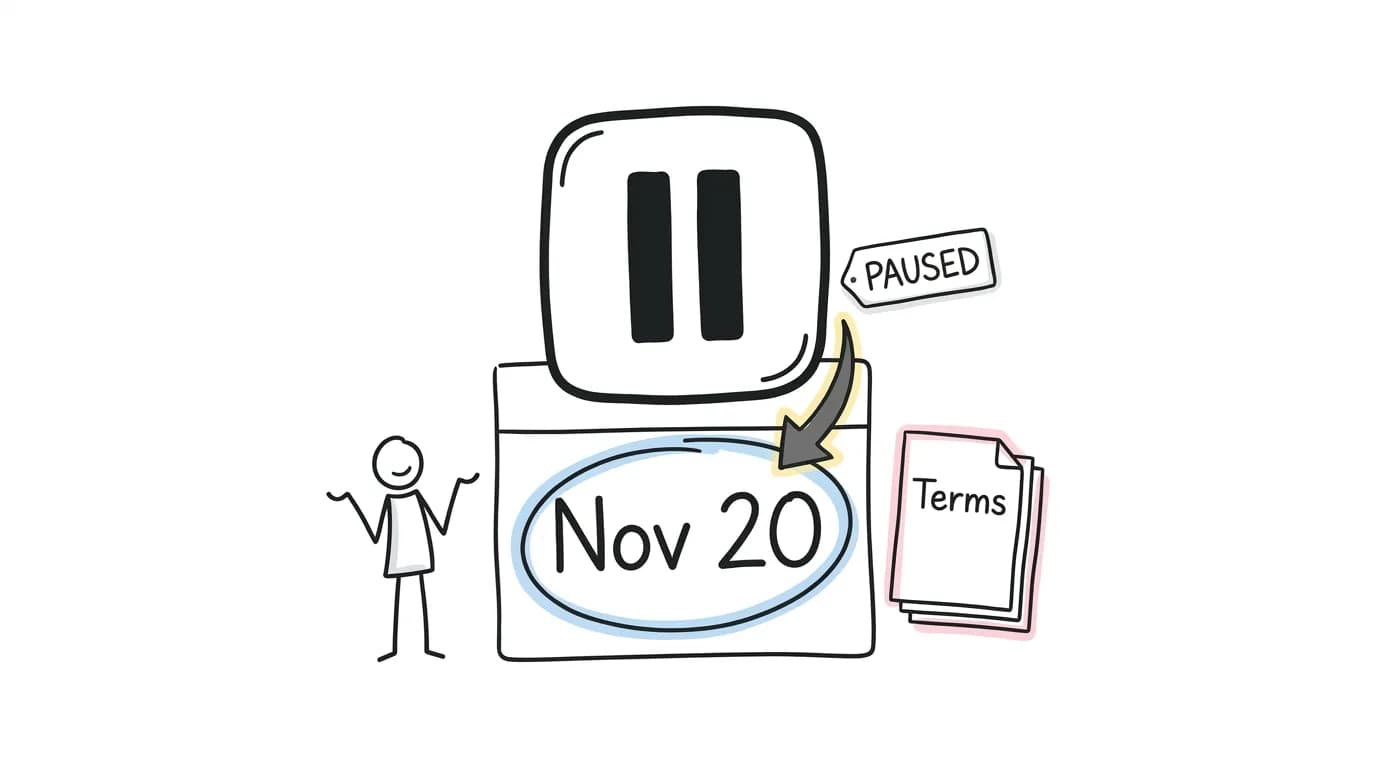
Meta's New Terms Hit the Pause Button on the Eve of the Effective Date
A while back, I was helping a friend of mine who runs a cross-border e-commerce business go through the compliance checklist for his ad account.
Google and Meta changed 17 ad rules this week. 6 of them need checking today.
A few days ago, I was helping a friend who runs a cross-border e-commerce business go through his ad accounts.