
Your Martech Stack, LEGO-ized: Composable Sounds Like Freedom — but the Bill Is Yours
An explainer on composable martech based on an industry roundtable: keep customer data and core logic in a central warehouse, assign a clear owner, budget for compute costs, and retain identity resolution, consent management, and foundational customer data in-house.
A couple of days ago, an old classmate of mine called. He runs marketing technology at an FMCG brand.
His company wants to take the all-in-one marketing suite he has relied on for years and break it apart, replacing it with a "composable" architecture. The boss thinks it's trendy. He's the one with knots in his stomach. His question to me: is this whole thing an opportunity, or a trap?
As it happens, at a martech industry conference last week, one roundtable was devoted to exactly this question. My conclusion after listening: the direction is probably right — but first, you need to learn how to count the costs.
First, What Exactly Is "Composable"?
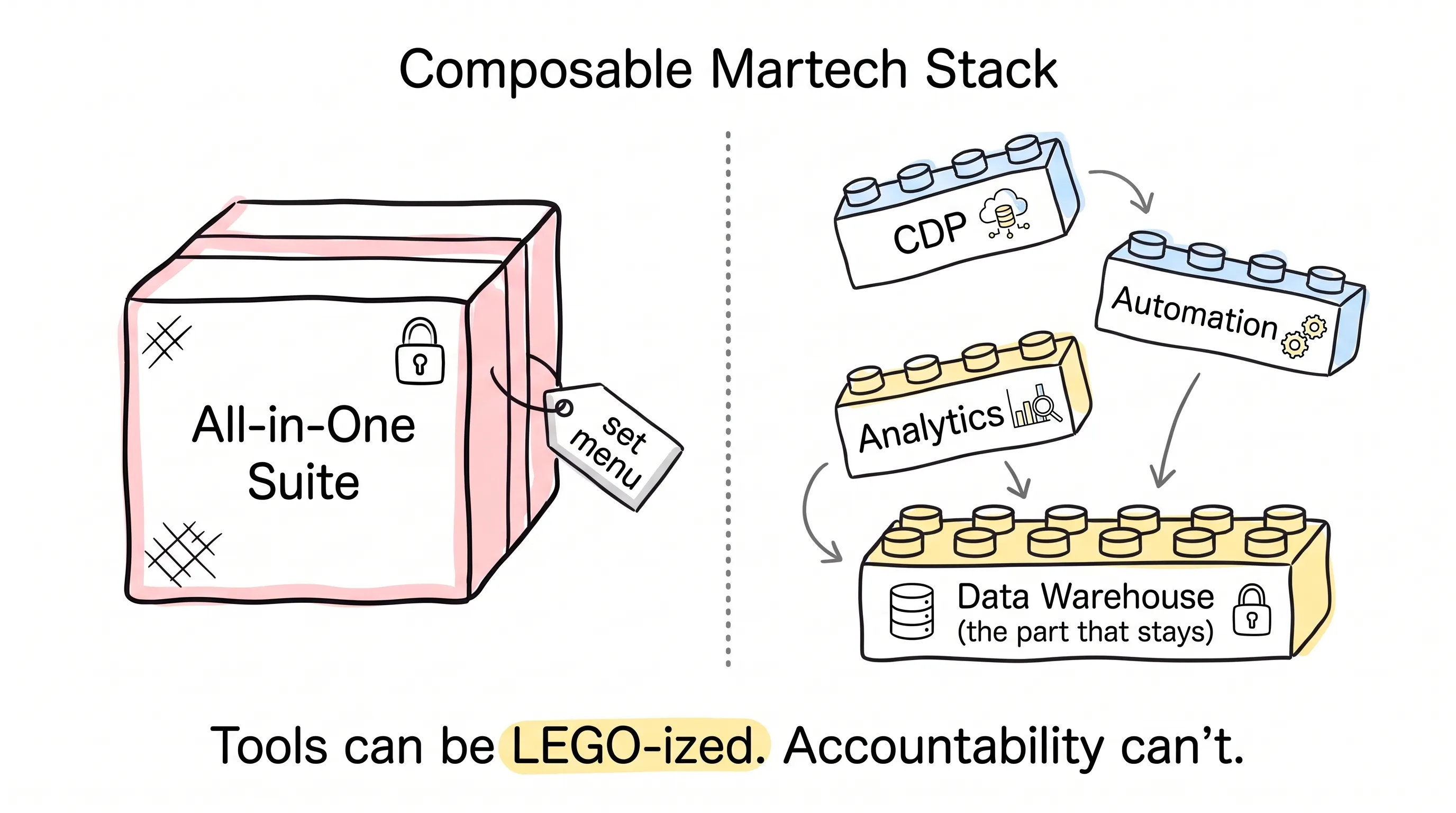
Marketing technology used to work like ordering a wedding-banquet set menu. Cold dishes, hot dishes, soup, fruit — the whole table arrives at once. Want to swap out a dish? You can't. It comes as a package.
Composable martech means breaking the set menu into à la carte ordering. Customer data from one vendor, marketing automation from another, analytics from a third — stitched together through interfaces. Unhappy with any one of them? Unplug it and swap it out; everything else keeps running.
Sounds great, right?
But the four seasoned practitioners on that roundtable — Kristina Kalpokaite, marketing technology lead at Loop Horizon; Yefim Natis, principal analyst at Natis Labs; Gene De Libero, founder of Digital Mindshare; and Craig Schinn, chief operating officer at Actable — not one of them urged anyone to "rip it all apart, and fast." What they talked about was precisely the accounts you need to settle before, during, and after the breakup.
Account One: Don't Mistake "Hybrid" for Half-Finished
When migrating toward composable, many people feel pushed by one voice: decompose everything, or touch nothing.
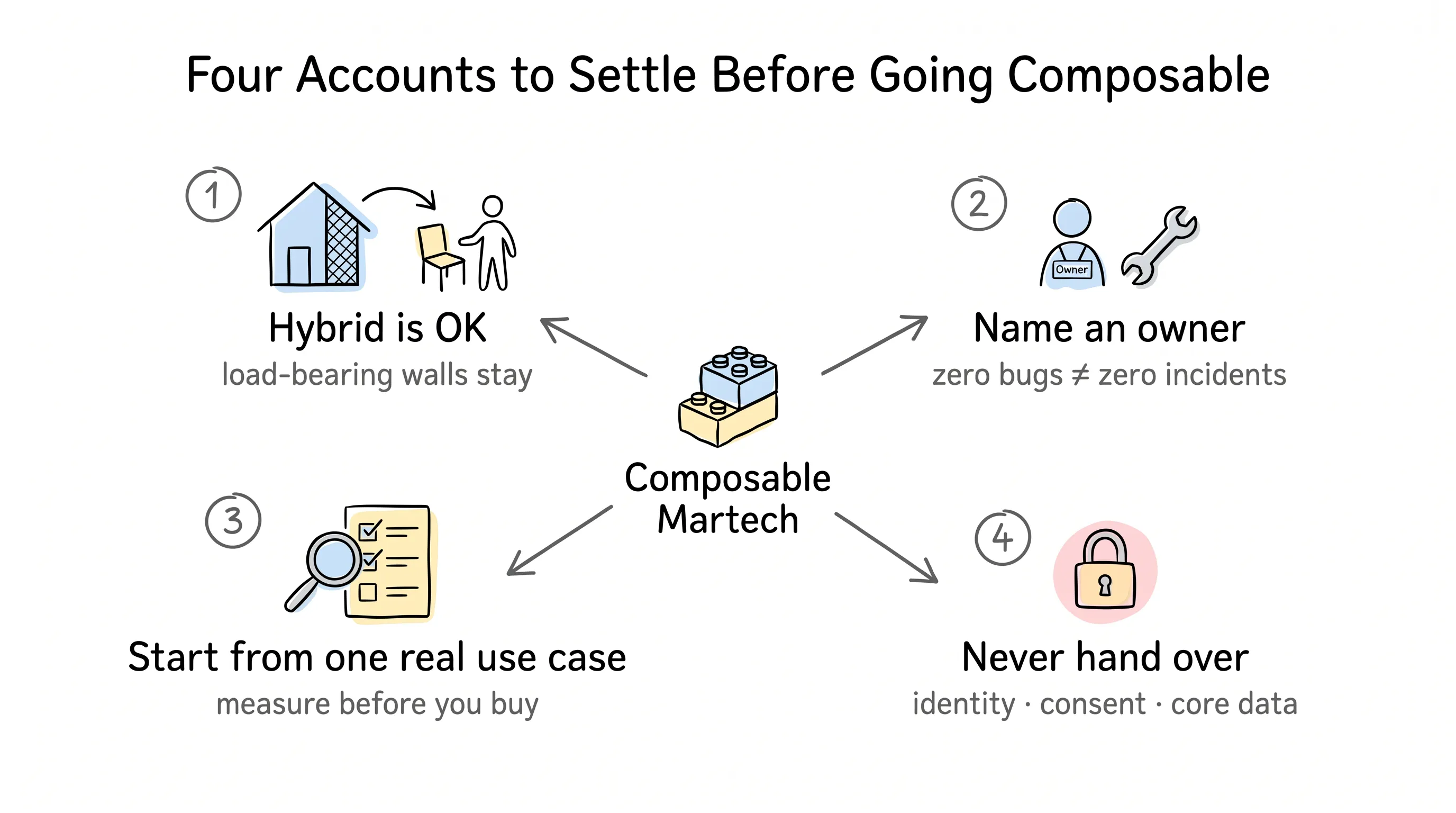
Kalpokaite offered a pragmatic model. Lock your customer data and core business logic inside a central data warehouse — that's your foundation. The execution tools doing the actual work plug into that foundation through interfaces. The foundation doesn't move; everything around it can be swapped freely. Data stays clean, audience segmentation stays stable, and edge applications can be replaced at will.
What does this look like? Renovation. The load-bearing walls stay put — the furniture you can change anytime.
Natis added a dose of blunt truth: business waits for no one. You can't shut down the whole restaurant for a year just to remodel the kitchen. And today's cutting-edge integration is tomorrow's legacy system. However thorough your decomposition, you can't hold back time.
De Libero put it even more bluntly: keeping part of the architecture hybrid is nothing to be ashamed of. For companies running small teams on tight budgets, or industries where compliance draws hard lines, having fewer integration points and leaving trusted core tools exactly where they stand is often the most resilient choice.
Architectural maturity isn't measured by how aggressively you decompose, but by how well the architecture matches the complexity you can afford to maintain.
Account Two: After the Breakup, Who's Accountable When Things Break?
This was, to me, the most valuable stretch of the entire discussion.
Interfaces and APIs only solve how data flows. Kalpokaite's warning: the people in engineering and data need to genuinely understand how marketing works day to day. If they don't know what a campaign is trying to do, then even with code that contains zero bugs, the wrong fields can still flow, flawlessly, into the wrong tools.
Zero bugs doesn't mean zero incidents.
So what do you do? De Libero gave a crisp answer: treat the composable architecture as an internal product to be nurtured, and name a real owner for it.
What does that mean? When you use the all-in-one suite, the data flows, the dependencies, the costs — the vendor carries them for you. The moment you break it apart, all of that lands on your own head.
Including the money. Run the numbers: once you move workloads into the central warehouse, every single query burns compute. With nobody watching, reports multiply — and at month's end, the infrastructure bill will quietly deliver you a surprise.
Surprise — as in jump, not as in party.
That's why Schinn framed it as a discipline: before you build any integration, first be clear about which customer signals are actually driving engagement. Wiring up every data point has never been the goal. Reliably feeding a handful of high-value signals into your marketing workflows — that is.
Account Three: When Choosing Vendors, What Do You Anchor On?
Kalpokaite's advice: start from one concrete campaign use case and list out, field by field, the data you actually need. That way you won't commit one particular blunder: syncing an entire expensive, heavyweight database into an execution tool that touches only a scattering of fields.
Measurement, meanwhile, has to be baked into the blueprint from day one. Marketing operations and finance sit down first and settle the baseline revenue attribution model. When renewal-negotiation day arrives, what you slam on the table is performance you have already verified. Promises in a vendor's slide deck don't count.
This is especially critical in the AI era. What composable architecture really buys you, Natis said, is agility. AI tools are popping up one after another, morphing every three months. You can pilot a capability at low cost: costs spiking? Swap it. Underperforming? Swap it. That's a freedom the all-in-one era never dared to imagine.
But De Libero added one caution: don't take a vendor's demo claims at face value. Run it through your own production pipeline first — see how much integration effort it takes and whether anyone in-house can carry it — and only then talk budget.
Account Four: Some Things You Never Hand Over
When the conversation turned to vendors' built-in AI capabilities, a pointed question hit the table: if you use someone else's model, who owns that model and the historical data? Is your most valuable brand insight locked away inside somebody else's environment?
Kalpokaite offered two very concrete pieces of advice.
First, when vetting integration support, accept only what already runs in production today — not the pie in the sky on some roadmap.
Second — the one she pressed hardest: identity resolution, consent management, and foundational customer data. These three must stay in your own hands.
Natis took the point to its logical endpoint: your brand must fully own its customer experience. Tools will change, databases will change, microservices will change — but the relationship and trust between you and your end users are, forever, your own responsibility. You can't offload it, and you shouldn't try.
To Decompose or Not: Settle the Accounts First
At this point, I called my old classmate back.
I said: this question looks like a technology choice on the surface, but underneath, it's governance — who is accountable, how costs are counted, how measurement is built, which data may never leave. If you can't settle those four accounts, the faster you dismantle, the faster things fall apart.
The tools can be LEGO-ized. The accountability can't.
Then he asked: if we really do this, where do we start?
I said: start by getting everyone to one table. Marketing, IT, data, analytics — sit down together and align on priorities first. That weight was never meant to rest on marketing operations' shoulders alone.
Here's wishing you a stack you can take apart — and afford to keep.
Continue reading
Related articles

What Is an AI Marketing Agent? From "Using AI" to "Delegating to AI"
A learn article explaining what an AI marketing agent is, how it differs from rule-based automation, and which repetitive tasks such as lead qualification, reporting, and campaign monitoring can be delegated while humans keep key decisions.

Marketing Automation Is Shifting from "You Do It" to "You Say It"
This article explains how marketing automation is shifting from rule-based platforms that merely execute toward AI agents that plan, create, publish, and review campaigns, covering delegable tasks, underlying technologies, tool categories, adoption steps, and risks such as privacy and automating without strategy.

When AI Does the Creative, Mistakes Come in Batches Too
A learn article on the risks of using generative AI for marketing creative across brand, legal, compliance, and operational layers, with case examples and seven practices for review, rights clearance, documentation, and vendor governance.