
In the Age of AI Search, Ranking on the First Page Alone May No Longer Be Enough
An explainer on GEO (Generative Engine Optimization): how AI search shifts the goal from ranking on page one to being cited in AI answers, why the author sees GEO growing alongside SEO rather than replacing it, and simple first steps for making content easier for AI engines to cite.
A few days ago, a friend of mine who runs an independent website sent me a screenshot.
He had asked ChatGPT, "What tools would you recommend in [your niche]?" — and the AI listed five brands. His was one of them.
He hadn't spent a dime on ads.
His question: what is this? The new SEO?
I told him no. This thing has a name now: GEO.
So what is GEO?
GEO stands for Generative Engine Optimization. Put simply, it means this: figure out how to get AI to cite you when it writes its answers.
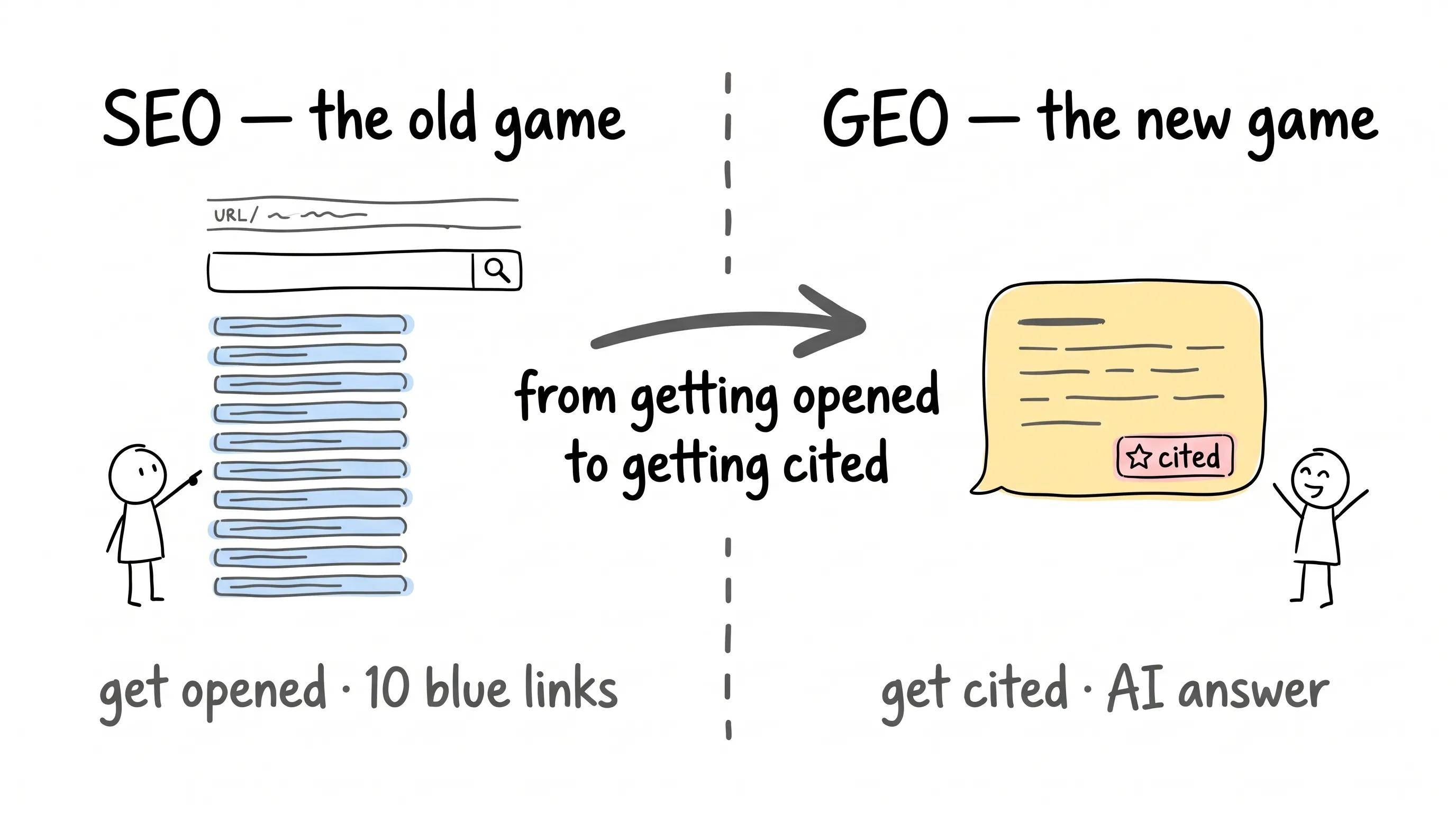
In the old days, SEO was a fight for rankings. Lay out your keywords, build enough backlinks, tune each page up to passing grade, and squeeze your way onto Google's first page. Make the first page, and the traffic follows.
Now the game has changed. AI search is like asking a knowledgeable friend. Ask it a question, and it won't hand you ten links — it chews the answer up and feeds it to you directly.
Whichever brand's content it chews up is the brand it lifts into your view.
The old game was about getting opened. The new game is about getting cited.
People were taking this question seriously a year ago. A content-marketing practitioner overseas asked in a marketing community: will GEO replace SEO?
He had just finished reading an article about how to get your content cited by models like ChatGPT, and he laid out what he'd learned — six points in all. Let me walk through them; see if they sound familiar:
- Semantic depth, not keyword stuffing. AI understands what an article actually says — it isn't counting how many times you wrote the keyword.
- Clear structure. TLDRs, bullet lists, FAQs — AI loves to "borrow" from answers that are clean, direct, and easy to lift.
- Topical authority. If this isn't your field, no matter how well you write, the model won't quite dare to cite you.
- AI crawlers have to be able to reach your pages.
- Freshness. Keep your content updated — AI is too cautious to use stale information.
- Natural long-tail questions. The questions AI answers come from questions people ask. Write what people are asking.
Sound a bit like SEO? Exactly — at its core it's still "help machines find you, understand you, trust you." Not one word has changed.
But there's always another side.
Someone poured cold water on it right away: GEO? That's just a bunch of people who never liked SEO hyping a new buzzword.
And it was a well-aimed splash. Search engines have been running for decades on a single creed: never trust a publisher's own claims. What publisher doesn't say nice things about themselves? If anyone could game the rankings through self-polish, search results would be finished. That's why search engines operate on zero trust in publishers.
Generative AI engines work by the same logic, only more so. They won't truly trust you just because your content is written to be easy to lift.
So is GEO a real opportunity, or just hype? Here's the math I found:
In 2024, a research team at Princeton tested a set of methods. Adding citations, adding statistics, adding authoritative sources — these could raise a piece of content's visibility in generative engines by as much as 40%.
Forty percent. That number doesn't sound like a concept. It sounds like a lever.
And there are already people doing the serious work. A brand-monitoring team built their own tool, Lorelight, specifically to track how their brand gets mentioned in LLMs like ChatGPT and Claude. They observed that after reworking their content along GEO principles — adding TLDRs, adding FAQs, updating regularly — when users asked an AI "what do you recommend in [your niche]?", the number of times their brand came up in a positive light genuinely went up.
They never claimed "replacement" — only "correlation."
So, back to the original question: will GEO replace SEO?
My call: no.
GEO won't replace SEO. It will grow right next to it.
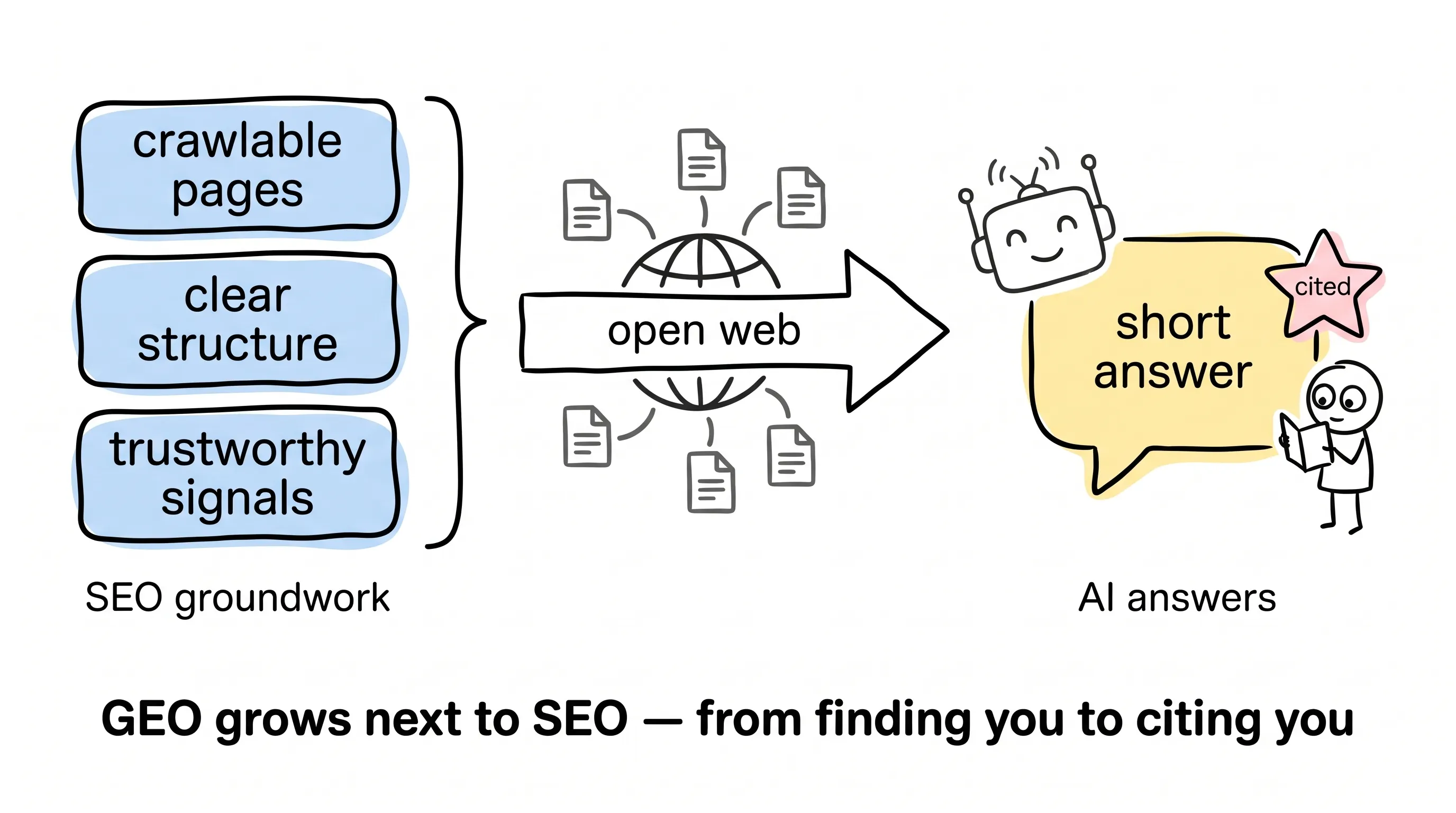
The reason is plain: AI answers need sources. Where do those sources come from? The open web. And the orderliness of that web is the groundwork SEO has built up over the years — pages that can be crawled, structure that's clear, signals that can be trusted. These GEO principles are really an extension of the same old craft: help machines find you (crawling), help machines understand you (structure), help machines believe you (authority).
It's just one more step — from "finding you" to "citing you."
Later, my friend asked me: so what should I actually do?
I told him to start with the three dead-simple things. First, rewrite the opening paragraph of every piece as a question and an answer. Second, keep every piece updated. Third, think about how your users would phrase the question — then write your headlines in their words.
If you're building a brand too, open ChatGPT right now and ask, "What products would you recommend in [your niche]?" Then see who the AI mentions.
Maybe you're not on the list. Perfect — that's your first GEO to-do list.
Continue reading
Related articles

It's 2026: Stop "Buying" AI Tools for Your Marketing Team — Start "Hiring" AI Agents
This learn article explains how AI agents differ from standalone AI tools in marketing, outlines three agent categories — build-your-own platforms, CRM-native agents, and vertical tools — and covers use cases across SEO, social media, advertising, and reporting, plus criteria for choosing one.

What Is GEO? How Your Brand Gets "Mentioned" in the Age of AI Search
An explainer on GEO (Generative Engine Optimization) for e-commerce and DTC brands: how it differs from SEO and AEO, why AI answers shape brand visibility, and eight practices covering question-focused content, consistent brand messaging, structured pages, external evidence, comparisons, and AI mention tracking.

AI Is Already Making Decisions for Your Customers. Are You on the List?
A learn article explains GEO (Generative Engine Optimization): why AI-generated answers now shape which brands customers see, and how SEO fundamentals, entity clarity, citable evidence, and monthly measurement affect visibility in AI answers.