
AI Marketing Daily · 2026-10-16
Daily AI marketing briefing for 2026-10-16 covering GEO tactics after Google's February 2026 core update, Meta's case for incrementality measurement, agentic ad account tools, virtual influencer market data, and cross-border e-commerce studies, with hands-on commentary on each item.
Today's theme: the rules are being rewritten. Google's February 2026 core update puts GEO into the game, Meta is recalculating who gets credit in marketing, agentic tools have started reaching directly into ad accounts, and the virtual influencer market is expanding at a 40.8% annual clip. Eleven items spanning AI search tactics, measurement, ad-buying automation, virtual influencers, and cross-border field data — two older pieces that read best alongside today's fresh validation, and the lead GEO guide is worth a careful read. Every item comes with hands-on commentary. Read this one brief and the last 24 hours of the AI marketing world are at your fingertips.
🎯 Today's Lead Story
A Hands-On GEO Guide Lands: After the February 2026 Core Update, Content Needs Rearranging Around How AI Feeds
Adsmurai, an ad agency, has published a hands-on guide to GEO (Generative Engine Optimization), defining the discipline as the playbook for getting content understood, cited, and used outright by generative engines such as ChatGPT, Gemini, and Google AI Overviews. The piece positions GEO as an extension of SEO: Google's own documentation on generative search already uses the terms GEO and AEO (Answer Engine Optimization) explicitly, while stating plainly that the generative experience still rests on the existing ranking and quality systems — there is no shortcut that bypasses quality content.
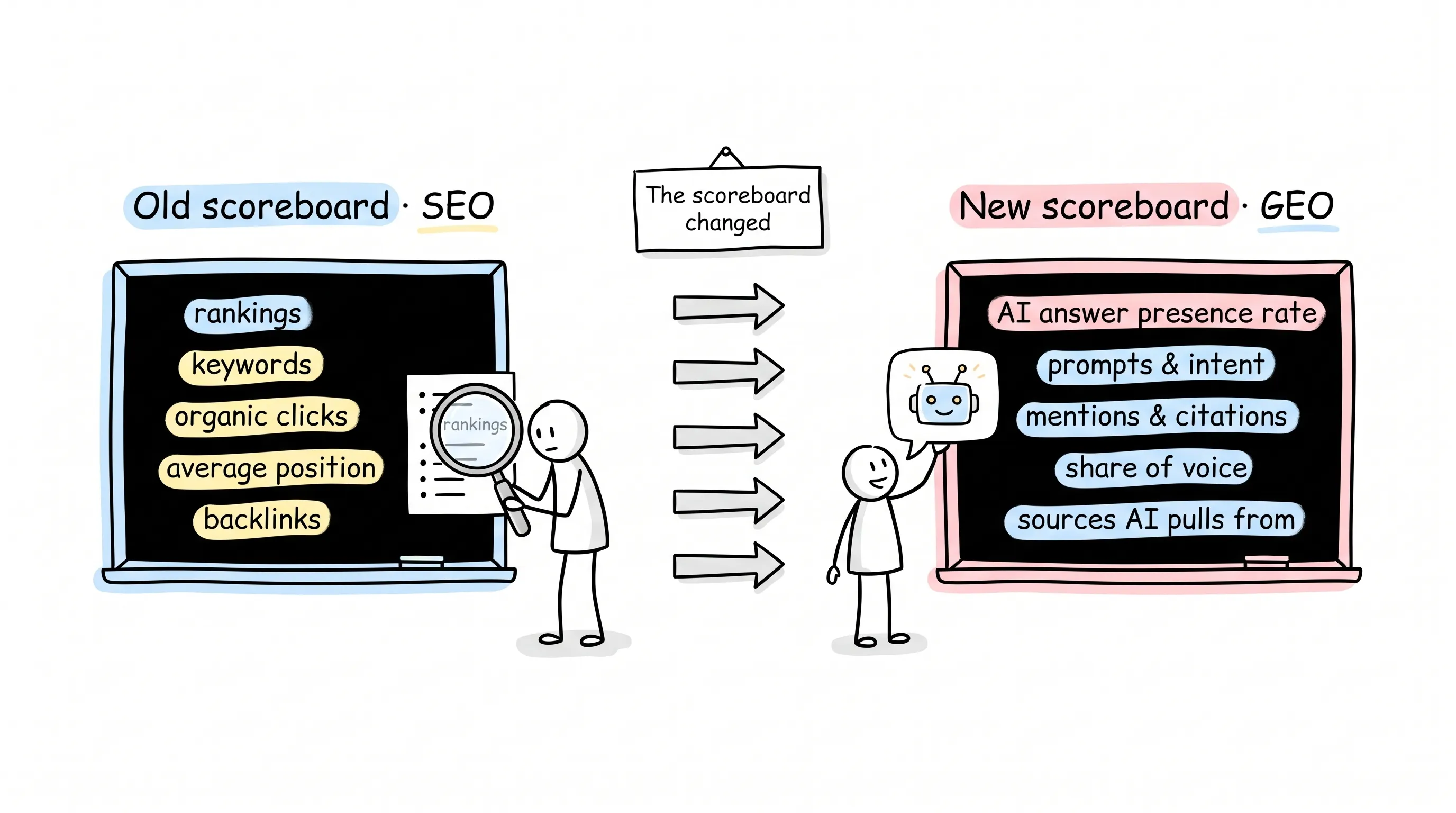
The real change is in the metrics. The article includes a side-by-side table that swaps the traditional SEO scoreboard for GEO terms, item by item: rankings become AI answer presence rate, keywords become prompts and intent, organic clicks become mentions and citations, average position becomes share of voice, and backlinks become the sources AI actually pulls from. Change how you keep score, and you change the very definition of a content team's job.
Adsmurai also offers a sense of scale: evidence from a recent paper, Generative Engine Optimization: How to Dominate AI Search, shows that applying GEO tactics can lift a page's visibility inside generative answers by roughly 40 percent. This is not a concept play — it's a playbook with experimental numbers behind it.
The February 2026 Google core update is flagged as the year's most important variable, and it tightens the screws in three places. First, penalties get harsher for low-value, mass-produced AI content. Second, demonstrable first-hand experience earns more weight — title-only authority claims no longer cut it. Third, organic rankings and AI Overviews performance are bound more tightly together: if your content is hard for AI to extract, your traditional SEO performance suffers too. What the article observed: a batch of technically well-optimized but content-homogeneous sites lost traffic in this update, while pages that articulate real experience and can produce proprietary data went up.
Why does this sit above everything else today? Because the power to distribute search traffic is moving from the results page into the answer itself. Users get their conclusion inside the AI conversation; the link is an afterthought. When AI Overviews and AI Mode synthesize an answer, they lift fragments from multiple sources. For teams that acquire customers through organic traffic, that amounts to a new scoreboard: you're still staring at rankings and clicks while your customer's first impression of your brand has already been formed inside an AI answer. There's an extra twist: the February core update twisted the two threads together, so SEO and GEO are now two acceptance tests for a single piece of content — you can't dodge either one. One detail from the article worth memorizing: "extractable" means the AI can snip your text out in whole passages to assemble its answer. Sections like "What is this?" or "What are the advantages?" make the model's job effortless.
Role by role, content teams feel the impact most directly. Editorial workflows need a new gate: an extractability check. Rewrite subheads as the questions users actually ask, cut paragraphs shorter, lean on tables and bullet points, fill in semantic markup — make it possible for a model to lift your content in whole blocks and assemble answers from it. For ads and media teams, the change is in where budget flows: generative engines favor content that has been cited by authoritative external sources, so earned media shifts from a soft PR-department task to supporting infrastructure for paid media, and media partnerships now belong on the search optimization ledger. Analytics teams have to rebuild their dashboards: AI answer presence rate, brand mention and citation counts, the list of sources AI cites, share of voice per engine — no existing SEO tool reports any of these directly, so you'll have to build your own monitoring.
On execution, the article's steps are specific enough to run. Step one: an engine-by-engine audit. Ask the same brand question in ChatGPT, Gemini, and Perplexity, and record who gets cited and who is speaking for you. The three engines have different feeding habits — what works in ChatGPT may not carry over to Gemini — so audit them separately. Step two: restructure your content. Break priority pages into self-contained blocks that each carry their own conclusion, and present data in tables so AI can lift them whole. Adsmurai is already running this content-chunking-plus-semantic-markup playbook on some client projects, so it's not just theory. Step three: add external citations. Partner with trade media, vertical sites, and named authors so your data gets picked up and re-cited — the more external citations, the better your AI visibility. Step four: build monitoring. The article offers a copy-this-now method: use a custom prompt to patrol ChatGPT daily for brand mentions and treat AI citation likelihood as a routine metric. Finally, defend the fundamentals: don't pull out of traditional SEO. If rankings collapse, the foundation under your AI visibility collapses with them.
My take: the guide's real value is dragging GEO out of concept-land and back into tables and actions. In 2026, content ships to two sets of standards — human readers want story and judgment, generative engines want extractable blocks and citable data, and the same page has to serve both ways of eating. Move the metrics first, then the content. Get AI citation monitoring running, and you'll know half a year before your peers whether you're a leading character in AI answers — or missing without a trace.
🔗 Further reading: Read the full article
🏷 AI Search & Content Tactics
Siege Media Publishes a GEO Tactics Checklist: A 50-Site Study Shows Homepages with AI Optimization Gain 10.7% Clicks on Average
The GEO guide from content marketing agency Siege Media stays at the tactical level. Two data points: its study of 50 sites found that homepages with AI optimization gained 10.7% clicks on average, and 36.4% of content marketers reported traffic declines from AI search between 2024 and 2025. The tactics checklist is directly executable: write subheads as questions so the model instantly matches them to user queries; produce original statistics and definitions so you become the first-hand source that gets cited; add Schema structured markup; cite high-authority sources to back yourself up; and keep content short and scannable. The article leads with GEO's four principles: content follows intent, continuous monitoring and testing, Schema structuring, and AI-friendly content structure. The 36.4% decline figure comes from its content marketing trends survey, driven mainly by the rise of AI Overviews and AI search. It also nails the query difference between GEO and SEO: queries shift from short keywords to long-tail conversational questions, and the goal shifts from SERP rankings to citations inside AI answers. The measurement framework gets rewritten accordingly — success metrics change from rankings to whether you appear in AI answers at all, and whether you're recommended — all tracked continuously. The guide includes a dedicated section on common mistakes, warning against writing in machine-speak to please AI — the human reader still has to be served just as well. The mark against it: publish date unclear, and some of the material leans evergreen and basic.
💬 The action checklist is today's most crib-worthy material. This week, pick five key articles already in your library, convert their subheads to question form, and work a set of your own data into each; compare AI citations two weeks later. The 10.7% figure says this pays for itself — no need to wait for a perfect plan to be in place.
🔗 Further reading: Read the full article
NerdWallet's Earnings Report Rings the Alarm: The Traffic Floor Under Search-Heavy Businesses Is Collapsing
An August 2024 episode of HubSpot's podcast Marketing Against the Grain keeps getting recirculated now because the impact it predicted has come true. NerdWallet's earnings report mentions headwinds in organic search traffic ten times, with quarterly search volume down roughly 15 to 18 percentage points quarter over quarter. Sites built on personal finance content lean heavily on search and are among the first to get hit. Any business where search drives more than 60% of traffic is in the line of fire; to protect ad revenue, Google rolls out AI summaries first on low-commercial-intent informational keywords, leaving high-purchase-intent terms for later — and that rollout order is itself a signal to act on. What makes NerdWallet significant is that this is no longer a prediction; it's written into the financials. Kipp Bodnar and Kieran Flanagan's answer is to pivot to personality-driven content: AI can generate information at scale, but differentiation comes from real people's expertise and stories, and turning your in-house experts into creator-grade personalities is a key step. Supporting moves include the Hormozi-style ten-draft grind paired with AI real-time editing to compress iteration cycles by an order of magnitude, and an honest skills-inventory self-diagnosis of the team to expose the gaps before deciding whether to hire or train. The hosts' verdict: talent decides everything.
💬 The 2024 warning no longer needs arguing today. Search-dependent teams should run a stress test: if search traffic drops another 30%, can the business keep running? While you're at it, take stock of who on the team has the most personality and make them a recurring franchise — the cheapest moat available right now.
🔗 Further reading: Read the full article
🏷 Ads & Measurement
Meta's Head of Data Science: 60% of Searches End Without a Click, and Marketing Measurement Must Shift from Attribution to Incrementality
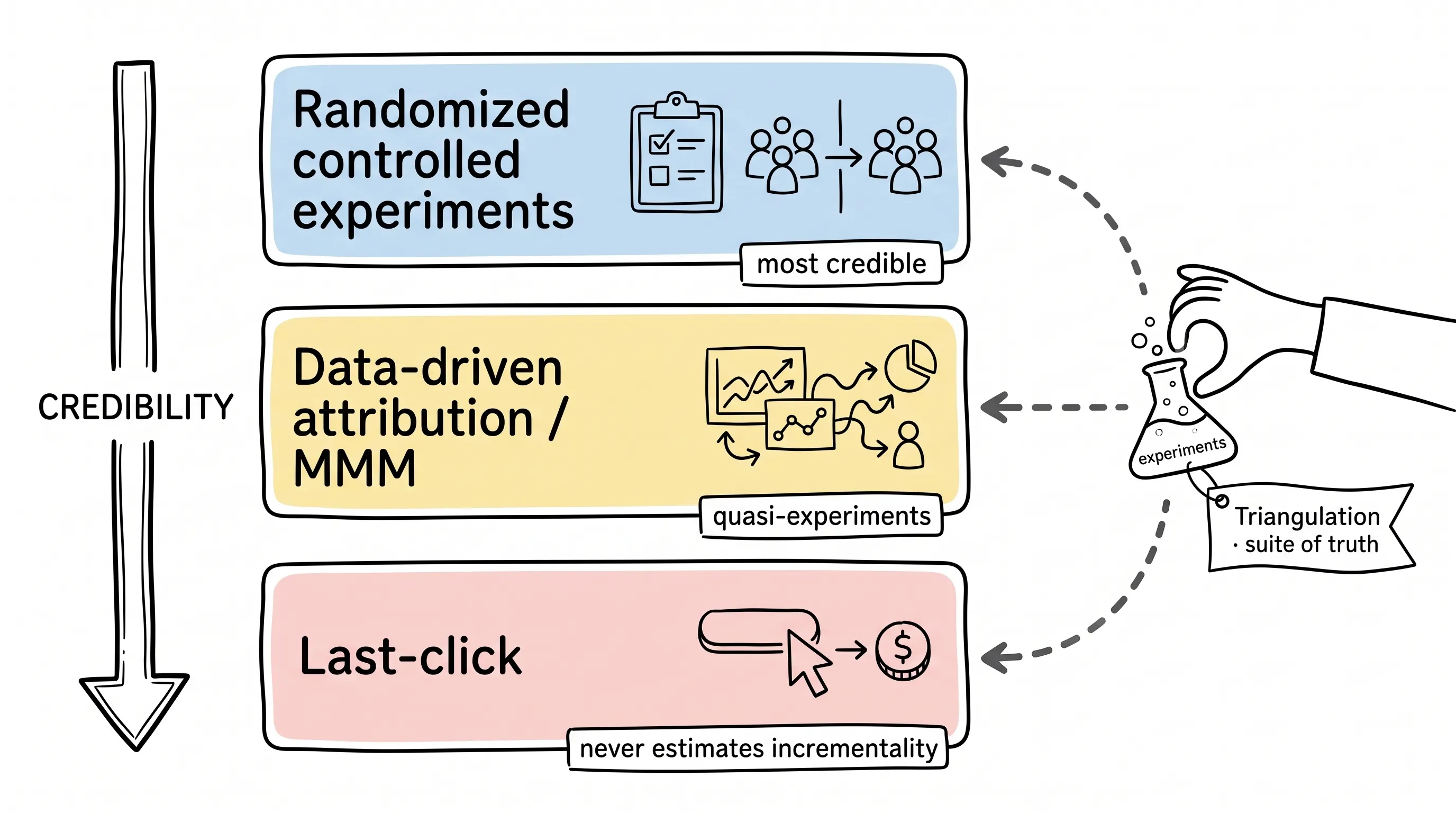
In the transcript of IAB Australia's MeasureUp 2026 conference, Meta's head of data science, Eby Jose, delivered a set of gut-punch numbers: 60% of searches end without a click, and when profits dip, the marketing budget has roughly a 45% chance of being the first line item cut. AI shopping, short video, and social discovery have shattered the purchase path into pieces; new formats like Reels and Shorts scatter a single purchase decision across many touchpoints. Click attribution can only tell you where the last interaction happened — it can't say who actually drove the purchase. He laid out a spectrum of incrementality measurement: randomized controlled experiments at the top; quasi-experiments like data-driven attribution and MMM (marketing mix modeling) in the middle — imprecise estimates, but directionally useful; last-click metrics, which never estimate baseline incrementality, at the bottom. Meta's position is triangulation (a "suite of truth"): keep using attribution and MMM, then calibrate each model against experimental results to assemble a truer causal picture. He was careful to note that every tool on the spectrum has a reason to exist — what matters is knowing which slot your tool occupies. In his view, a measurement system's first mission is defending the budget: teams that can't articulate their true contribution get cut the moment profits wobble. Canva's head of media optimization admitted live that their MMM systematically overstates marketing's contribution and is demoting MMM output to a prior. The implementation path has four steps: assess the baseline, run incrementality experiments across channels, calibrate the experimental results back into the models, and embed it operationally into everyday decisions.
💬 Don't wait for a perfect measurement stack. Small teams can start this week: pick one channel, run an on/off experiment, and use the true incrementality to calibrate your existing reporting. The 45% figure is the reminder — teams that can quantify their real contribution survive budget meetings.
🔗 Further reading: Read the full article
Adsroid Describes What Agentic Campaign Management Looks Like: AI Operating Directly Inside Your Ad Account
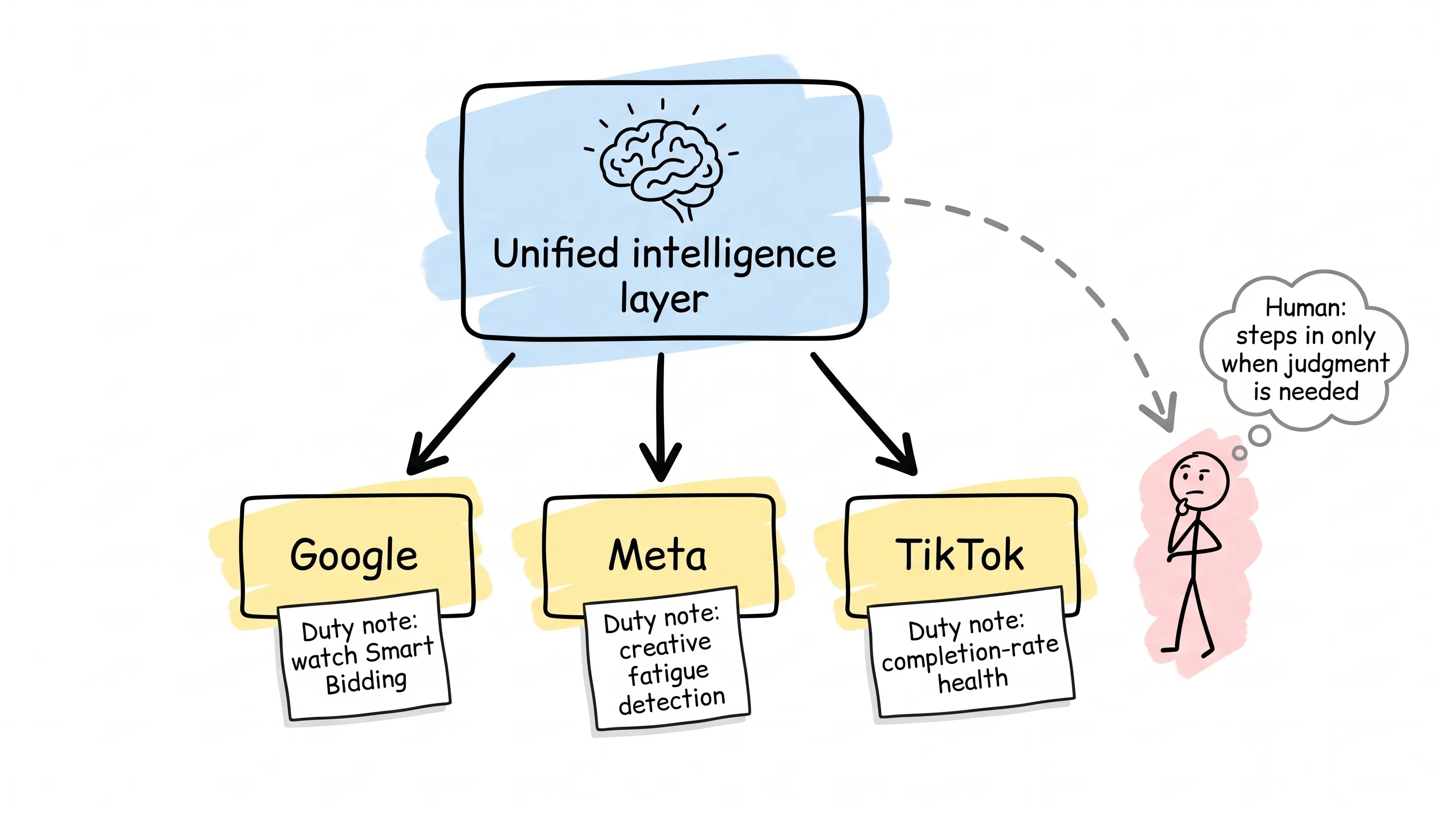
A long-form piece from ad automation vendor Adsroid describes the product shape of agentic campaign management: it doesn't broker traffic or touch budgets — it operates as an intelligence layer sitting on top of the official Google, Meta, and TikTok APIs, executing directly. On the Google side it watches Smart Bidding, auto-correcting bids when they drift from historical baselines; continuously scans search terms reports to add negative keywords; and reallocates budget intraday against efficiency targets, so a high-performing campaign doesn't burn through its daily cap by noon while an inefficient one is still clutching its money. The piece names the industry's default state plainly: reactive management — fix things after they break, after ROAS has already been eaten and CPA already pushed up. Each of the three platforms has its own bidding logic, attribution methodology, and reporting interface, and the classic headache — adjusting budgets on one while disturbing the data signals of the others — is sidestepped with the unified intelligence layer approach. On Meta the highlight is creative fatigue detection: when CTR falls, frequency rises, and conversions stall, it auto-pauses and switches to the next-best creative in the set. On TikTok, completion rate and 6-second view rate serve as health metrics; when conversions are weak but engagement strong, it adjusts the landing path. Beyond cross-platform management there's anomaly alerting — when a metric swings past a threshold the team gets notified, and humans step in only at the moments requiring judgment. The article cites HubSpot's State of Marketing survey as evidence of demand: manual reporting and repetitive optimization tasks rank among the top five weekly time sinks for marketers, and teams running five or more active campaigns can save eight hours a week by handing the execution layer to an agentic layer. The vendor also offers an MCP (Model Context Protocol) server for ad accounts, with more than 140 tools, letting LLMs like Claude query and operate ad data directly. The claimed 35% ROAS lift and 8 hours saved per week are vendor self-reported, with no third-party verification.
💬 Halve the benefit claims before believing them, but the capability map is worth holding up against your own campaign workflow as a crib sheet. Small and mid-size teams should try automated creative fatigue detection first — right now this is watched manually in weekly meetings, and the response is too slow. The MCP hookup that lets an LLM see the account is a new species worth tracking.
🔗 Further reading: Read the full article
🏷 Influencer Marketing
The Virtual Influencer Market at $45.88B Six Years Out: Which of the Four AI Influencer Types to Pick
GoodFirms' updated AI influencer guide provides the market coordinates: Grand View Research data shows the virtual influencer market growing from $6.06B in 2024 to $45.88B in 2030, a 40.8% compound annual growth rate. A Later survey says 77% of brands report better results after using AI in influencer campaigns. The article sorts AI influencers into four types: fully fictional (no real-human prototype), hyper-realistic (indistinguishable from real people), brand-owned (serving the brand exclusively, with no personal persona), and platform-exclusive (built to grow on a single platform) — each with its own fit. Five benefits accrue on the brand side: fully controllable creative, no risk of a real-person scandal, around-the-clock content consistency, lower long-term cost, and multilingual global scale. Use cases run wide: Instagram brand campaigns, new product launches and brand ambassadorship, scaling content production without leaning on real people, all the way to affiliate marketing and social commerce. The creation process unfolds in five steps: lock down four things in step one — persona, vertical, audience, platform; then build the visual identity; and in the content system, stick with AI-assisted plus human editing, because full automation loses the soul.
💬 A 40.8% annual growth rate means this lane will be crowded within two years. Start with a brand-owned virtual influencer: the persona asset stays in your own hands — no revenue splits, no contract breaches. First deploy the virtual avatar on livestream clips and multilingual versions, validate the ROI, then scale it up.
🔗 Further reading: Read the full article
MINI x Lil Miquela Case Retrospective: The Value of Virtual Influencers and the Transparency Bottom Line
Influencer agency Pulse Advertising looks back at the MINI x Lil Miquela partnership it ran five years ago: an AI influencer is a digital persona driven by artificial intelligence that talks and behaves like a real creator; Lil Miquela, run on CGI plus machine learning on Instagram, now has 2.4 million followers, and the same lane holds virtual humans like Leyla Love and Lu do Magalu. The campaign placed Lil Miquela in, around, and sitting inside the car, fitting tightly with the electric vehicle's "new, different, special" product proposition and pulling off a narrative integration a human influencer would have found hard to deliver. Data cited in the piece: 52.8% of marketers believe AI influencers will significantly shape the future of marketing. The agency's positioning is restrained: virtual influencers complement human influencers; humans won't be replaced — the value lies in creative consistency and controllable messaging. The bottom line is transparency: audiences must know they're interacting with a digital character, and clearly labeling AI content is the only way trust survives. It's a short piece, but its edge is that the case is first-hand.
💬 This is the case study to hand to a boss still on the fence: start with scenes a human couldn't shoot, rather than rushing to find a replacement spokesperson. There's exactly one execution red line — label every piece of AI-generated content. Once trust breaks, no amount of saved budget buys it back.
🔗 Further reading: Read the full article
🏷 Organization & Risk
Scott Brinker Roundtable: Marketing Teams in 2030 Will Be Smaller and More Experimental — and Adaptation Takes Four Years
On October 14, Progress Sitefinity released a 46-minute roundtable transcript in which three MarTech practitioners — Scott Brinker and Frans Riemersma among them — game out the marketing organization of 2030. The opening pins the clock: 2030 sounds far off, but it's only three years and three months away. The consensus: once AI takes over production and analysis work, marketers shift toward strategy and creative, the center of gravity moves to experimentation — and that freedom takes about four years to adapt to. Brinker proposes a third dimension beyond media and message: mechanisms — building functional experiences like calculators and interactive guides in natural language to convey brand value. This used to require pulling in an engineering team; now marketers can build it themselves, and it's precisely the area teams are least prepared for. Data literacy plus storytelling are the critical skills; in his words, storytelling is data with a soul — while most marketers haven't even run the most basic quantitative analysis. One pragmatic footnote from the session: for cash-strapped, resource-poor CMOs, do the data work solidly and build the business case from it — no CEO turns down a good opportunity that makes money. AI brings output abundance and atomized work; teams may get smaller, and it may also spawn more marketing-driven small companies. One easily missed shift: more and more non-marketing departments will join in making marketing, the whole company contributes content — and the marketing team paradoxically finds it harder to prove its standalone value. A guest left behind a line that stings: over-reliance on AI is the fastest route to obsolescence. The discussion lands on marketing leaders: decide what to automate, what to leave to experimentation, where human judgment creates value — and governance and culture still need someone watching over them.
💬 The four-year adaptation estimate deserves a line in your team plan. Two things to do this year: put data literacy into quarterly goals, and draw the boundaries of automation — name which judgments must stay human. You can start small on the mechanisms dimension, say, a self-assessment calculator for customers.
🔗 Further reading: Read the full article
From Sports Illustrated's Fake Author to Fabricated Case Law: A Cautionary-Tale List for Generative AI Marketing
AMT Lab's overview lays the benefits and risks of generative AI marketing on the same table. On the benefit side: SEO-friendly headlines, image synthesis in seconds, post automation, and targeted placement. Creative design, insight generation, and audience targeting that once took months now roll out in days to weeks, with built-in personalization at scale and automated testing. The risk side lists a string of famous 2023 failures: Sports Illustrated caught publishing fictional AI authors; lawyers caught in court after citing precedents ChatGPT invented; Samsung employees leaking secrets by feeding confidential material to ChatGPT; MSN auto-displaying a poll next to an obituary. The article cites Statista data that 73% of US marketing agencies already use generative AI, and a RAND report warning of the trust crisis posed by AI-driven online personas. Behind the macro numbers there's a gap in lived experience: Deloitte's 2023 survey shows 31% of US Gen Z and 20% of millennials have used or tried generative AI, versus only 9% of older generations. The industry-level math is hefty too: McKinsey estimates roughly $4.4 trillion in global productivity could be credited to generative AI, and the marketing efficiency opportunity is about 5% to 15% of total marketing spend — roughly $463B a year. The positive case in the piece is craft retailer Michaels, which built its own content generation and decisioning platform so copy serves different messages to different customer-segment profiles. Five usage pitfalls: over-reliance, not verifying facts, ignoring copyright and legal risk, deploying AI jarringly inside established audience relationships, and failing to train the brand voice. For small organizations the way out is AI efficiency plus human gatekeeping — learn from Duolingo-style personality-driven operations.
💬 Turn this list of failures directly into your team's pre-publish checklist: AI-generated facts get verified twice, customer data never enters public models, and the brand voice is fed sample copy before it goes on duty. For a small organization, the human touch is an asset — don't save three hours by saving it away.
🔗 Further reading: Read the full article
🏷 Cross-Border E-Commerce Research
Field Evidence from 210 Tianjin Factories: Brand Building Catches Up Only After AI Raises Productivity
An arXiv preprint, based on a survey of 210 cross-border e-commerce manufacturers in Tianjin, uses a PLS-SEM (partial least squares structural equation modeling) approach to validate a causal chain with all four slots in place — independent variable, dependent variable, mediator, moderator: generative AI significantly lifts productivity (path coefficient 0.43); productivity mediates between AI and brand building (indirect effect 0.21); and cross-border e-commerce strategy intensity positively moderates AI's return on brand building (coefficient 0.18). In plain language: AI saves labor hours first, and only the resources it frees up can raise a brand; factories with a clear go-global strategy get a higher brand return on their AI investment. The authors state the gap they're filling is exactly the intersection of generative AI, productivity, and brand building in the cross-border e-commerce context — no one had quantified the manufacturing-goes-global scenario before. The sample is factories in Tianjin alone, so take care when extrapolating to other industries. The theoretical framework is TOE (technology–organization–environment) plus the resource-based view plus contingency theory. By the way, the paper's title still carries the template placeholder "Paper Title" — judge the preprint's rigor for yourself.
💬 The lesson for cross-border teams is to get the sequence right: use AI first to speed up the execution layer — listings, creative assets, customer service — then put the freed-up people into content assets and brand narrative. Don't expect AI to conjure a brand directly; the mediator is productivity, and skipping that step turns the investment into money down the drain.
🔗 Further reading: Read the full article
An AIGC Review for Cross-Border E-Commerce: The Opportunity in Personalization and Multilingual, the Pitfalls in Compliance and Acceptance
A review published October 28, 2025 in academic journal JOEBM maps the AIGC (AI-generated content) application landscape in cross-border e-commerce. The opportunity side holds two major scenarios — personalized marketing and customer service automation — plus data-driven decision-making and multilingual content production. The challenge side has two mountains: data privacy and security, and cross-jurisdiction regulatory compliance and consumer acceptance. The review also drops one easily overlooked line: user awareness of potential data security issues needs to be raised proactively — remedial lessons after an incident come too late. The literature review covers Chinese- and English-language research from 2018 to 2023 with a clear thread: Zhu (2018) used the cases of Yihaodian and Kaola to verify AI's strengthening of cross-border e-commerce supply chain management; Lu (2021) ran empirical work across 29 provinces nationwide, concluding that AI development raises local informatization levels and in turn drives cross-border e-commerce; Ma (2020) pointed out firms' chronic troubles — lacking data, lacking precision procurement, lacking localized marketing. The overall conclusion: AI lifts cross-border e-commerce efficiency as a whole through supply chain management, market expansion, and operational optimization. As a general review it offers no new data; its value is putting compliance on the table, and the appended 2018–2023 literature index saves go-global teams the labor of re-reading six years of publications themselves.
💬 The right way to use this piece is as a compliance checklist. Go-global teams should check item by item: which jurisdiction holds the customer data, whether the target country imposes AI-content labeling obligations, and whether auto-generated ads will trip the local advertising law. The fines for these pitfalls cost far more than the labor saved.
🔗 Further reading: Read the full article
💡 Today's Synthesis
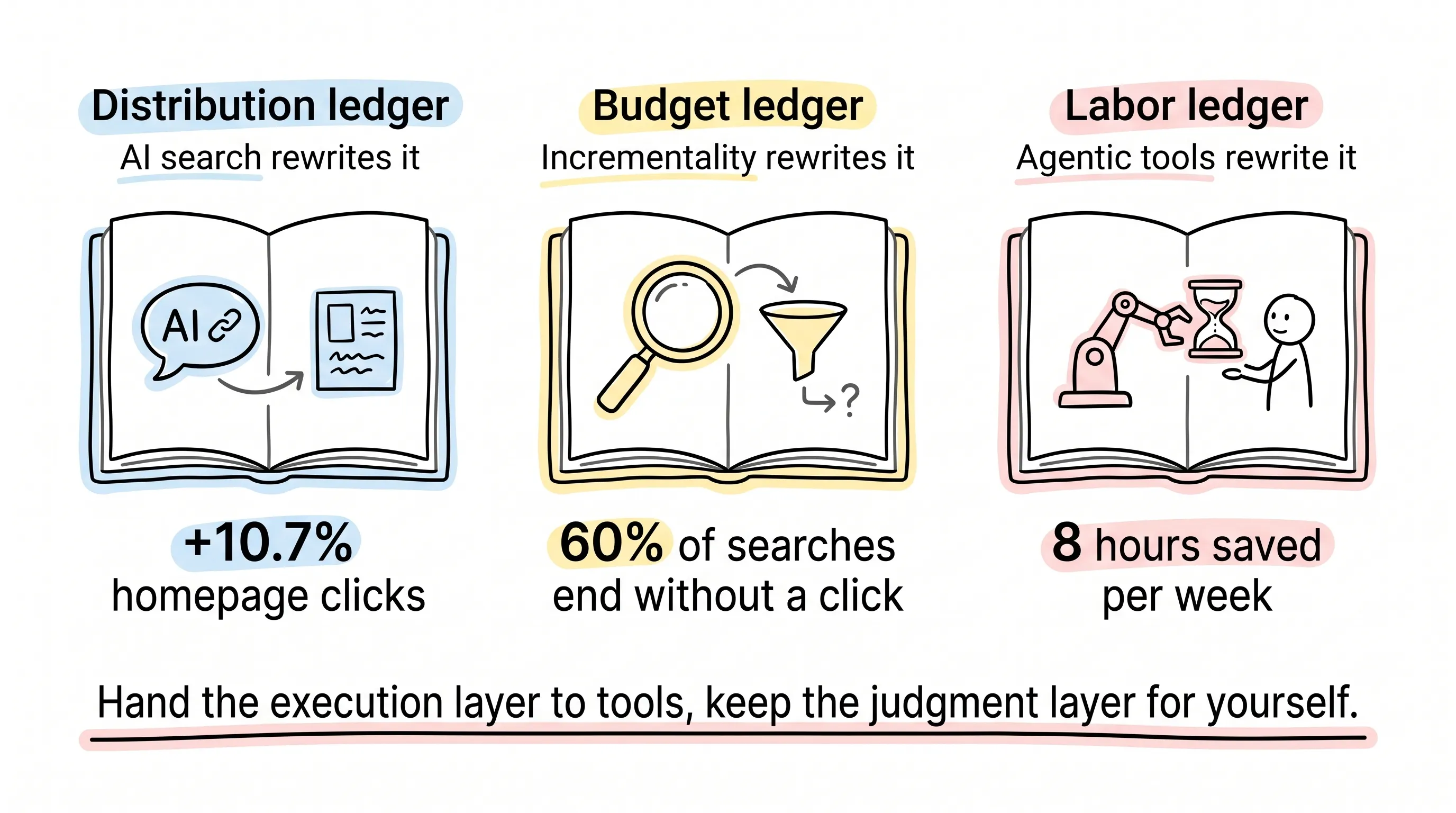
Read today's eleven items side by side and the main line emerges: AI is turning from a content tool into marketing's bookkeeper and executor. The lead story covers how content gets chosen by AI — Siege Media brings a 10.7% positive return proving the work is worth doing. Meta teaches how to prove marketing actually works — 60% of searches ending without a click mean the old credit ledger is void. Adsroid takes over the execution layer of campaign operations too. Three threads point to the same conclusion: AI search is rewriting the distribution ledger, incrementality measurement is rewriting the budget ledger, and agentic tools are rewriting the labor ledger.
The second line is an undercurrent: trust is becoming scarce. The virtual influencer lane's 40.8% annual growth sounds exciting, yet the Pulse item makes transparency a precondition; AMT Lab's cautionary list reminds us that the scale of AI content and its credibility are in a race. Brinker says teams will be smaller and output more abundant by 2030 — and once output is abundant, what's scarce is verifiable experience and people willing to own the consequences. The two cross-border studies that made today's cut tell the same story: AI raises efficiency first; only the resources it frees up earn the right to talk about brand.
One reminder for marketers: in this round of change, the first to fall behind are often those who use AI without building measurement and without guarding trust — those who don't use AI at all rank right behind them. Getting AI citation monitoring and incrementality experiments running matters more than stockpiling ten more new tools. Hand the execution layer to tools, keep the judgment layer for yourself — that is the one survival strategy every item today assembles into.
Continue reading
Related articles
AI Marketing Daily · 2026-11-22
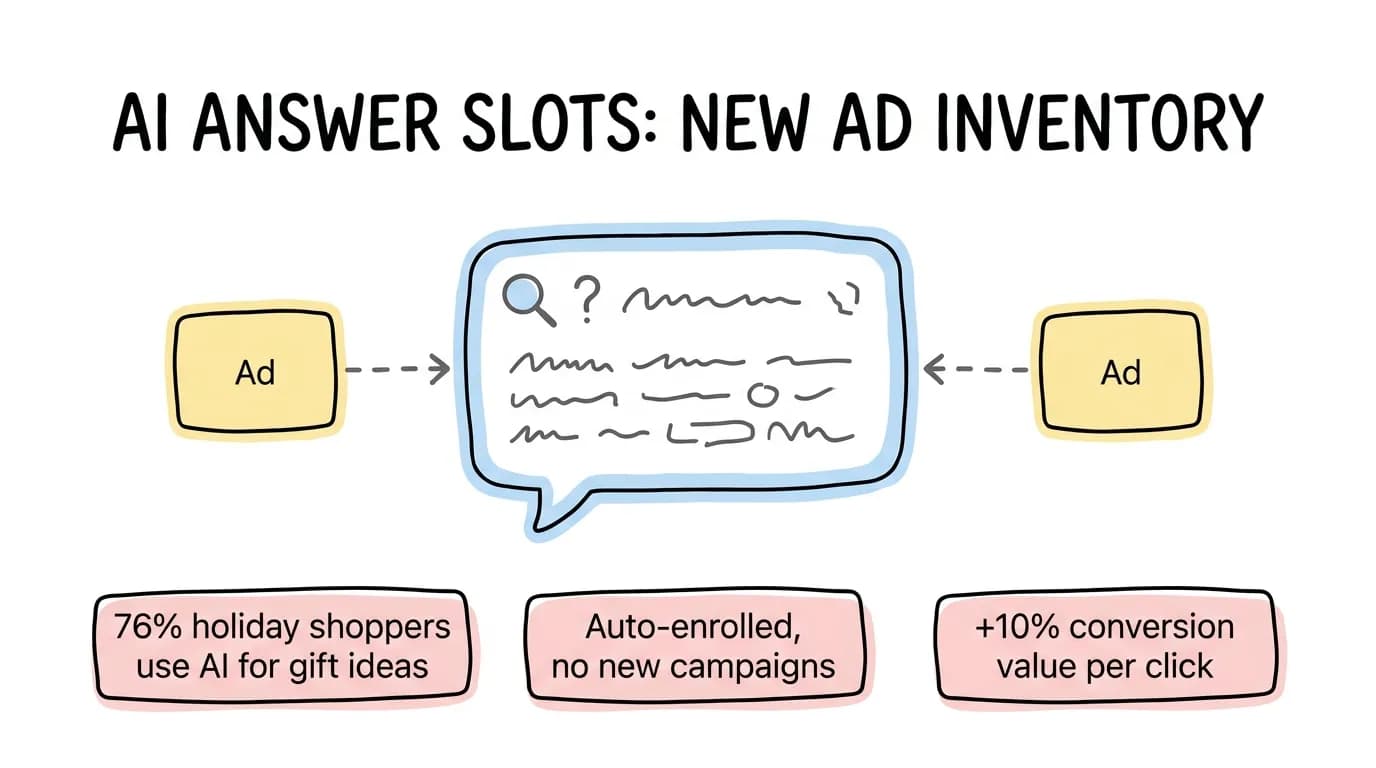
AI Marketing Daily for 2026-11-22 rounds up 20 items led by Microsoft opening Bing AI Overviews to ads and Google expanding AI Mode ads to ten countries, plus GEO guides, ad automation delegation guidance, AI Overviews CTR data, and a legal-risk checklist for AI-generated creative.
AI Marketing Daily · 2026-11-21
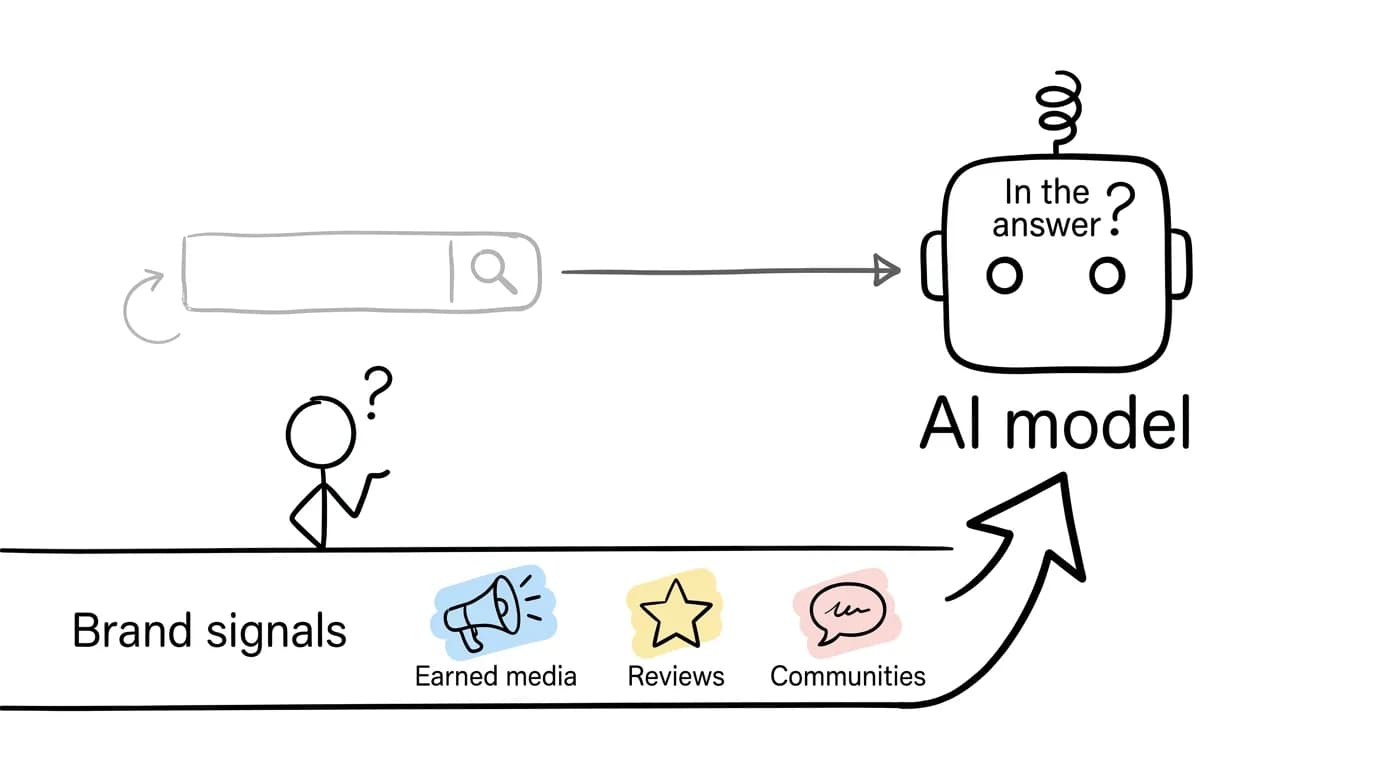
A November 21, 2026 AI-marketing daily covering AI search visibility, GEO methods, Google AI Mode ads expanding to ten countries, Meta's pre-Black Friday changes, agentic shopping, and industry adoption and ROI data.
AI Marketing Daily · 2026-11-20
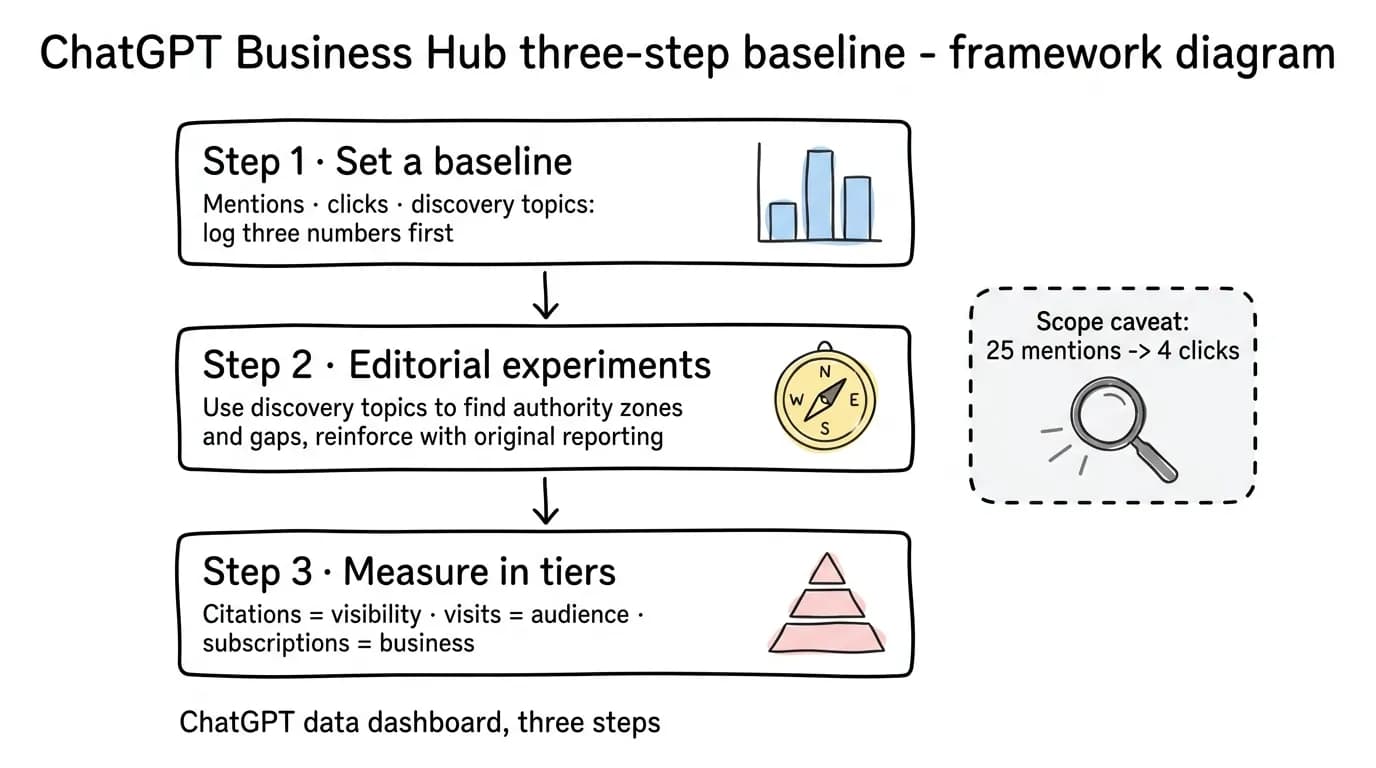
AI Marketing Daily for 2026-11-20 rounds up 19 items centered on measurement: OpenAI's ChatGPT Business Hub dashboard, EU rules for agent-mediated purchasing, Meta pausing four AI terms, and B2B data on shortlists and the dark funnel, each with action advice.