
AI Doesn't Search the Web — It Picks the Answer: The New Playbook Called GEO
This article explains GEO (generative engine optimization): how AI answers draw on search-visible sources, which content structures AI tends to quote, a four-step loop for updating and measuring content, common pitfalls, and a Mentimeter case study.
Picture a scene.
You run content at your company. One day, the boss walks over holding his phone with a question: he just asked ChatGPT "which firms in our industry are actually reliable," and the AI rattled off a list of names.
Is yours on it?
No.
Now ask another question: where do we rank for our keywords? First page, year in, year out.
Doesn't that sting? Users can find you just fine — but when AI starts making decisions on their behalf, it treats you like you're not even there.
I've been chewing on this for a while now. And the deeper I dig, the clearer it gets: behind it sits an entire new playbook. The industry calls it GEO — Generative Engine Optimization.
Today I'll walk you through it. No mysticism. Just logic and concrete moves.
Let's Break It Open: What Is GEO Actually Optimizing?
First, let's be clear about one thing: how does AI answer a question?
Ask ChatGPT something, and it doesn't make it up out of thin air. It sweeps the web for sources first, digests what it finds, then assembles an answer for you. There's a technical term for this process: RAG — Retrieval-Augmented Generation. The name sounds intimidating, but the idea is simple: before the AI answers, it hits the books.
So here's the question: which books does it open?
The same old search stack. Authoritative sources, sources that rank, sources with clean structure — those get opened first. If you can't even squeeze into the search results, you're not on AI's bookshelf to begin with.
That's the first key insight: traditional SEO decides whether you make it onto the shelf. GEO decides whether AI lifts your content into the answer.
Put bluntly: the old game was getting found. The new game is getting quoted.
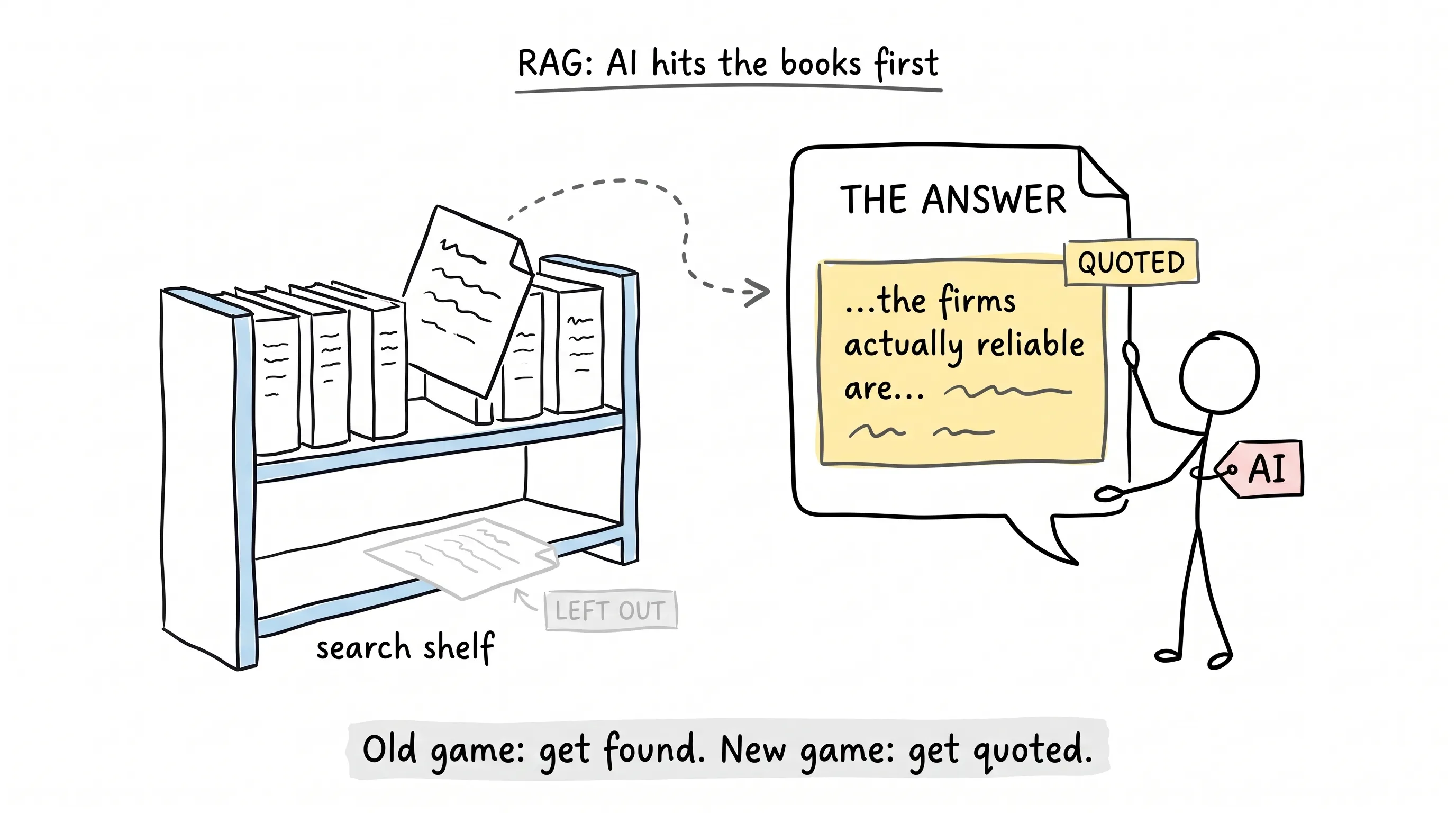
When users search, they see ten links and still get to choose which one to click. When users ask AI, it hands them one answer — and whoever gets named in that answer exists. The ones left out never even get the chance to be disliked.
So what is GEO? Making sure that when AI assembles its answer, it rates you, trusts you, and is willing to weave your content into what it says.
Why This Can't Wait
You might think this is just a trend — something to watch from the sidelines.
I don't see it that way. Here are three numbers.
Number one: in a survey of content marketers conducted between 2024 and 2025, 36.4% admitted their site traffic had dropped — and the reason was the rise of AI Overviews (Google's AI-generated answers sitting at the top of search) and AI search more broadly. The content didn't get worse. AI simply intercepted it.
Number two: in February 2025, OpenAI announced that ChatGPT had reached 400 million weekly active users, up a third from 300 million just two months earlier. Growth at that pace would turn heads in any industry.
Number three: in 2025, Siege Media ran a study across 50 websites and found something counterintuitive — overall traffic was falling, yet homepage clicks rose 10.7% on average. The biggest gains went to the pages that had already been optimized for AI's taste.
Put the three numbers together and the picture comes into focus: traffic hasn't disappeared. It's regrouping somewhere else.
An SEO lead at Siege Media talked about this, and he hit the nail on the head. People flock to AI tools, he said, because AI gives them answers tailored to one person — them. Traditional search shows everybody the same ten results; AI takes your specific question and hands back a ready-to-use reply. Once you've gotten used to that experience, there's no going back.
The Logic of How AI Picks Content — and Why You Need to Get It
The core of GEO is writing content that fits the way AI "reads."
Think about it: when AI assembles an answer, isn't it just like an assistant doing homework for the boss? Time is tight, the workload is heavy, and out of hundreds of documents it has to pick a few passages it can use as-is.
What does it like? From everything I've observed, it comes down to a handful of rules.
Lead with the answer. Under every subheading, the first paragraph states the conclusion. If it takes three detours to reach the point, the assistant loses patience and moves on.
Use questions as headings. AI slices content along the subheadings, and question-style headings like "What is X" or "How to do X" line up exactly with its cut lines.
Keep the structure clean. Lists, tables, definitions — clearly chunked. One big undivided slab of text makes it hard for AI to lift clean sentences out of it.
Bring exclusive goods. Your own customer data, your own industry surveys, your own original definitions — things AI can't source anywhere else. Those carry the highest quoting value.
Back up what you say. When key claims carry credible sources, AI dares to quote you. What it fears most is copying unreliable information into an answer and wrecking its own name.
These five rules boil down to a single move: do the "excerpting" work for AI ahead of time.
The Methodology: Not a One-Time Overhaul — A Loop
Most people write up GEO as a checklist. I'd rather describe it as a loop system — the kind that actually spins.
The loop has four steps.
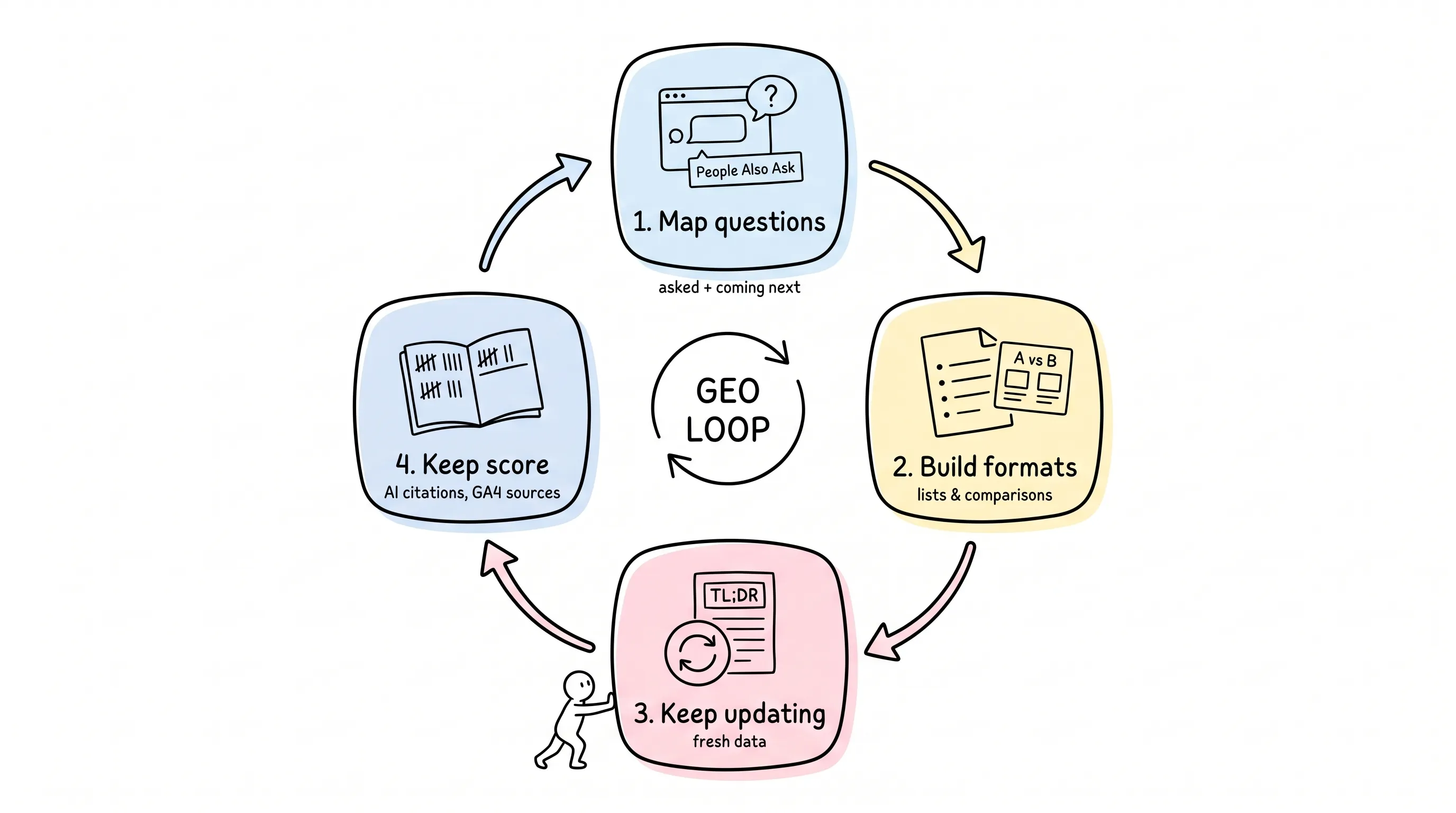
Step one: map the questions, completely.
The questions users ask AI come in two layers: the ones asked out loud, "which tool suits a freelancer for invoicing"; and the ones not yet asked but coming right behind, "should I pay for it," "how does it compare to so-and-so." When you pick topics, cover both layers. The intel isn't hard to find: the People Also Ask boxes on search engines, various long-tail keyword tools, even walking up to ChatGPT yourself and watching what it asks next — all of it is reconnaissance.
Step two: build the content formats AI loves to quote.
There's one format that reads to AI like ready-made answer material: lists and comparisons. "Top 10 call center software," "A or B — how do you choose" — clear structure, distinct items, ready to lift. And this kind of content should be organized around the user's goal: whatever users want to get done when they buy a tool, that's what you write around. These pages don't just bring traffic; they walk high-intent people straight up to the decision.
Step three: keep updating — don't let the content go stale.
AI has a hidden preference: new. Content with outdated information, it won't quote freely. The move is to pick out the key pages that already have traffic and are already being cited by AI, and polish them over and over: conclusion up front, a TL;DR block added, examples and data swapped for the latest.
A content marketing agency called Siege Media has turned this into a system. They built a mechanism called DataFlywheel, where three things — first-party data research, digital PR, and AI-assisted content updates — pull one another along and keep the content continuously fresh. And underneath sits an internal engine called BlueprintIQ, built to audit how outdated each piece of content is, benchmark it against current search rankings and competitor positions, and work out which pages are worth touching first.
See what's happening? Others have turned "updating" into a flywheel, while you're still editing articles on gut feel. That's exactly how the gap opens.
Step four: keep score.
The old ledger looked at rankings and clicks. That ledger isn't enough anymore — time to add a few new line items.
How often is AI quoting you? Set up dedicated tracking links for AI-source traffic; only when you can count the clicks can you account for the contribution.
Did the overhaul actually work? Put scroll depth and button click rates before and after the change side by side — don't just say it "feels better."
Do the people coming from AI actually stick? In GA4, view OpenAI, Perplexity, and Google as separate sources. Whichever one's visitors bounce at a higher rate, fix that one's landing pages.
Are you iterating fast enough? Set a cadence — say, one round of testing a month — and run a stopwatch from spotting a problem to shipping the fix.
Run this accounting and you'll find that in the end, GEO is a contest of response speed. Content that never changes is, in AI's eyes, already expired.
Three Traps — Don't Step In Them
Trap one: letting AI handle the writing end to end.
Using AI to research and to frame the skeleton is great; it's good for filling blind spots too. Let AI think for you — don't let AI write for you. Generate the whole piece and have a human only copy-paste, and sooner or later it goes wrong: the tone drifts, the facts slip, the prose turns mediocre. The human has to stay on the wheel — setting the tone and guarding the quality are the two jobs you can't hand off.
Trap two: winning visibility and ignoring the experience.
Getting your pages cited by AI is a good thing. But when users actually click in and the page spins forever, pop-ups plastered everywhere — they turn on their heel and leave. Those bad-experience signals will come back around and drag down your odds of being picked by AI the next time. Load speed, navigation, pop-ups: give them a regular checkup.
Trap three: throwing traditional SEO away.
As I said before: AI hits the books before it answers, and the books are still the search stack. If you have no position in the search results, you have no place on AI's bookshelf. GEO is built on SEO's foundation — not a separate construction.
A Real Case
This playbook already has a report card.
Mentimeter, an interactive presentation tool, brought in the content marketing agency Siege Media to build up its presence in AI search. The playbook was exactly the one above: a batch of bottom-of-funnel content (content aimed at buyers who are ready to decide) built around software comparisons, serving two audiences at once — teachers who want to liven up their classrooms, and professionals who give interactive presentations.
The results: Mentimeter's content showed up in more than 124,000 ChatGPT sessions, drove more than 3,000 conversions, and grew overall impressions by nearly 5 million.
No magic — just the right content, shaped into a form AI is willing to quote, and then kept the loop turning.
One Last Thing
Remember the scene at the top? In the boss's ChatGPT, it rattles off a list of competitors — and yours isn't in it.
Now you know what to do: make the answers direct, the structure clean, the data exclusive, the updates frequent — and the books in order.
Who your content is written for decides what shape it grows into. It used to be written for the search engine's crawler. Now, it also has to be written for the AI that does homework on behalf of millions.
Here's to you becoming the one that gets quoted in that answer.
Continue reading
Related articles

It's 2026: Stop "Buying" AI Tools for Your Marketing Team — Start "Hiring" AI Agents
This learn article explains how AI agents differ from standalone AI tools in marketing, outlines three agent categories — build-your-own platforms, CRM-native agents, and vertical tools — and covers use cases across SEO, social media, advertising, and reporting, plus criteria for choosing one.

What Is GEO? How Your Brand Gets "Mentioned" in the Age of AI Search
An explainer on GEO (Generative Engine Optimization) for e-commerce and DTC brands: how it differs from SEO and AEO, why AI answers shape brand visibility, and eight practices covering question-focused content, consistent brand messaging, structured pages, external evidence, comparisons, and AI mention tracking.

AI Is Already Making Decisions for Your Customers. Are You on the List?
A learn article explains GEO (Generative Engine Optimization): why AI-generated answers now shape which brands customers see, and how SEO fundamentals, entity clarity, citable evidence, and monthly measurement affect visibility in AI answers.