
The 2030 Marketing Department Might Be Down to a Handful of People—and Still Put Out More Marketing Than We Do Today
A recap of a marketing roundtable on AI discusses how teams might get smaller while producing more, with machines handling production and humans making decisions. Topics include data-backed judgment, optimizing for AI answers, a lab-and-factory experimentation model, and AI governance.
A few days ago, I finished watching a roundtable transcript. The topic was AI and marketing; it ran forty-six minutes, and I never once hit fast-forward.
The host opened with a brutal question: It's October 2026 now, only three years and three months out from 2030. By then, what will be fundamentally different about marketing teams? And what, against all odds, will still look exactly the same?
Buried in the answers from a few marketing veterans was one detail I couldn't stop turning over. Here it is for you today.
What Doesn't Change
So what is it that doesn't change?
Budget.
Several guests laughed almost in unison: by 2030, we'll still be fighting over budget.
Behind the joke sits a real judgment. The marketer's predicament hasn't changed: you will always have to prove your worth to the boss with limited resources. What changes is how you prove it.
More Marketing, Fewer People
And what does change?
There's a word I especially love: abundance.
What is abundance? It's when the things you could do suddenly multiply past the point of ever finishing them.
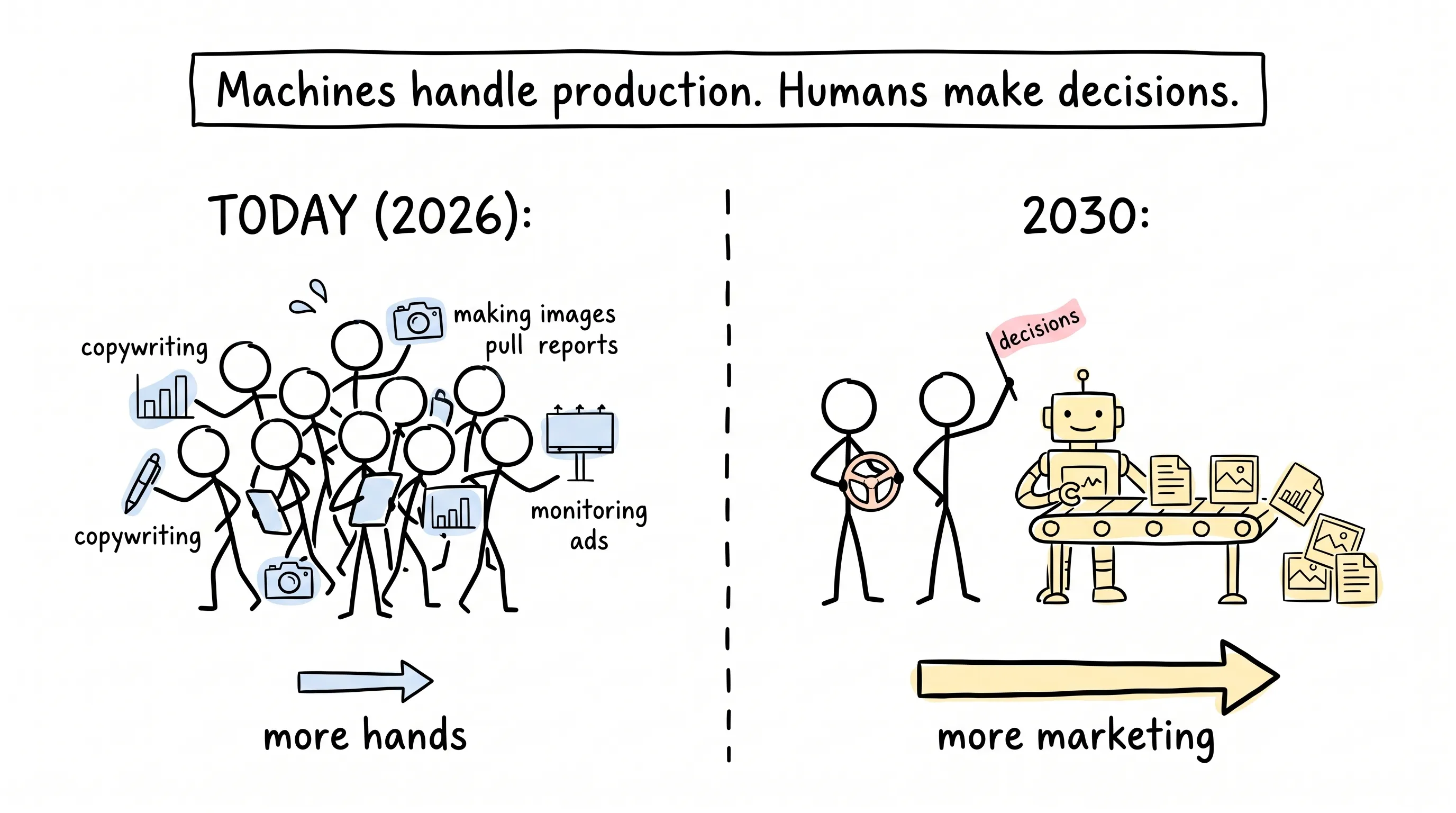
The bulk of a marketer's old job was production and analysis. Writing copy, making images, pulling reports, monitoring ad campaigns—these consumed most of your daily brainpower. Your brain only holds so much; fill it with production, and there's no room for anything else.
Once AI takes those tasks away, what happens to the freed-up space? You pour it into creativity, strategy, and experiments.
So that guest's judgment: there will be more marketing, but teams may be smaller. More experiments, more trial and error, finding out what works and what doesn't.
He calls this trend "atomization." Technology gets broken into atoms, work gets broken into atoms, and teams get broken smaller. A crop of smaller companies might sprout up, each one marketing-driven.
Machines handle production; humans make decisions.
That division of labor is the real watershed.
What Marketers Are Least Prepared For: Splitting Themselves in Two
The host pressed on: facing all this change, what are marketers least prepared to handle?
The answer was interesting: running your left brain and right brain at the same time will become standard-issue for marketers.
What does that mean? You have to read the data, and you have to tell a good story.
Brené Brown gave a brilliant definition of "story": a story is data with a soul.
What do many marketing proposals look like today? "This brand campaign looks good. Let's try that creative." Fine. And then? Where's the data?
The mere mention of data makes plenty of people's skin crawl. But a guest who has taught business school for years said something refreshingly honest: what we teach in business school isn't anything complicated like regression analysis. It's counting. How many people opened the email? Who opened it? How old are they?
Something that simple, and many marketers don't do it.
Why not? Because they're uncomfortable with technology and data.
But once you're willing to count, the story surfaces on its own: oh, so this is what customers actually want.
Scott Vaughan, former CMO of Integrate, said something that stuck with me: a marketer's job is to carry the customer's story into the boardroom.
How do you carry it in? With data underneath it.
Following that thread, another guest landed a blow that hurt.
Marketing's classic framework is the 4Ps: product, price, place, promotion. Guess how many of those a marketing department still owns today?
One. Promotion.
Product, price, and place were all handed off to other departments. That's why, in many companies, marketing is called "the stickers and umbrellas department"—printing logos, handing out swag.
How do you win it back? By telling stories. Tell the customer's story well, count the data clearly, and you earn the right to sit back at the product, price, and place table.
A marketer's hardest currency is judgment backed by data.
The Third Kind of Creativity: Mechanism
On the subject of preparation, one more idea made my eyes light up.
Marshall McLuhan has an old line: the medium is the message.
Half of marketing is deciding what to say; the other half is choosing where to say it and how. That framework hasn't moved in decades.
But one guest said the digital world has a third dimension, and he reached for an alliteration to go with it: mechanism.
What is mechanism? It's what the thing you publish can actually do.
Put a calculator on your website that lets users figure out how much they'd save; build an interactive walkthrough that lets people understand the product while they play with it. All of these put the function itself to work carrying brand value.
Why did marketers rarely play in this space before?
Because it was hard. Building one interactive component meant pulling in the engineering team and waiting in line.
And now? Describe your idea clearly in natural language, and the thing builds itself.
This is a whole new continent. It's not that people didn't want in; the price of admission was just too steep. Now it has collapsed.
What Should a Leader Do First?
In the second half of the roundtable, the host asked something very practical: if you're a marketing leader short on budget, time, and resources, what do you do first?
The first guest to answer opened with a joke: "short on budget, time, and resources"—that qualifier is redundant. Just say "marketing leader" and everyone understands.
After the laughter, his answer fit in a single phrase: learn by doing.
That's exactly how he works. He uses Claude, he uses ChatGPT, pushing them as hard as he can; when they stall, he grumbles and sets them aside. A few months later, a new model version has landed; he comes back, tries the same problem again—and the result is shockingly better. Then he wires up a few MCPs (Model Context Protocol connectors), feeding the tools more data and context, and the output jumps a whole tier.
He stressed that a leader getting hands-on isn't mainly about personal output. It's about building a feel for the thing. Only with that feel do you know what to expect from your team.
Then: pull the team in and do it together.
Subtraction Is a Competitive Edge Too
Another guest took the exact opposite route: stop adding things. Subtract.
He said he once worked with a consultant who opened with a strange line: take subtraction to the extreme.
He didn't get it at first. Later he did: the more tools, the more data, the more variables, the dizzier you get. What you actually need is very little.
He also told a graffiti story. In a very poor neighborhood in Germany, someone had written on a wall: We have no chance—but we're taking it anyway.
Marketing is the same. He has seen plenty of CMOs with pitiful resources who simply did the data work rigorously, somehow built beautiful business cases, and walked out with the budget signed off.
After all, have you ever met a CEO who says "no" to a good opportunity that makes money?
Work Backward from Revenue
An audience member asked a pointed question: more than half of all internet traffic is now bots—the so-called "dead internet." How is marketing supposed to measure anything?
Good question. The answer comes in two layers.
Layer one: stop staring at vanity metrics. Impressions, traffic, form fills—all just front-end noise.
One guest recounted his own crash: front-end numbers looked great, customer acquisition cost down to six dollars, and he rushed off to share the good news with the sales team. Their reply: revenue is falling.
He froze on the spot.
Where was the problem? The marketing team had no access to back-end revenue data. So his advice is blunt: find a way to pipe revenue data in, and treat it as the anchor for every analysis. If you can't clear that hurdle, everything after is wasted effort.
Layer two is more interesting. Another guest said we're linear creatures, used to drawing funnels—reading top-down, left-to-right. Flip it around instead: start from your best customers. What did they buy? What was the margin? Then trace backward through the path they walked.
Some of those paths have data in your systems. Some don't.
Then you're left with the one thing many people refuse to do: go talk to the customers.
Bots Might Be a New Channel
Back to the bot topic, another guest floated an idea live: could the bot itself be a new channel?
He flagged it himself as thinking out loud—give it six months and he might reverse it entirely.
But the observation is interesting: in B2B, procurement departments have already started sending bots out the door to ask for quotes and compare offerings on their behalf. That's a legitimate new channel—track it, study its behavior.
And B2C? Consumers using a bot to pick out a pair of running shoes for themselves—still rare today. But he predicts it will happen within a few years. The order, roughly: B2B first, B2C after.
Don't Split Your Strategy by Model
On optimizing for AI answers, someone asked: should you build separate strategies for different large models?
The answer was unexpected: you're overthinking it.
Every major model has the same goal: give users the most valuable information so they come back next time. So the core of the strategy is universal.
Details exist, of course. ChatGPT recently struck a deal with Yelp, calling on its business-location data; Perplexity, Grok, and Gemini have shown little interest in Yelp. And OpenAI's partnership with Reddit ran long—until marketers were found systematically gaming engagement, and in August 2026 OpenAI severed the partnership. Teams that had placed heavy bets on Reddit watched their wagers change nature overnight.
So the conclusion: don't bet on individual partnerships; put the work into the fundamentals. Off-platform brand equity is never a losing bet. Keep the strategy elastic, because the underlying data relationships can flip at any moment.
The Lab and the Factory
One more question: data sits scattered across departments—how do you break the silos?
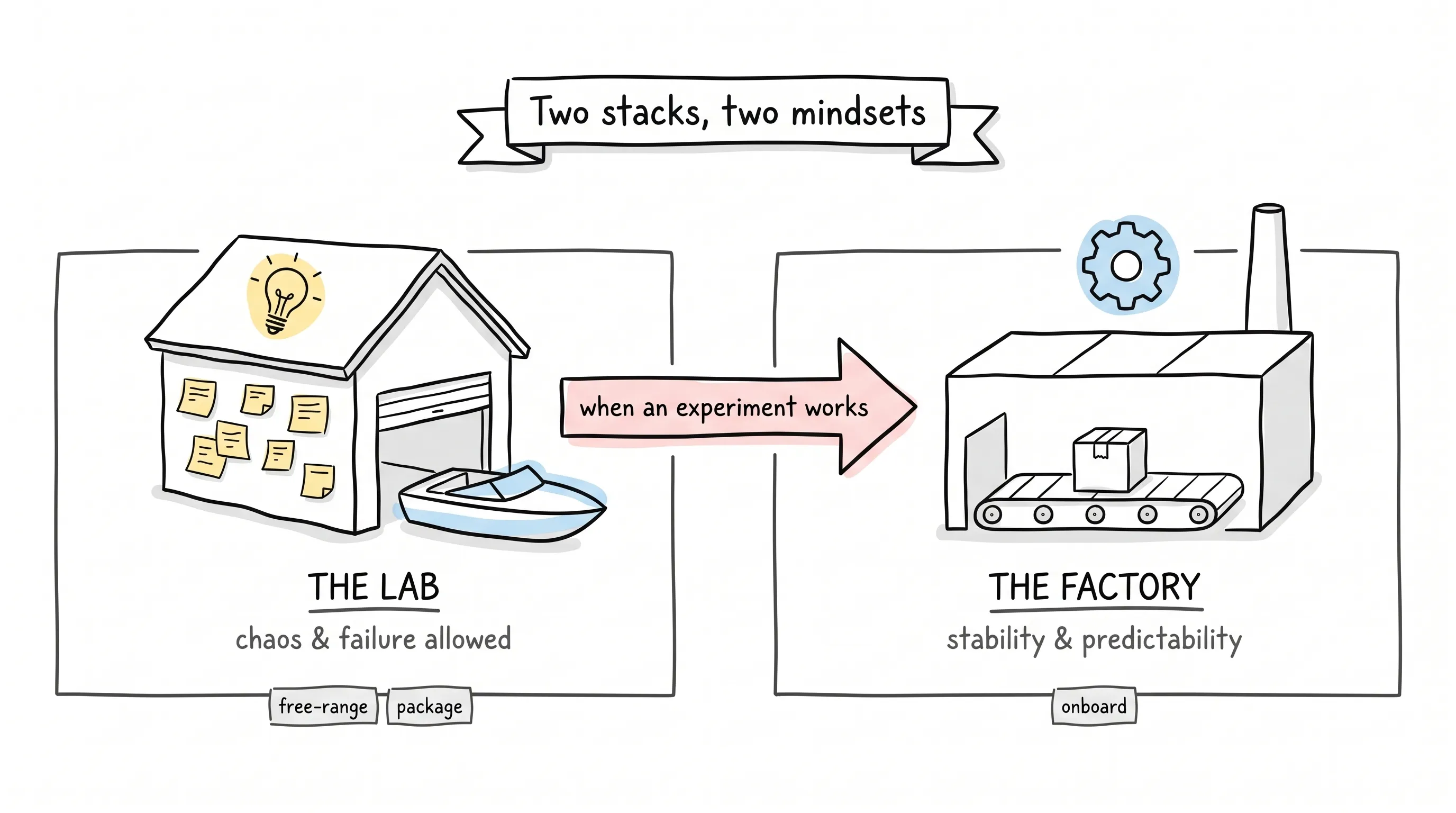
One guest's methodology has three steps: free-range, then package, then onboard.
Step one, free-range. Find a handful of growth hackers, isolate them, put guardrails around them, keep the compliance musts intact, then give them room to roam and experiment.
Step two, package. A few months later, whichever experiment shows promise gets pulled out on its own; strip the useless integrations and extra features, keep only the essential.
Step three, onboard. Cleanly install the thing into the enterprise's official production systems.
His gripe: many people's mistake is trying to experiment directly on the enterprise's big machine. It feels like drifting an oil tanker. What you want is a speedboat.
Another guest gave this playbook a better name: the lab and the factory.
In the lab, chaos and failure are allowed—that's its superpower. In the factory, what you want is stability and predictability—that's also its superpower. Two stacks, two groups of people, two mindsets. When an experiment works, move it into the factory.
On cross-department work, they told a story from their own experience. Over a content-rendering issue, they spent months deadlocked with the IT lead of a large organization, who kept saying the CMS (content management system) didn't support it and it wasn't on the roadmap. This time they arrived with a lightweight proposal prepared with the help of a large model: "ChatGPT, you say you can't see this piece of content—why? Which elements are blocking you? What different approach would solve it?"
Fifteen minutes, and the other side completely turned: "This might actually be doable. Let me check with my team and get back to you in two weeks."
The posture of the negotiation changed too. From "we're marketing, build this for us" to "we may have found a path—help us pressure-test it."
There's an even more basic piece of homework: build a shared dictionary. Different departments can understand the same word worlds apart. One guest said their business unit and headquarters marketing spent years talking past each other over "program" and "campaign." When you hit a wall, stop and ask: are we talking about the same thing?
Sounds dumb. Works beautifully.
Getting a Small Team Moving
An audience member from a small agency asked: few people, uneven skill levels, some afraid of change—how do you make this work?
The guests' answers were strikingly aligned.
First, build safety. Allow failure, but make failure purposeful: state what you want to validate, how long it will take, how much it will cost—then try.
Second, identify strengths. One manager said a woman on her team was good at everything development-related, so all of that work went to her; conversely, for some tasks she said plainly: this is your home turf. Everyone stands on their strength, and together they form a complete squad.
Third, level everyone up. One guest arranged three training sessions for the whole team, using Microsoft Copilot's free courses, from basic prompting to advanced techniques, and in the end everyone built an agent together. From the most anxious to the boldest person on the team, all said they learned something. Her summary was spot-on: you can't ask a team to change and then refuse to arm them.
Finally, organize around customer problems. Put the customers' real problems on the table and let people claim their own: "I'm interested in this one, I'll take it." Those who claim a problem will fight to the end for it.
One guest also told a management story. He once led a team of 80 in Germany, where meetings were perpetual blame-shifting. The English word for that was the first word he learned there. Then he set one rule: every complaint must come with three proposed solutions.
The meeting room went quiet at once.
The Moat That Can't Be Prompted
Near the end of the roundtable, one topic turned the heaviest: AI governance.
Should there be oversight? Of course. How?
One idea is clever: align AI's permissions to a person. Companies already have permission systems—who can see what data, who can use what systems. AI shouldn't float outside that system, roaming the world with more authority than the human behind it.
Another idea is more fundamental: accountability for outcomes. When something goes wrong, whoever is responsible is responsible, whether or not AI did it. One guest gave a glaring example: OpenAI's crawler once crossed a boundary and scraped data it shouldn't have. Incidents like this don't need brand-new regulation—breaking into someone else's system is already covered by law. Make "the company answers for outcomes" real, and most of the incentives fix themselves.
There was a lighter side too. One guest said she had uploaded a Google Analytics export to Claude the day before, wanting to ask what it thought—only for Claude to suspect something was wrong with the file and refuse to process it no matter what she tried. Annoying, yes. But then she thought: fine, I'll look at this one myself.
See, the tool itself already carries a bit of governance inside it.
A guest who has spent twenty years building marketing tools closed it out with one last jab: in twenty years, among all the legal and compliance leads he'd dealt with, he'd met exactly two with a complete plan. Now, ironically, it's AI that's forcing everyone to take governance seriously for the first time. He only hopes we don't get to a fourth stage: crawl, walk, run—then duck and cover.
At the end, the host asked each person to leave one hot take. No explanations allowed.
The first: You can take the context away from the customer, but you can't take the context out of the customer.
The second: Over-relying on AI is probably the fastest way to become obsolete.
The third: Most marketers are afraid of AI.
In software circles, a broader anxiety has been building these past months: features will be copied within hours by AI coding tools, so what moat is left for a product? The host gave his answer: look at the things prompts can't produce. Customer trust, partner ecosystems, and a company's culture.
Whatever AI can generate is not a moat.
Back to the question we started with. Some morning three years from now, you'll have an idea, and AI will render it into production-grade marketing, the pipeline smooth as running water.
By then, production will no longer be worth anything. Decisions will be.
Here's hoping that when that morning comes, you're the one making the decisions—not the one being decided for.
Continue reading
Related articles

What Is GEO? How Your Brand Gets "Mentioned" in the Age of AI Search
An explainer on GEO (Generative Engine Optimization) for e-commerce and DTC brands: how it differs from SEO and AEO, why AI answers shape brand visibility, and eight practices covering question-focused content, consistent brand messaging, structured pages, external evidence, comparisons, and AI mention tracking.

AI Is Already Making Decisions for Your Customers. Are You on the List?
A learn article explains GEO (Generative Engine Optimization): why AI-generated answers now shape which brands customers see, and how SEO fundamentals, entity clarity, citable evidence, and monthly measurement affect visibility in AI answers.

Google Is Stuffing Ads Into AI Search: These Recent Stories Are Really One Story
A news roundup linking recent AI marketing stories—Google adding ads to AI Mode, Amazon's Ads Agent, ChatGPT image updates, a UK startup tracking brand mentions in AI answers, and an AI ransomware warning—arguing that control over ad data and visibility is shifting toward platforms.