
AIGC Storms Into Cross-Border E-Commerce: The Upside Is Real — and So Are the Pitfalls
A learn article on how AIGC is applied in cross-border e-commerce, covering product selection, listing and detail-page generation, SEO shifts after AI-powered Bing launched, and customer-service bots, while weighing tool costs and risks around localization, data privacy, bias, and ethics.
A while back, I had dinner with an old friend who runs a cross-border e-commerce business. We hadn't seen each other in three years, and the topic he talked about with the most excitement was, surprisingly, neither product selection nor logistics — it was AI.
He said: at his company these days, the people writing copy, making images, reworking product detail pages, answering customer messages — behind every one of them stands an AI.
I asked: so that's saved you quite a few people, right?
He waved his hand: saving headcount is incidental. The point is, things we didn't dare do before, we dare to do now.
I chewed on that line the whole way home. Back at my desk, I kept turning the matter of cross-border e-commerce and AIGC over and over — and the more I thought about it, the more I felt it deserved a serious discussion.
What Exactly Is AIGC?
Some of you may not have come across the term. AIGC — AI Generated Content — content created by artificial intelligence.
Put simply, AI used to be an analyst: you fed it piles of data, and it helped you calculate, categorize, and find patterns. Today's AI is a creator: you say one sentence, and it writes a piece of copy, draws an image, synthesizes a clip of audio.
ChatGPT, Midjourney — you've most likely used both.
So here's the question: among all the new buzzwords of the digital economy — blockchain, the metaverse — why single out AIGC?
Think about it. Blockchain is about encryption and traceability; the metaverse moves our social lives into virtual space. Both directions sound thrilling, yet ordinary merchants get stuck the moment they try to start: what does this have to do with me selling goods?
AIGC is different. It's a production tool you can pick up and put to work today.
The Track Has Changed, and Efficiency Is Life or Death
First, look at how big this track has become.
In 2015, e-commerce made up only 7.4% of the global retail pie. In 2020, the pandemic pushed the whole world online, and that number leapt straight to 18%. By 2024, it had climbed to around 21.8%.
That pace is frightening.
During the pandemic years, the online economy hit fast-forward: logistics routes were pushed open, social-media marketing and cross-border payments stepped up to a new level. The competitive landscape shifted with them — Etsy, a small, beautifully curated handicrafts platform, was quietly grabbing territory; sellers moved from general stores to vertical stores, then evolved all the way into standalone brand websites.
The cake got bigger, and more players piled in. At that point, efficiency became the line between life and death.
Interestingly, academia had its eye on this long ago. In 2021, an empirical study covering 29 provinces in China came to a crisp conclusion: the better AI develops in a region, the higher its level of informatization, and cross-border e-commerce rises along with it. In 2022, researchers scraped user reviews for sentiment analysis and found that users' attitudes toward AI were positive on the whole — what they cared about most was logistics and personalized service, while inventory management, payments, and pricing still had wide-open gaps. The 2023 research offered one key reminder: how to build long-term trust between users and AI is the question platforms and companies should truly be worrying about.
The judgments are in. What's left is execution.
First, the Upside
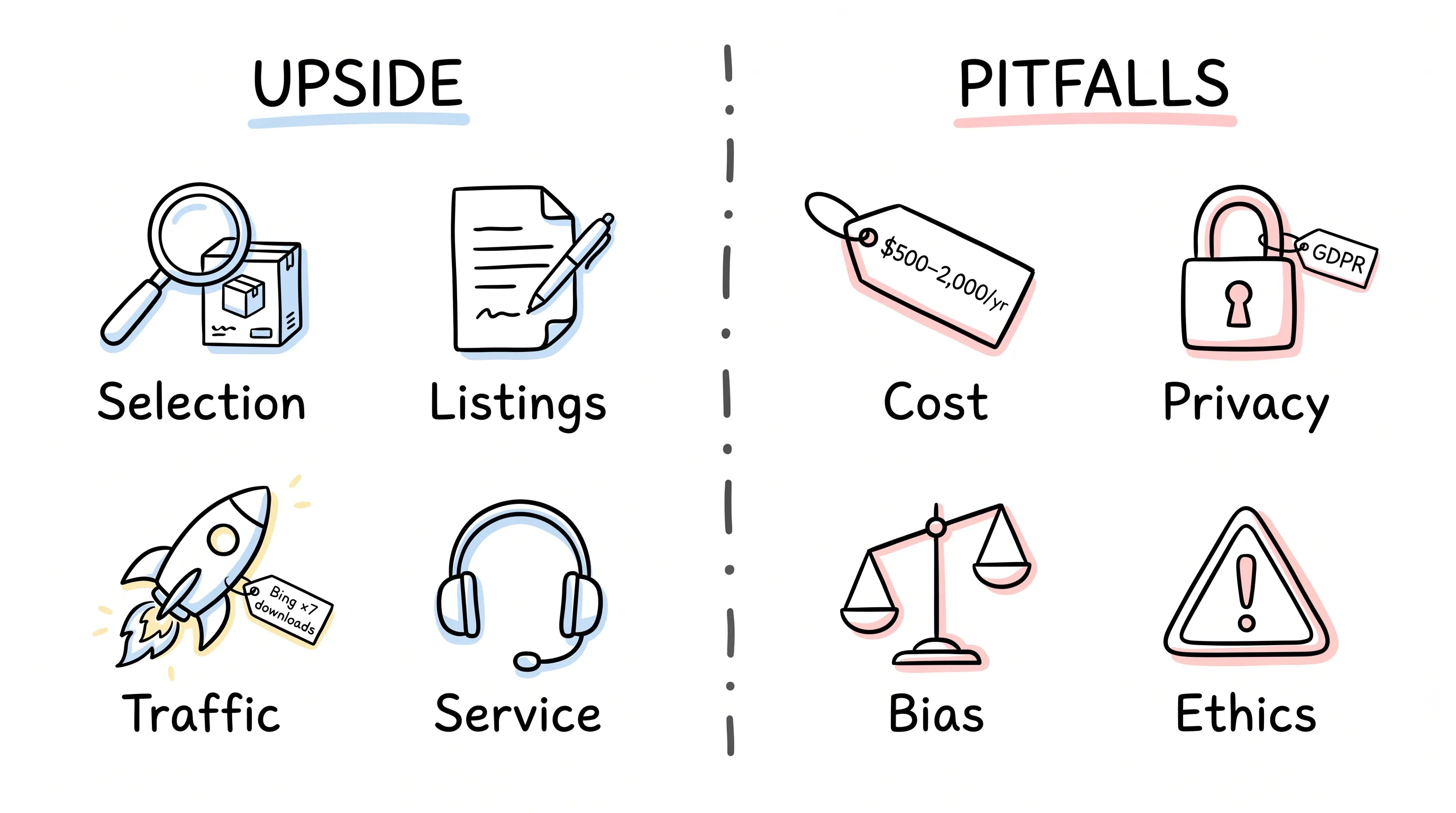
AIGC's room to work its magic in cross-border e-commerce concentrates in four places.
The first stop: product selection and product development.
The trade has an old saying: product selection is seven-tenths of the game; operations are the other three. Success or failure is often half-decided at the selection step.
Selection used to run on experience, on combing bestseller lists, even on gut feel. The way it works now: first let AI chew through market-research data and distill product keywords, then use tools like DALL-E and Midjourney to draw the product concept out directly — materials, colors, sizes adjusted over and over, until it fits the brand's tone. After the product goes live, real sales data flows back in to drive the next iteration.
The underlying technology is generative adversarial networks and diffusion models (neural networks that learn to generate images by imitating what they've seen) — no need to memorize the names. You only need to remember one sentence: it learns "what the things that sell well actually look like."
The second stop: detail pages and listings.
Cross-border e-commerce has a counterintuitive trap: the same product cannot look the same in different markets.
Take AliExpress and Amazon. AliExpress is used to piling every piece of product information onto the front page; Amazon requires white-background images, with the product filling at least 85% of the frame. Platform rules differ, consumer habits differ, so each detail page needs its own tailored care.
Language is a bigger hurdle. AliExpress's machine translation supports 17 languages, but the quality is frankly hard to praise. Behind it sits statistical machine translation (translation that matches phrases against huge bilingual corpora, without any real understanding): it "checks answers" against massive bilingual corpora and can offer only one best guess — understanding never enters the picture. Large models like ChatGPT are different: they grasp context, they can generate coherent text that follows a sentence's meaning, and translation quality clearly steps up a level.
Then there are factory-style stores with a dizzying number of SKUs. In the past, product descriptions written by different editors came out in all sorts of styles — nothing you could call standardized. Once AIGC arrives, description style is unified, information accurate, errors fewer — and brand credibility actually rises.
The Amazon ecosystem also has tools like Seller Spirit: the seller feeds in the ASINs of benchmark products, the tool pulls down those listings to learn and model them, filters keywords, then automatically generates a brand-new listing. Why go to such great lengths over a listing? Because Amazon's A9 algorithm ranks products by it. Rank near the front, and you have a business.
The third stop: traffic.
In early 2023, there was a traffic earthquake: Microsoft connected ChatGPT into its own search engine, Bing.
Powerful.
Similarweb's data puts it this way: the AI-powered Bing launched on February 7, 2023; by March 20, Bing's page visits had risen 15.8%, while over the same period Google fell almost 1%.
Data.ai's numbers are even more dramatic: after the AI features launched, downloads of the Bing app worldwide rose sevenfold, while over the same period downloads of the Google app fell 2%.
Brutal.
During that stretch, plenty of cross-border sellers moved their SEO strategies onto Bing overnight. Why? Those who move first eat the traffic dividend first.
The fourth stop: customer service and after-sales.
AIGC's presence in after-sales is often indirect: the agent translates in real time while hunting for a solution. But the more mainstream approach is the intelligent customer-service bot. Google Dialogflow, Amazon Lex, Microsoft Azure Bot Service — all continuously polishing their voice-support capabilities. These bots use natural language processing to hear and understand customers' questions and answer automatically; response speed and efficiency both come up.
You can go one step further. The system analyzes customers' data and history to generate personalized recommendations and tailored plans; it can even recognize customers' emotions from calls and voice, helping the agent judge how to answer.
More valuable still is anticipation. From massive customer data, spot the early warning signs of problems; adjust strategy and allocate resources ahead of time. After-sales goes from "putting out fires" to "preventing them."
And You Have to Count the Cost of the Tools
That's the upside — now, before you get carried away, hold on. These tools themselves carry three bills.
The first bill: they're expensive. Data-analysis tools like SellerApp, which handle market research, keyword analysis, and product optimization, charge 500 to 2,000 US dollars a year. Pocket change for big sellers; a hard cost for small ones.
The second bill: they're hard to learn. AI software keeps piling on features, updates come fast, and the learning curve is steep. Sellers without relevant experience lose a layer of skin just getting started.
The third bill: data silos. Each tool's data lives disconnected from the rest; the seller switches back and forth between several platforms, and management cost rises instead of falling.
Whether to buy, and which to buy — weigh your own business scale, budget, and concrete needs. Don't buy just because everyone else is buying.
Now, the Pitfalls
But everything always has a flip side.
The first pit: localization and integration — expensive and hard.
Cross-border e-commerce faces multilingual, multicultural markets. AIGC must understand how every country expresses itself, and fit the consumer habits shaped by each region's culture. The complexity of technical integration turns straight into cold, hard spending: developing multilingual systems, writing APIs, adapting data formats, reworking operational processes — every one of them costs money and headcount.
What stings more is the corpus. Chinese text makes up only about 1% of GPT-3's training data. In other words, these smartest of models actually understand very little of Chinese history and culture. If you want it to understand you, you have to feed it Chinese corpora specifically.
The second pit: data privacy.
AIGC's abilities are fed by massive user data: personal information, behavioral data, consumption preferences. If that data isn't protected well, it becomes a privacy leak.
More troublesome, every country's regulations differ. The EU's GDPR pursues one big unified framework, clamps down hard on cross-border data transfers, and its fines strike hard. China's Personal Information Protection Law focuses on domestic data processing and outbound security review — a different regulatory playbook altogether.
If your users' data gets used for ad targeting, user profiling, or market research, and you never got authorization — that's when trouble arrives.
The third pit: bias.
Algorithmic bias is, at bottom, the bias of training data. Some categories, brands, and demographic groups have large amounts of data, so the model recommends them more diligently; niche products and new products without data stay buried forever in no man's land.
Advertising is the same. If the training data leans toward American culture and values, the generated ad content carries an American perspective, and other regions' cultural differences and consumption habits are simply ignored. If the data skews young and high-income, the ads revolve around them, and everyone else is left out in the cold.
The fourth pit: ethics and social impact.
When the model favors high-ticket items, users with weaker purchasing power get pushed out the door again and again — and the gap between rich and poor is deepened by the algorithm itself. Generated ad content may also step on sensitive minefields like gender and race. A brand's reputation can collapse overnight — all it takes is one image, one sentence.
So What Should You Do?
My judgment comes down to three sentences.
First sentence: treat R&D as a real investment. Data scientists, machine-learning experts, software engineers, e-commerce veterans, business analysts — assemble an interdisciplinary team. Money alone isn't enough; R&D must work shoulder to shoulder with marketing, sales, and operations, responding fast when business needs come. Run the process with tools like Jira and Trello, and keep the incentives in step: bonuses, equity, promotion paths — not one of them can be missing.
Second sentence: don't build carts behind closed doors. Enterprises join hands with universities, startups, and research institutions on innovation projects, sharing technical resources and research results. The era of going it alone has passed.
Third sentence, zooming out: this industry cannot live without flow. The most advanced AI models today were all built by experts from different countries and disciplines working together. In recent years, anti-globalization has raised its head — technical barriers, trade frictions, supply-chain decoupling — all of it dragging on AI's development. Only when information, talent, and technology can flow freely can this industry move fast.
Back to That Dinner
Toward the end of that dinner, I asked my friend: will AI one day turn cross-border e-commerce into a one-person business?
He thought for a moment, then said: it used to be about who had the most people. From now on, it's about who figures it out first.
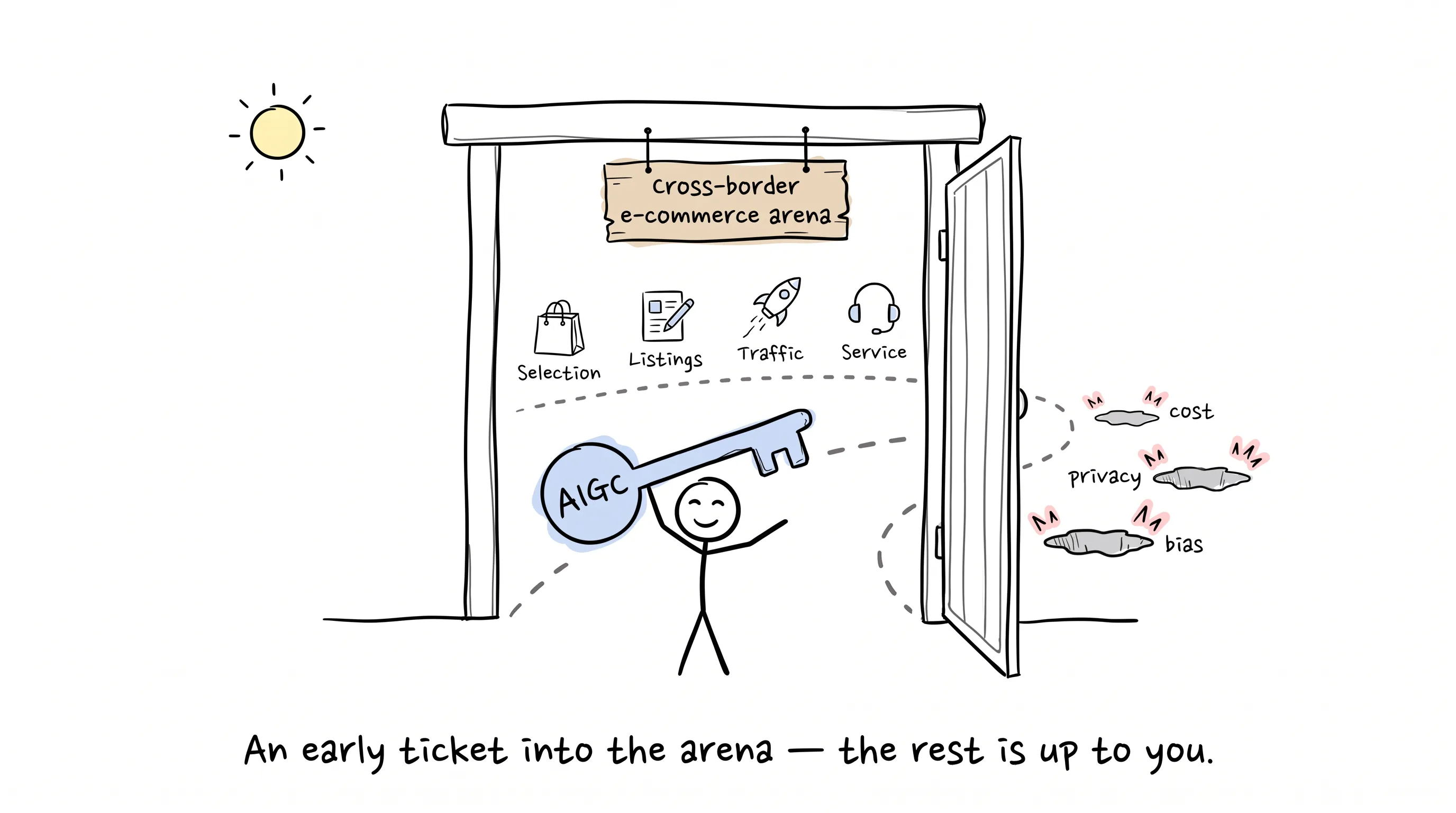
What AIGC hands cross-border e-commerce is an early ticket into the arena. Whether that key unlocks the kingdom behind the door — that part is up to you.
Here's hoping you catch this train. And here's hoping you hold your key steady.
Continue reading
Related articles
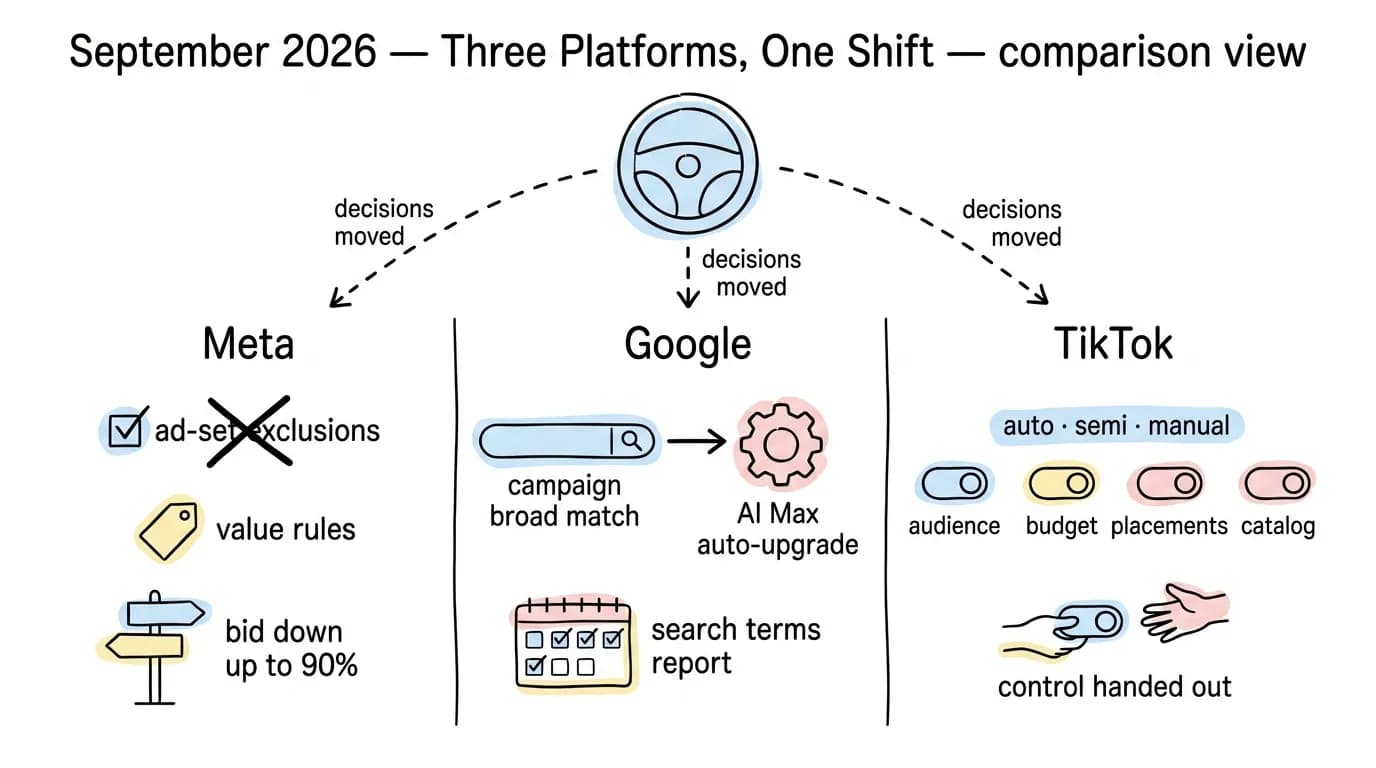
In September, Three Platforms Took Away Part of Your Steering Wheel
A few days ago, I went through everything the three big ad platforms did in September 2026. And I noticed a remarkably interesting coincidence.

Meta's New Terms Hit the Pause Button on the Eve of the Effective Date
A while back, I was helping a friend of mine who runs a cross-border e-commerce business go through the compliance checklist for his ad account.
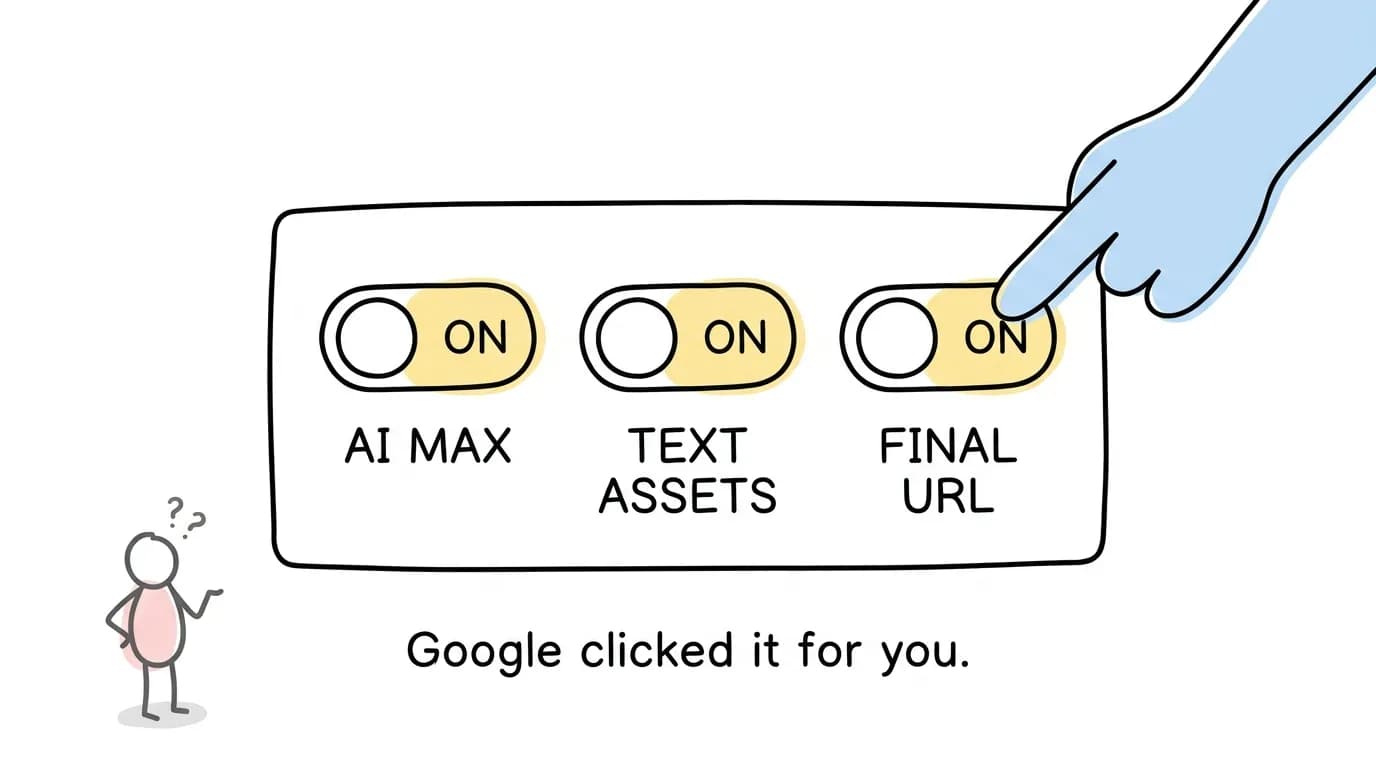
Google and Meta changed 17 ad rules this week. 6 of them need checking today.
A few days ago, I was helping a friend who runs a cross-border e-commerce business go through his ad accounts.