
So You've Started Using AI — Will Your Brand Stand Up? 210 Factories in Tianjin Have the Answer
A summary of a survey study of 210 Tianjin manufacturers: generative AI adoption lifts productivity, productivity supports brand building, AI's direct brand effect is weak, and cross-border e-commerce strategy amplifies the gains. The article also notes the study's limitations.
A while back, I came across a research paper on manufacturing in Tianjin.
Honestly, I didn't expect much at first. Academic papers — you know how they are, wall-to-wall equations and jargon. But the further I read, the more I realized it was answering a question a lot of factory owners are asking right now:
Can AI help you build a brand?
Its answer is interesting: yes — but not directly.
How the Study Was Done
The researchers surveyed 210 manufacturing factories in Tianjin: 94 in electronics (45%), 63 in textiles (30%), and 53 in machinery (25%).
The sample was chosen with care. What is Tianjin? An old industrial base, a key link in global supply chains. Much of what these factories make ends up sold overseas — the cross-border e-commerce that's been so hot these past few years.
And these aren't giants. More than 70% of the sample are small and mid-sized factories with under 200 employees, and half have annual revenue between $1 million and $10 million. Put simply, this is a study of ordinary factories like the ones all around us.
The researchers sent questionnaires to the key decision-makers at each factory, rating AI adoption on a five-point scale from "not used at all" to "fully adopted," with separate scales for productivity, brand performance, and cross-border e-commerce strategy. Reliability coefficients ranged from 0.85 to 0.91 — these weren't numbers made up off the top of anyone's head.
Finally, they used a statistical method called structural equation modeling (SEM) (a way of testing several cause-and-effect chains at once) to work out how those chains connect, all in one go.
Finding 1: AI Really Does Boost Productivity
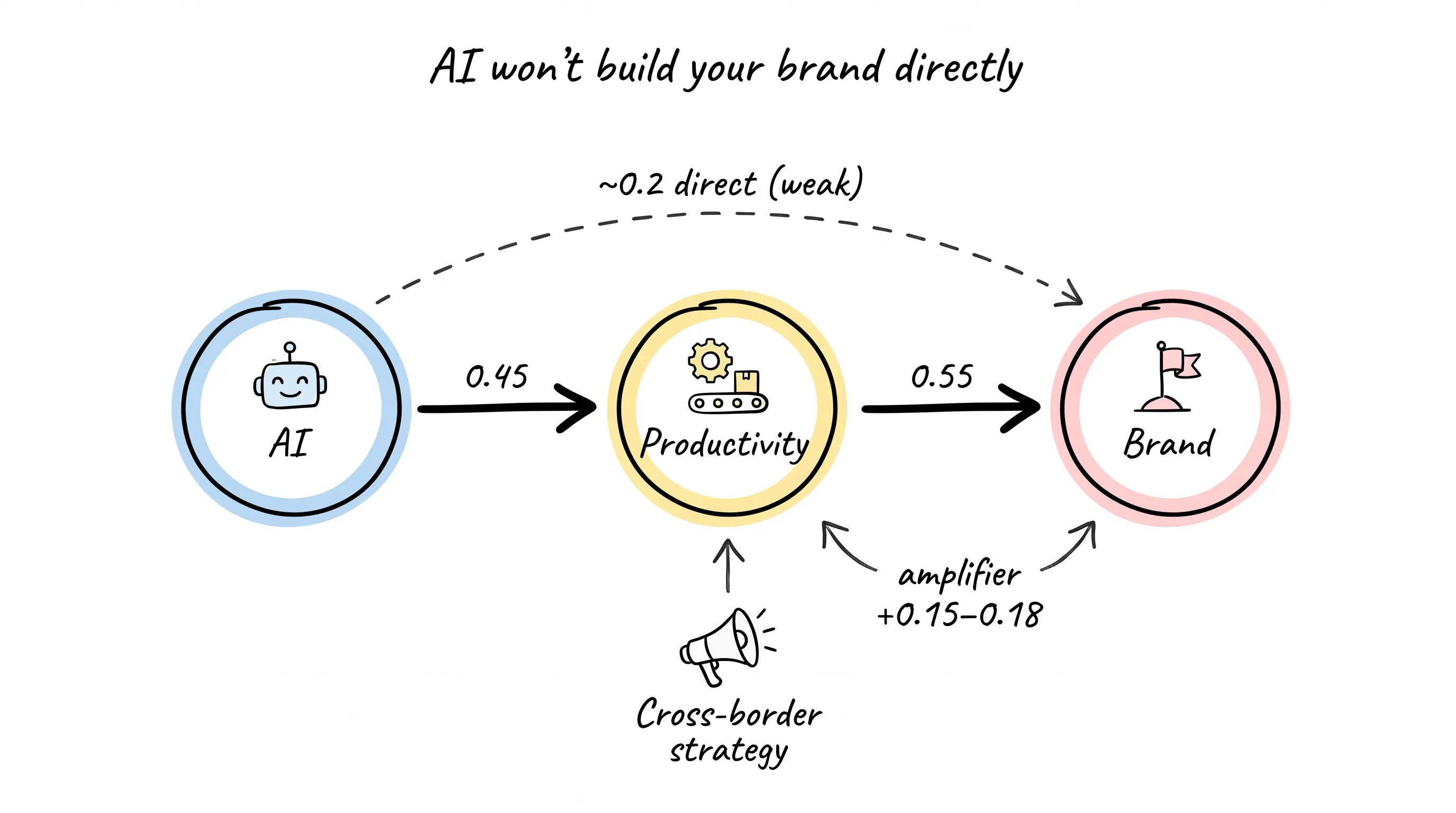
The first finding is no surprise: the deeper a factory's adoption of generative AI, the higher its productivity. The coefficient is 0.45 — slightly different figures appear across the paper's tables (0.43 to 0.45), but all clear the significance threshold, with p < 0.01.
What does p < 0.01 mean? It means the odds of this result being pure coincidence are less than one in a hundred.
What is generative AI? It's AI that creates new things on its own — writing copy, making images, that kind of thing. In a factory, there's plenty it can do: batch-generating product descriptions, optimizing supply chain scheduling.
On the productivity front, AI has genuinely delivered.
Finding 2: Productivity Isn't Brand — There's a Bridge in Between
The interesting part is the second finding.
If AI could build a brand directly through being "cheaper, faster, better," the story would be simple. The data refuses to cooperate.
Here's what it shows: AI's direct effect on brand building has a coefficient of only about 0.2. The indirect path through productivity is clearly larger — AI first lifts productivity (0.45), and productivity in turn lifts the brand (0.55). Add the two together and the indirect route lands far harder than AI's one direct punch at the brand.
In other words, AI won't raise your brand for you. It first drives up your production efficiency; with efficiency up, deliveries get fast and reliable, quality stays consistent, and as customers work with you over time, they slowly come to remember you and trust you.
Here's an analogy: AI is a more powerful engine, productivity is the driveshaft, and brand is the speed showing up at the wheels. Swap in a great engine but leave the driveshaft unconnected, and the wheels still won't turn.
The effort AI saves you doesn't automatically become brand.
I didn't say that — the data from 210 factories did.
Finding 3: Cross-Border E-Commerce Strategy Is the Amplifier
The third finding, I think, is the most valuable one for business owners.
Cross-border e-commerce strategy means how you pick platforms, lay out your channels, and handle overseas marketing and logistics. It doesn't build a brand on its own, but it works like an amplifier: factories with stronger strategies capture a visibly bigger brand boost from AI. The interaction effect comes in between 0.15 and 0.18, with p < 0.05.
When I read this, one thought hit me: now that's straight talk.
The same engine on two different chassis makes two very different cars. Think about it: suppose two factories each use AI to generate a hundred sets of product images and copy a day. Factory A has mature overseas channels and localized operations, so the material is live in every market the same day. Factory B hasn't even sorted out its overseas warehousing, so the material just sits on a hard drive. A year later, are A and B still the same A and B?
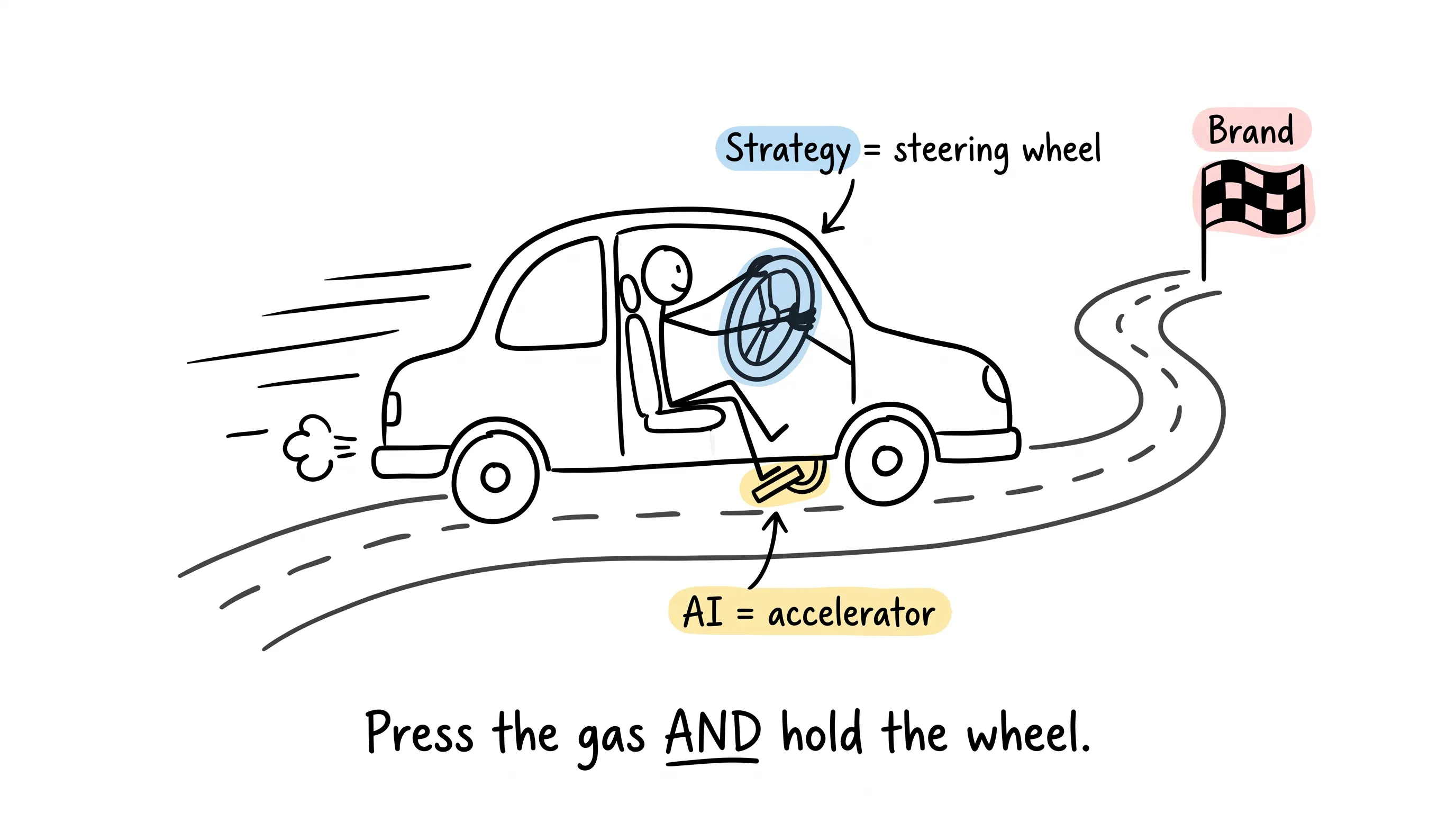
AI is the accelerator; strategy is the steering wheel. Press the gas without holding the wheel, and the car won't go far.
The Study Owns Up to Three Things
At the end, the paper honestly owns up to its limitations, and I think they're worth going over.
First, it's a cross-sectional study. What does that mean? It's a single snapshot — the state of these 210 factories at one point in time, not a multi-year drama that follows them along. So it can show these factors are highly correlated, but it can't nail causation down completely.
Second, the sample is Tianjin only. Whether the conclusions hold in other regions and industries is hard to say.
Third, the questionnaire data is self-reported. When a boss says "my AI adoption is going great," it tends to skew a bit rosy.
And one more limitation the researchers didn't list — I'll add it myself: AI technology turns over every few months, so the shelf life of conclusions like these may be shorter than we think. Don't treat this paper as scripture; treat it as a road sign.
A Final Word
Back to the opening question: you've started using AI — will your brand stand up?
This paper's answer, taken apart, comes down to three sentences. Yes, AI lifts productivity. But that efficiency has to become steady product strength and delivery strength before it can settle into a brand. And whether that conversion gets amplified or leaks away depends on how well your cross-border e-commerce strategy is run.
So here's the most practical item on the action list right now: stop competing on who uses AI the most, and start competing on who channels the time and money AI frees up into distribution and brand.
I don't know where your factory is on this journey. But if you're using AI too, try asking yourself a question tonight: all that time and money AI has saved you — where did it go?
Spent in the right place, they become tomorrow's brand.
Here's to pressing the accelerator with the steering wheel firmly in your own hands.
Continue reading
Related articles

What Is an AI Marketing Agent? From "Using AI" to "Delegating to AI"
A learn article explaining what an AI marketing agent is, how it differs from rule-based automation, and which repetitive tasks such as lead qualification, reporting, and campaign monitoring can be delegated while humans keep key decisions.

Marketing Automation Is Shifting from "You Do It" to "You Say It"
This article explains how marketing automation is shifting from rule-based platforms that merely execute toward AI agents that plan, create, publish, and review campaigns, covering delegable tasks, underlying technologies, tool categories, adoption steps, and risks such as privacy and automating without strategy.

When AI Does the Creative, Mistakes Come in Batches Too
A learn article on the risks of using generative AI for marketing creative across brand, legal, compliance, and operational layers, with case examples and seven practices for review, rights clearance, documentation, and vendor governance.