
AI Just Answered Everything for You — Why Would Anyone Still Read Your Content?
A learn article arguing that AI answers are displacing search-dependent content and urging a pivot to personality-driven content, covering hiring expressive creators, keeping channel ownership in-house, and pruning hard-to-defend SEO pages.
A couple of days ago, I came across a video.
A formidable creator of business content was talking about preparing to publish a book. One book, revised through ten drafts. The accompanying talk — hours in the chair every day, months of grinding. He said you keep grinding until you feel like there's "nothing left to give." Only then does it count.
Honestly, watching that kind of slow, unglamorous work, I felt awe — and a little ache on his behalf.
But when the video ended, something went "ding" in my head, and a rather brutal question surfaced:
That grind? AI could turn out a presentable first draft in a tenth of the time.
So what exactly was he polishing? And what should you be polishing?
I'd urge you to spend ten minutes thinking this through. Because for many companies in the content business, the water is already leaking out — it just hasn't reached your feet yet.
A Health Check: The Search-Content Business Is Starting to Hurt
Here's the conclusion up front: what AI is disrupting is the kind of content that depends on search to stay alive.
That's not an abstraction. You can run the numbers.
There's a publicly listed American company in personal-finance content called NerdWallet. Think of it as the poster child of the search-content business: writing about how to choose a credit card, how to compare them, which ones are easiest to get approved for — occupying search queries one by one, pulling in traffic, then finding ways to monetize it. That playbook worked for years. Predictable, measurable returns. Textbook stuff.
In 2024, it released an earnings report. A veteran who specializes in dissecting the search business went through the earnings call transcript line by line and noticed something:
Management used the phrase "organic search headwinds" ten times in a single quarter.
Ten times.
The corresponding traffic number was down nearly 20% quarter over quarter. Twenty percent means little for an ordinary company. But for a company that lives almost entirely off search traffic, that's the foundation sinking.
Later, the CEO came out to reassure the market, saying they could already see signs of recovery — because Google had, at the time, pulled back its AI search coverage. That may well be true. But flip it around: if a company has to depend on "Google temporarily not stuffing AI into more search boxes" to catch its breath, how much safety does this business actually have left?
And the sharpest pain is in informational traffic, not transactional.
What is informational traffic? Searches like "I want to understand something." What is transactional traffic? Searches like "I've already decided to buy — help me pick one."
AI is eating exactly the former. Because "understanding something" is something AI does far better than search does.
Think about it. You search "the rewards credit cards most worth getting." What does Google give you? A pile of links, seven or eight listicles, each one practically begging you to click in and do the comparison yourself. Google gave up on handing you answers long ago. It's an entry point whose whole message is: "Please keep doing your homework."
AI? You just say: pick me three credit cards that match these criteria. Three seconds, answer delivered. The homework, done for you.
Google has become a research engine. AI is the researcher. How do you fight a war like that?
Fortunately, the Window Is Real
Having said all that — don't panic yet.
AI has troubles of its own these past two years: training data is running dry, capability gains have gone from giant leaps to baby steps, and it still fumbles factual questions all the time. The reason Google reined in AI search in the first place was precisely those wildly wrong answers.
So the past year or two has been a rare window for people in content: AI is shifting gears, and you have a chance to switch lanes before it speeds up again.
But windows never wait until you're ready. They only notify you on the way shut.
While the window is still open, let's get practical. What's the new lane called?
What Is Personality-Driven Content?
Remember the grinder from the opening, the one who revised his book ten times? Taken line by line, what he says isn't actually information-dense. How to run a business, how to be a decent person, how to spot opportunities — it's all "common knowledge 101."
But he has one thing AI can't give him: personality.
He wraps every piece of common sense in his own stories, his own catchphrases, his own failures — and tells it like a secret you weren't supposed to know. That is personality-driven content.
Here's an even better example. There's a guy who does a podcast, and the content is: every week, a "book report" on one good book. That's it. That plain. He's made millions of dollars doing it.
See the pattern? Simplify what smart people know, pack it into a good story, then nail it home with one or two memorable lines. A recipe anyone can understand, and almost no one can pull off.
AI can help you simplify. But "the sincere you" — that, it cannot give you.
That's the watershed. Educational content of the old kind: AI can replicate it to eighty-percent quality. Content going forward has to have you in it.
So how do you actually implement this? Three things.
Thing One: Solve the Personality Problem Through Hiring
If you want content with personality, the easiest path is to hire someone who has one.
Take a visa-services startup. Their original playbook was utterly standard: hire a batch of writers to produce articles like "how to get a Singapore visa, what documents you need, how long it takes, whether you can expedite in a pinch" — carpeting Google.
Those articles are now worthless. Because they've all become commodity questions: any AI can answer them for free, instantly, and more clearly than the original SEO articles ever did.
What's the new playbook? Hire a group of young people with vivid personalities, with a job description that reads "travel the world" — and their actual work is to record and share the journey. How to get a visa is no longer a dry how-to guide — it's "last month I hit a snag at Singapore immigration, here's where I got stuck, and here's how I got through."
Content like that has warmth. It has exclusive, on-the-ground scenes. AI can't replicate it, and neither can the company next door.
Your job postings are your content strategy.
Thing Two: Get the Incentives and Ownership Right
Someone will say: why would an influencer work for you? They could grow their own audience and monetize on their own — isn't that better?
Get the incentive design right and this resolves itself. Two paths:
One is to develop talent. Like a talent show: sign promising unknowns, give them your best resources, and build them into IPs. The other is to import talent: sign established creators, offer a base salary plus a share of distribution revenue, and make them willing to borrow your stage.
But there's one iron rule you never give up at the table:
The channel must belong to the company.
The account you paid to build cannot live in someone else's hands. The influencer can walk; the account stays, and the next person steps up. It's like Marvel: the company owns the IP, the infrastructure, the story universe. Actors can be swapped — anyone can play Wolverine — but Marvel is forever Marvel.
What you're building is Marvel, not a machine for minting one star.
Thing Three: Subtract From Your Content Stockpile
This one is for every company already sitting on a tall pile of SEO articles.
The method is simple, and it stings: lay out everything you have and sort it into two piles.
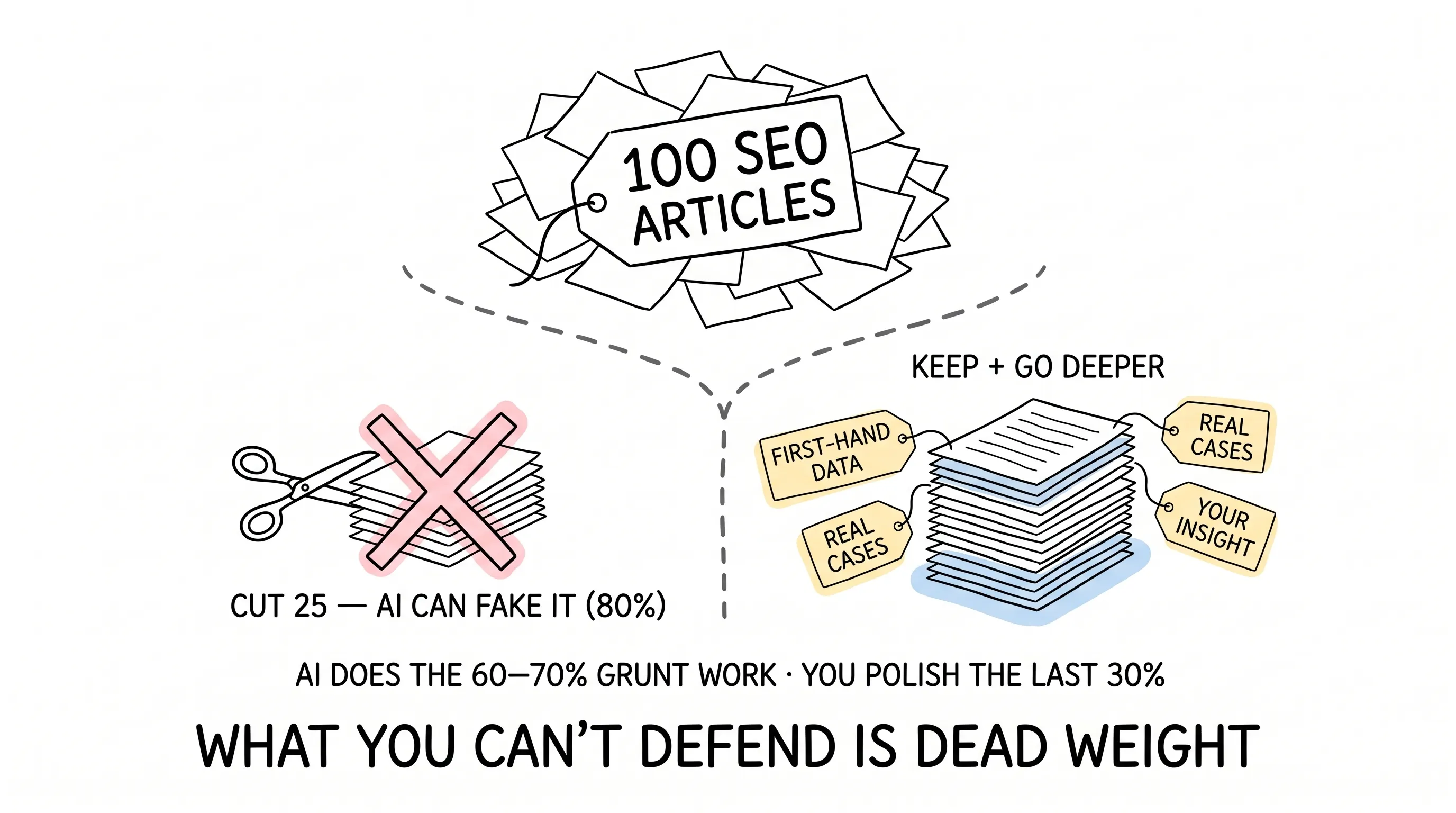
One pile: the content you couldn't defend no matter how hard you tried. That visa guide, for instance — AI can generate eighty percent of it casually. Cut it. Roughly speaking, out of every 100 articles, you need the courage to cut 25.
The other pile: the content where you hold a unique edge. First-hand data, real client cases, deep industry insight. Go relentlessly deep on this pile: add video, add charts, add expert interviews, add the information only you have.
Here, AI becomes your worker. It does the grunt work — 60%, 70% of it — and you polish the last 30% into something only your company could have written.
Don't cling to what you cut. What you can't defend is just dead weight if you keep it.
One Final Reminder — the Most Important One
These transformations don't fail on the tools. The tools aren't hard. What's hard is honesty.
I've watched too many companies say, "We get the new playbook, our current team can handle it." And then? Twelve months later, nothing has changed. Because people don't grow a feel for the internet (an instinct for what works online) just because you tell them to.
The method is plain: hold a meeting today, list the skills the new lane requires, go through your existing team, and check off one item at a time. Whatever's missing — train it or hire it. That simple. And that hard.
When the times shift gears, the losers usually lose because they refused to admit which skills they lack.
Back to the friend from the opening, the one who ground through ten drafts. His plodding effort has not been invalidated. What's invalidated is the nine drafts without a soul.
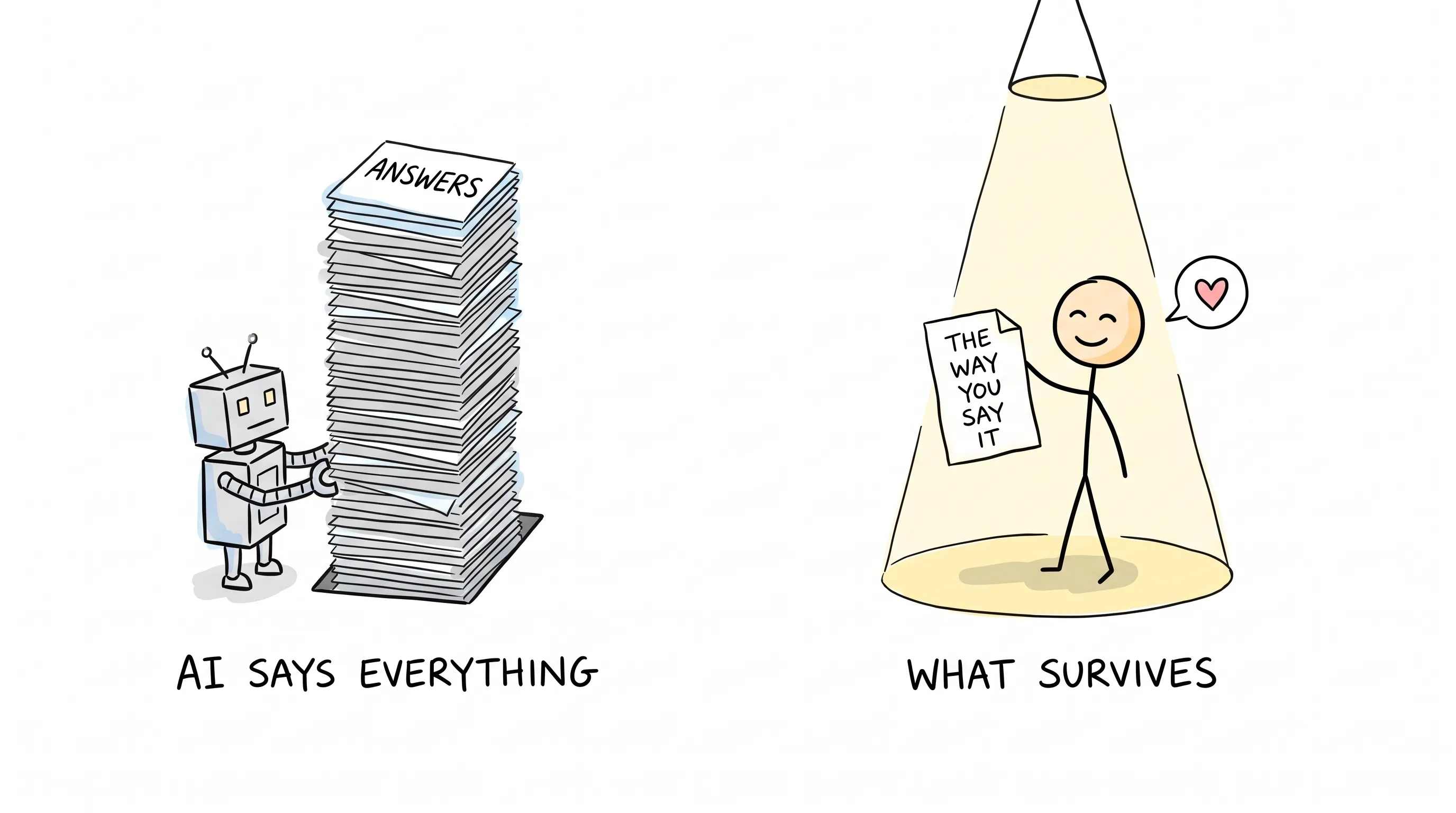
After AI has finished saying all the answers, what survives is the way you say them.
So here's to you: starting today, may you slowly grow into a self AI can't replicate.
Continue reading
Related articles

It's 2026: Stop "Buying" AI Tools for Your Marketing Team — Start "Hiring" AI Agents
This learn article explains how AI agents differ from standalone AI tools in marketing, outlines three agent categories — build-your-own platforms, CRM-native agents, and vertical tools — and covers use cases across SEO, social media, advertising, and reporting, plus criteria for choosing one.

What Is GEO? How Your Brand Gets "Mentioned" in the Age of AI Search
An explainer on GEO (Generative Engine Optimization) for e-commerce and DTC brands: how it differs from SEO and AEO, why AI answers shape brand visibility, and eight practices covering question-focused content, consistent brand messaging, structured pages, external evidence, comparisons, and AI mention tracking.

AI Is Already Making Decisions for Your Customers. Are You on the List?
A learn article explains GEO (Generative Engine Optimization): why AI-generated answers now shape which brands customers see, and how SEO fundamentals, entity clarity, citable evidence, and monthly measurement affect visibility in AI answers.