
How Much of Your Ad Budget Is Going to People Who Would Have Bought Anyway?
A learn article on proving ad effectiveness: running incrementality experiments, calibrating attribution and MMM toward causal evidence via a "portfolio of truths," plus Meta's Ads AI Connector (MCP) and Canva's measurement practices.
A while back, I watched an internal marketing-industry presentation properly, start to finish. The main speaker led the data science team at Meta; in the second half, they brought on stage the person who runs global marketing data at Canva.
Both were talking about the same thing: how, exactly, should the math of marketing be done?
My biggest takeaway was this: for the past two years, everyone has been talking about using AI to do marketing, but hardly anyone has explained "how to prove marketing actually works" this thoroughly. Today, let me retell the best parts in my own words.
First, an uncomfortable fact.
Ask CMOs what their biggest challenge is, and the answer at the top of the list is almost always the same: proving that marketing truly moves business results.
And when company profits slip, the first budget to get cut is, more likely than not, the marketing budget. How likely? Roughly 45%. Out of every ten profit crises, marketing is first to the knife four and a half times.
So you see, measurement was never decorative busywork for weekly reports. It is the weapon that protects your budget — and even wins you more.
So what does measuring right look like? One question from that talk stuck in me like a needle:
You spend money on ads and buy 100 conversions. How many of those people were going to buy anyway?
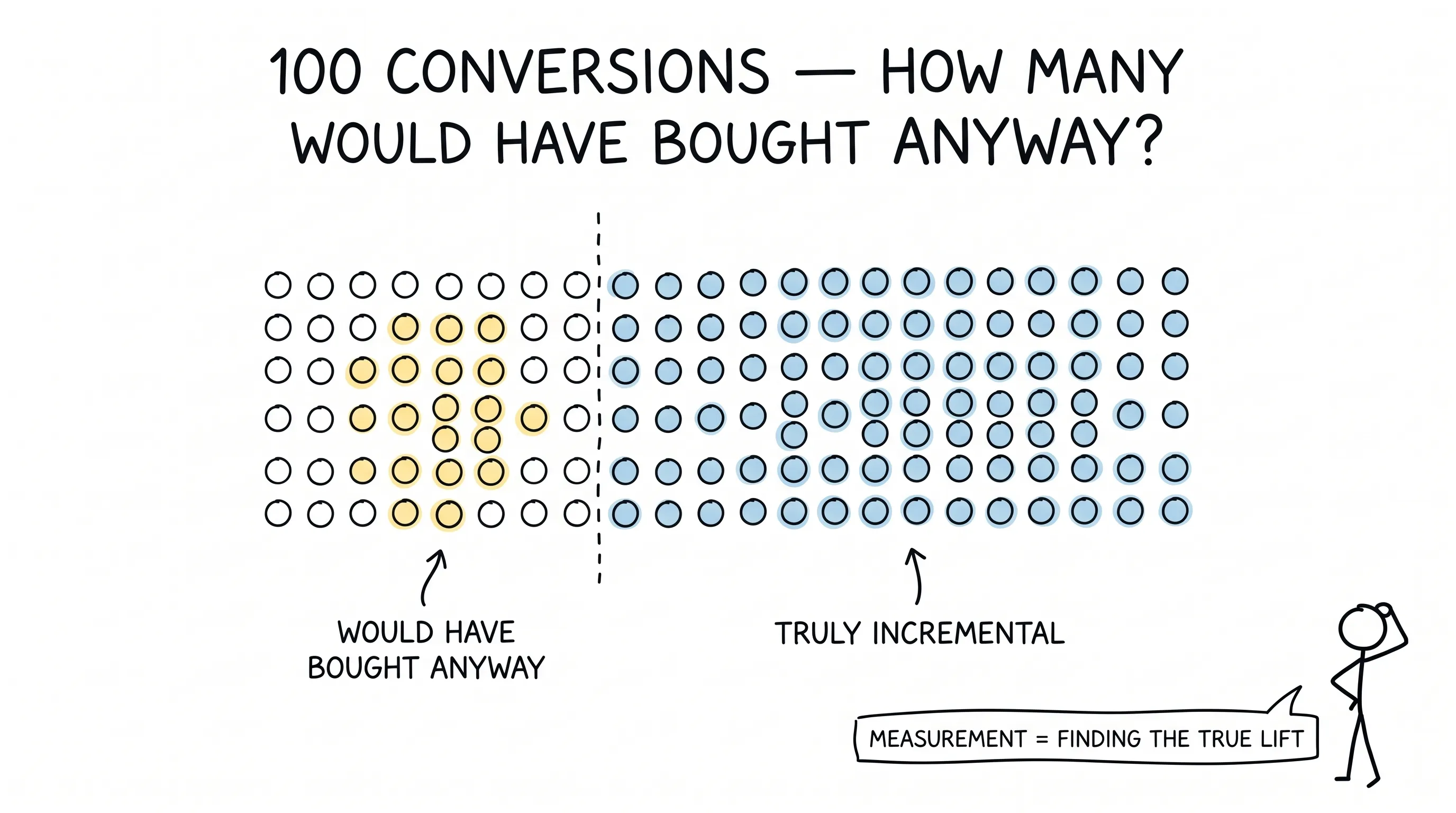
Think about it. For any business with a few years behind it, sales don't drop to zero the moment ads stop. There's always a base of customers who will pay whether or not you advertise. Money spent on reaching them is money spent for nothing.
Get measurement wrong, and you can't find the channels that are actually driving the business. Every dollar you then optimize is a dollar misplaced.
Clicks Are Losing Their Magic
So how did you used to do this math?
Most likely, you looked at clicks. A click meant interest; interest that ended in a purchase meant the ad worked. That logic has ruled digital marketing for over a decade.
But that map is now failing.
The numbers say 60% of searches today end with no click at all. AI shopping, short video, and social feeds are reshaping the entire path from discovery to desire to purchase. In formats like Reels and YouTube Shorts, the decision happens without the viewer ever "clicking" at all.
The journey has fragmented — and attribution has fragmented with it.
Attribution shows you the last touchpoint before the sale. But the last touch is not the one that did the work. A user may have been warmed up by three pieces of content, then casually searched your brand name at the end — and attribution hands all the credit to that search.
Put plainly, attribution measures correlation: who happened to stand close to the sale. What running a business actually requires is causation: who actually caused it.
The gap between those two things is what this article is about.
What Is Incrementality?
What is incrementality?
It's the degree to which your measurement system can detect causation, not just correlation.
How do you measure it? With randomized controlled experiments. Pharma has run this playbook for decades; marketing borrowed it, and it cuts just as sharp.
The method isn't complicated. Split the audience randomly into two groups. The test group sees the ads; the control group would have seen them too, but you deliberately hold them back. Run it, then compare the two, and the business gap between them is the part your marketing actually "created."
Meta is nearly obsessive about this. Incrementality is the foundation under almost every measurement they run. A former executive who led their analytics later wrote an entire book on the subject, and repeats one line to anyone who will listen: incremental results are everything.
Why the obsession? The logic is simple: if you can't prove incrementality, you don't know how much you're overestimating — and the money quietly leaks away.
Incrementality Is a Ruler With Many Markings
That said, don't rush to shred your reports just yet.
Incrementality isn't black and white. It's more like a ruler, with many markings along it.
At the very top sits the randomized controlled experiment. The hardest evidence, closest to true causation.
In the middle sit various quasi-experiments and models — data-driven attribution, Marketing Mix Modeling (MMM). They compare the people who actually saw the ads against a simulated stand-in group, modeled to look just like the exposed group but unexposed, to estimate an incremental effect. Less precise, but workable.
At the bottom sit non-incremental methods, like last-click attribution. They never estimate what the ads added over not advertising at all; they only record exposure.
No layer is better in the abstract — each is more or less fit for the job. The key is knowing where each of your tools sits on the ruler.
What Is a Portfolio of Truths?
So should you throw out attribution and MMM and run only experiments?
No. The answer this talk offered is one I particularly liked: a portfolio of truths.
The idea: use a set of tools that check and balance one another, closing in on the truth together. Every tool has bias, but the biases point in different directions. Use experiments — your "ground truth" — to calibrate the estimates from attribution and models, until they align with one another.
The core move in all of this is calibration.
What is calibration? Let me run the numbers for you — you'll get it instantly.
Say your attribution system credits the Meta channel with 100 conversions. You then run a conversion lift study on the platform, and it says the true incremental number should be 150.
The calibration factor is 150 divided by 100: 1.5.
From then on, every time the attribution report books one Meta conversion, you know the real contribution to the business is roughly 1.5.
Someone will ask: doesn't multiplying like that inflate the total?
Good question — and here's the key: every channel runs its own experiment and computes its own factor. The math evens itself out. The denominator is one and the same pie; the numerators all come from experiments; once you add them up, the numbers get anchored back to the ground.
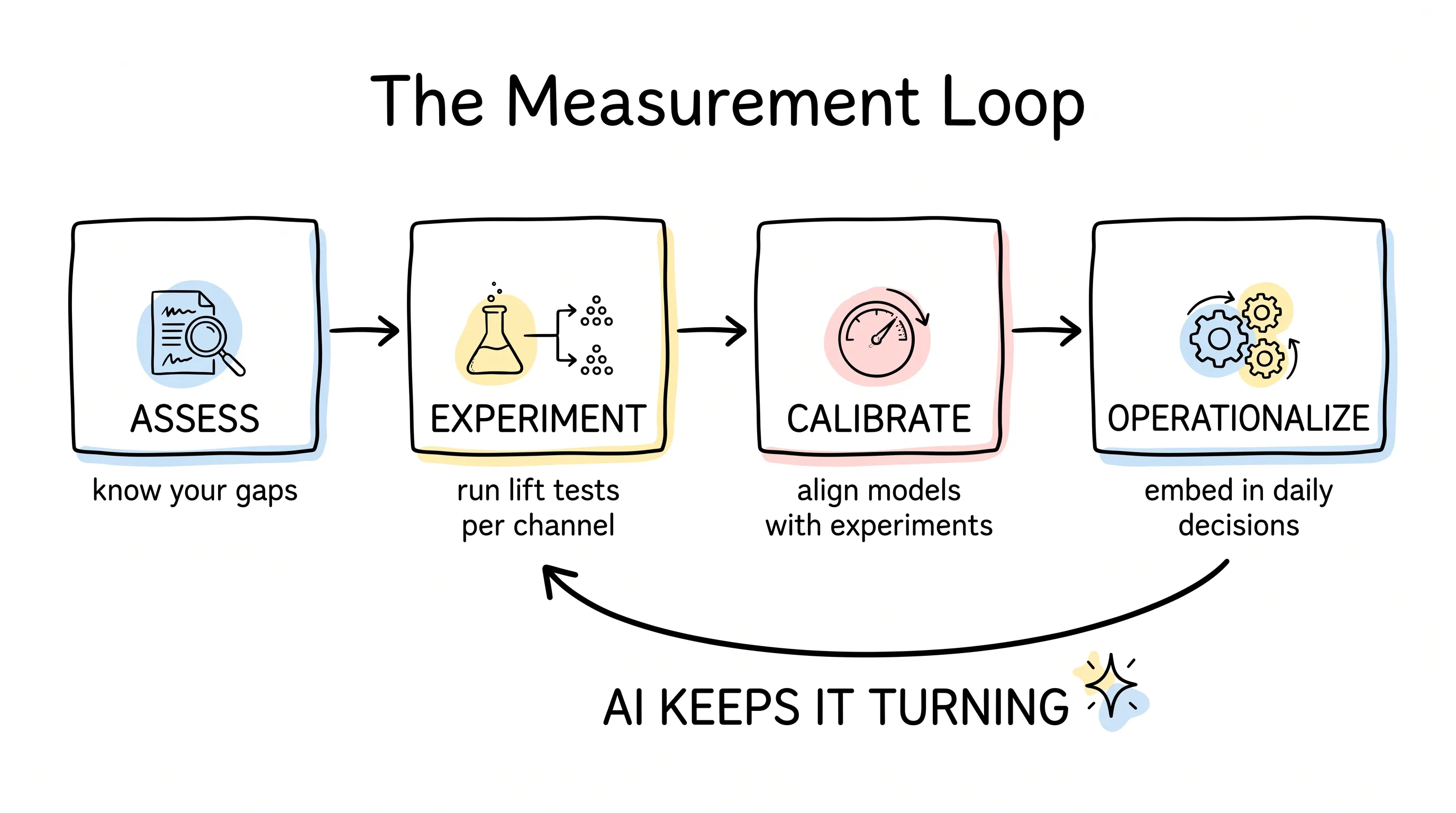
Putting It to Work: Four Steps
Theory done. How do you act on it? The talk laid out a four-step path that nearly every advertiser can use.
Step one: assess. Take stock of what you have. What are your current models saying? Where are the gaps? Where are the strengths?
Step two: experiment. Run incrementality tests on every channel you can reach, and get each channel's true contribution — its value and its direction.
Step three: calibrate. Bring attribution and models into line with the experimental data. Whatever doesn't match, fix.
Step four: operationalize. Embed the whole system into your everyday decision flow, so it keeps turning on its own.
Step four is the most overlooked — and the most lethal to skip.
Treat incrementality measurement as a one-off project and it loses its magic. At launch, the data looks great and the business feels it. The moment the project ends, nothing gets updated and the value falls off a cliff. Sound familiar? It's exactly like fitness: you get the membership, hire the trainer, build a little definition — then skip three months, and it's all back to zero.
It should be a repeating loop: every additional round of experiments pulls the models closer to the ground. The data snowballs, the calibration sharpens, the decisions get quicker and better.
Calibrating Attribution and MMM, Separately
Down at the tool level, the talk split this into two tracks.
Attribution first.
First — and this is the one I most want you to remember: run incrementality experiments. Run them on every platform you advertise on, then put the experimental results next to the attribution reports and hunt for the gaps.
Second, try every attribution model your system offers. First-touch, last-touch, evenly split — run them all, and see which model's conclusions track the experimental data most closely. Pick that one, then keep calibrating it with experimental data.
Now MMM.
You might ask: didn't you just say MMM is itself a quasi-experiment, already standing at the middle of the ruler? Why calibrate it at all?
That question deserves applause. The answer: MMM is powerful, but it is observational. It infers each channel's contribution from past spend and behavior. Same business, same method — change the parameters and you get a different result. MMM tools keep multiplying, one company ends up holding several reports that contradict each other, and that is exactly how trust gets ground away.
But you can't throw MMM away. It sees the whole picture, and the synergies between channels — nothing else can give you that.
The fix? Calibration again. Ranked from least to most investment, there are three tiers.
Tier one: align the direction. Check whether MMM's ranking of channel contributions points the same way as the experiments. The numbers can drift; the ordering must not. The cheapest option, moderate precision — good enough to start.
Tier two: use experiments to choose parameters. Tuning MMM is like facing a giant table of parameters — lay the experimental data over it and pick the set that best matches what the experiments found.
Tier three: use experiments to fine-tune the model itself. Let experimental data directly define the model's hyperparameters — the lag effects of advertising, the media saturation curves, all decided by the experiments. Hardest to do, but the most rigorous. It's effectively welding the hardness of experiments onto MMM's global view.
The talk gave a real case: the retailer H&M used experiments to calibrate its own MMM and attribution system. Over a two-year cycle, ROAS (return on ad spend) measured on an incremental basis tripled, while ROAS on an attribution basis rose 21%.
Three times. That is what getting the math right is worth.
AI Has Made the Loop Turn by Itself
You might say: I get the logic — but experiments, reports, models? That's a mountain of spreadsheets, and people reconciling numbers day and night.
This is what excited me most about the talk: that loop can now be handed to AI.
Take Meta. They launched a tool called Ads AI Connector — at its core, an MCP connector (a standard that lets AI assistants plug directly into outside services). It does three things.
First, it connects securely and directly to your ad account, so data no longer has to be exported back and forth.
Second, it delivers cross-channel insights and recommended actions. From inside whichever AI tool you already like — Claude, Perplexity, Gemini — you can ask directly and act directly, without hopping between dashboards.
Third, and to me the most brilliant: it can act for you. Your AI assistant can use your account's campaign history to launch a conversion lift study directly on the platform; when the study finishes, the lift results come back; then, carrying the cross-channel context, it talks to your MMM, computes the calibration factor, and writes it back into the model.
A loop of "experiment, calibrate, experiment again" starts turning on its own. The team doesn't have to rebuild anything; the existing way of working stays as is.
Of course, every action goes out only after you nod. You remain in the driver's seat. But the AI can see the full story of the account: which campaigns have run, how budgets were adjusted, which operational mistakes were made — it knows, because that is your account data.
Getting connected isn't complicated either: confirm your AI tool is on the supported list, find the connector on Meta's business site, paste the MCP server address into your AI tool, authorize — and you can start using it to launch lift studies, read results, run brand lift and A/B tests, and keep calibrating.
How Canva Actually Does It
With the theory done, Canva came on stage to hand in its homework.
Canva's marketing data science team is about twenty people, carrying the marketing budgets of more than 100 countries, accountable for answers and insight.
How do they do the math? Unpacked, it looks roughly like this: measurement in around 20 countries, with MMM running in 10 to 13 of them; in markets with too little data, heavier reliance on the platforms' own tests; woven throughout, geo experiments and conversion lift studies. The whole toolkit is weighted differently by country and by data volume. In their words, the machine is running fairly smoothly now, and the ongoing homework is to keep evolving the toolbox and to draw a roadmap of measurement tools for the whole company.
A few details I find especially worth chewing on.
First, why commit to incrementality in the first place? Their answer was candid: MMM is useful, but it isn't always an accurate picture. You need to know the true baseline so you don't over-credit marketing. In some countries there is so little data that platform tests are the only lever. So the real effort all goes into triangulation and calibration.
Second, how do you go from one-off tests to testing as a routine? The answer: no single team going it alone. The performance marketing teams join in together, a rigorous testing cadence gets established, every channel gets validated, and the results flow back to calibrate MMM. In a year, roughly 200 tests.
Two hundred. Compare that with the once-or-twice-a-year "annual experiment" at many companies — the gap is right there.
Third, how honest are they willing to be? The moderator asked: of the three calibration tiers, which one are you at? The answer: the middle. And they admitted outright that their MMM currently overstates marketing's contribution to some degree; much of the work is pulling the model toward the experimental data, with calibration values fed in first as priors. They want to go further, but constrained by business cadence and scale, you can't fix that with a snap of your fingers.
Finally, the moderator asked the question everyone had been waiting for: if a company is still living off proxy metrics like last-click, what's the first thing to do when they sit back down at their desk tomorrow?
The answer was disarmingly plain:
Don't wait for perfect. Start testing.
Build out your own triangulation, cross-check with your intuition often, run more experiments, and raise the baseline a little at a time. Waiting for perfect gets you nowhere.
Finally, Back to That Knife
Remember the number at the opening? When profits fall, there's roughly a 45% chance the marketing budget gets cut first.
Why does marketing always go first? Often because we can't produce a set of books the CFO can nod at. Anyone can make an attribution report — which is exactly why it persuades no one.
But when you hold experiments, calibration, and a model repeatedly aligned against them, what you hand over isn't a report. It's causal evidence that survives interrogation.
Correlation can't survive cross-examination. Causation defends the budget.
May every dollar of your ad spend land on the edge that actually brings in business — and not on the people who were going to buy anyway.
Continue reading
Related articles

It's 2026: Stop "Buying" AI Tools for Your Marketing Team — Start "Hiring" AI Agents
This learn article explains how AI agents differ from standalone AI tools in marketing, outlines three agent categories — build-your-own platforms, CRM-native agents, and vertical tools — and covers use cases across SEO, social media, advertising, and reporting, plus criteria for choosing one.

Did the Money You Spent on AI Marketing Ever Come Back?
A guide to measuring AI marketing ROI across three layers: ad reports, sales pipeline, and the financial ledger. Covers metrics such as ROAS and CPA, eight dashboard metrics, industry benchmarks, and common measurement mistakes.

How to Pick a Creative Automation Platform: First, Figure Out What These Eleven Actually Do
A learn article sorts eleven creative automation platforms — including Bannerflow, Celtra, Smartly.io, and Storyteq — into four functional groups and proposes five evaluation questions covering publishing reach, automation depth, ease of adoption, team fit, and verifiable evidence.