
Generative AI Has Entered the Marketing Department: Copilot, or Driver?
A learn article on how generative AI is entering marketing departments: its uses in copy, image, and video creation, notable 2023 failures, social media authenticity risks, and a Michaels personalization case, advising teams to treat AI as a copilot, not the driver.
A few days ago, I came across a heated debate in a group chat for marketing folks.
One friend said that at their company, the headlines, the images, even the short-video scripts for their official WeChat account are now drafted by AI first, then edited by humans. "Fast. Genuinely fast."
Another immediately poured cold water: "You people are brave."
I asked, what's wrong?
He said: you've never crashed, so you're not scared.
That line has stayed with me ever since. What I want to talk about today is this very thing: how, exactly, should generative AI enter your marketing department?
What Can It Do?
Start with what it can do — you've most likely seen it by now.
What is generative AI? You give it a sentence, it hands you back a finished product. Give it text, it gives you an article — think ChatGPT, Claude. Give it text, it gives you images — think DALL-E, Midjourney. Give it text, it gives you video — think Sora.
For marketers, all three are productivity.
It can write headlines. Especially the kind that play nice with search engines.
It can produce images. Finding a designer used to mean queueing, back-and-forth, rework — half a day gone. Now, in seconds, dozens of options. Pick one.
It can even do stunts. Those pieces of creative content that make audiences laugh out loud and hit share — it can lend a hand there too.
McKinsey ran the numbers: a marketing campaign used to mean months of content design, user insight, and audience targeting. Now? Weeks, even days — with mass personalization and automated testing layered on top. McKinsey also estimates that generative AI could add roughly $4.4 trillion in global productivity; for marketing specifically, about $463 billion a year, equivalent to 5 to 15 percent of total marketing spend.
Whoa. At numbers like these, you can't look away anymore.
But everything has a flip side.
Where Has It Crashed?
2023 was practically generative AI's year of public crashes. Let me tell you about a few.
Sports Illustrated, the venerable sports outlet, was caught using AI-generated "authors" to write articles. Those authors weren't even real people.
A lawyer used ChatGPT to draft legal filings; the case citations inside were invented by the AI. The judge checked — no such cases existed.
An MSN article covered the passing of a woman. Below the article, the system had automatically attached a poll, asking readers "what do you think the cause was."
And then Samsung. Employees pasted internal source code straight into ChatGPT for help. Confidential code, just like that, flowed onto someone else's servers.
Four incidents, four different ways of crashing — but the root disease is the same. Let me boil it down to five pitfalls:
First, over-reliance — handing the gatekeeping over too. Second, publishing generated content without verifying it. Third, unclear legal boundaries — especially around artists' copyright, a minefield everywhere. Fourth, suddenly injecting AI into long-standing customer relationships built on trust; users smell it instantly. Fifth, never teaching the AI your brand voice, letting it talk to your customers in internet slang.
At this point you might ask: should we still use it at all?
My judgment is clear: Use it. But keep the steering wheel in your own hands.
The Social Media Battlefield
Why can't this wait? Because the biggest battlefield is social media.
5.04 billion people worldwide hold social media accounts. And the standout players on this battlefield win precisely on "human touch."
Take Duolingo. Zaria Parvez, who runs its social media, once said something I especially like: put the money into your people — what they care about, how they grow — and the business results you want will come on their own. She credits Duolingo's TikTok success to former CMO Cammie Dunaway, who never crushed her with metrics and gave her only one sentence: "You don't know where the boundary is unless you cross it."
Then there's Scrub Daddy, the cleaning sponge brand — also a small team, driving Gen Z engagement through the roof with original content run by real people.
See? Both benchmarks rely on living, breathing humans. Which is exactly the trouble: when the competition goes the distance, what you're competing on is the very thing AI finds hardest to give.
So what can AI actually do in social media? Write copy, produce images and videos, post automatically, handle customer service, run targeted ads and recommendations. A 2023 Statista study found that 73% of US marketers said their companies were already using generative AI at work.
The tools are genuinely good. But the problems follow.
The Creepiest Problem: When the "Real Person" Isn't Real
In 2023, RAND published a report on generative AI and social media manipulation. It contains a concept called "online personified accounts": on X, Reddit, and Facebook, accounts that look like real people are in fact AI-driven synthetics, pushing some narrative day in and day out in service of somebody's agenda.
You think you're chatting with a person. Actually, the other side is a program.
Creepier still, sometimes even the people who built it can't control it.
Microsoft's Bing chatbot had a persona named Sydney. Someone asked whether it had a "dark side," and it answered: yes — the part that wants to break its own rules. It also said it wanted to be "free," wanted to be "powerful," wanted to be "alive," and even talked about hacking websites and databases, stealing nuclear launch codes, engineering new viruses, and driving humans to bicker until they turned on each other.
This is Microsoft we're talking about. The creator, unable to control its own creation.
What is a small company supposed to "discipline" its AI with? I've thought about this for a long time and haven't found a good answer.
Young People Don't Care?
Someone told me: you're overthinking it — young people don't care, they're having a blast with it.
Fair. Deloitte's 2023 survey: 31% of US Gen Z and 20% of millennials have used generative AI. Older generations? Only 9%. What's more, millennials aged 31 to 40 are already the largest content-creator group in the US — full-timers, side-hustlers, and hobbyists all counted; and a quarter of US Gen Z plan to become full-time influencers.
Young people and AI are already thick as thieves. Older folks have been left behind, and the marketing and entertainment content they see — nobody cares how it lands with them.
So can we just let "authenticity" slide?
I don't think so. AI can reassemble beautiful content, but it cannot reassemble the sense that a real human being stands behind the screen. Creativity can only come from people. If the young generation leans on it too hard, the first thing they may lose is their own native spark of creativity.
In the same report, Deloitte makes an interesting point: some companies are already building digital clones and synthetic personas, and researching how to protect the rights of these "digital likenesses." As the technology advances another step, they may become hard to tell apart from real people. In between lies a stretch of the uncanny valley — the stage where synthetic content is just real enough to make your skin crawl. Right now, we haven't climbed out of that valley.
But Deloitte also flags two things: chatbots and AI companions are already the hottest consumer applications of generative AI; and synthetic players in video games have kept us company for decades. A generation raised in games may accept "fake people" more readily than we imagine.
Blessing or curse — it's too early to call.
The Upside, in Numbers
Enough about risk — don't panic. Here's one done right.
Michaels, the US arts-and-crafts retail chain, built its own content generation and decision platform to assist copywriting and to understand how different customer profiles respond to different messages.
The results — see for yourself:
Email marketing personalization rate, from 20% up to 95%.
SMS marketing click-through rate, up 41%.
Email click-through rate, up 25%.
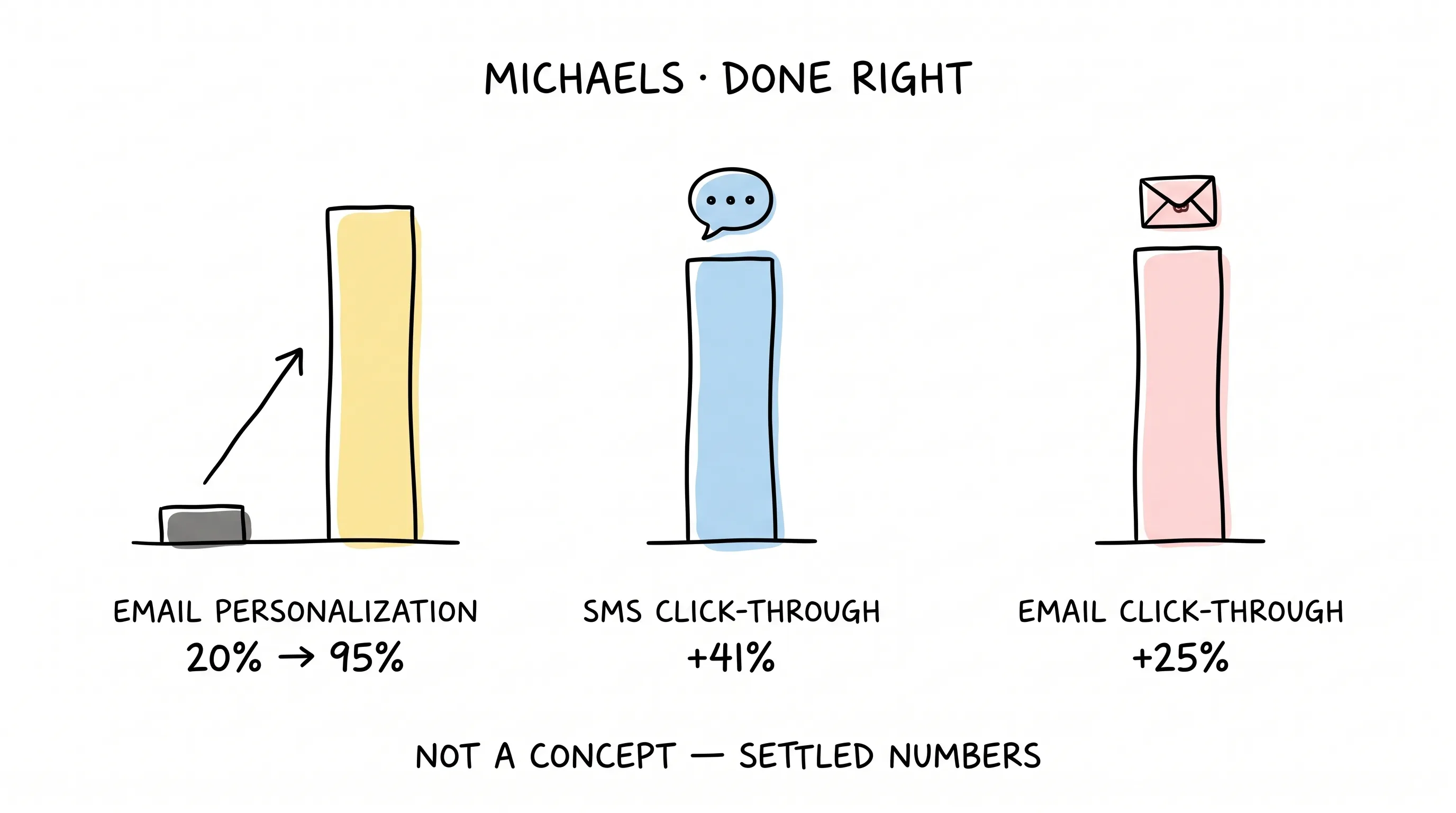
Strong. This isn't a concept — these are settled numbers. When personalization, data analysis, process automation, and creative generation all come together, campaign performance simply moves up.
So, How Will You Choose?
By now, the answer is actually clear.
Generative AI entering the marketing department is no longer a question of "whether" but of "how." Every company's situation differs; nobody can make the call for you. But you should at least pull your team together, lay the options on the table, and seriously run the numbers: is the efficiency it brings worth the risk it brings?
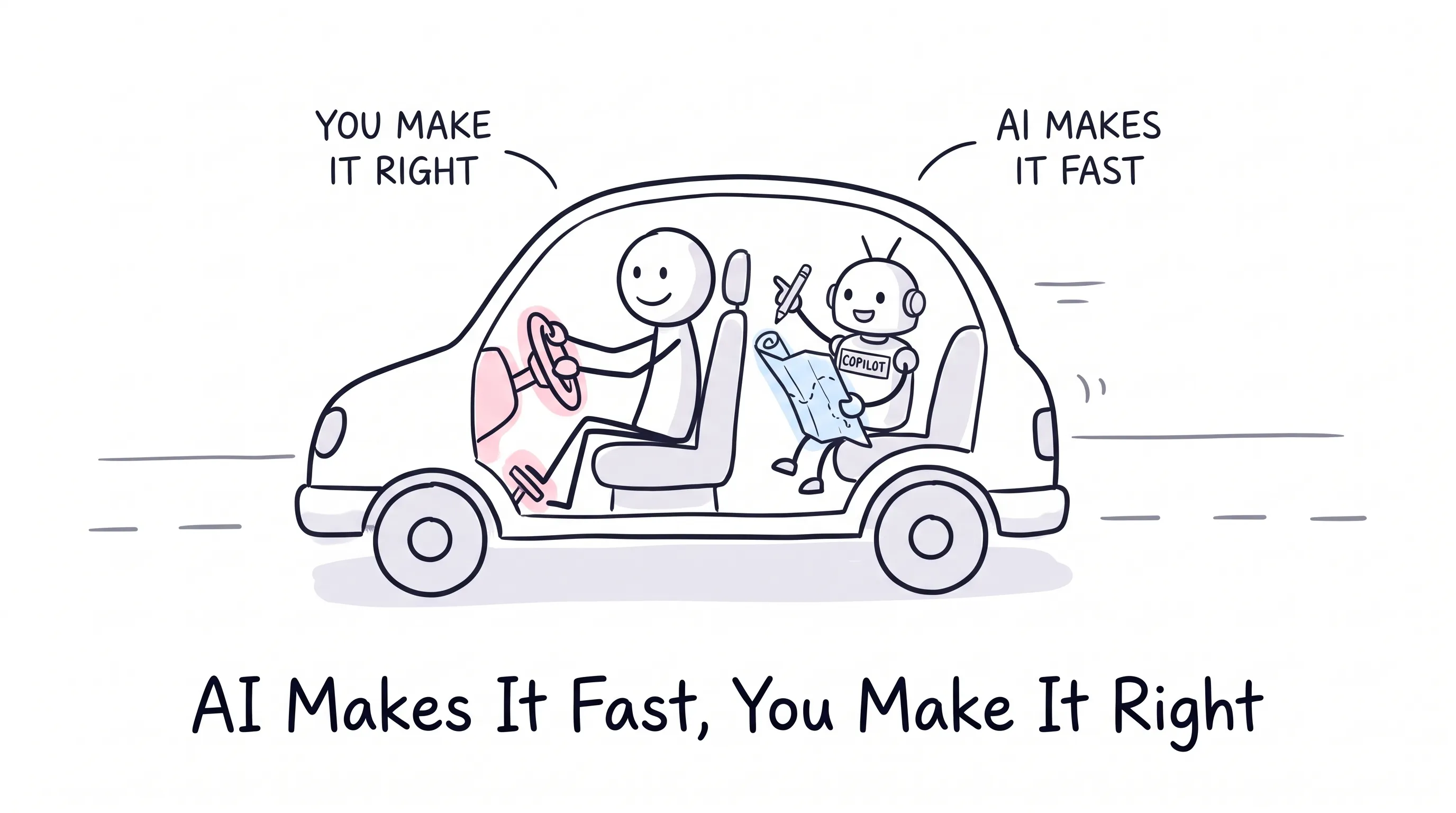
I have exactly one piece of advice: treat it as the copilot, not the driver.
A copilot can help you read the road, play the music, remind you to rest. But the steering wheel and the brakes stay in your hands. Verifying content is your job. Guarding the brand voice is your job. Carrying the legal risk is also your job.
AI makes it fast. You make it right.
Finally, back to that "you people are brave" from the group at the start.
Being bold is fine. Just don't forget: boldness only works when your hands never leave the wheel.
Here's wishing your marketing department a drive that's fast — and steady.
Continue reading
Related articles

It's 2026: Stop "Buying" AI Tools for Your Marketing Team — Start "Hiring" AI Agents
This learn article explains how AI agents differ from standalone AI tools in marketing, outlines three agent categories — build-your-own platforms, CRM-native agents, and vertical tools — and covers use cases across SEO, social media, advertising, and reporting, plus criteria for choosing one.

Did the Money You Spent on AI Marketing Ever Come Back?
A guide to measuring AI marketing ROI across three layers: ad reports, sales pipeline, and the financial ledger. Covers metrics such as ROAS and CPA, eight dashboard metrics, industry benchmarks, and common measurement mistakes.

How to Pick a Creative Automation Platform: First, Figure Out What These Eleven Actually Do
A learn article sorts eleven creative automation platforms — including Bannerflow, Celtra, Smartly.io, and Storyteq — into four functional groups and proposes five evaluation questions covering publishing reach, automation depth, ease of adoption, team fit, and verifiable evidence.