
3 A.M., Who's Watching Your Ads for You? Meet Adsroid
Let me start with a question.
Let me start with a question.
Have you ever had this experience: you're lying in bed scrolling your phone at midnight, and it suddenly hits you that your ad accounts are still running. Money is still being spent. How badly? You have no idea.
Get up and check? That feels a bit dramatic. Don't check? You won't sleep anyway.
The next morning you open the dashboard and discover that one ad set started spending wildly at 2 a.m., and your CPA (cost per acquisition — what you pay for each converted customer) doubled before you knew it. By the time you reacted, a few hundred were already gone.
It's annoying. But for a long time, this was simply the daily routine of nearly every media buyer.
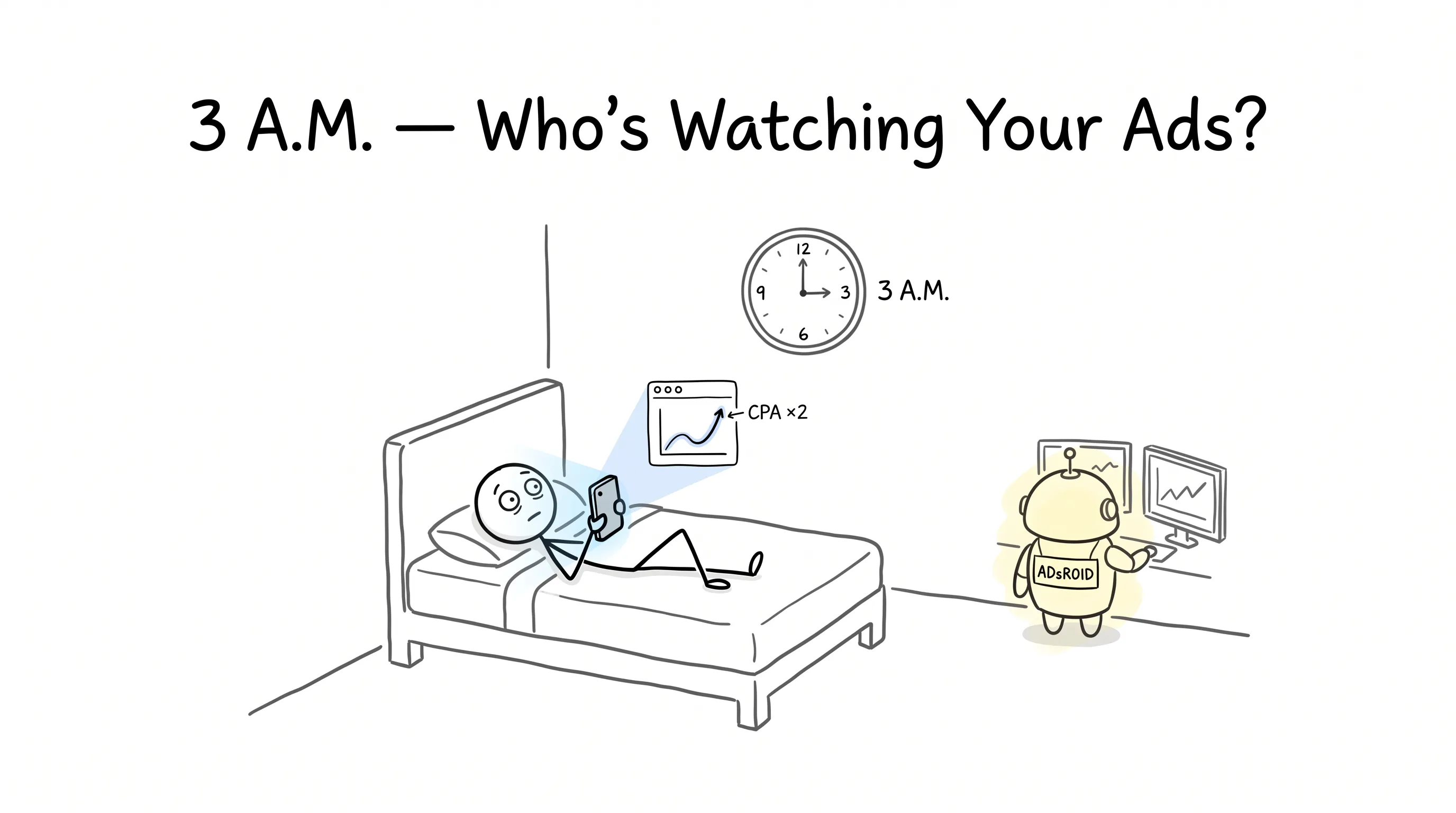
Until recently, when I took a serious look at a new category of product: the AI ad agent. One of them is called Adsroid. Today I want to talk about what it actually is — and about the bigger shift behind it.
What Is an AI Ad Agent?
So what is an AI ad agent?
Put simply, it's an AI media buyer that lives in the cloud and knows how to run campaigns. You authorize it with your Google, Meta, and TikTok ad accounts, and it goes to work on its own: watching the data, adjusting bids, shifting budgets, pausing creatives that have run off the rails, and delivering reports on schedule.
Notice the key phrase: "on its own."
This point is crucial. Most tools on the market put the data in front of you, tell you "something looks off here," and then wait for you to act. The data is visible; the work is still yours.
Adsroid is different. It acts on its own. When it sees an anomaly, it handles it; when it spots an opportunity, it executes. Every action goes through the official APIs into your own accounts. It never touches your money and never tops up funds on your behalf — your budget is always spent inside your own Google, Meta, and TikTok accounts.
One is a helper who reads the dashboard for you; the other is a driver who holds the wheel for you. These are two different things.
Why Is Media Buying Getting Harder and Harder to Do?
At this point you might ask: can't I just hire someone to watch the accounts? Why hand it to an AI?
You can — but you'll find that people can no longer keep up.
Why? Because there are too many platforms.
Google, Meta, TikTok — three companies, three entirely different sets of game rules. The auction logic differs, the audience data differs, the creative specs differ, the attribution models differ, even the reports look nothing alike.
Running Google Search ads, Meta's Advantage+, and TikTok's Spark Ads at the same time means one person sitting at three card tables at once. And those three tables influence each other: shift a chunk of budget on Meta, and the signals on Google's side may change along with it.
The result is that most teams can only fight fires passively. Wherever something is burning, they rush to put it out. By the time they discover the problem, ROAS (return on ad spend — revenue earned per dollar spent) has already dropped and CPA has already risen.
There's survey data to back this up. In HubSpot's State of Marketing research series, marketers themselves voted manual reporting and repetitive optimization among the five most time-consuming things they do each week.
Think about a media buyer's day: bouncing between three platform back-ends, staring at three sets of attribution data that never line up, manually adjusting bids across dozens of ad sets. After finishing all that, how much time is left for the work that actually creates value?
Not much.
When people are pinned to the ground by spreadsheets, strategy can only stand aside.
Adsroid's answer is to move the entire execution layer away. Hand the computation to machines, and people step back to do strategy, write creative briefs, and think about where the next phase of growth comes from. The company has shared one reference figure: teams managing five or more active campaigns at the same time save more than eight hours a week after connecting it.
Eight hours a week is two full days of work a month. And that's only the overtime saved.
Three Platforms — How Does It Manage Each One?
When it comes to the three platforms specifically, Adsroid plays them differently. Let me pick the most interesting point on each and tell you about it.
First, Google.
Google already has Smart Bidding — AI bidding, very smart. But there's a problem: it's a black box. You hand it your money, and as for how it adjusts and why, you can basically only guess.
What Adsroid does is add a layer of monitoring around this black box. It watches Smart Bidding's performance, compares it against your own historical benchmarks, and when it finds it running off track lately, it flags it for you — or corrects course directly according to rules you set in advance.
There are also two small but genuinely practical features. One is the search terms report: it continuously scans search queries, catches the irrelevant, low-intent ones, and automatically adds them as negative keywords according to the thresholds you set. The other is budget pacing: it watches each campaign's spending curve for the day, and whichever one is running better than its efficiency target, it shifts that day's spare budget toward it.
This solves the classic horror story: the winning campaign burns through its daily budget by noon, while the money still lies in the losing ad sets, fast asleep.
By the way, on the Google side it supports all of Search, Shopping, Display, and PMax (Performance Max — Google's fully automated campaign type) campaign types. Its asset group performance analysis for PMax also fills in the transparency gap left by native reporting — something many media buyers have been complaining about for a long time.
Now, Meta.
Meta these days is basically "creative is king." What the system rewards is creatives with high engagement, high completion, and good conversions.
So what Adsroid watches most closely on Meta is creative health. What is creative fatigue? Click-through rate is falling, frequency is rising, and conversion rate has stopped moving. This dish? Your audience has eaten it until they're sick of it.
It used to take a weekly review to discover the dish had gone stale. By then, the money had already burned uselessly for days. Adsroid discovers it in real time: the moment it detects fatigue signals, it automatically pauses that creative, switches the budget within the same ad set to the next best-performing one, and sends the creative team a structured diagnostic report.
Meta's own advertising documentation also says that creative refresh cadence is directly tied to auction competitiveness. Swap faster, and CPM gets cheaper. Adsroid's own observed data: accounts that used to manage creative fatigue through weekly manual reviews saw ROAS improve by more than 35% after connecting the automation.
35%. Sit with that number for a moment.
Finally, TikTok.
TikTok is no small stage anymore. According to eMarketer's data, TikTok's global digital ad revenue passed $18 billion back in 2023, and it has kept up double-digit growth since. Teams that still treat it as an "experimental channel" today are already behind.
What makes TikTok different is that it runs content-driven bidding. Whether the creative looks good decides the performance of what you put out more than how precise your targeting is. So on TikTok, Adsroid mainly watches three signals: completion, six-second view rate, and the pacing of conversion events.
What's interesting is when it catches funnel breaks. If a campaign looks lively at the front end but back-end conversions can't keep up, the problem is usually in the landing page or the pixel events. Adsroid points out this break point before the learning-phase budget is wasted — instead of waiting for the money to burn out before telling you "hmm, doesn't look great."
How Is It Different from the Platforms' Built-in Automation?
By now you might be asking: Google has Smart Bidding, Meta has Advantage+ — isn't the platforms' own AI pretty good? Why connect another layer?
Good question. This is the key to understanding Adsroid's value.
A platform's automation, however clever, only tends its own little fiefdom. Smart Bidding only understands Google's auction; Advantage+ only understands Meta's distribution. They don't communicate with each other, and neither will think on the other's behalf.
The three platforms' automations are three butlers loyal only to their own masters. Global decisions — nobody makes them.
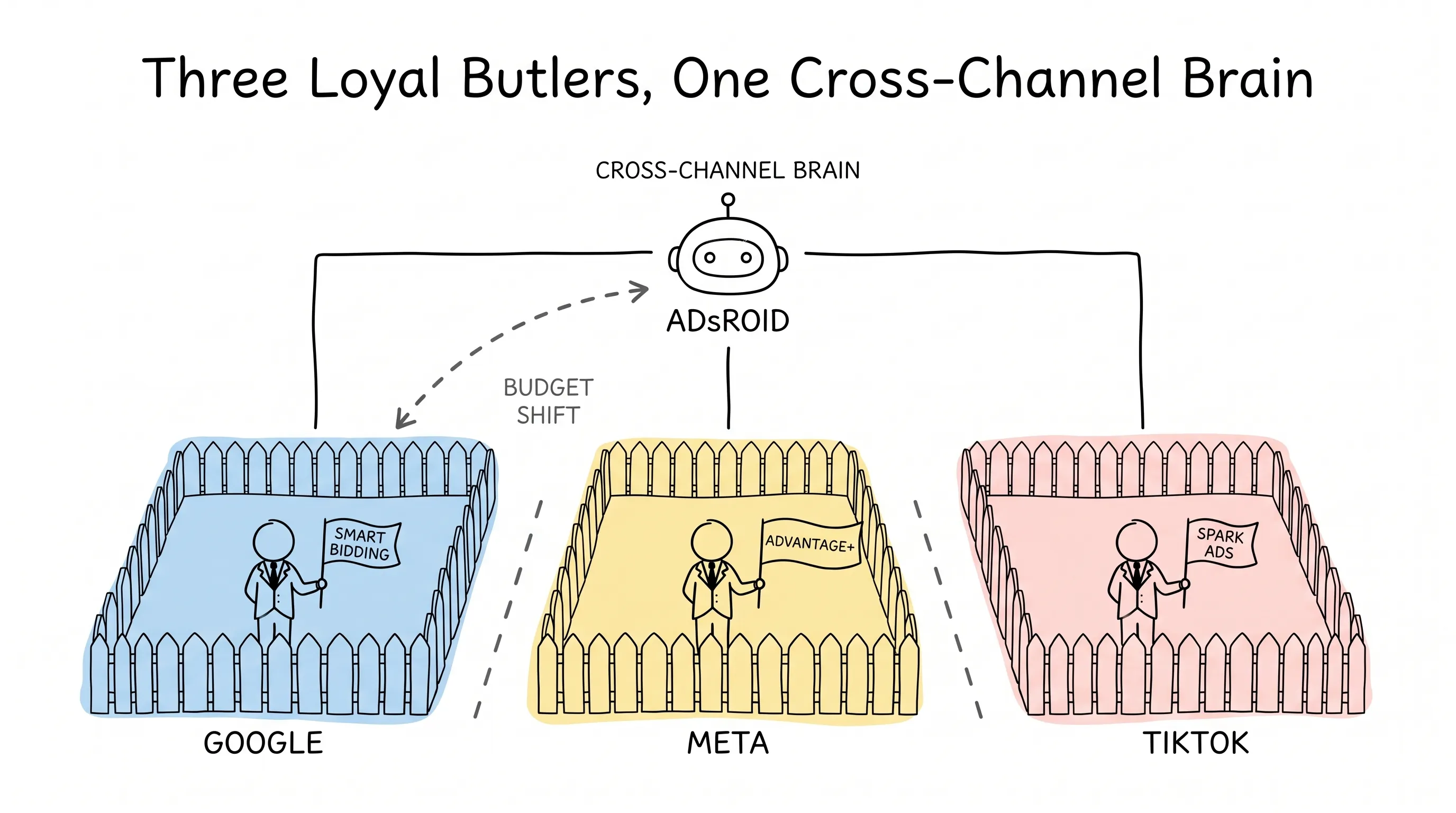
That's exactly the gap Adsroid fills. It sits above the three platforms as the one watching the whole board. For example, when cross-channel ROAS signals show that Google is the better deal at the moment, it can move budget over from Meta. No platform's native automation can make that move — it can't even see the other side's data.
While we're at it, a word on similar products. This space also has Madgicx, Revealbot, and Optmyzr. Madgicx basically revolves around Meta, with limited cross-channel capability. Revealbot's rules-based automation is well done, covering Meta and Google, but it has no native TikTok, and autonomous cross-channel scheduling is out of the question. Optmyzr is strong on Google, shallow on Meta, and basically absent on TikTok.
The difference isn't just "how many channels are supported." The real divide lies in "who does the doing": most tools are automation rules plus manual confirmation; Adsroid takes another path — it executes on its own according to the thresholds you've set, freeing people from the confirmation step too.
How Do You Get Started? Don't Panic — Five Steps
If you're interested, the onboarding process looks roughly like this — I've compressed it into five steps.
Step one: register with Adsroid and connect your ad accounts through official OAuth. It asks for read access to data plus permission to run optimizations — the principle of least privilege; it doesn't touch billing, doesn't touch money. All three platforms can be connected in one go, so from day one it has a global view.
Step two: set the guardrails. Target ROAS, maximum CPA, daily budget caps per channel, creative fatigue thresholds. These numbers are the boundaries of the AI's actions. My suggestion: set the thresholds conservatively for the first two weeks, observe its behavioral style first, then hand over control gradually.
Step three: let it do a comprehensive health check. The initial audit lists the problems in your account by priority: audience overlap, low-intentioned keywords burning money, poorly performing ad sets squatting on budget, creatives showing early fatigue signals. This list is at the same time your future baseline.
Step four: let go. Once you've confirmed the audit results and made the manual adjustments you wanted to make, turn on autonomous optimization. Bids, budgets, creative rotation, negative keywords — it executes automatically within the guardrails, without you approving item by item. Set your reporting cadence here too.
Step five: keep watching anomaly alerts, and add leverage gradually. It has a set of real-time anomaly detection: sudden CPA spikes, unexplained drops in conversion rate, spending rhythms that don't look right — all pushed to you, and each alert comes with a root-cause guess of its own, saving you a large amount of troubleshooting time. The official word is that most accounts see efficiency improvement within two to four weeks; at sixty to ninety days, the compounding of cross-channel reallocation and creative rotation starts to show. The longer it runs, the more you can trust it, and the wider you can open the guardrails.
There's also a Copilot you can talk to. Ask it directly: "If we raise the Meta budget by 20%, how will overall performance change?" It will run the projection for you based on your account's historical data, instead of making you go back and rebuild an Excel model.
Agencies get taken care of, too. Multi-account management, white-label reports, tiered permissions — which actions the agent does itself and which need the account manager's nod can be set separately. That way, you can take on more clients without doubling your optimization headcount.
But There Are Three Pitfalls You Must Avoid
Everything up to here has been upside. But everything has a flip side. With AI ad agents, there are three pitfalls I must warn you about.
Pitfall one: setting the thresholds too harsh from the start.
Say your account's average CPA is currently 50, and you press the cap straight down to 45. Looks strict, right? The likely result: during a normal period of volatility in the account, the agent sees "over the line" and pauses campaigns early. The learning phase gets interrupted, the data ends up with a gap, and later optimization actually becomes harder.
What works instead is a two-to-four-week calibration period — start the parameters conservative, wait for the agent to learn your account's temperament, then tighten gradually.
Pitfall two: treating the AI as creative director.
However strong agents like Adsroid get, they only optimize the distribution and budgeting of "existing creatives." They won't think up ideas for you, let alone produce good creatives for you.
Machines amplify good creative; they can't save bad creative.
If the creative pipeline breaks, and all running creatives fatigue at the same time, even the most perfect automation can't turn the tide. So that old saying holds especially true here: AI is responsible for spending the money on good creatives — you first have to be responsible for having good creatives.
Pitfall three: the muddled ledger of attribution.
The same conversion, claimed once by Google, claimed once by Meta, claimed once by TikTok too. All three keep their own books, and the conversion count you get by adding them up is several times your real conversion count.
Normally this may just make the reports ugly. But when you turn on automatic cross-channel budget allocation, it becomes a big problem: the agent will lean toward moving money to the platform that is "most active at claiming credit," not the one that "truly drives incrementality."
So the unified framework for cross-channel attribution has to be built first. A third-party attribution tool, or a data warehouse solution — choose one of the two. If the foundation isn't clean, the taller the building gets, the more dangerous it is.
A Bigger Change Is Happening
Finally, I want to pull the camera back.
For the past few decades, the quality of media buying has been roughly proportional to team size and seniority. More people meant more campaigns you could watch, denser testing, faster optimization. Big budget paired with big team — this was an iron law.
AI ad agents have loosened this iron law. A team of three or four people, connected to this kind of agent, gains execution throughput that may equal a veteran team of media buyers from the past. The agent doesn't sleep, doesn't take leave, watches the data at 3 a.m., and manages fifty campaigns without dropping the ball on any of them.
There's also an even more invisible change: the way knowledge accumulates.
In the past, a team's buying experience grew inside the heads of a few veteran buyers. When the people left, the experience left with them, and whoever took over stepped on the same landmines from zero. Now the optimization logic is written into threshold configurations, audit logs, and performance baselines. People can leave; the system stays where it is, running truer and truer.
The craft of media buying is turning from "human intuition" into "organizational asset."
And this advantage is compounding. The agent's learning speed will always be faster than the pace of manual iteration. That gap will only keep widening. The earlier you connect, the earlier the compounding starts rolling.
As for the you who jolts awake at 3 a.m. to check the account — perhaps soon you'll get to sleep a whole night through.
Machines watch the boards; humans make the calls. This may be the most important change in the division of labor that the media-buying trade sees in the coming years.
Here's hoping you can soon cross "3 a.m. panic check" off your skill list.
Continue reading
Related articles
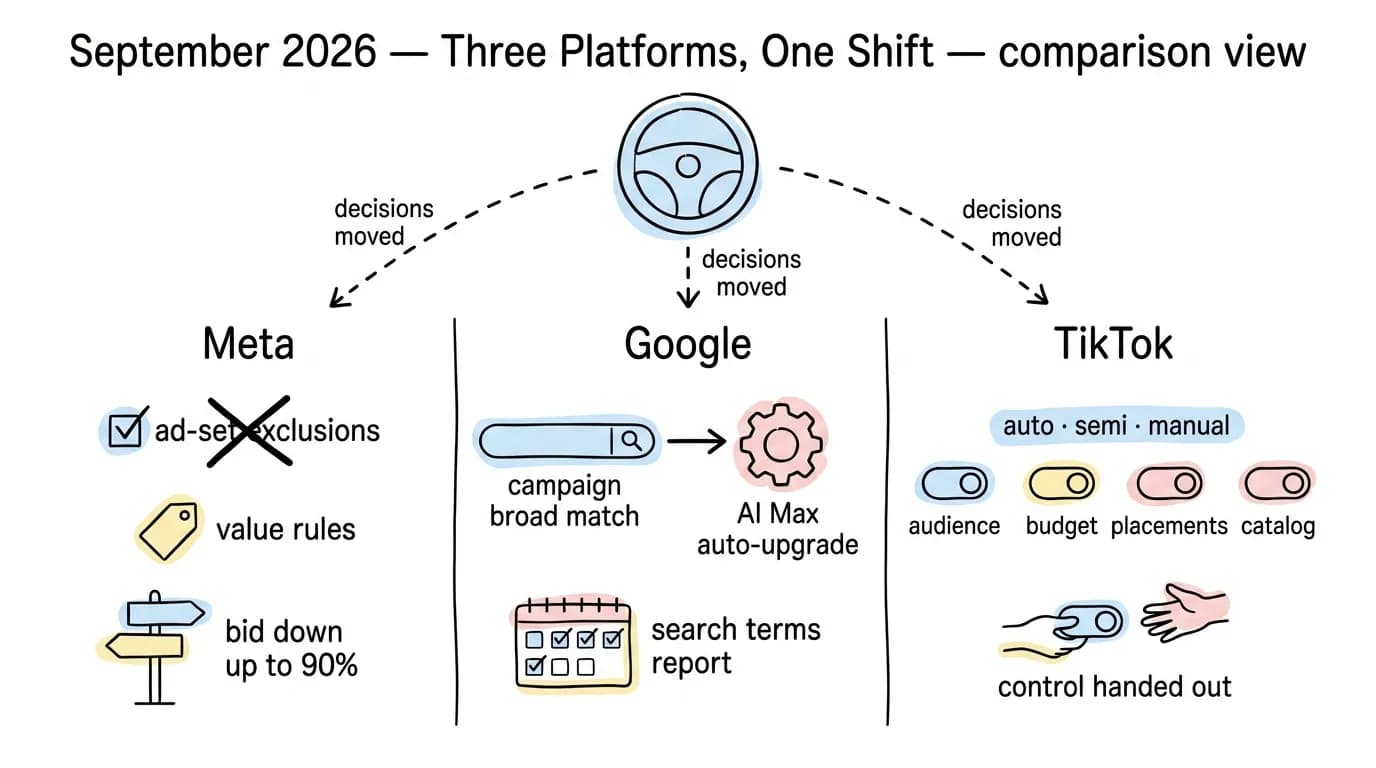
In September, Three Platforms Took Away Part of Your Steering Wheel
A few days ago, I went through everything the three big ad platforms did in September 2026. And I noticed a remarkably interesting coincidence.
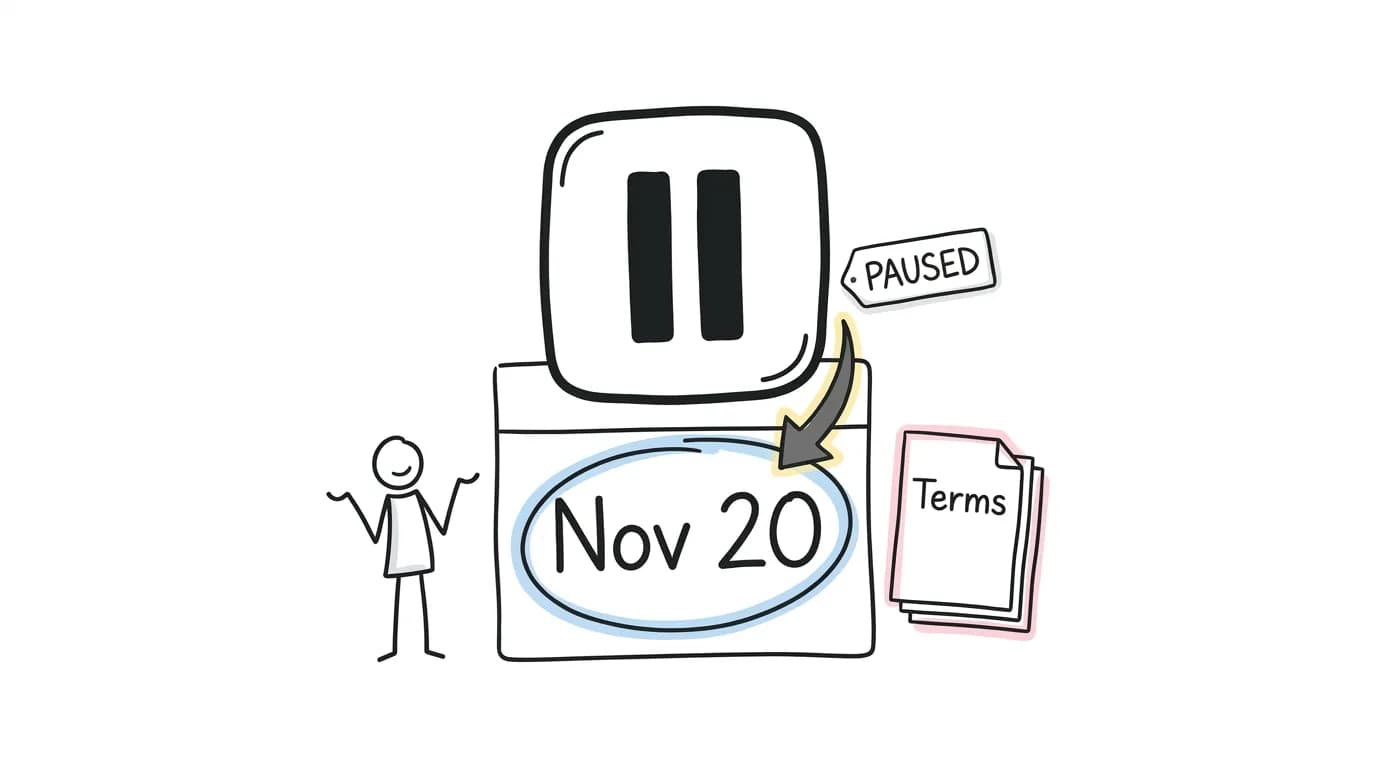
Meta's New Terms Hit the Pause Button on the Eve of the Effective Date
A while back, I was helping a friend of mine who runs a cross-border e-commerce business go through the compliance checklist for his ad account.
Google and Meta changed 17 ad rules this week. 6 of them need checking today.
A few days ago, I was helping a friend who runs a cross-border e-commerce business go through his ad accounts.