
What Is GEO? The Traffic Entrance Is Shifting — You'd Better Know Where to Stand
A learn article explaining GEO (Generative Engine Optimization): how AI-generated answers cite sources, why GEO extends rather than replaces SEO, and five practical moves such as chunking content for extraction, earning external citations, and per-engine strategies.
A few days ago, I asked a friend to run a little experiment.
He asked ChatGPT a question from his own industry — the kind of thing his company deals with every single day. The AI reeled off a polished answer. Methods, steps, even a few recommendations.
I asked him: are you mentioned anywhere in there?
He said: no. The ones it mentioned were all competitors.
So what about your SEO rankings? Steady at the top of page one.
That got me thinking for days afterward. Because people are quietly switching to a new front door for information. It used to be: go to Google, search, scroll the results, click a link. Now more and more people just ask AI directly. They ask, they leave — they can't even be bothered to click.
So here's the question: if AI's answer doesn't include you, do you basically not exist?
I'll say something that might sting: that's pretty much how it is.
What Is GEO?
GEO — Generative Engine Optimization.
Put simply: it's about making your content something AI wants to pick.
When a user asks an AI a question, the engine pulls from a pile of sources to assemble its answer. If your content gets cited, adopted, woven into that answer — you win. Even if the user never clicks through to your site at all.
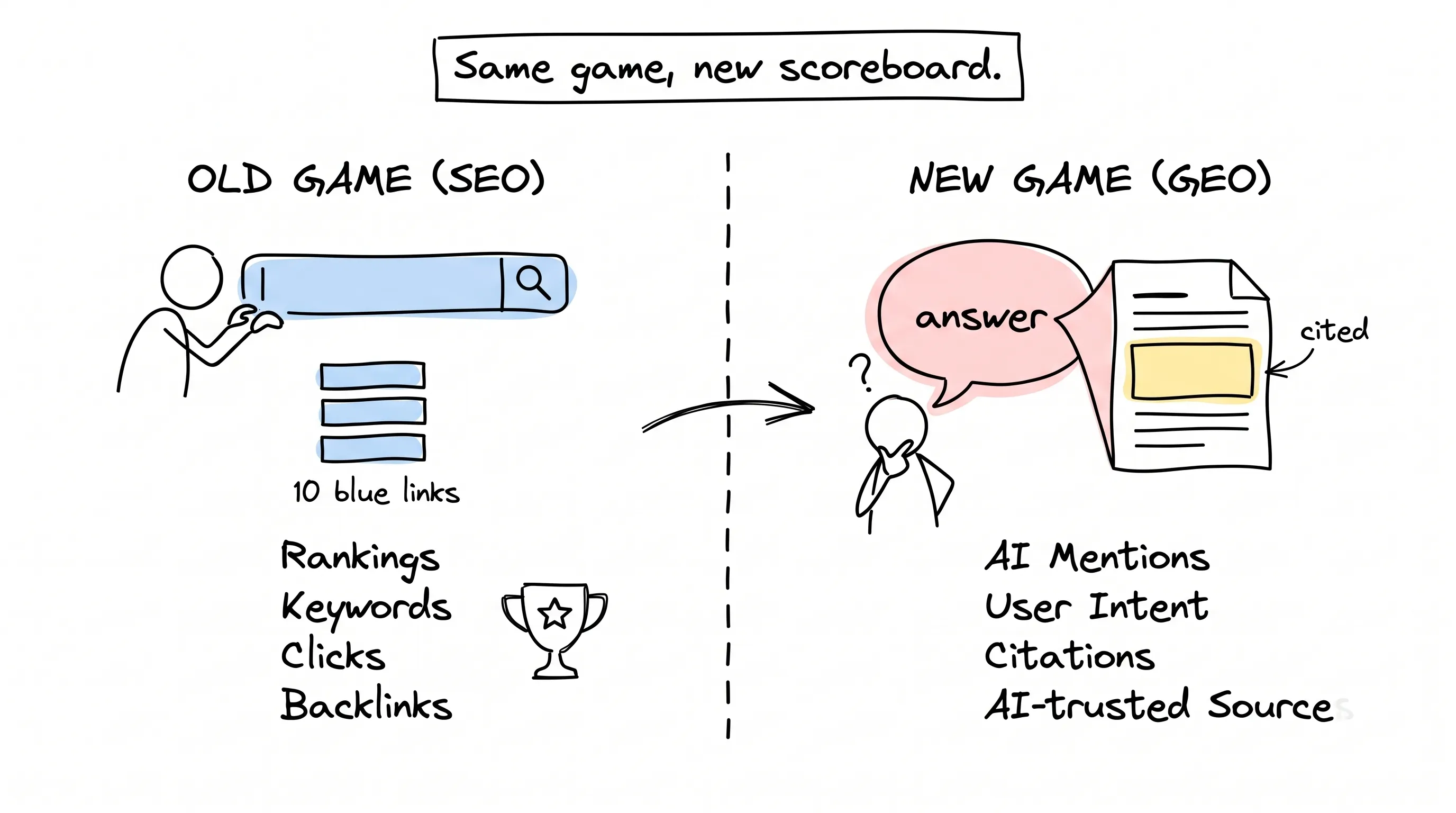
What does traditional SEO chase? Rankings, keywords, backlinks. Making yourself legible to crawlers, getting search engines to put you up front.
GEO chases something else: getting engines like ChatGPT, Gemini, Perplexity, and Google's AI Overviews to understand you, remember you, and use you directly.
Here's an example. You write an article with a section that plainly says "What is X," nails it in three sentences, and includes data. AI can lift that section wholesale and use it on the spot — worth more than ten florid long-form articles.
That's GEO.
The Most Easily Misunderstood Point
Many people hear "GEO" and their first reaction is: it's over, SEO is dying, better learn the new tricks fast.
I say: quite the opposite.
Google's own documentation on generative search specifically mentions GEO and AEO. But it also says something refreshingly honest: no magic trick can replace solid SEO and genuinely useful content.
You want to get into AI Overviews, into AI Mode? It still comes down to those same old friends: indexability, content quality, relevance, authority, user experience. Every single one still required.
GEO is not a replacement for SEO. It's an extension of SEO.
Where's the difference? In what you're now keeping score of. Let me run the numbers for you:
You used to watch rankings. Now you watch whether AI's answers include you.
You used to watch keywords. Now you watch user intent — what are people actually trying to ask?
You used to watch click volume. Now you watch citation counts.
You used to watch backlink counts. Now you watch which sources AI treats as its evidence.
Same game, new scoreboard.
What's Been Happening on the Field in 2026
So what exactly has been going on in AI search lately? A few things I've been tracking closely.
First: Google's core update in February 2026.
This update pushed "quality first" another step forward, with three changes worth noting:
Mass-produced AI content with no real value got squeezed even harder.
Content with verifiable first-hand experience earned points. If you've actually done it, actually tested it, and have real data, that's worth more than calling yourself an expert.
Organic rankings and AI Overviews got tied together more tightly. If your content is useless to AI, chances are it won't do well in traditional search either.
The result: a whole batch of websites that were technically flawless saw their traffic drop. Meanwhile, content that explains things clearly and carries real cases climbed.
That signal could not be louder.
Second, a step further back: in the June 2025 core update, Google changed how it understands content relevance, and many sites went through dramatic swings in traffic. What do you do after the dust settles? Pull out the pages that took the worst damage, re-examine their quality signals, and shore up E-E-A-T (experience, expertise, authoritativeness, and trust). If you've actually done the work, show the receipts.
Third, the spread of AI Overviews and AI Mode. The search results page is less and less "ten blue links," and more and more an AI-assembled answer with a few sources hanging underneath. Whether your content can get cut into that answer directly decides whether you're still on the field.
Fourth, generative engines have a noticeable taste: they prefer to cite content that external authoritative sources have already mentioned. Ten self-published posts aren't worth one proper citation from someone else.
How Do You Do It? Five Practical Moves
Enough theory. Here's what you can actually do.
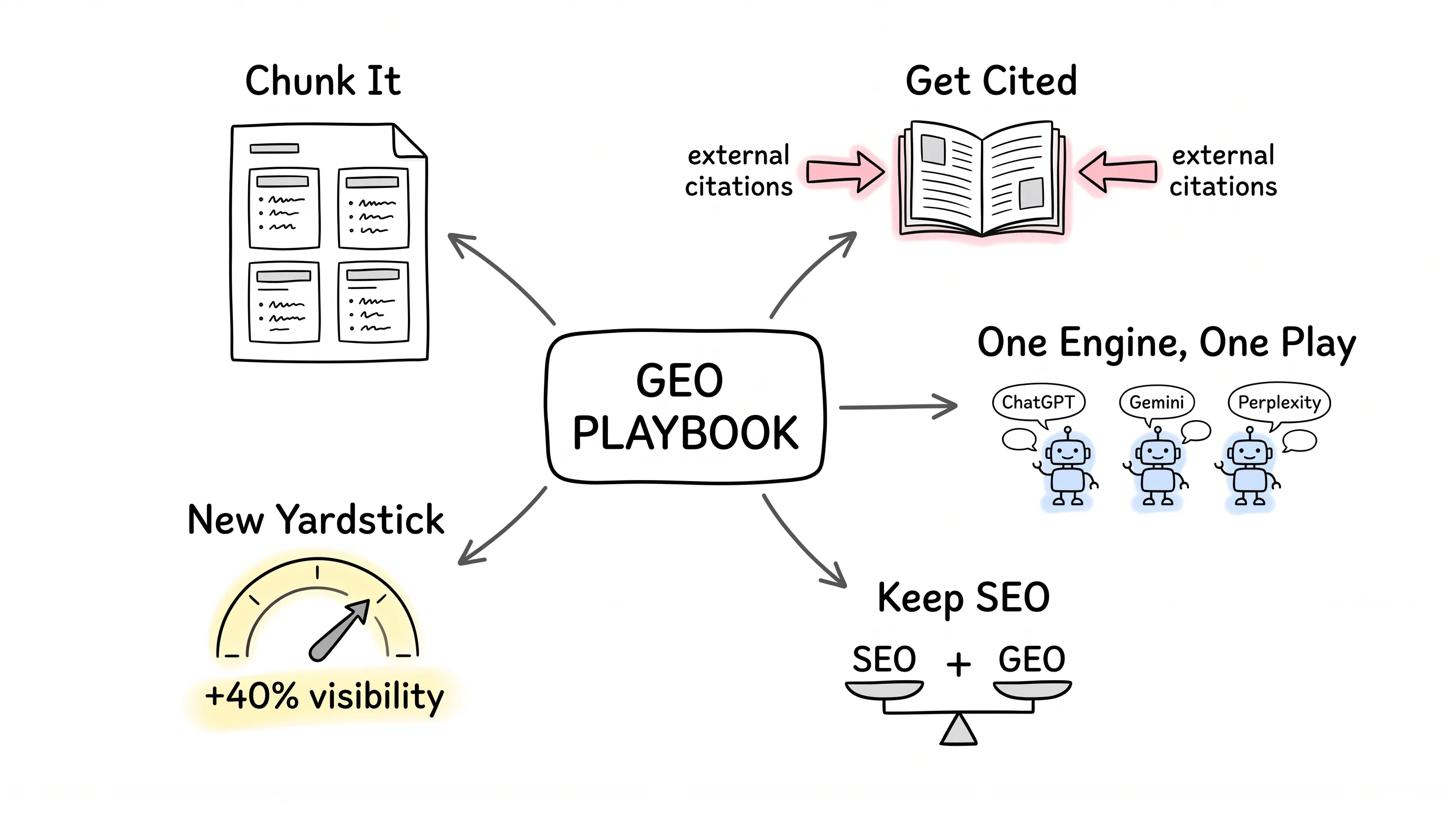
First move: cut your content into "blocks."
What does extractable mean? It means AI can lift a clean section out of your article and use it as-is. How? Clear heading hierarchy, short paragraphs, lists where lists belong, tables where tables belong, key data spelled out. Sections like "What is X" or "What are the benefits of X" are essentially pickup windows built for AI.
Second move: get other people to cite you.
Partner with serious media outlets and industry writers so your content gets mentioned and referenced by third parties. The more external citations you have, the more weight you carry in AI's eyes. Self-praise doesn't work — AI doesn't buy it.
Third move: one engine, one strategy.
What works in ChatGPT may not work in Gemini or Perplexity. Each engine has its own preferences, its own sources, its own way of reading. Really — don't send one set of content to conquer them all.
Fourth move: swap the yardstick.
Old metrics like rankings and clicks still matter, but they're no longer enough. Now you watch the new ones: the probability of being cited by AI, and your visibility inside generative summaries. One research paper dedicated to GEO ran the numbers: optimizing content with GEO methods can lift its visibility in generative answers by up to roughly 40%.
Forty percent. That's not a small number.
Fifth move: whatever you do, don't drop traditional SEO.
GEO is an addition, not a move. If your traditional rankings collapse, your base traffic will fall off visibly. You need both hands on this one.
A Real Case
Teams are already doing all of this — and doing it as part of daily operations.
Adsmurai, a marketing technology company, has broken this playbook down into concrete actions: chunking content and adding semantic markup specifically so AI can extract it easily; running per-engine visibility audits for clients — ChatGPT, Gemini, and Perplexity each checked separately, because every engine has its own taste; they even built a tool called Brand Tracker GPT that uses custom prompts every day to track whether — and how — the brand gets mentioned in ChatGPT's answers, then feeds the data back into content adjustments.
See? This isn't mysticism. It's operations. Watch it daily, adjust it daily.
Two Last Things
Remember the experiment at the beginning? My friend sat steady on page one, and yet AI's answers had no room for him.
They used to say fine wine needs no marketing — however deep the alley, people would find it. Here's the situation now: AI is that new alley. Before anyone gets to taste your wine, AI has to be able to smell it first.
Keep making content properly. Make it clearer, grounded in real experience, worth citing. It's the dumb way — but as of now, it's also the way that works best.
May you be the first source AI thinks of.
Continue reading
Related articles

It's 2026: Stop "Buying" AI Tools for Your Marketing Team — Start "Hiring" AI Agents
This learn article explains how AI agents differ from standalone AI tools in marketing, outlines three agent categories — build-your-own platforms, CRM-native agents, and vertical tools — and covers use cases across SEO, social media, advertising, and reporting, plus criteria for choosing one.

What Is GEO? How Your Brand Gets "Mentioned" in the Age of AI Search
An explainer on GEO (Generative Engine Optimization) for e-commerce and DTC brands: how it differs from SEO and AEO, why AI answers shape brand visibility, and eight practices covering question-focused content, consistent brand messaging, structured pages, external evidence, comparisons, and AI mention tracking.

AI Is Already Making Decisions for Your Customers. Are You on the List?
A learn article explains GEO (Generative Engine Optimization): why AI-generated answers now shape which brands customers see, and how SEO fundamentals, entity clarity, citable evidence, and monthly measurement affect visibility in AI answers.