
AI Marketing Daily · 2026-10-15
Daily AI marketing digest covering hands-on tracking of brand visibility in AI Overviews, the gap between AI mentions and website citations, creative replacing audience targeting in PMax and Advantage+, buyer-side AI agents in B2B research, AI content review gaps, and cross-border advertising compliance.
Today's stories all radiate from one shift: control of marketing outcomes is changing hands. HubSpot delivers a complete measurement system for tracking AI Overviews; Semrush data shows that, on average, fewer than half of the brands AI platforms mention also get their websites cited as sources; and 60% of B2B buyers already hand research and comparison to their own agents. On the ads side, creative has become the new targeting. The two cross-border items are quick-reference material — compliance and the poor fit of home-trained models deserve a note from any team going overseas. Read on: every item comes with an action.
🎯 Top Story
Still Ranking, but the Traffic Is Gone: A Hands-On Playbook for Tracking AI Overviews
HubSpot's marketing blog published a long hands-on piece on October 14, answering a question more and more teams are running into: now that AI Overviews are here, how do you track your brand's visibility inside them? First, the lay of the land. AI Overviews now sit in the highest-visibility slot on the search results page, above Featured Snippets, merging multiple sources into a single answer — a brand either gets cited or gets ignored, and users may never click through to any website at all. The real trouble is the measurement gap: Google Search Console doesn't break out AI Overviews impressions and clicks separately, and GA4 receives no distinct source parameter — hence the odd pattern of rankings holding steady while traffic slides. Citation behavior has also decoupled from rank: the page at position 5 may get cited while position 1 gets passed over, something traditional rank monitoring simply cannot see. And a single observation means nothing — run the same query across 3 to 4 independent sessions, and only when the direction holds for 4 consecutive weeks can you call it a trend; otherwise you're chasing noise.
What gives this piece its weight is that measuring GEO (Generative Engine Optimization) and AEO (Answer Engine Optimization) is the hottest practical gap in the international marketing scene right now — most teams are still judging AI-era visibility with rank tools, without even a baseline in place. The article's value is a complete, replicable system: a five-step tracking checklist, three-tier keyword segmentation, five KPIs, a five-dimension competitor gap analysis, threshold alerts and role assignments — every step lands on a concrete action. Its honesty is rare too: it says outright that every metric is a directional hypothesis, there is no closed-loop attribution, and every decision can only be made as an evidence-backed hypothesis.
At the role level, the change is real. The yardstick moves from rankings to five metrics: coverage, mention frequency, citation coverage, distribution of cited pages, and proxy metrics for business impact. Citation coverage deserves special watch: high mentions with low citations mean your content was rewritten without credit — go inspect at the page level. The distribution of cited pages is about dependency risk: citations concentrated on one or two pages means your lifeline is riding on them. UGC is gaining weight — Reddit threads, YouTube videos, and reviews on G2 and Trustpilot get cited constantly for first-hand-experience questions, so running those platforms now falls within SEO's job description. Engagement has rules: disclose who you are, never fabricate or incentivize reviews — a backlash looks worse than an absence. Teams also need a clear division of labor: data collection, alert review, and monthly rollups each need a named owner; on a small team one person can wear all the hats, but data with no name attached ends up watched by no one.
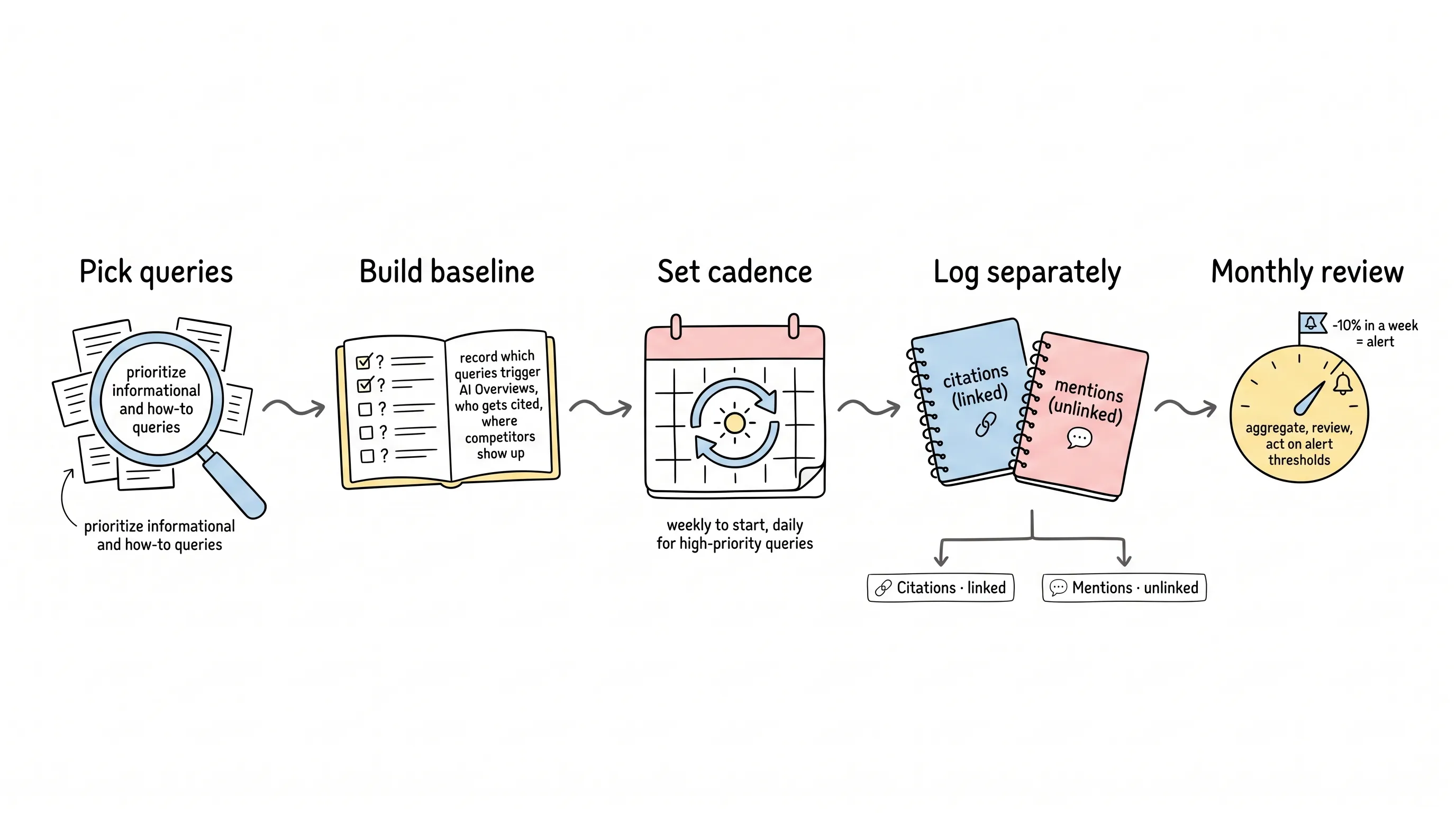
How to start: five steps. Step one, pick your queries — prioritize informational and how-to queries; park transactional ones for later. Step two, build your baseline: record which queries trigger AI Overviews, who gets cited, and where competitors show up. Step three, set a cadence — weekly to start, daily for high-priority queries or during algorithm updates. If you don't know where to begin, HubSpot's free AI Search Grader works as a one-time diagnostic starting point. Step four, log citations and mentions separately — linked citations and unlinked mentions are two different things, and mixing them makes everything downstream a mess. Step five, aggregate and review monthly. Alert thresholds you can copy outright: citation coverage on a first-tier keyword dropping more than 10% in a single week; a competitor newly appearing in 3 or more priority queries; a stable high-priority query with zero citations for two consecutive cycles — any of these triggers, go investigate.
The competitor-gap method is there too: fix a sample of 20 to 50 priority queries, rerun them on the same tool at the same cadence, and compare five dimensions — citation coverage, share of mentions, citation sources, types of cited content — plus a list of queries where competitors appear and you don't. Queries where you're absent but competitors get cited are your highest-priority content gaps; compare length, structure, specificity, data, and freshness to see where the difference lies. After fixing, don't rush to expect results — run the loop of publish, monitor, interpret, iterate, turning observations into concrete hypotheses before testing them. To raise your odds of being cited, remember one principle: answering one question completely beats answering several shallowly. Structure, original data, and hands-on experience all improve your odds; thin pages, conversion-oriented pages, and pages unreadable out of context are essentially out of the running.
The most valuable part of this piece may be its self-imposed limits. The author says plainly that improving content only raises your eligibility to be cited — it guarantees nothing, and there is no submission channel. My take: treat AI Overviews optimization as a content investment serving multiple goals, and collect citation eligibility as a side benefit. Build a bespoke checklist just for it and your actions will distort into optimization theater. Teams that measure first already have a head start — by the time you want to optimize, you'll at least know where you fall short.
🔗 Further reading: Read the full article
🏷 Search & GEO
Your AI Visibility Score May Be Hiding a Trap
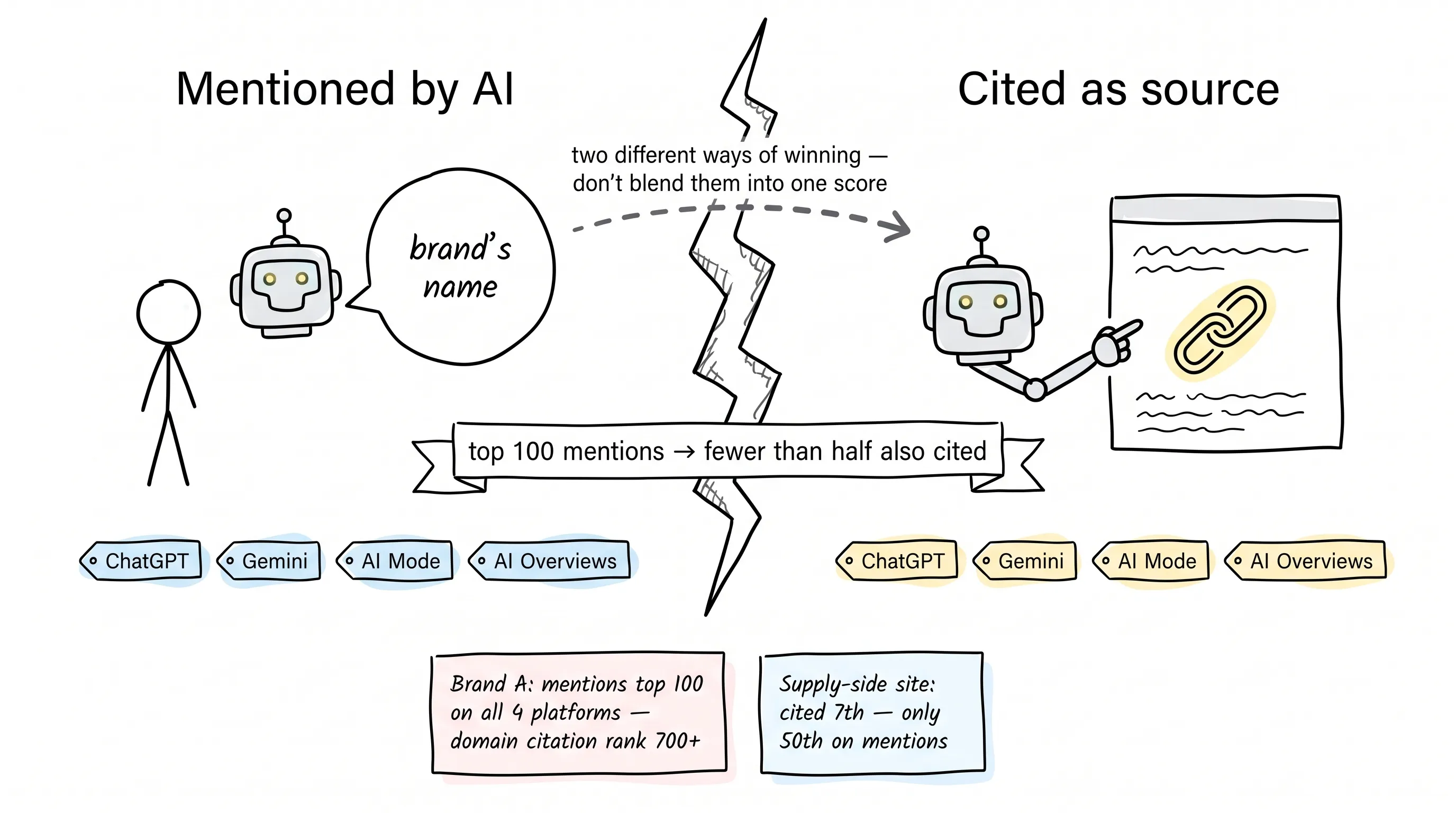
Semrush's 2026 AI Visibility Index scanned 22 categories across four platforms — ChatGPT, Gemini, AI Mode, and AI Overviews — and found that of the top 100 brands on mention leaderboards, on average fewer than half also appear in the top 100 for citations. Two different things got blended into one score: a brand being mentioned by AI, and a brand's website being listed as a source, are two distinct ways of winning. Ford made the mention top 100 on all four platforms in the US, yet its domain-citation ranking sat way outside — 1,055 on ChatGPT, 1,146 on Gemini, 1,320 on AI Mode, 748 on AI Overviews. The reverse also holds: Investing.com ranked 7th among cited domains in US Finance on ChatGPT but only 50th on mentions — the supply-side site's weakness lies in getting into answers, not in getting cited. Tesco and Asda posted similar mentions while their citations differed by a factor of more than 20. Seven brands including Chevrolet, Disney, and Toyota made the mention top 100 on every platform while their citations all ranked beyond 500 — the ones carrying their visibility are publishers, retailers, and community sites. Platform behavior varies widely too: Gemini mentions more brands per answer, ChatGPT attaches the most sources per answer, and AI Overviews overlaps least with the other three — doing well on ChatGPT says nothing about doing well on AI Overviews.
💬 Stop looking at a single composite score. Fix a set of customer questions, record mention and citation baselines separately per platform — you can finish in a week. The gap decides who gets the work: weak mentions go to content and PR; weak citations go to page structure and engineering; categories where third-party sites carry visibility should start with Reddit and review platforms. Category differences can be bigger than platform differences — in US Real Estate, all four platforms share one stable set of sources, while industrial categories have none — so diagnosis should bind customer questions, competitor set, platform, and category together. The report itself cautions that a causal link from mentions to revenue is unproven; keep your claims conservative in reporting.
🔗 Further reading: Read the full article
The Old Model of Ranking First on Google Is Collapsing
In an April live webinar, Exposure Ninja offered a judgment already in motion: the old model of ranking first on Google isn't dead, but it is eroding. CEO Charlie Marchant spoke with Semrush senior market research manager Fernando Angulo, describing how users bypass search engines and go straight to AI assistants for answers, comparisons, and purchase decisions — organic click-through quietly drains away while AI referral traffic rises. Semrush's enterprise MCP (Model Context Protocol) pilot (clients including eBay, Zalando, and Yext) found a gap between traditional SEO visibility and AI visibility: content that does well in SEO doesn't automatically earn AI citations, because LLMs pick citations by a mechanism of their own. The 2026 content playbook they give has three layers — structured data, E-E-A-T trust signals, and entity optimization — plus a question-first content model: start from how users would ask, then retrofit content ranked by revenue impact. Three new metrics come with it: AI citation rate, zero-click impressions, and share of AI answer presence — useful because you can report to management without rebuilding your analytics stack. The blurb also mentions an included Salesforce case study and a method for prioritizing content changes by revenue impact. This item is based on the webinar's official blurb.
💬 Don't wait until every tool is in place to audit. Following its framework, a round of AI visibility auditing takes a week: pick a batch of priority questions, ask each one to ChatGPT and AI Overviews in turn, note who gets cited — that record is your baseline. For reporting to management, switch on the two new metrics first — AI citation rate and zero-click impressions — rather than forcing old dashboards to fit; they won't explain anything anyway. The companies that win in 2026 are the ones that start now — use that line to justify putting it on the roadmap.
🔗 Further reading: Read the full article
🏷 Ads & Content
Creative Is the New Targeting: The New Filter in the PMax and Advantage+ Era
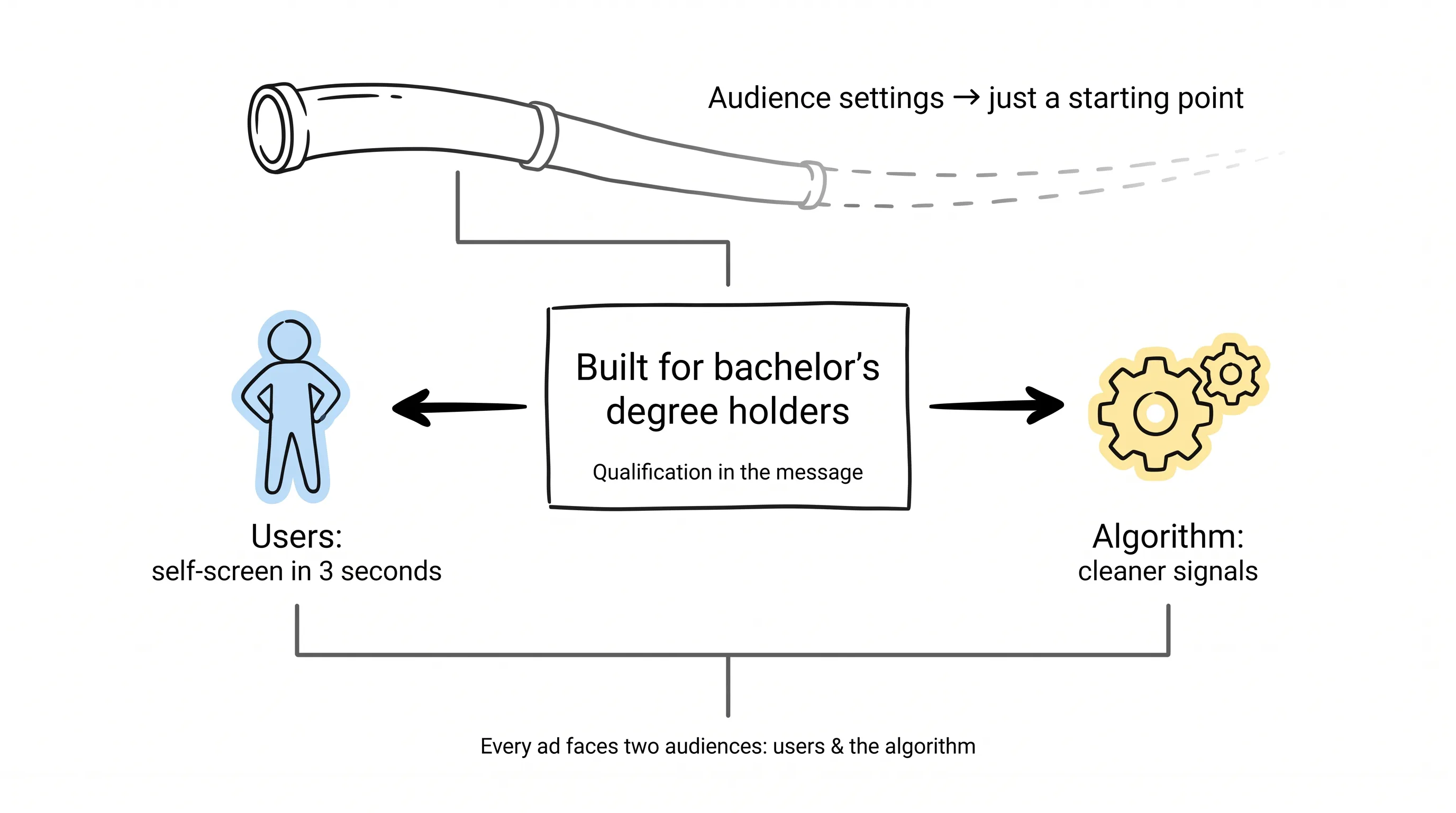
With Performance Max, Meta Advantage+, and TikTok's AI targeting fully rolled out, advertisers' direct control over audience settings is shrinking, and audience signals have been reduced to mere starting points for the algorithm's learning. This MarTech analysis argues that creative — the headlines, images, videos, and CTAs — is replacing audience settings as the most effective qualification filter. The logic runs both ways: qualified users self-select in through the copy, unqualified users swipe away, and the algorithm simultaneously receives cleaner optimization signals, so lead quality and learning efficiency both improve. The cost of broad targeting paired with vague creative is already visible: lower lead quality, higher cost per qualified lead, noisier conversion data. The article uses higher education as an example: copy that puts the qualification itself into the headline — "Built for bachelor's degree holders" — screens for qualified master's program prospects better than generic headlines. On TikTok, the first 3 seconds are both a retention hook and a content classification signal: stating the qualification in the first line completes audience self-screening and algorithm learning in one move. PMax's audience signals are not hard targeting; creative becomes the algorithm's main basis for judging target audiences across Search, YouTube, Display, Discover, Gmail, and Maps. The article's underlying verdict: qualification filtering hasn't disappeared — it has migrated from audience settings into the message itself, and every ad now faces two audiences at once: users and the algorithm.
💬 Rewrite your headlines next week. Put every ad's copy through a four-point check: Does it say who it's for? Is the qualification threshold stated? Can a poor fit tell within three seconds that this isn't for them? Does the signal feed both the user and the algorithm? Teams running PMax and Advantage+ should first swap headlines on their highest-spend campaigns to qualification-filtering types — what you save is the budget that would have gone to junk clicks. Creative teams and media teams now need to collaborate earlier: creative discussions must keep pace with strategy meetings, not wait for the media schedule.
🔗 Further reading: Read the full article
AI Influencers Won't Replace Humans, but They Will Eat UGC Footage
In her latest video, Tess Barclay takes the AI influencer business apart. Such characters have existed since 2016 — CGI-born Lil Miquela, with millions of followers and Prada-level ad deals, is strictly a CGI virtual persona, not generative AI, but the lane opened back then. Today TikTok and Instagram host thousands of AI influencers, and one report projects the market reaching $45 billion by 2030. She disagrees with Gary Vaynerchuk's claim that AI influencers will replace $5,000-per-post human influencers at $5 per post: what brands pay premiums for has never been content volume but influence and community trust — Alix Earle commands seven figures because her followers know her life and therefore trust her recommendations. What AI will actually swallow is a different piece: pure product-display UGC footage — display content without a real human likeness in billboards and feed ads will shift heavily to AI generation. Her two predictions are worth noting. One: AI influencers and human influencers will coexist as an added lane, echoing the resistance-then-acceptance cycle when celebrities first joined TikTok; a year from now, the strangeness will have faded. Two: the winners will be transparent AI characters — real people using an AI persona to tell personal stories they'd rather not show their faces for, or straight-up brand mascots joining podcasts and social personas; the audience knows who the creator is and connects because of it. We know it's AI — and we like that. That's the inflection point. She also warns that the course-selling ecosystem is a mixed bag: Reddit users report most AI influencer courses don't work, and an AI UGC agency model is on the rise. The space is already highly segmented — AI influencers, AI content, and UGC content are three different things, and conflating them leads to budget mistakes. For human creators, the conclusion is one line: being a real person is the hardest competitive barrier in the coming flood of AI content.
💬 On the brand side, start by handing UGC footage production to AI as a trial — production cost per ad asset can drop by more than half, and that's money you can save this year. Don't cut the budget for human influencers; that purchase is trust. If you want to build your own AI character, starting from a mascot positioning is steadier than building a virtual persona outright — disclose identity transparently, and never touch the incentivized-review red line.
🔗 Further reading: Read the full article
🏷 Org & Talent
AI Won't Kill the Sales Job — Buyers Will
This MarTech opinion piece turns the threat of AI to sales on its head: what decides a sales rep's fate isn't AI, it's the buyer. Three data points. G2's 2026 buyer behavior report shows over 60% of B2B buyers have already let, or plan to let, AI agents handle research, shortlisting, and comparison in software purchases, with final decisions still left to humans — agents take the stages before shortlisting, and how the shortlist gets generated is the new battleground. In Gartner's 2026 survey, 45% of buyers recently used generative AI to gather vendor information; in Forrester's 2025 survey, generative AI and conversational search already rank ahead of vendor websites, sales reps, and product experts as information sources. But Forrester also finds about one in five buyers using generative AI lost decision confidence because the information was unreliable — that reliability shortcoming is, for now, still a window of opportunity for humans, though the author judges it will eventually be engineered away. The author breaks trust into three pillars: the capability gap AI is closing fast, reliability is an engineering problem, and the true moat is alignment — are you on my side? The real turn comes at the end: the seller's AI is a salesperson that never sleeps, so buyers discount it by reflex; the threat comes from the buyer's own agent. Trust won't transfer from human sellers to the seller's machines — it will transfer from the seller side as a whole to the buyer's machines. The projected sequence: transactional scenarios automate first — renewals, standard licensing, and cloud capacity get taken over early; seven-figure deals hold out for now on personal-reputation bets and invisible political intelligence — who's feuding with whom, whether the champion is losing power, that "no budget" really means "not this quarter" — information that never makes it into the CRM and that only humans can process for now. But call recordings, email, and meeting notes are shrinking that data gap year by year.
💬 B2B sales leaders should re-run the math this week: the budget now spent on making sales reps more efficient is going toward exactly the tasks buyers have already handed to their own agents. Move the money in four directions: judgment, navigating buying-organization politics, translating risk into confidence, and owning outcomes. The connected move on the marketing side is making content readable by buyer agents — the website's position in the information chain will only keep sliding down.
🔗 Further reading: Read the full article
The Marketing System Has Outrun the Organization That Runs It
The MarTech landscape grew from roughly 150 products in 2011 to 15,505 in the 2026 edition; CRM, automation, personalization, and AI have already knitted marketing work into a cross-team production system, yet organizational authority, governance, and accountability remain locked inside functional silos. McKinsey's survey of 104 C-level marketing and growth executives yields three numbers: only 27% consider their marketing operating model mature, only 37% report smooth cross-functional collaboration, and only 12% have clear and effective governance. The article positions AI as an amplifier: in the past, human employees served as the cross-functional buffer layer, bridging system seams through side conversations, verbal rules, and institutional memory — but AI agents cannot tolerate ambiguity. They need explicit data permissions, approval rules, escalation thresholds, and accountable owners, which amounts to hard-coding informal negotiation into system design. Orchestration software can't help here: platforms move data but can't settle who owns the customer model; workflows can automate approval paths but can't decide who holds approval authority — software can only automate decisions the organization has already made. The risk scenario is already on display: content agents, journey agents, outbound-call agents, and service agents deployed separately by function, each inheriting its own incentives and blind spots — automation may replicate silos rather than eliminate them. The author's words: the silos didn't disappear; they just got APIs. The way out is neither a reorg nor having the CMO absorb IT, but letting decision rights cross the same boundaries as output — product teams, fusion teams, and centers of excellence are workable forms of shared accountability.
💬 Before standing up an agent, answer three questions: who owns the data permissions, who sets the approval rules, and who do you call when something breaks. If you can't answer, take a step back and pilot in low-risk pipelines like content production first. MOps teams can lift this governance checklist straight into their agent project-intake templates — far cheaper than patching policy after the fact.
🔗 Further reading: Read the full article
🏷 Tools & Governance
A Generative AI Marketing Guide: Five Use Cases and Four Risks
Insider One has published a 2026 generative AI marketing guide, opening with McKinsey's estimate that generative AI could add $2.6 to $4.4 trillion annually to the global economy across 63 analytical use cases, with marketing among the chief beneficiaries. The guide groups the gains into categories: full-lifecycle personalization built on CDP data, automated content production, campaigns adjusted in real time to market feedback, multi-channel experience upgrades, and real-time insight. The use-case section offers five directions: smart journeys and segmentation, auto-completing customer journey touchpoints from historical data, multilingual content localization, AI on-site search to improve product discovery, and recommending the next best channel by journey stage to optimize the channel mix. It cites a case from a G2 review: a customer used predictive segmentation for Facebook ads and lifted conversion by 381% on the same budget — a single case; extrapolate with care. The risk list has four items: algorithmic accountability and transparency, security, accuracy, and data quality — with the "garbage in, garbage out" reminder tucked into the data-quality item. Note that the whole piece steers toward the vendor's own product and ends with patent-pending talking points; weigh the use-case framework and the product pitch separately.
💬 It's more useful as a requirements-organizing template than as a tutorial. Of the five use cases, localization and on-site search pay off fastest — one saves translation hours, the other plugs straight into conversion — good first pilots. Keep the 381% figure out of any report until you've measured your own baseline. Copy the four risks verbatim into your vendor evaluation sheet and ask about whichever one is missing.
🔗 Further reading: Read the full article
Only 27% of Companies Review AI Content Before Use
MarketingProfs relays data from McKinsey's State of AI survey: 1,491 business professionals worldwide, 42% of them from organizations with annual revenue above $500 million. The generative AI risks companies prioritize mitigating are, in order, inaccurate content and cybersecurity, with IP infringement and regulatory compliance behind. The most striking number: only 27% of respondents say employees review all generative AI content before business use. Larger organizations are more likely to establish deployment norms — dedicated teams, internal communications — and the norms are consolidating toward big enterprises. The survey dates to July 2024, so the readings are dated, but the structural problem of the review gap hasn't changed: fact-checking and compliance review inside the content pipeline remain the most visible gap today.
💬 Audit your own content pipeline: is there a mandatory human review step between AI generation and publication? If not, add that link first — it's more urgent than buying any governance tool. Use 27% as a negative benchmark, and write into your SOP who reviews on the team, what they review, and how often. Big enterprises are moving toward formal norms, but small and mid-size teams are actually positioned to stand this step up first — don't drag your feet.
🔗 Further reading: Read the full article
🏷 Cross-Border E-commerce
Compliance and Model-Fit Pitfalls in Cross-Border Advertising
Baidu Baike's English edition has an entry on cross-border e-commerce advertising that splits cross-border ads into on-platform and off-platform — the former meaning ads placed inside e-commerce platforms, the latter meaning overseas media platforms like Google, Facebook, and TikTok. The planning-elements section lists resource inventory, competitor ad analysis, multidimensional audience profiling, media-mix cost-effectiveness, and performance evaluation, requiring metrics that map one-to-one to quantifiable ad objectives, with performance assessed across psychological, economic, and social dimensions. Its trend judgment: AI and big data are pushing ad placement toward intelligent precision — AI recommendation systems target users by behavior, while social commerce, AR/VR immersive experiences, and live-stream selling become new growth points. What cross-border teams should really note in the entry are two challenges: divergent advertising laws across countries, stacked with tightening data privacy, have driven up the cost of precise profiling; and data models trained on China's domestic market often fit overseas markets poorly, while global ad costs keep rising. The countermeasures offer a few paths: compliance review plus AI-assisted moderation, machine-learning localization analysis, RTB/PPC/DSP precision targeting and retargeting, and private-domain traffic. The entry has no byline and no first-hand data, with citations drawn mostly from vendor soft marketing — fine as a quick-reference framework.
💬 Take the domestic-model mismatch warning seriously: transplanting a model polished at home to Europe or the US will skew both audience profiles and creative preferences — localized data analysis has to be built from zero. Put the compliance-review mechanism in place ahead of ad scale: overseas ad-law fines cost more than the pitfalls themselves. Take the AR/VR and live-selling trend judgments lightly; solve the two real things first — compliance and model fit.
🔗 Further reading: Read the full article
The Cross-Border E-commerce AI Agent: A Service Page to Read as a Requirements List
Bluebash's cross-border e-commerce AI agent service page opens with seven pain points: lagging exchange-rate updates, slow and costly human translation, error-prone manual regulatory monitoring, abandoned orders from missing local payment options, marketing-culture mismatches, inefficient manual logistics planning, and expansion constrained by staff and process. It then claims its agent can autonomously handle dynamic exchange-rate pricing, multilingual localization, import/export regulation and tax monitoring, local payment gateways plus anti-fraud, regional culture and marketing adaptation, warehouse and delivery route optimization, and real-time competitor and demand scanning. The page closes with a human-machine division-of-labor table: humans handle strategy and exceptions, while the agent takes over pricing updates, translation, compliance reminders, multi-channel syncing, and other high-frequency repetitive operations. The claimed ROI points — localization pricing lifts conversion, faster entry into new markets, avoided compliance fines, local payments reduce abandonment — come with no supporting data; at bottom this is a customer-acquisition page for custom development services.
💬 Don't read it as a solution; use it as a requirements list. Take the seven pain points to your own cross-border team: which ones actually exist, and how many person-hours do they burn weekly? Then decide whether an agent is warranted. If you do shortlist vendors, demand verifiable cases and pilot data first — promises without numbers on a service page all get discounted. The human-machine division of labor is drawn reasonably well, and the bottom line that strategy stays with humans is worth writing into the contract.
🔗 Further reading: Read the full article
💡 Today's Big Picture
Read together, today's 11 items are four facets of one thing: control of marketing outcomes is changing hands — and what it is changing hands to is one and the same: AI.
Search is the most direct. AI Overviews now occupy the highest-visibility slot; citations have decoupled from rank; and neither GSC nor GA4 gives you an independent read. HubSpot's tracking checklist, Semrush's mention-versus-citation gap data, and Exposure Ninja's behavioral observation all point to the same conclusion: the unit of being seen has shifted from rank to citation. The three pieces complement one another — one supplies the measurement actions, one the diagnostic framework, one the behavioral evidence — and together they form a GEO starter kit. They also jointly flag one variable: UGC and third-party sites are siphoning off brand visibility.
Decision-making is changing hands too. Sixty percent of B2B buyers let their own agents do the research and comparison — trust is moving from the seller to the buyer's machine. On the ads side, platforms are reclaiming targeting, and the job of qualification filtering falls to creative. On the org side, agents tolerate no verbal rules, governance gaps get forced onto the table — and only 27% of companies review AI content before use. One common thread across the three: what used to be held up by people and experience must now become measurable and auditable.
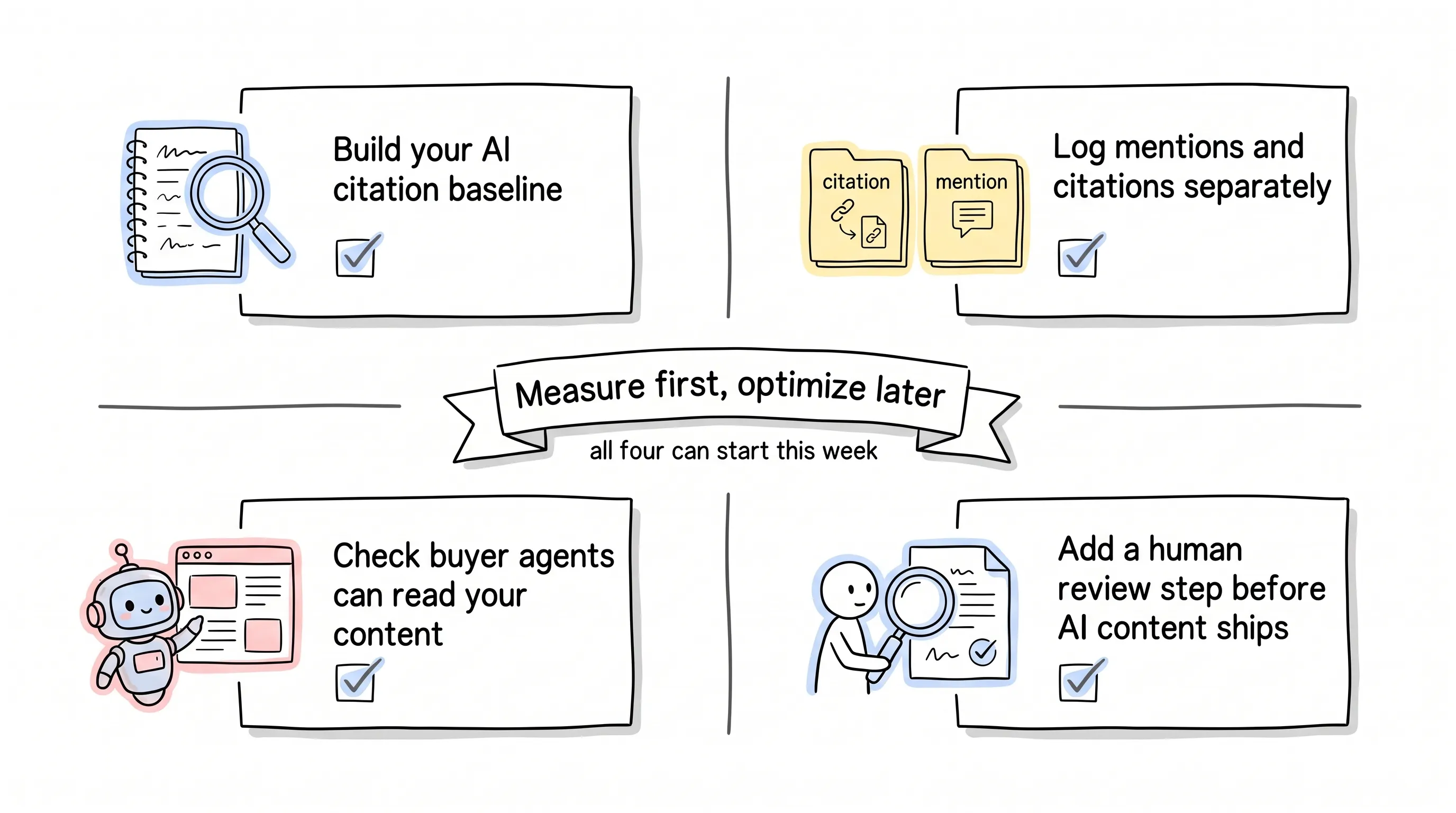
Set today's tone for action: build measurement first, talk optimization later. An AI citation baseline, mentions and citations logged separately, whether buyer agents can read your content, an AI-content review step — all four can start this week. Nothing in today's material asks you to buy a tool first; every play is record-first, judge-second. Board after the platforms finish writing the rules, and the tuition only gets steeper.
Continue reading
Related articles
AI Marketing Daily · 2026-11-22
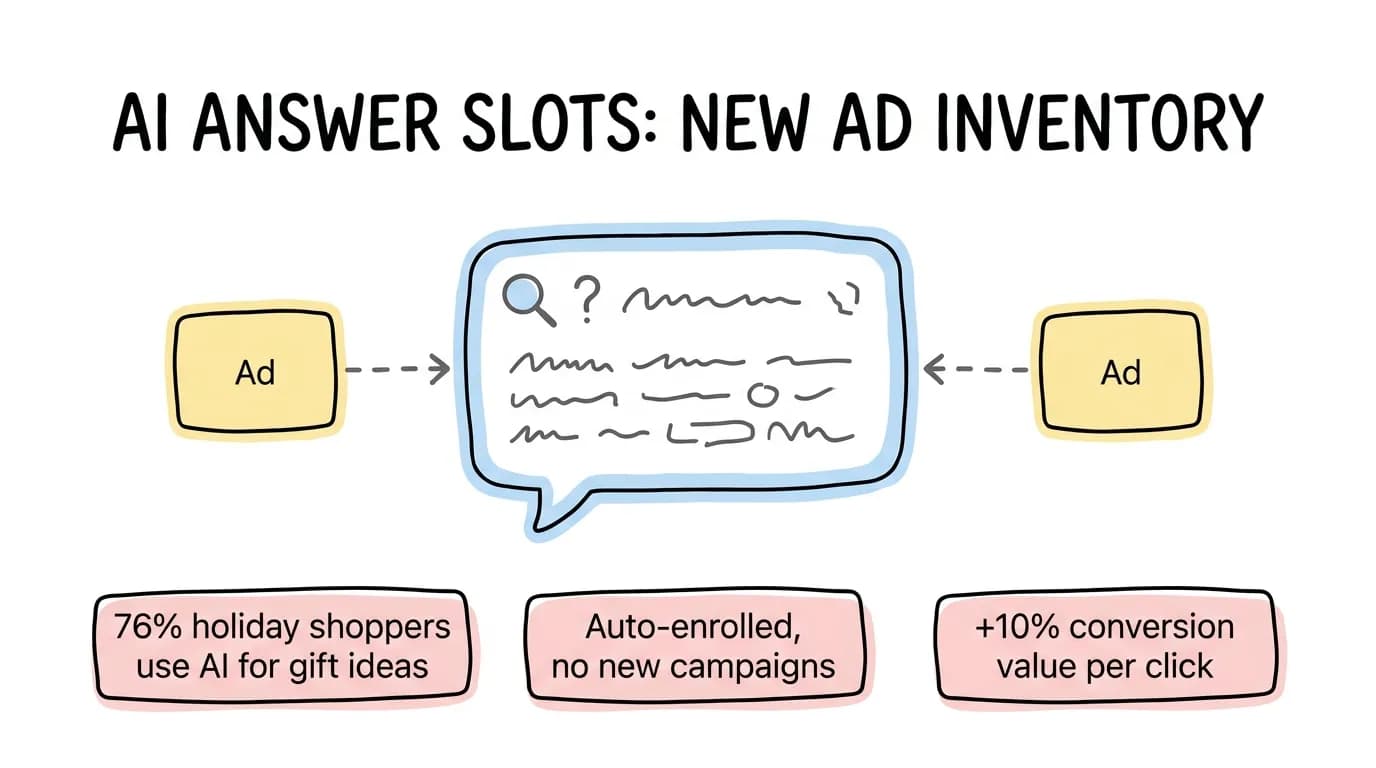
AI Marketing Daily for 2026-11-22 rounds up 20 items led by Microsoft opening Bing AI Overviews to ads and Google expanding AI Mode ads to ten countries, plus GEO guides, ad automation delegation guidance, AI Overviews CTR data, and a legal-risk checklist for AI-generated creative.
AI Marketing Daily · 2026-11-21
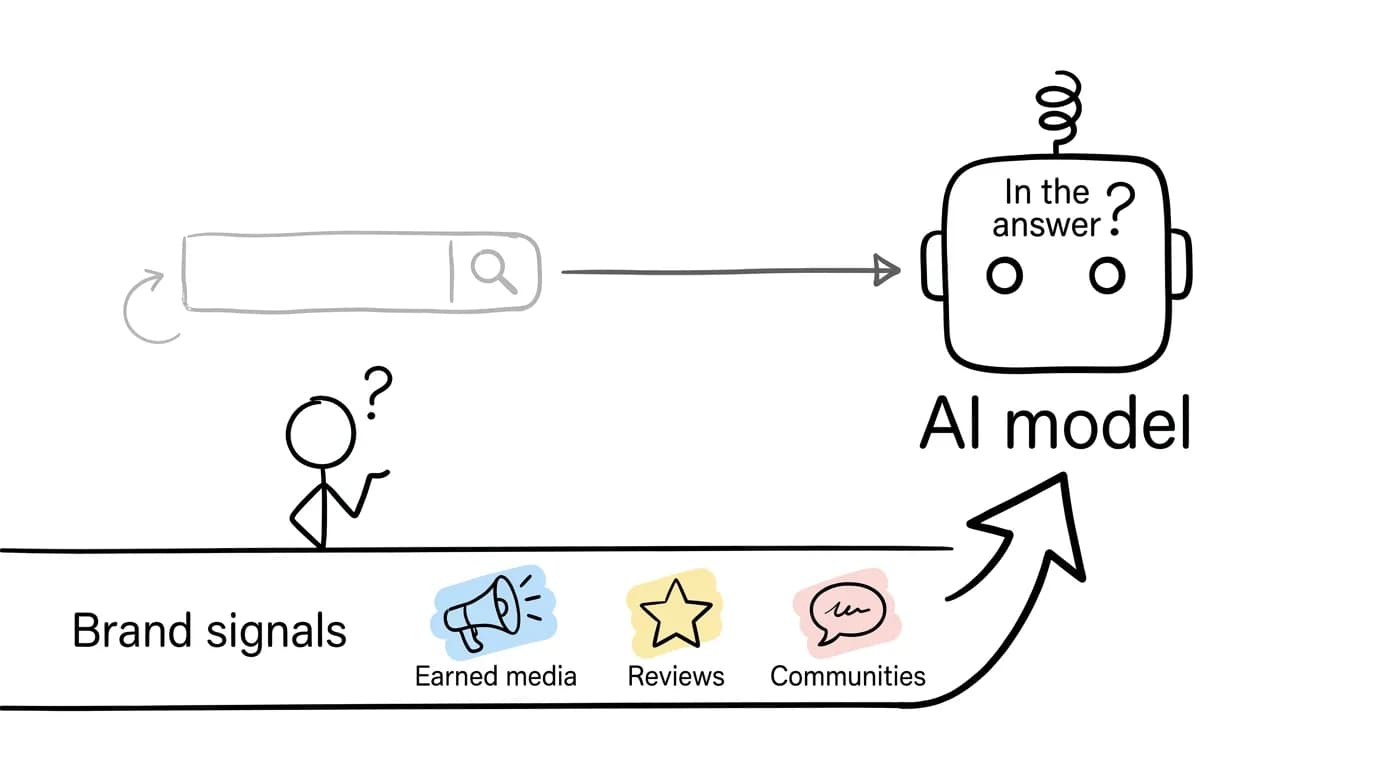
A November 21, 2026 AI-marketing daily covering AI search visibility, GEO methods, Google AI Mode ads expanding to ten countries, Meta's pre-Black Friday changes, agentic shopping, and industry adoption and ROI data.
AI Marketing Daily · 2026-11-20
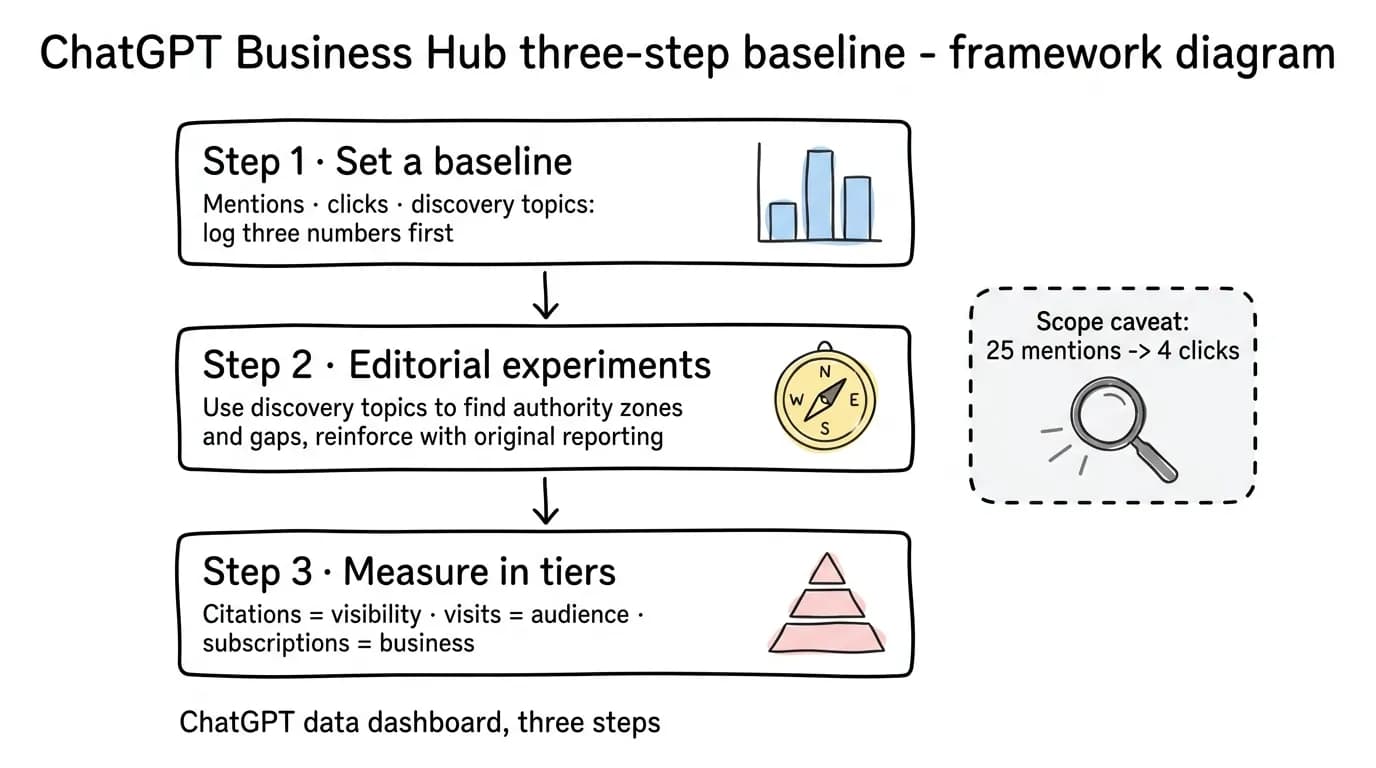
AI Marketing Daily for 2026-11-20 rounds up 19 items centered on measurement: OpenAI's ChatGPT Business Hub dashboard, EU rules for agent-mediated purchasing, Meta pausing four AI terms, and B2B data on shortlists and the dark funnel, each with action advice.