
Happy With Your AI Visibility Score? Don't Celebrate Yet
Explains the difference between being mentioned and being cited in AI answers, why a high visibility score can hide citation gaps across platforms and categories, and outlines a three-step diagnosis before increasing spend.
A while back, an old friend who works in branding invited me out for coffee. He'd barely sat down before he said it: our AI visibility score is up quite a bit — the team wants to raise the budget and press the advantage.
I told him: hold on. Answer one question first.
Is your brand being mentioned by AI, or being cited by AI?
He froze. Aren't those the same thing?
No — and the gap between them is enormous.
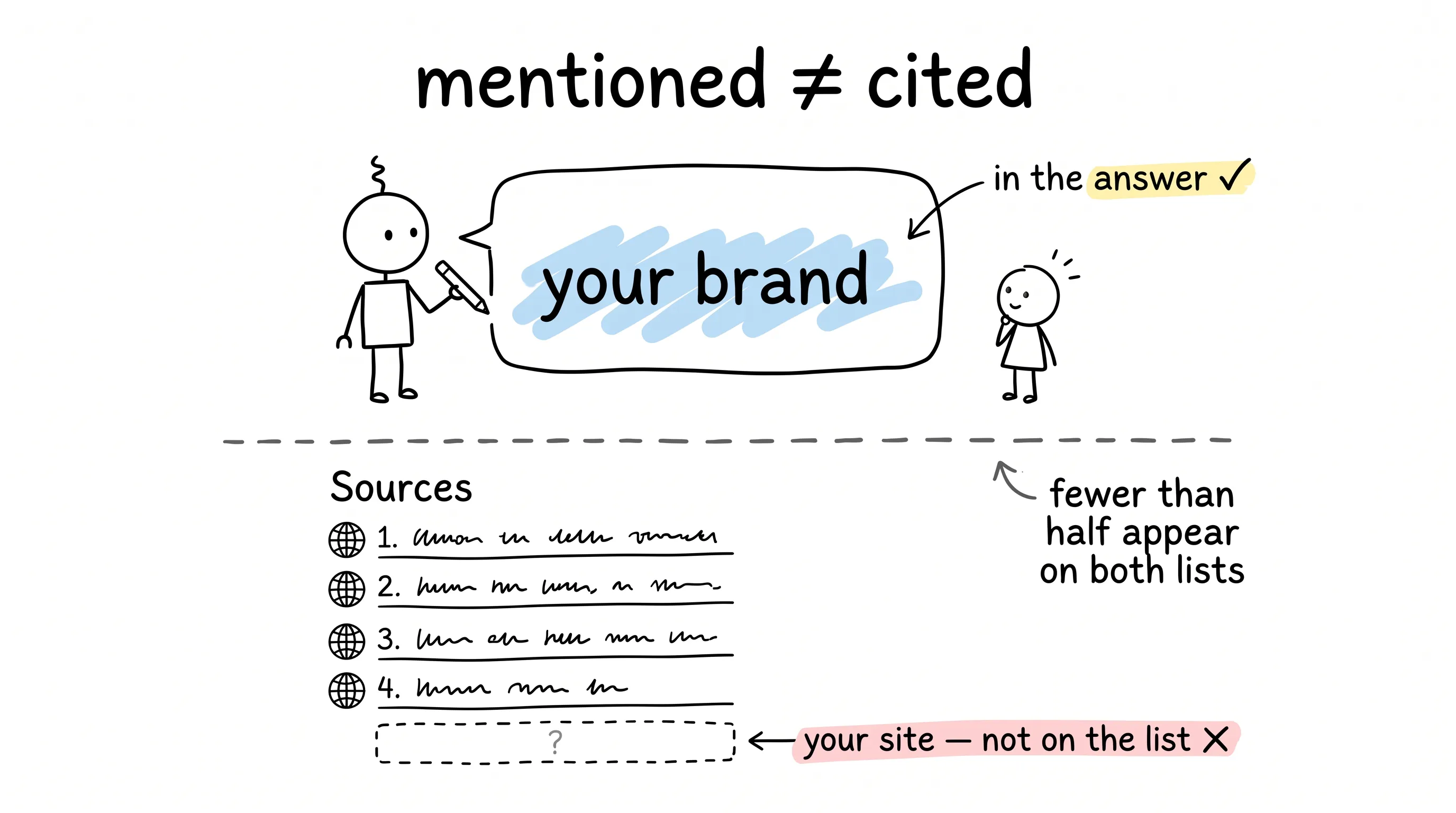
First, Get This Straight: Mentions and Citations Are Two Different Things
What is a mention?
A mention is when AI names your brand while generating an answer. The user asks a question, AI answers in a paragraph, and your name is in there. That's being seen.
And what is a citation?
A citation is the source AI lists underneath the answer. Whatever domain gets listed counts as cited. That's being trusted.
Semrush put a number on all of this with its 2026 AI Visibility Index: across 22 categories and 4 AI platforms, it puts the mentions Top 100 and the citations Top 100 side by side every month. On average, fewer than half of brands appear on both lists.
Most brands shine on one list and vanish on the other.
Take an example. Ford, US market, July of this year. It made the mentions Top 100 on all four platforms. Sounds great, right? Now look at where its own domain ranks in citations: #1055 on ChatGPT, #1146 on Gemini, #1320 on Google AI Mode, #748 on Google AI Overviews.
All four past the thousand mark.
Users hear about Ford in AI answers every day, yet among the evidence AI actually cites, Ford's own website sits way down the list. So who is being cited? Other websites.
The reverse happens too. In the US finance category on ChatGPT, Investing.com's domain ranks #7 in citations but only #50 in mentions. It's the evidence provider — it just never shows its face in the answers.
And here's a more interesting one. In the UK, Tesco and Asda, two supermarket giants, both made the mentions Top 100 on all four platforms. But on ChatGPT's citation list, Tesco sits at #25 while Asda sits at #606 — a gap of more than twentyfold. Switch to Gemini? #29 and #60. Suddenly they're practically neighbors.
Same brand, different platform, completely different situation.
So Ford and Tesco should be asking: which websites is AI actually citing — and why not mine? Investing.com's problem is the exact opposite: absent from the answers, all over the evidence.
These are two different diseases, and they call for completely different prescriptions. Treating both with the same playbook is money down the drain.
Platforms Don't Even Play the Same Game
Then comes the second layer of trouble.
A lot of people treat AI search as one monolithic thing. It isn't. The platforms behave very differently.
Same report, US data. Gemini mentions more distinct brands per answer than ChatGPT, month after month; when it comes to the number of sources listed, ChatGPT lists the most and Gemini the fewest.
Their taste in sources differs too. What ChatGPT cites is dominated by news and media sites. AI Overviews leans toward streaming, business software, online learning, and medical reference sites. AI Mode is the most extreme of all, concentrating its citation weight on a tiny cluster of top domains.
The odd one out is AI Overviews. The overlap between its top-mentioned brands and every other platform's is the lowest of any pair; its sources overlap with ChatGPT's less than any other pairing too.
What does that mean?
A high score on ChatGPT can still leave you invisible on AI Overviews.
Your customers don't use just one AI. So before you spend money, figure out one thing: which platform is the gap actually on?
For Many Brands, the Position Isn't on Their Own Website
At this point, someone will surely want to say: if I just make my website content better, the citations will follow, won't they?
The old-school SEO instinct is that every problem traces back to your own site. When it comes to AI visibility, that instinct often fails.
Look at this list of names: Chevrolet, Disney, Ford, Honda, Marvel, Nintendo, Toyota. US market, four platforms — all of them in the mentions Top 100. And citations? Every month, all outside the top 500.
Seven big brands, and none of their official websites made the citation list. So who supplies the evidence in AI's answers? News media, retailers, community sites, reference platforms.
AI says the brand's name — but it's someone else's website doing the vouching.
What should you do then? Dig up the pages that actually get cited, and figure out why they get cited. That work might belong to content, might belong to engineering, might belong to PR and communications — it only sometimes belongs to SEO.
"Just write more content" is the laziest default answer. If the root of the problem lies elsewhere, writing more is wasted effort.
Category Matters as Much as Platform
There's one more layer, and it's the most easily overlooked: category.
Within the same US market, the differences between categories — in mention-and-citation overlap — are bigger than the differences between platforms. Every single month.
Take real estate. Across four platforms, month after month, the same handful of sites gets cited over and over: Apartments.com, Realtor.com, Redfin, Zillow. The source pool is rock solid. For real estate marketers, the starting point is clear: study these resident sources.
Now look at industrial categories. No such stable core of sources exists; the cited domains change every month.
The same industry-wide map is a clear chart for a real estate team and a blurry sketch for an industrial team.
So a useful AI visibility question has to carry four coordinates with it: which customer question, which competitors you're benchmarking against, which platform, which category. Missing any one, the question can't be answered.
Diagnose First, Then Assign the Work
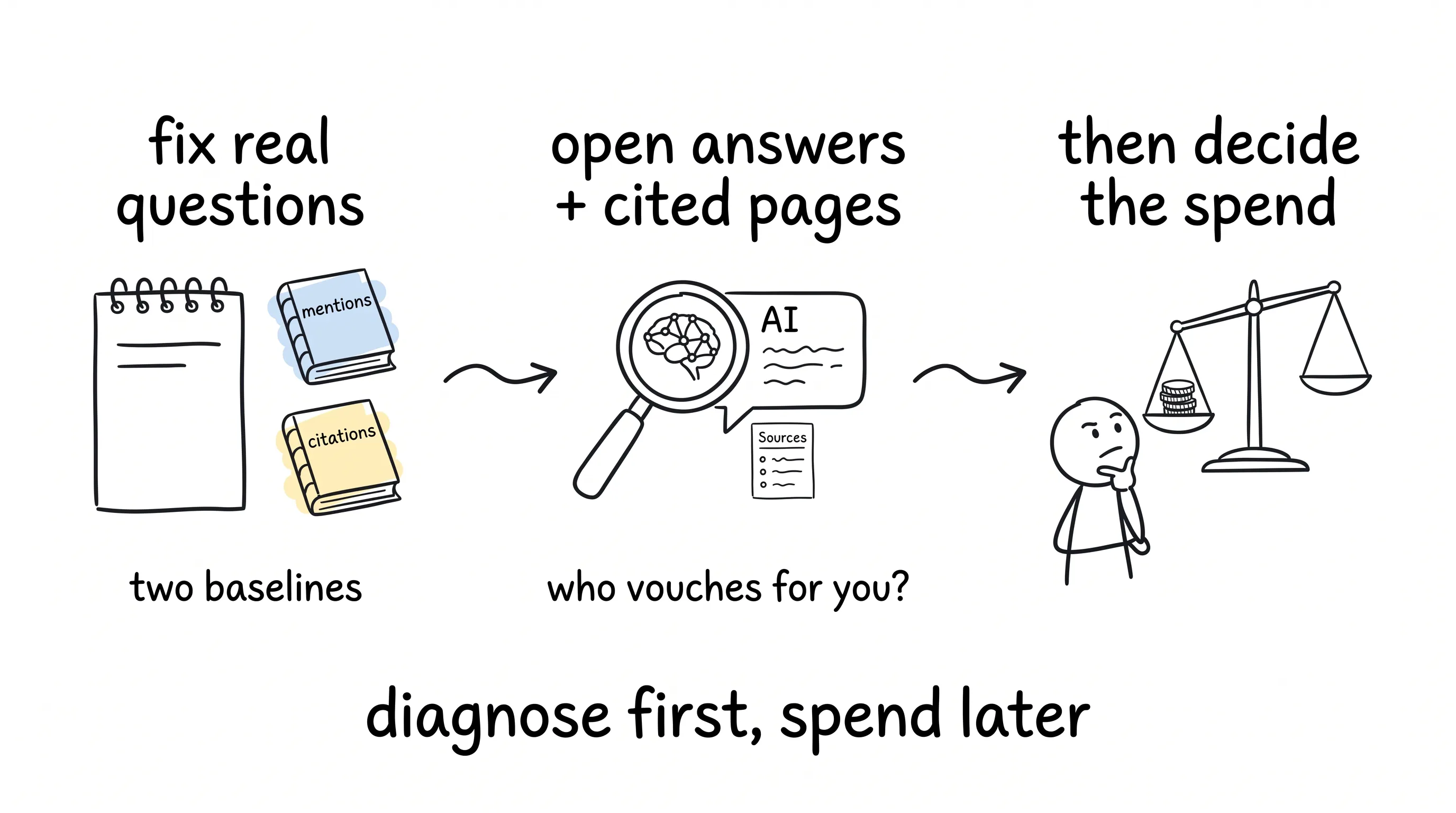
For execution, here are my three steps.
Step one: fix a set of real customer questions, and build two baselines against them — one for mentions, one for citations.
Step two: open up AI's answers and the pages they cite, and see exactly where visibility is coming from.
Step three: only then decide whether to spend, and on whom.
One more thing. Don't mistake a visibility metric for a business outcome. Semrush's study does not prove that changes in visibility cause changes in business. It's a health check, not a sales report.
At the end of the day, it comes down to one sentence:
First figure out whether you're missing mentions or missing citations — then hand the work to whoever can actually fix it.
My friend went back and checked. The high score rested on mentions; the citation side was a mess. The budget increase got put on hold, and he went off to look at who AI is actually citing.
Good. Diagnosis first, spending later.
And here's wishing your brand the same: seen, and trusted.
Continue reading
Related articles

What Is GEO? How Your Brand Gets "Mentioned" in the Age of AI Search
An explainer on GEO (Generative Engine Optimization) for e-commerce and DTC brands: how it differs from SEO and AEO, why AI answers shape brand visibility, and eight practices covering question-focused content, consistent brand messaging, structured pages, external evidence, comparisons, and AI mention tracking.

AI Is Already Making Decisions for Your Customers. Are You on the List?
A learn article explains GEO (Generative Engine Optimization): why AI-generated answers now shape which brands customers see, and how SEO fundamentals, entity clarity, citable evidence, and monthly measurement affect visibility in AI answers.

Google Is Stuffing Ads Into AI Search: These Recent Stories Are Really One Story
A news roundup linking recent AI marketing stories—Google adding ads to AI Mode, Amazon's Ads Agent, ChatGPT image updates, a UK startup tracking brand mentions in AI answers, and an AI ransomware warning—arguing that control over ad data and visibility is shifting toward platforms.