
Targeting Is Getting Broader, and Creative Is Becoming the New Targeting
Explains how automated ad platforms like Performance Max and Advantage+ are broadening targeting, making creative the main signal that tells algorithms who an ad is for. Covers self-selection copy, lead-quality tradeoffs, and how creative and media buying teams should collaborate.
A couple of days ago, a friend who runs ad campaigns took me out to dinner. He'd barely sat down, chopsticks untouched, and he was already sighing.
He said, Bro, I've moved my entire account over to automated campaign types. Google's Performance Max, Meta's Advantage+ — everything that could be switched on, I switched on. And the result? Lead volume hasn't dropped, but the quality is a disaster. A pile of people reaching out, and once you actually talk to them, some never even went to college.
I said, this one's not the algorithm's fault.
He said, then whose fault is it?
Your creative. You handed "who do we reach" over to the algorithm, but you never told the algorithm who exactly you're trying to reach.
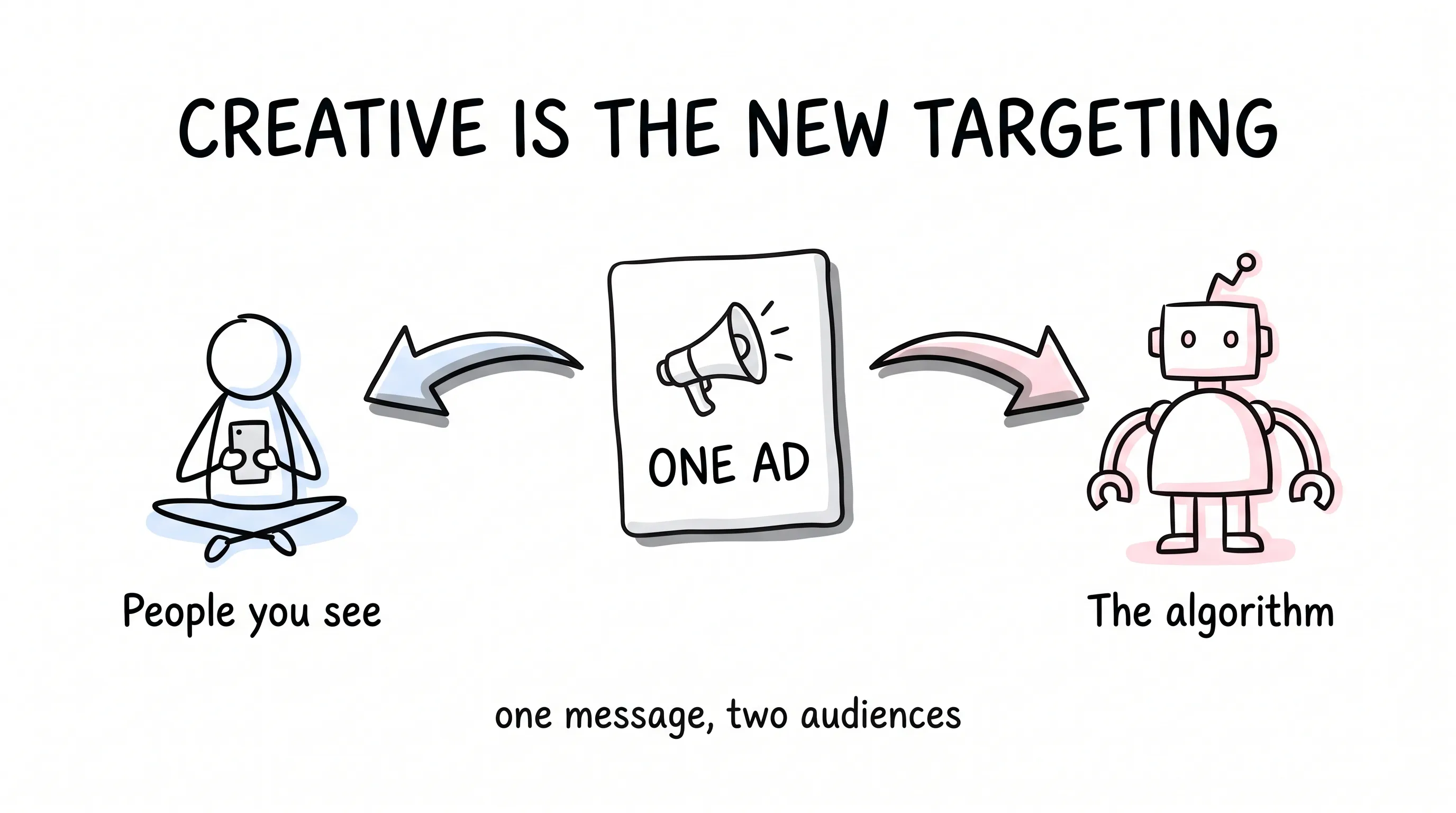
In this piece, let's talk about exactly that: as targeting gets broader, creative is becoming the new targeting.
Where Did the Targeting Go?
First, some background.
What is targeting? It's the circle you draw in the ad platform's back end: age, region, interests, past site visitors. The smaller the circle, the more precisely the ad lands.
For the past decade-plus, people doing performance advertising spent most of their craft on drawing that circle.
Recruiting grad students? Stack on education interests, degree status, remarketing audiences. Looking for patients with a specific condition? Build audience segments around health behaviors and search intent. Selling insurance? Narrow down along age, life stage, and spending interests.
The finer the circle, the better the leads. This playbook worked, and everyone was comfortable with it.
But open up today's mainstream platforms and take a look.
Google's Performance Max, Meta's Advantage+, TikTok's automated expansion — the thinking is strikingly consistent: stop slicing so fine. Give me broad audience segments, plenty of conversion signals, and solid creative, and I'll take it from there — who sees what, where it shows, the algorithm decides.
The old playbook hasn't disappeared. Its voice just gets quieter every year.
So here's the question: the algorithm isn't psychic — how does it know who should see your ad?
Signals.
The strongest signal is conversion data. Who actually bought, signed up, left their contact info — the algorithm remembers all of it. That part hasn't changed.
But beyond conversion data, another signal has become more and more important — so important that many media buyers haven't caught up yet.
Creative, itself, is a targeting signal.
Every headline you write, every image you use, every video you shoot, every call to action (CTA) — each one tells the algorithm who this ad is speaking to, and who you want to do what.
Put another way: "reaching the right people" is moving out of the settings page in the back end and into your creative.
Good Creative Dares to Scare People Off
Many advertisers still make creative the old way: targeting will sort the audience, so my creative just casts a wide net.
When circles were small, that was fine. Now that circles are huge, the trouble starts.
An ad that's too generic will attract a flood of people who were never going to convert. And then comes the scene you know all too well: lead quality slides, the cost per qualified lead keeps climbing, optimization drifts further off course, and the conversion data gets dirtier and dirtier.
Let me do the math for you.
Suppose a lead costs 50, and out of every 10 leads only 3 are real. Then the true cost of a real lead isn't 50 — it's 167. Now suppose you rework the creative so it keeps the other 7 junk leads out. Even if the cost per lead rises to 80, and 6 of every 10 are real, your true cost is only 133.
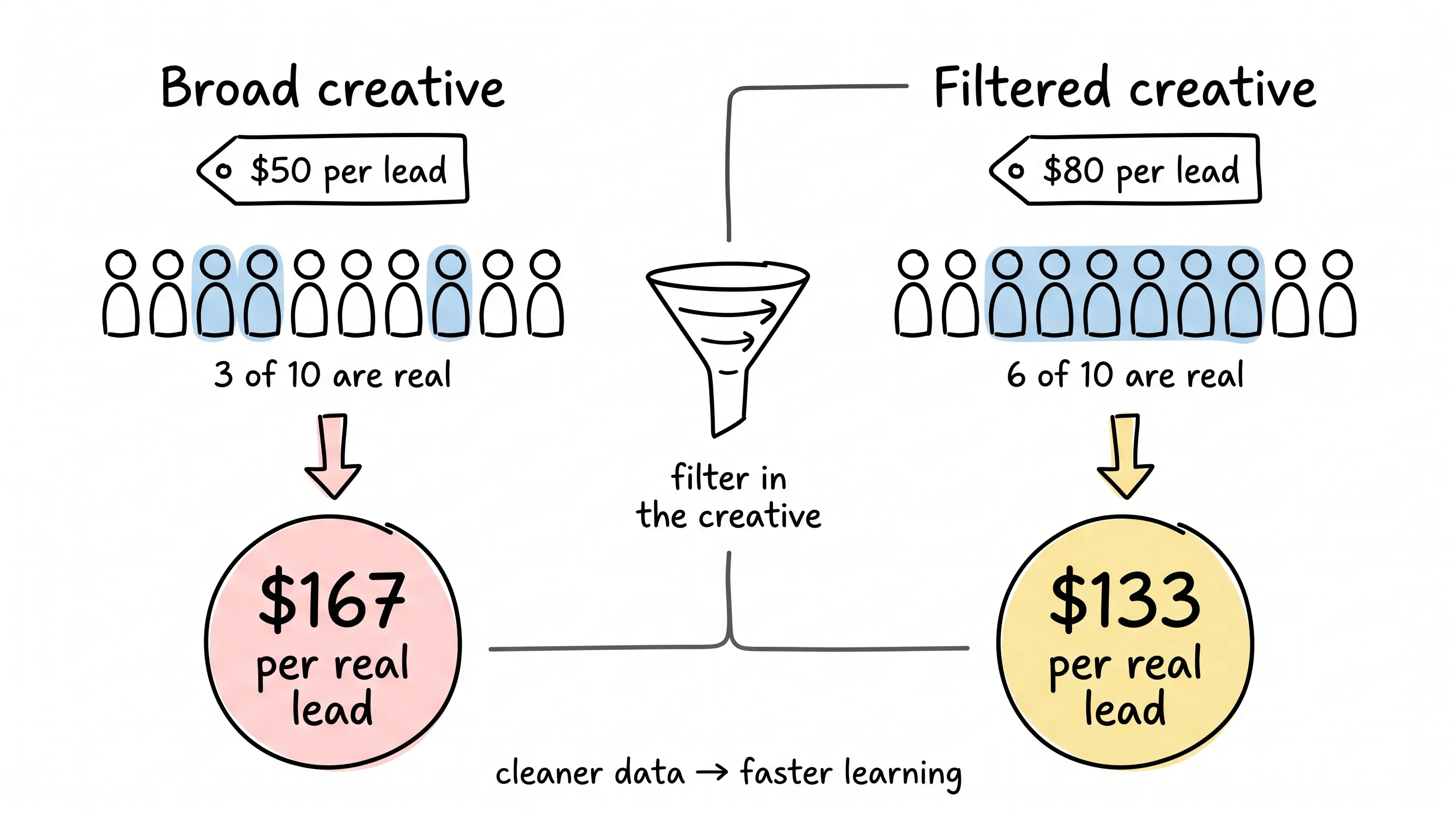
Run the numbers and it stings, doesn't it? It comes out cheaper — and the data is cleaner, so the algorithm learns faster.
What's the key to this math? That creative has to make two things clear: who this product is for — and who it is not for.
Take an example. A university is promoting an online master's in data analytics. What it wants is not "any student who wants to keep studying." It wants: people who already hold a bachelor's degree, have a few years of work experience, and want to move toward management or a more technical track.
Now you've got two headlines in front of you:
One says: "Advance your career — choose a data analytics degree."
The other says: "Already hold a bachelor's and headed for management? Our online master's in data analytics was designed for you."
With the second one, undergrads scroll right on by. The right people click in.
This move has a name in the trade: self-selection. The right people come closer, the wrong ones walk away, and both sides save effort. The signal the algorithm receives gets cleaner too — it quickly figures out what kind of person clicks in and then actually fills out the form.
Creative is no longer just a tool of persuasion. It is a filtering mechanism.
Three Platforms, the Same Lesson
This change wears a different face on each platform. Let me show you the three most typical ones.
First, Google's Performance Max.
The name promises everything, everywhere, which sounds impressive. But there's one thing you need to know: the "audience signals" you fill in there are not a targeting switch — they're just a starting hint for the algorithm. Whether the ad shows on Search, YouTube, the Display Network, or Maps, and who it shows to — Google decides.
If you can't control the audience, what can you control?
The creative.
Imagine an orthopedic clinic. The headline says "Caring for your health with expertise" — nothing wrong with it, but it also says nothing at all. Swap it for: "Knee pain for three months that won't go away? Come meet our orthopedic specialists." A specific symptom, a specific person, a specific fix. Anyone whose knee hurts right now sits up straight, and Google instantly knows who this ad should be shown to.
The same logic holds across industries. Insurance, legal, finance, education — all of it.
Now, TikTok.
This platform has always distributed videos on content signals, and as automation climbs higher, creative matters even more. The first three seconds of a video don't just decide whether a user swipes past — they decide which category TikTok files it under and which crowd it gets pushed to.
So for lead generation, the very first line has to start filtering:
A grad program opens with: "Already have your bachelor's and wondering what's next?"
Selling Medicare insurance, open with: "Comparing Medicare plans right now?"
A workers' comp lawyer opens with: "Injured on the job in the past year?"
One line doing two jobs. The right people stop, and the algorithm gets a sharper behavioral signal. The wrong people swipe past? Good. Their swipe is itself a signal.
The more it sees, the better the algorithm understands who you want. This learning snowballs on its own.
Creative Is Strategy
At the end of the day, the easiest mistake to make in media buying today is still treating creative as the last station on the assembly line: set the strategy first, then the targeting, and finally "get the assets made."
In an increasingly automated buying environment, creative is the strategy.
Your headlines, visuals, first three seconds, CTAs — they're no longer just the storefront in charge of brand and conversion. They are deciding for you who sees the ad.
So the creative team and the media buying team have to sit at the same table. Before your next asset review meeting, have the whole team ask three questions:
Can someone tell at a glance who this creative is for? Are the necessary filters written in — degree, experience, budget? Would an obviously wrong-fit person immediately realize "this isn't about me"?
If you can't answer all three, then that campaign is counting on targeting to solve a problem that should have been solved by creative long ago.
Every Ad Has Two Audiences
From here on, automation at Google, Meta, and TikTok will only get more aggressive, and the audience you can directly control will most likely keep shrinking.
But filtering isn't going away. It just changed addresses: from the back-end settings into your headlines, your visuals, and the first three seconds of your video.
Think back to that friend at the start. His problem was never the algorithm. He handed off the "who do we reach" job and didn't hand over a proper instruction manual.
Dinner was on me that night. But it wasn't a loss. He went back and fixed his headlines, and next month the wasted budget he saves will be enough to buy me dinner for a whole year.
Every ad, in truth, is speaking to two audiences at once: one you can see, and one you can't — the algorithm.
The platforms are doing more and more of the work for you, but they still need you to point the way.
And now, that direction is written in your creative.
Here's to you: may every ad you run be heard by the right people.
Continue reading
Related articles

It's 2026: Stop "Buying" AI Tools for Your Marketing Team — Start "Hiring" AI Agents
This learn article explains how AI agents differ from standalone AI tools in marketing, outlines three agent categories — build-your-own platforms, CRM-native agents, and vertical tools — and covers use cases across SEO, social media, advertising, and reporting, plus criteria for choosing one.

Did the Money You Spent on AI Marketing Ever Come Back?
A guide to measuring AI marketing ROI across three layers: ad reports, sales pipeline, and the financial ledger. Covers metrics such as ROAS and CPA, eight dashboard metrics, industry benchmarks, and common measurement mistakes.

How to Pick a Creative Automation Platform: First, Figure Out What These Eleven Actually Do
A learn article sorts eleven creative automation platforms — including Bannerflow, Celtra, Smartly.io, and Storyteq — into four functional groups and proposes five evaluation questions covering publishing reach, automation depth, ease of adoption, team fit, and verifiable evidence.