
Marketing Has Outgrown the Organization Built to Run It
An analysis of why marketing has outgrown its organization: specialization solved complexity but not cross-department dependencies, and AI agents force unresolved questions about permissions, approvals, and decision rights into system design.
A few days ago, I had dinner with a friend who runs marketing at a consumer goods company.
He vented. Last month, one marketing campaign crossed five departments on its way from idea to launch. The creative team waited four days for a single product image, because nobody could say for sure which version was the final approved one. Legal had rejected a line of copy last year, but that rule lived in exactly one colleague's head — nowhere else in the company.
He asked me: we've bought so many tools — why is the work still this hard?
I told him: that question hits the nail on the head.
Let's start with a number.
In 2011, when someone first took stock of the marketing technology products on the market, they counted about 150. By 2026, that number had become 15,505.
Honestly, the first time I saw that number, I had only one reaction: whoa.
But that number isn't the point.
The point is, over these fifteen years, technology has quietly changed how marketing gets produced. CRM, automation, content management, personalization, data analytics, e-commerce platforms — plus the AI of the last couple of years — have linked jobs that used to run in isolation into a single web. Data flows between systems, content moves from a brief into production and then out into delivery, and every action a user takes triggers the next step in return.
Technology used to be a tool that helped marketing get work done. Now, it is the assembly line on which marketing itself gets produced.
The organization's response to this sounds perfectly reasonable: add people, add specialists. Marketing operations, marketing technology, creative operations, CRM, data analytics — every discipline now has its own bench of experts.
And the specialists aren't the problem. The problem lies somewhere else.
Specialization Solved "Complexity," Not "Dependencies"
Think about it: what does specialization actually mean?
It means each person digs deeper and deeper within their own box. The ones who understand customer data understand the data better than ever; the ones who understand the creative process understand the process better than ever.
But for a system to run, what it depends on isn't the depth inside each box — it's the relationships between the boxes.
Let me give you an example: personalization.
On its face, this is one hundred percent marketing's job, right? Start actually doing it, and you find it drags in customer data, user consent, identity resolution, product information, audience segmentation, decision logic, content, production, delivery, and measurement. Ten things. Some of those ten sit in marketing's hands; the rest sit with technology, data, product, e-commerce, legal, sales, and customer service.
To the user, it's one brand. The way the system runs, it's one connected whole. But on the org chart, it's box after box.
McKinsey has looked at exactly this. They surveyed 104 executives in consumer goods and retail: only 27% considered their marketing operating model mature enough, and only 37% said collaboration was smooth — inside marketing, and with departments like e-commerce, product, and sales. As for "clear and effective governance," only 12%.
You see, the capabilities are all there, the people are all good, the money has been spent — and yet everything still stalls on someone else's decision.
No matter how well creative operations tunes the production line, if the product information fed in from upstream is a mess, it's all for nothing. Marketing operations redesigned the whole process, but the enterprise architecture underneath didn't budge. The technology team integrated two platforms beautifully, but the identities, security, and data standards the integration depends on aren't theirs to decide.
Is Every Problem the Structure's Fault?
Let me be clear first: no.
In marketing, botched implementations, redundantly bought tools, bad data, and processes that should never have been automated — there's plenty of all of it. For some companies, the most valuable thing to do right now is learn to use what they already have, properly.
Here's another number that says a lot. In the 2026 CMO Survey, marketing leaders rated their own ability to "design the overall marketing technology architecture" at 4.6 (out of 7), choosing the right vendors at 4.9 and the right mix of tools at 4.8. Choosing the parts scores higher than designing the whole machine.
So when should you suspect a structural problem? Here's a test you can run yourself: a capable team keeps running into the same wall, and that wall isn't a capability problem — it's a power problem.
Marketing is accountable for the results, yet has little say over the systems, capabilities, and decisions that determine those results — that's what a structural problem actually is.
What sits between marketing and technology?
Marketing holds the judgment: brand, customer value proposition, creative direction, business priorities — and the outcomes it wants.
Technology holds the foundation: cloud, security, identity, enterprise architecture, the core data platform.
And the middle? The middle holds an entire operational layer: workflows, systems integration, approval paths, data activation, the content supply chain, entitlements, decision logic, customer journeys. Marketing's ideas become things the organization can actually execute on this layer.
Every wave of technology has thickened this layer. One more integration, one more process, one more system, one more dependency. Yet almost nobody has seriously designed who gets the final say on this layer.
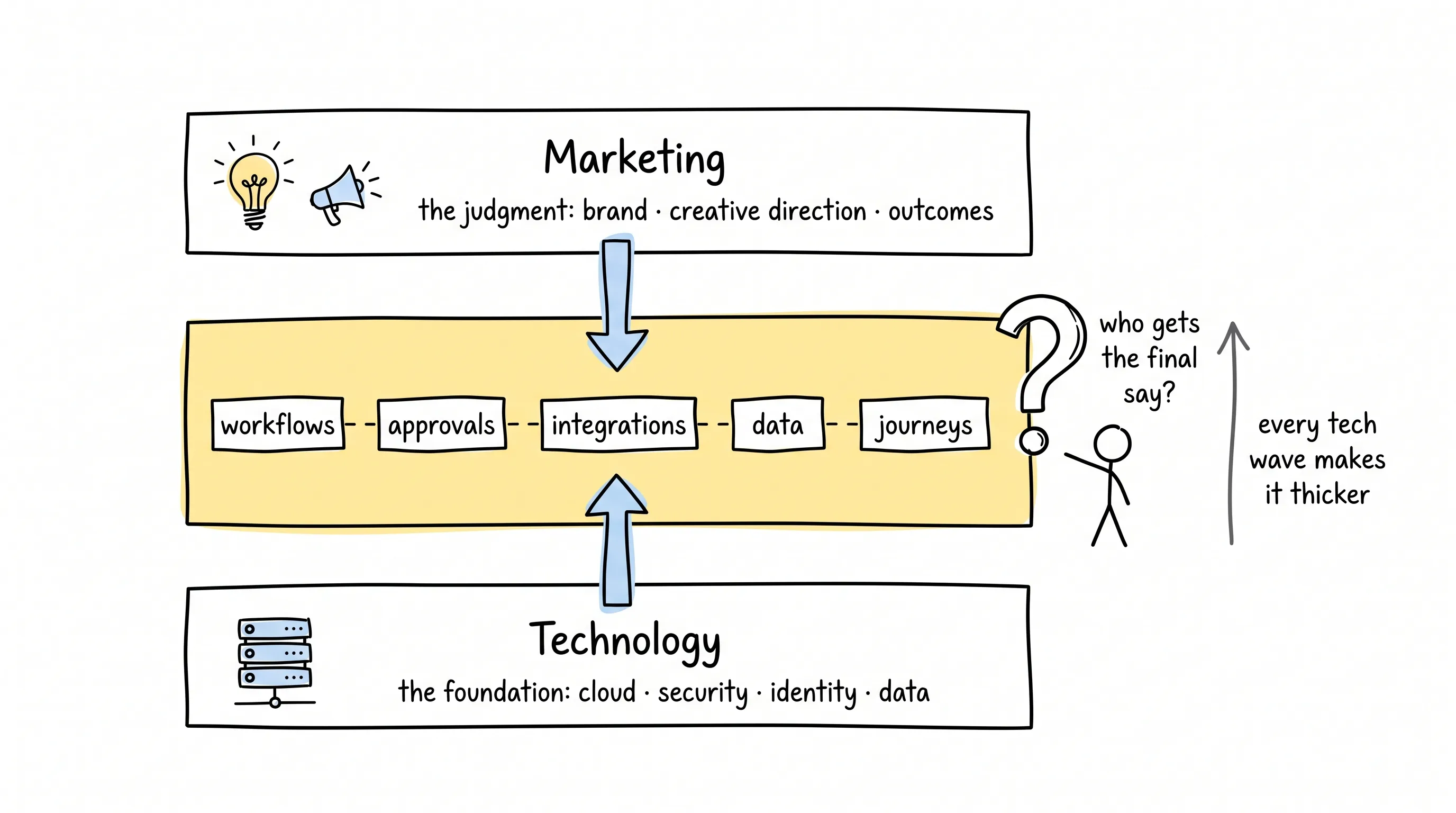
So "put everything under the CMO" is not the answer. The CMO doesn't need to swallow IT, data, product, and legal. But flip it around: if marketing is accountable for results yet has zero influence over the shared capabilities that determine those results, then that accountability is hollow.
What about buying orchestration software, then? Customer journey orchestration, campaign orchestration, content orchestration, workflow orchestration — they all sound like they can straighten out a complicated environment.
But software can only automate the decisions the organization has already thought through.
A platform can move customer data back and forth between systems, but the unfinished fight over "who gets the final say on the customer model" — it can't referee that. A workflow tool can automate the approval path, but who should hold approval rights, it cannot decide.
The tighter technology ties the work together, the less the organization's unresolved questions can stay hidden.
Why It Took AI to Break This Open
This problem has actually been sitting there for years. What's been packed into all those gaps, all this time, is people.
Before a campaign launches, the marketing manager gives customer service a heads-up: don't clash with the promo. Lao Wang in the creative group knows which image is the approved version. The ops lead knows which reviews can be run in parallel to save time. Someone remembers that legal shot down that phrasing last time — even though this rule is written down nowhere.
Companies are full of people like this. They chase approvals, chase down data, sync with product to get the story straight, and broker exceptions for people — patching, with personal rapport and memory, every gray area the organization never formally resolved. Inefficient, undocumented. But it works.
This is the human buffer layer.
AI has no room for it.
For an agent to actually run, it needs data, permissions, rules, a threshold for "escalate when unsure," and a person who answers for it when it goes wrong. The things that used to be settled person-to-person, through negotiation, now all have to be written into the system design.
Permissions are power. Approval rules are governance. Escalation paths are accountability.
Which creates a new risk: creative spins up a content agent, marketing operations spins up a journey agent, sales spins up an outbound sales agent, and customer service hatches one of its own. Each one is designed quite well within its own turf, but each inherits its own department's metrics, permissions, and blind spots.
Without a unified operating model, automation simply reproduces the organization's fragmentation, exactly as it is.
The silos haven't disappeared — they've just been wired together with APIs.
The Next Bottleneck May Not Be in the Tech Stack
For marketing leaders, growth, customer experience, personalization, brand consistency — not one of these outcomes can marketing deliver on its own as a single department. Every one of them has to be coordinated across departments.
So does that mean another big reorg?
No.
Product-model organizations, fusion teams, centers of excellence — these approaches proved one thing long ago: you can create shared cross-departmental accountability without redrawing the org chart. It comes down to one sentence: if the outcome crosses several departments, then decision rights and collaboration must cross the same boundaries.
Marketing technology, marketing operations, creative operations — these teams happen to sit right on top of those seams. So do technology, data, product, and e-commerce. None of them can deliver a complete outcome on their own.
The tools will keep evolving; that's not what matters. What matters is whether the organization built around those tools can come together as seamlessly as the tools do.
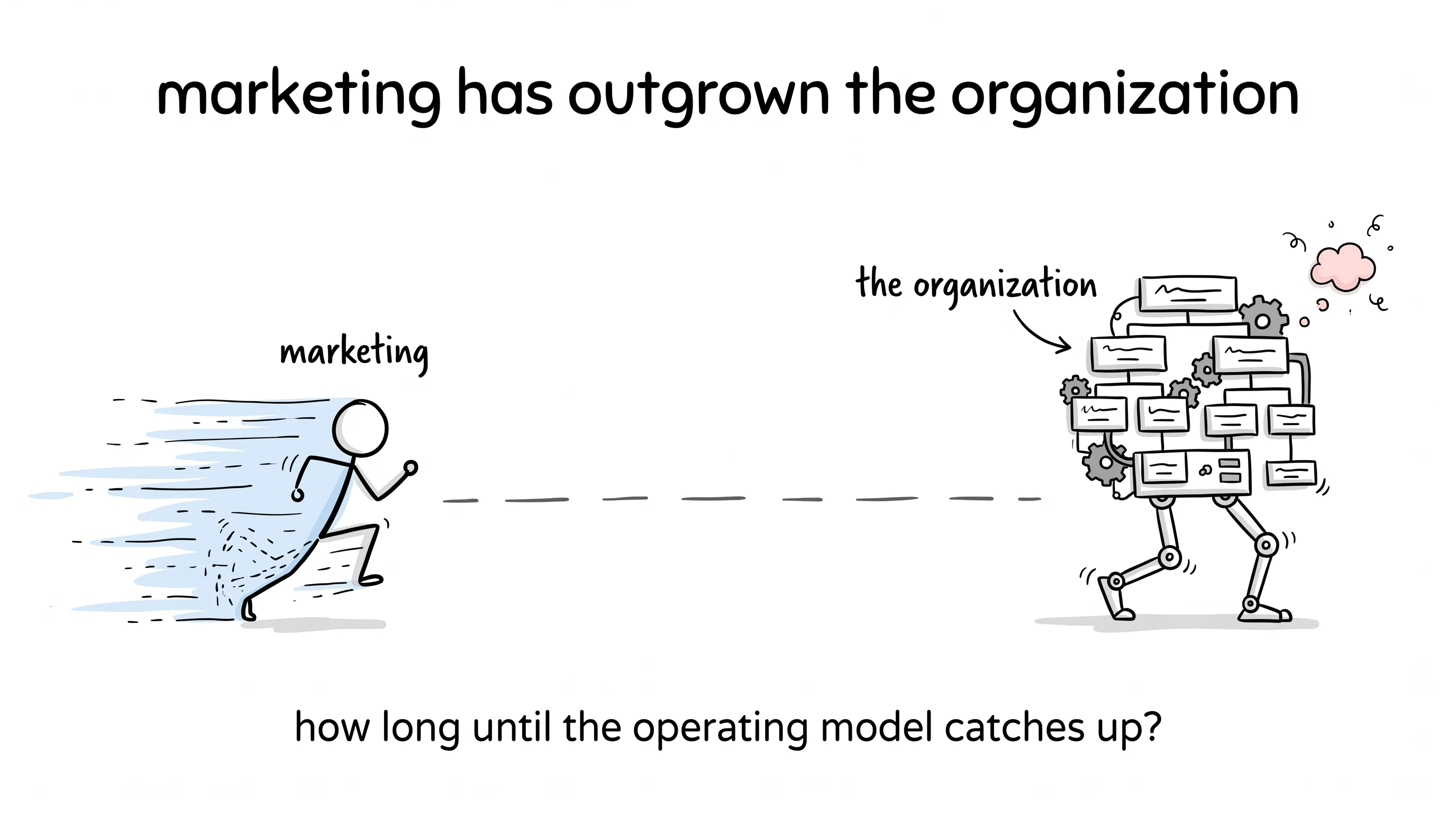
Marketing has already run faster than the organization. From here, there is only one real question: how long until the operating model catches up.
As we were leaving, I told my friend: don't rush to buy another tool. First get clear on "who gets the final say."
And here's hoping the organization you're in can keep up too.
Continue reading
Related articles

What Is an AI Marketing Agent? From "Using AI" to "Delegating to AI"
A learn article explaining what an AI marketing agent is, how it differs from rule-based automation, and which repetitive tasks such as lead qualification, reporting, and campaign monitoring can be delegated while humans keep key decisions.

Marketing Automation Is Shifting from "You Do It" to "You Say It"
This article explains how marketing automation is shifting from rule-based platforms that merely execute toward AI agents that plan, create, publish, and review campaigns, covering delegable tasks, underlying technologies, tool categories, adoption steps, and risks such as privacy and automating without strategy.

When AI Does the Creative, Mistakes Come in Batches Too
A learn article on the risks of using generative AI for marketing creative across brand, legal, compliance, and operational layers, with case examples and seven practices for review, rights clearance, documentation, and vendor governance.