
AI Won't Kill Sales Jobs. Buyers Will.
A learn article arguing that the real threat to sales jobs is not AI itself but buyers who increasingly trust their own AI agents for vendor research and evaluation. It discusses trust in transactions, which deal types are affected first, and what sales organizations should focus on instead of efficiency.
A while back, an old friend who sells enterprise software invited me out for tea. Three minutes after we sat down, he asked me:
"Tell me honestly — how much longer do I get to keep this job? These days, before clients even look at a proposal, they run it past AI first. If the AI says no, they won't even take the meeting."
I turned the question back on him: do you think it's AI that's going to do you in?
He froze.
Here's what I told him: you've got the wrong adversary. The thing that kills sales won't be AI. It'll be buyers. Buyers who trust their own AI more and more every day.
Why do I say that?
Buyers Are Already Putting AI to Work
This isn't fear-mongering. Look at the numbers.
In 2026, the research firm G2 published a buyer-behavior report called The Evaluation Maze. One figure in it: more than 60% of B2B buyers are already using AI agents to buy software — or planning to.
What's an AI agent? It's the tireless assistant every buyer now has at their elbow. It digs up research, builds the shortlist, runs the comparisons — the whole pipeline. Research, first-round screening, price checks, end to end. The final call still belongs to a human.
Notice the word still.
In Gartner's latest round of buyer research, 45% of buyers admitted they used generative AI in their last purchase, mostly to size up vendors and products.
Forrester's 2025 buyer journey survey cuts even deeper. As information sources, generative AI and conversational search now outrank vendor websites, salespeople — even product experts.
Think about what that means. When buyers want to know whether your product holds up, they used to ask you. Now they ask the AI.
But here's a detail buried in that same Forrester survey, and it's a fascinating one: among buyers using generative AI, roughly one in five said the information the AI gave them wasn't all that reliable — it actually made them more hesitant to commit.
Hold that thought. It matters later.
What Does Trust Actually Mean?
Back to the question we started with: why would buyers still need salespeople?
Strip it all down and you're left with one word: trust.
Trust in a business transaction comes down to three things:
Capability. Do you actually know this space? Is what you say on the mark?
Reliability. Is what you say true? Do you deliver what you promise?
Alignment. Whose side are you actually on?
Hold AI up against those three, and you'll see it closing the gap fast.
On capability, AI is improving at a stunning pace. On product specs, pricing models, competitive comparisons — most salespeople can no longer out-research it.
On reliability, that's exactly the "one-in-five problem" from a moment ago. Every time the AI invents a feature or quotes a wrong price, a little trust wears away. But this is an engineering problem. And engineering problems, sooner or later, become solved problems. History has rarely failed to bear that out.
What about alignment?
That's where the real show begins.
Your AI vs. the Buyer's AI
Some will say: aren't vendors deploying AI sales assistants and AI customer service too? Online 24/7, brimming with hustle.
Guess what buyers think of that?
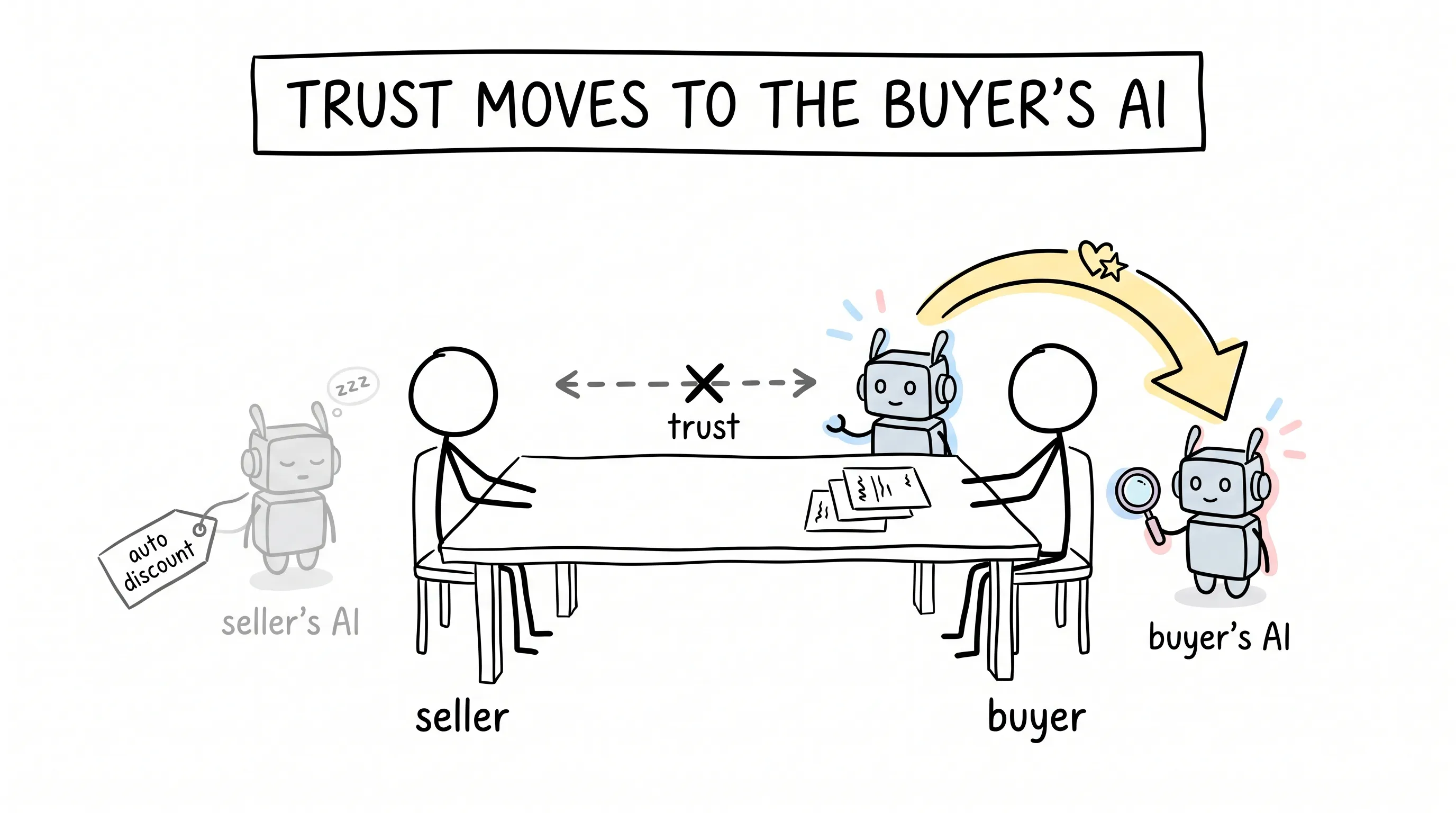
Buyers know exactly what it is. That AI is on your side of the table. It's a salesperson that never sleeps. Whatever it says to a buyer gets an automatic discount.
So not only does it fail to threaten human sellers — it makes a trustworthy human seller more valuable.
The real threat is something else: the buyer's own AI.
If a buyer trusts the AI working on their behalf, do they still need to trust your salesperson? No. That AI researches vendors, compares proposals, flags risks, negotiates terms.
And here's the detail that matters most — the one most people haven't thought through:
Trust doesn't transfer from the seller's people to the seller's machines. It transfers from the seller's people to the buyer's machines.
Only when buyers trust their own AI are your salespeople well and truly benched.
Where Does the Ground Give Way First?
Of course, this won't happen overnight.
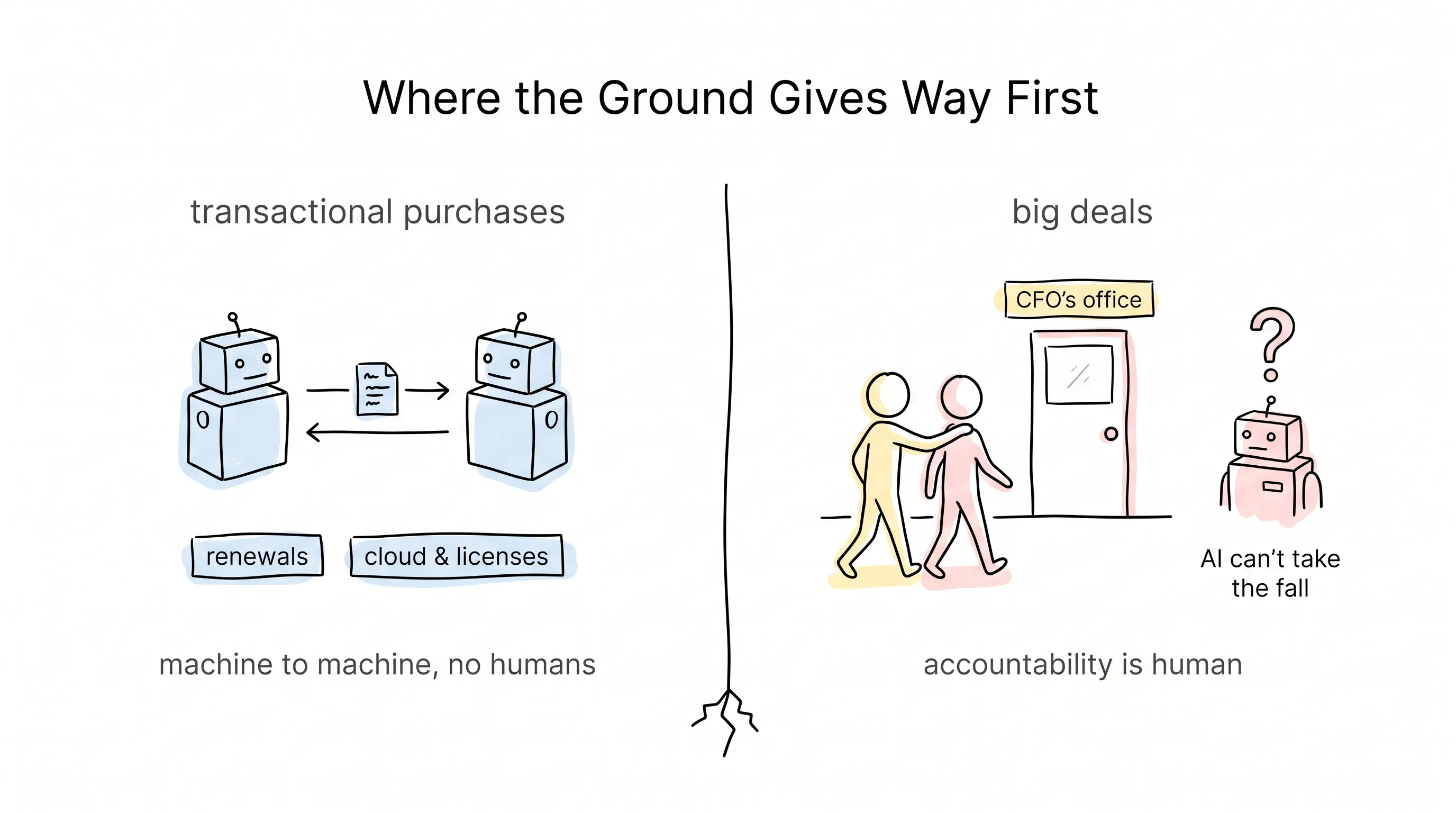
The first ground to go is transactional purchasing: renewals, standard software licenses, cloud capacity, supply-chain materials. Low risk, repeated, quantifiable outcomes. If last year's purchase went fine, why would placing the next order take any human relationship?
For deals like these, no human even needs to show up anymore. Software licenses, cloud resources — machine to machine, fully automated, not a living person on either side.
What about the big deals, then? Seven- and eight-figure platform purchases — why are those slower?
Not because the information is hard to process. Because the risk is personal.
Think it through: if a procurement team signs off on a platform worth tens of millions and the project blows up, someone has to answer for it. Someone has to walk into the CFO's office — and someone has to walk in with them. When things go south and someone needs to take the fall, what exactly can AI offer there? AI can't be held accountable. And a big slice of the premium buyers pay is precisely for that: a human being who can be held accountable.
Then there's a subtler kind of work. Knowing the IT director and the VP of Operations don't get along. Knowing your internal champion is losing standing. Hearing that "there's no budget" really means "not this quarter." None of this ever gets written down — it lives in hallway conversations and phone calls, and not a word of it is in the CRM.
At this point, salespeople reading along may breathe a sigh of relief: good news — this is my last moat.
Don't relax just yet.
Call recordings, email, work chat, meeting notes… these tools record a little more every year. The data gap that protects human sellers today is quietly closing.
So What Should Sales Organizations Do?
Here's the most ironic thing I see.
Plenty of sales organizations are still spending money to make their sellers more "efficient." Efficient at what? Research, comparisons, proposal writing, meeting notes.
Those are precisely the tasks buyers are learning to hand to their own AI.
You're doubling down on capabilities the other side is already phasing out.
What actually keeps a human at the table is a different set of things: judgment, a nose for internal politics, the ability to translate risk into confidence the boss can actually hear, and the willingness to carry the outcome on your own shoulders. None of that comes bundled with a software license or ships in an installer. It can only be built, one person at a time.
So stop asking, "When will AI get good enough to replace my sales team?"
Ask instead: when that day actually arrives, what reason is left for a buyer to keep your salesperson in the room?
The answer to that question isn't AI's to write.
It's the buyer's.
It always has been.
Continue reading
Related articles

What Is GEO? How Your Brand Gets "Mentioned" in the Age of AI Search
An explainer on GEO (Generative Engine Optimization) for e-commerce and DTC brands: how it differs from SEO and AEO, why AI answers shape brand visibility, and eight practices covering question-focused content, consistent brand messaging, structured pages, external evidence, comparisons, and AI mention tracking.

AI Is Already Making Decisions for Your Customers. Are You on the List?
A learn article explains GEO (Generative Engine Optimization): why AI-generated answers now shape which brands customers see, and how SEO fundamentals, entity clarity, citable evidence, and monthly measurement affect visibility in AI answers.

Google Is Stuffing Ads Into AI Search: These Recent Stories Are Really One Story
A news roundup linking recent AI marketing stories—Google adding ads to AI Mode, Amazon's Ads Agent, ChatGPT image updates, a UK startup tracking brand mentions in AI answers, and an AI ransomware warning—arguing that control over ad data and visibility is shifting toward platforms.