
You Can Open Your Store in Ten Countries Without Hiring Ten Times the People
A learn article on how AI agents can take over repetitive cross-border e-commerce chores—pricing, localization, regulation monitoring, payments, marketing, and logistics—so expansion means adding configuration instead of headcount, while humans keep the final decisions.
A while back, a friend of mine who runs a cross-border e-commerce business took me out to dinner.
Halfway through the meal, he pulled out his phone, showed me his backend dashboard, and asked: guess what my biggest headache was when I opened my store in its third country?
Product selection? I said.
Nope. Exchange rates.
Then he walked me through the math. The same product, priced off an exchange rate from three months ago. Over those three months, the local currency lost value, so his goods suddenly looked more expensive to local shoppers — out of nowhere. Sales were slipping, and he couldn't figure out why. He assumed the product was the problem.
It finally clicked: the product was fine. His pricing had expired.
Three markets meant three time zones of customer service, three sets of exchange rates, three books of regulations. As he put it: I used to think going global was hard because of traffic. Once you're actually in the water, you realize the hard part is all the messy details nobody ever writes into a business plan.
My reaction at the time was simple: this is exactly the kind of work you should hand to machines.
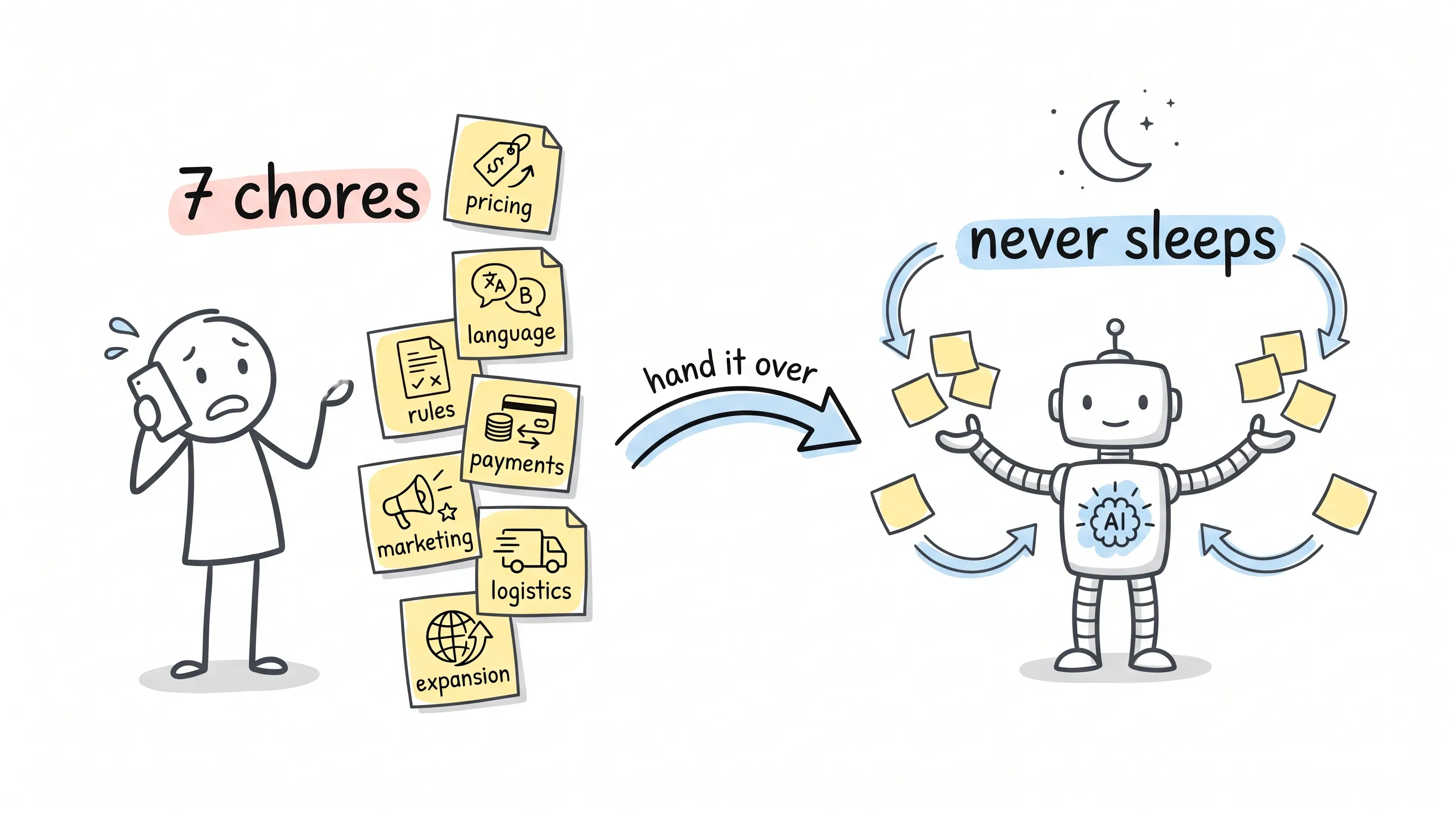
The Real Barrier to Going Global: Seven Chores
What counts as the hidden cost of cross-border business?
It's the bills you never think of until you're actually operating there. I counted them up — about seven.
The first is pricing. Exchange rates move every day; your price list gets updated once every three months. That's exactly how my friend got burned. And besides, the same product shouldn't sell at one flat price across markets with different purchasing power anyway.
The second is language. Translation is not localization. Copy produced by raw machine translation instantly tells locals "this is an outsider." You need to know the local jokes, the local taboos, how local people actually shop.
The third is regulations. Every country has its own import policies, tax rates, and product restrictions — and they change all the time. You can keep an eye on one or two countries by hand; you can't watch ten.
The fourth is payments. Believe it or not, in some markets a shopper fills the cart, reaches checkout, doesn't see the payment method they always use, and walks away. The whole order dies at the last step.
The fifth is marketing. A promotional pitch that works in your home market can fall flat in another culture — or even cause offense.
The sixth is logistics. Where to put warehouses, which routes to ship on, air or sea, when to dispatch — planned by hand, it's slow and error-prone.
The seventh — and the deadliest — is how you expand. Every one of the six above has to be redone for each new country. Staff up? By country number five, your team is bigger than you can personally manage.
Notice what these seven things have in common.
They're all repetitive judgment calls. Frequent, individually easy, but impossible to skip even once.
How did people handle this kind of work in the past? Hire people. Now there's another option.
What Is an AI Agent? An Operations Specialist That Never Sleeps
When many people hear "AI," they picture a chatbot: you ask, it answers.
Set that misconception aside. What we're talking about here is called an agent.
What's an agent?
If an ordinary AI tool is a consultant — it only answers when asked — then an agent is an employee: you give it a goal, and it monitors the situation and does the work itself.
So what can this "employee" do in a cross-border business? The same seven things, one by one.
Pricing: it tracks exchange rates and purchasing power in every market in real time, and adjusts prices automatically. My friend's costly lesson never has to happen again.
Localization: it translates product detail pages, customer-service scripts, and marketing copy into the local language — and tunes the tone to local sensibilities.
Regulations: it monitors trade policies, tariffs, and tax rules in every country around the clock, flags anything that changes, and can even rewrite the plan for you.
Payments: it connects local payment channels in each market and handles fraud and risk checks while it's at it.
Marketing: it watches local trends, competitors' prices, and consumer sentiment, and feeds all of it back into strategy.
Logistics: it works out where to put warehouses, which routes to ship on, air or sea, and when to dispatch for the best economics.
And finally, all of these actions sync automatically across platforms and channels. Change one price, and it goes live everywhere.
By the time you wake up, every market has had its prices re-checked and its policies re-verified.
That's powerful.
The Math That Matters: Add People, or Add Configuration?
Let's do the math.
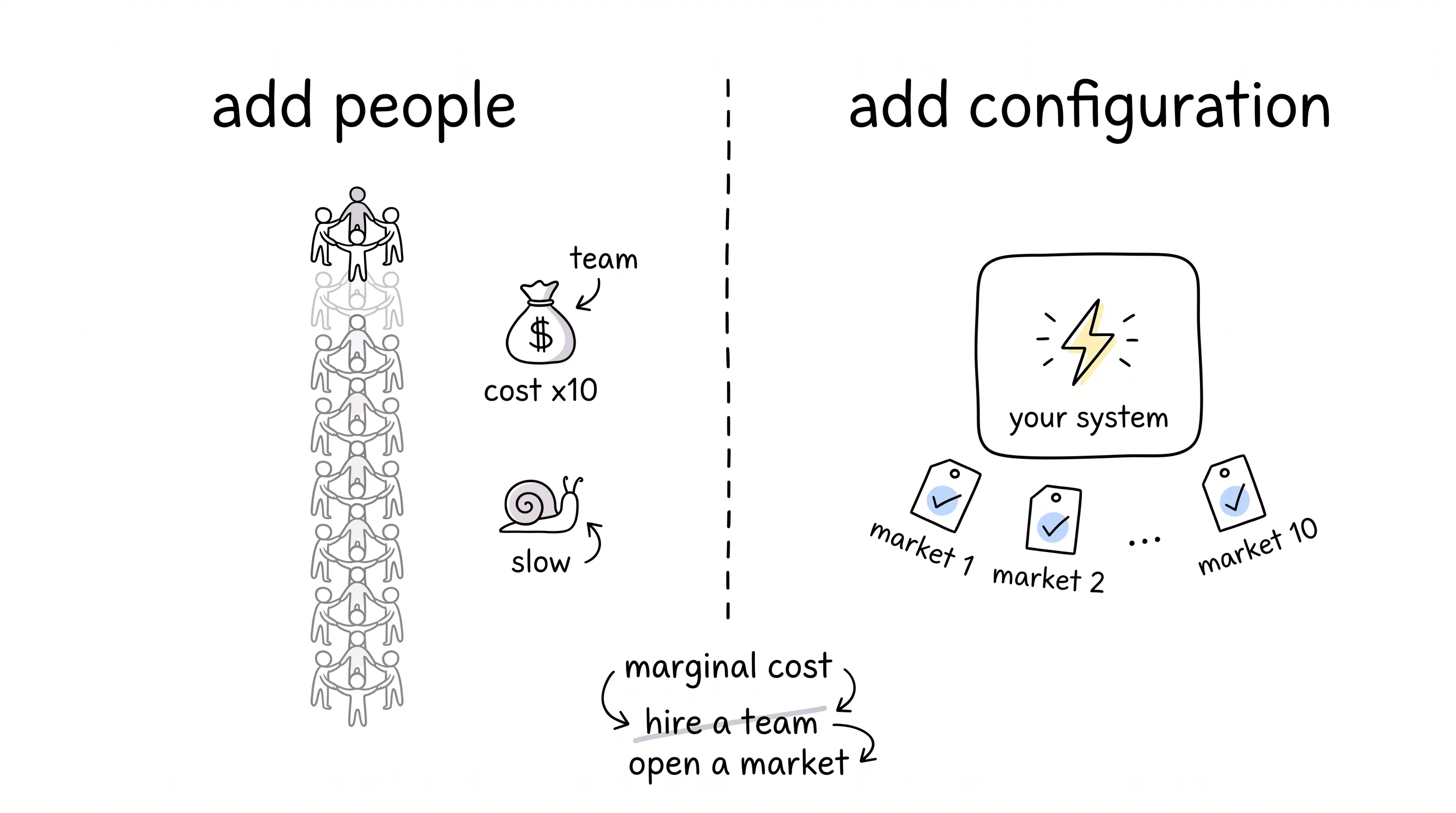
The traditional approach: enter a country, build a team — one ops person who speaks the language, one to watch regulations, one to run logistics, maybe one more who knows local marketing. Ten countries, ten teams.
The biggest problem with this structure isn't the cost. It's the speed. Every team needs hiring, training, and trial-and-error bonding; by the time it's up to speed, the window of opportunity may already be gone.
The agent approach changes how you expand: entering a new country means adding a configuration, not a crew.
Your experience, your processes, your rules — all of it gets built into the system, and the system runs in every market at once. The marginal cost of expansion drops from "hire another team" to "open another market."
That's what scaling is supposed to look like.
So What Do the Humans Do?
At this point you might be getting nervous: so what happens to people like us?
Don't worry. Every form of automation I've seen ends up at the same division of labor: machines handle execution; humans make decisions.
When this goes live, you have one dashboard: sales, conversion rates, compliance status, and shipments in transit for every market, all visible at a glance. The localization copy the AI writes — review it line by line if you want, or delegate it entirely. Whether pricing runs fully automatic or keeps a human approval step is your call, too.
In other words, the level of involvement is adjustable. Hand off the parts you trust; keep final review on the copy that carries your brand voice and the prices that carry your profit.
You go from "doing everything myself" to "deciding only what goes to the machine and what stays with me."
That's the seat a boss should actually be sitting in.
One Last Thing
I ran into that friend again recently. His store is now in seven or eight countries; the team has barely grown.
He said something I found pretty interesting: I used to hire people to do the work. Now I build systems that do the work for me, and keep the people for thinking.
In cross-border commerce, the barrier was never traffic — it's operational density. Whoever hands the density to the machine gets to keep their attention for real judgment.
May your store reach wherever you want it to go — and may you never be trapped in country number one by the chores.
Continue reading
Related articles

What Is an AI Marketing Agent? From "Using AI" to "Delegating to AI"
A learn article explaining what an AI marketing agent is, how it differs from rule-based automation, and which repetitive tasks such as lead qualification, reporting, and campaign monitoring can be delegated while humans keep key decisions.

Marketing Automation Is Shifting from "You Do It" to "You Say It"
This article explains how marketing automation is shifting from rule-based platforms that merely execute toward AI agents that plan, create, publish, and review campaigns, covering delegable tasks, underlying technologies, tool categories, adoption steps, and risks such as privacy and automating without strategy.

When AI Does the Creative, Mistakes Come in Batches Too
A learn article on the risks of using generative AI for marketing creative across brand, legal, compliance, and operational layers, with case examples and seven practices for review, rights clearance, documentation, and vendor governance.