
Still Ranking — but the People Are Gone
A learn article on how AI search shifts users from clicking results to asking AI directly, why strong SEO rankings do not guarantee citations in AI answers, and a three-layer playbook of structured data, E-E-A-T, and entity optimization, plus new metrics like AI citation rate and zero-click exposure.
Recently I noticed a habit of mine has changed.
When I need to look something up, my hand no longer goes to the search box first. I ask AI.
I ask, and the answer is just there. As for the ten blue links below it, nine times out of ten I never open them.
My guess is, you're the same.
What does this mean for people who do marketing? For the past decade, the playbook was one and only one: get rankings, grab traffic, then convert. That playbook can still run.
But the foundation just cracked.
What Is AI Search?
First, in plain language: what is "AI search"?
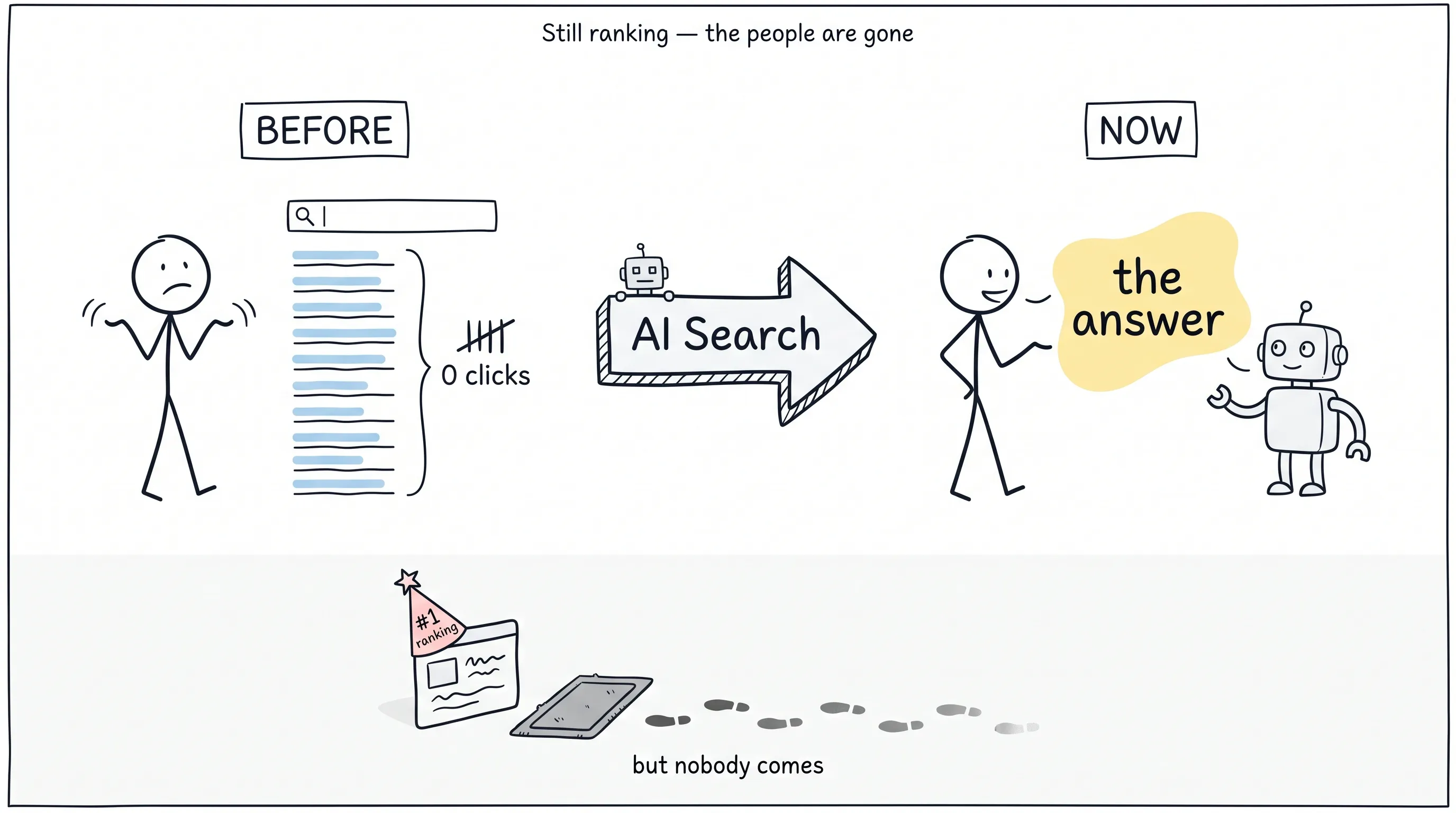
Before, you asked a search engine a question, and it handed you a "reading list": a pile of web pages, and you went digging yourself.
Now you ask AI the same question, and it gives you the "answer" directly. Where to go, which of two products comes out better, which one to buy — it says it all in one breath.
Users are no longer "looking things up." Users are asking for conclusions outright.
Search isn't dead. But the act of "going to a search engine to search" is becoming optional.
This shift isn't a hunch. Semrush's research data already points the direction: traffic arriving via AI is rising, while clicks from organic search are quietly slipping. Both moving at once means users are switching entrances.
Impressions Rising, Clicks Falling
Plenty of teams have seen the same strange pattern: impressions in the dashboard keep climbing, while clicks keep falling.
Many people's first reaction: something's wrong with SEO, optimize quickly.
That's the wrong direction.
You didn't do anything wrong. It's that users already got their answer from AI — they just stopped clicking through to you. Your page is still sitting there in the results; nobody's flipping through them anymore.
Before, one search might still bring your website a few clicks. Now the same question, and AI settles it in one sentence. Your ranking hasn't budged, but the pool of clicks has run dry first.
When impressions rise and clicks fall, don't rush to fix SEO. Go see how AI answers the questions that concern you.
The Part That Stings: Strong SEO Doesn't Mean AI Sees You
The next question is even more brutal.
If your SEO ranking is very high, is AI guaranteed to cite you?
The answer: not necessarily.
Earlier this year Semrush ran an enterprise-level pilot, with clients at the scale of eBay, Zalando, and Yext. The result surfaced a very common gap: brands that perform beautifully in search may never show up in AI's answers.
Why?
Because the two choose who makes the cut by different logic. Search engines rank "web pages," looking at keywords and links. AI answers "questions," and what it cites are the sources it trusts.
One is ranking, the other is trust. Rankings are won through optimization; trust is earned over time. These are two separate ledgers.
So stop asking "how do I rank first" — that question is outdated.
The new question is: Does AI know you exist?
The Playbook: Close the Gap in Three Layers
Knowing the root of the problem, how do you fix it? Three layers, one at a time.
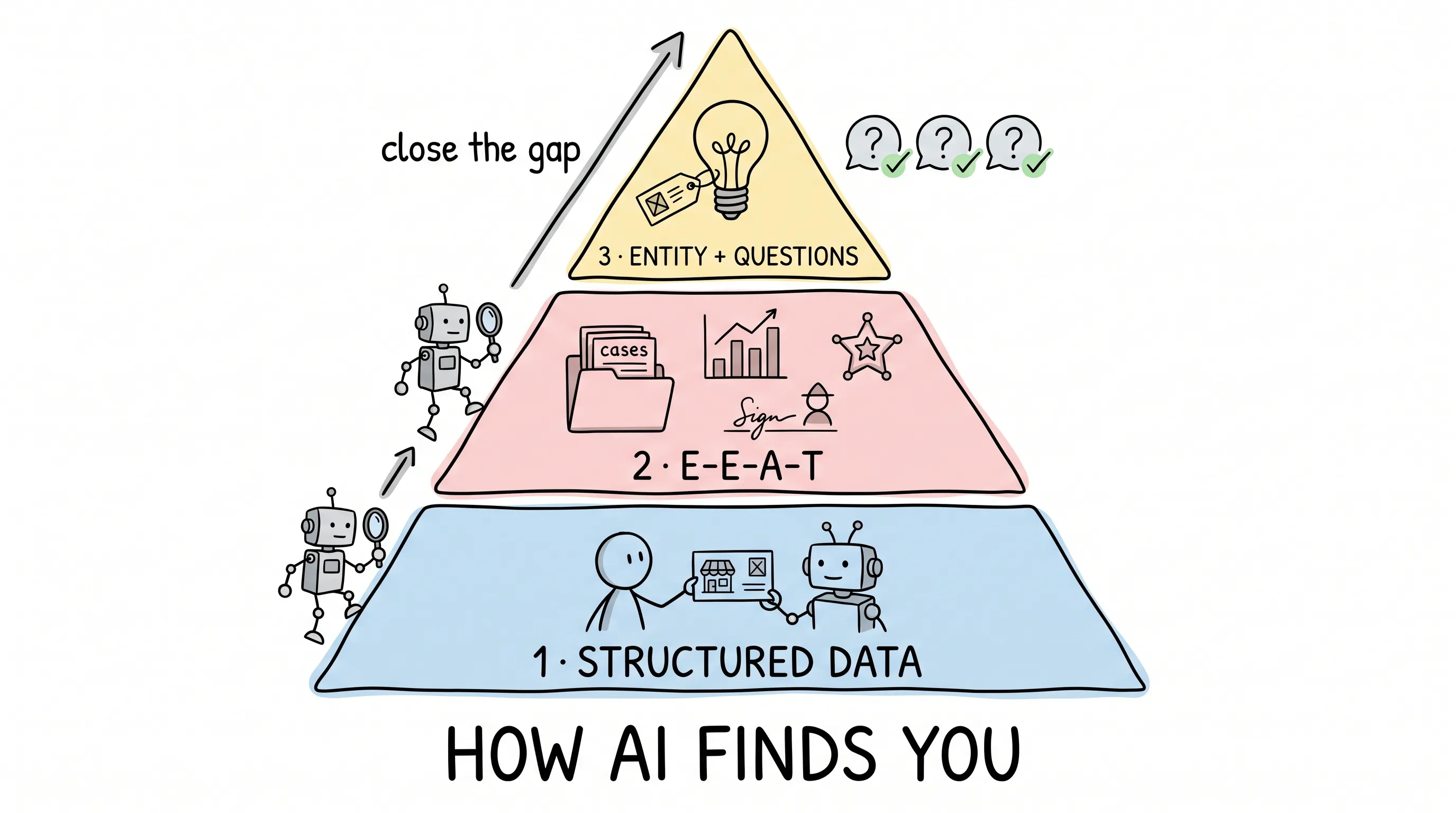
Layer one, structured data. This is your business card for AI to read. No matter how well your website content is written, if machines can't parse who you are, what you sell, and what you're good at, the machine has nothing to cite. Mark the key information in your pages in a way machines can parse.
Layer two, E-E-A-T. Experience, Expertise, Authoritativeness, Trustworthiness. Four terms that sound like officialese, but boiled down it's one sentence: make AI believe you've actually done this. Client cases, real data, bylined authors, industry endorsements — all of it is evidence.
Layer three, entity optimization, plus "question-first" content. AI remembers "entities": what role your brand plays, in which field your voice carries weight. How to write content? Stop circling keywords; answer the questions customers would ask, one by one. Semrush's observation is that this question-first content model is currently outperforming the traditional way of writing.
The Measuring Stick Has to Change Too
The playbook changed, so the measuring stick has to change too. Reporting to your boss with a traffic curve — the story no longer holds: falling traffic doesn't mean you're regressing.
Swap in three new metrics.
One, AI citation rate. When AI answers questions related to your industry, does it mention you?
Two, zero-click exposure. Users read AI's answer and leave — that exposure: is any of it being credited to you?
Three, your share in AI answers. When users compare brands with AI, is your name on the shortlist?
You can start tracking all three with the tools you already have — no need to tear anything down and rebuild your data system.
Don't Wait; One Week Is Enough
Last, action.
The best part of all this: the cost to start is low. Using the audit framework Semrush distilled from enterprise data, in one week you can sit down with your team and go through your brand's AI visibility end to end: does AI mention you at all? When it does, is it getting you right, or getting you wrong? Are your competitors in the room?
Once you've gone through it, you'll know which pieces of content to fix first. Start with the few that carry the biggest impact on revenue — don't spread your effort across a wishlist.
Back to the Beginning
I'm still that habit: got a question, ask AI first.
Only now I think one step further: when my users start asking this way too, how will AI introduce me?
Does it know me?
The person it describes — is that me?
In this reshuffle, what's being measured is no longer who ranks higher, but who gets remembered by AI first.
And here's hoping you're the name in AI's answer.
Continue reading
Related articles

It's 2026: Stop "Buying" AI Tools for Your Marketing Team — Start "Hiring" AI Agents
This learn article explains how AI agents differ from standalone AI tools in marketing, outlines three agent categories — build-your-own platforms, CRM-native agents, and vertical tools — and covers use cases across SEO, social media, advertising, and reporting, plus criteria for choosing one.

What Is GEO? How Your Brand Gets "Mentioned" in the Age of AI Search
An explainer on GEO (Generative Engine Optimization) for e-commerce and DTC brands: how it differs from SEO and AEO, why AI answers shape brand visibility, and eight practices covering question-focused content, consistent brand messaging, structured pages, external evidence, comparisons, and AI mention tracking.

AI Is Already Making Decisions for Your Customers. Are You on the List?
A learn article explains GEO (Generative Engine Optimization): why AI-generated answers now shape which brands customers see, and how SEO fundamentals, entity clarity, citable evidence, and monthly measurement affect visibility in AI answers.