
Rankings Holding, Traffic Falling? How to Actually Track Google's AI Overviews
An explainer on why steady keyword rankings can coexist with falling traffic when Google's AI Overviews answer queries directly, and how to track citations and mentions with a structured baseline, fixed keyword samples, and tiered monitoring cadences.
A few days ago, a friend who runs an e-commerce business came to me venting.
"Something's weird," he said. "Our keyword rankings are rock solid—steady in the top five. But traffic keeps dropping. The team checked the servers, the backlinks, the indexing. Couldn't find a single thing wrong."
I asked him: have you actually searched your own keywords lately? On Google, I mean.
"Of course," he said.
"Then did you notice," I said, "that at the very top of the results, Google has already written the answer for you? You read it, get your question solved, and never click a single link."
He paused for a second. "Huh. That's exactly what happened."
That's what I want to talk about today: AI Overviews.
What Are AI Overviews?
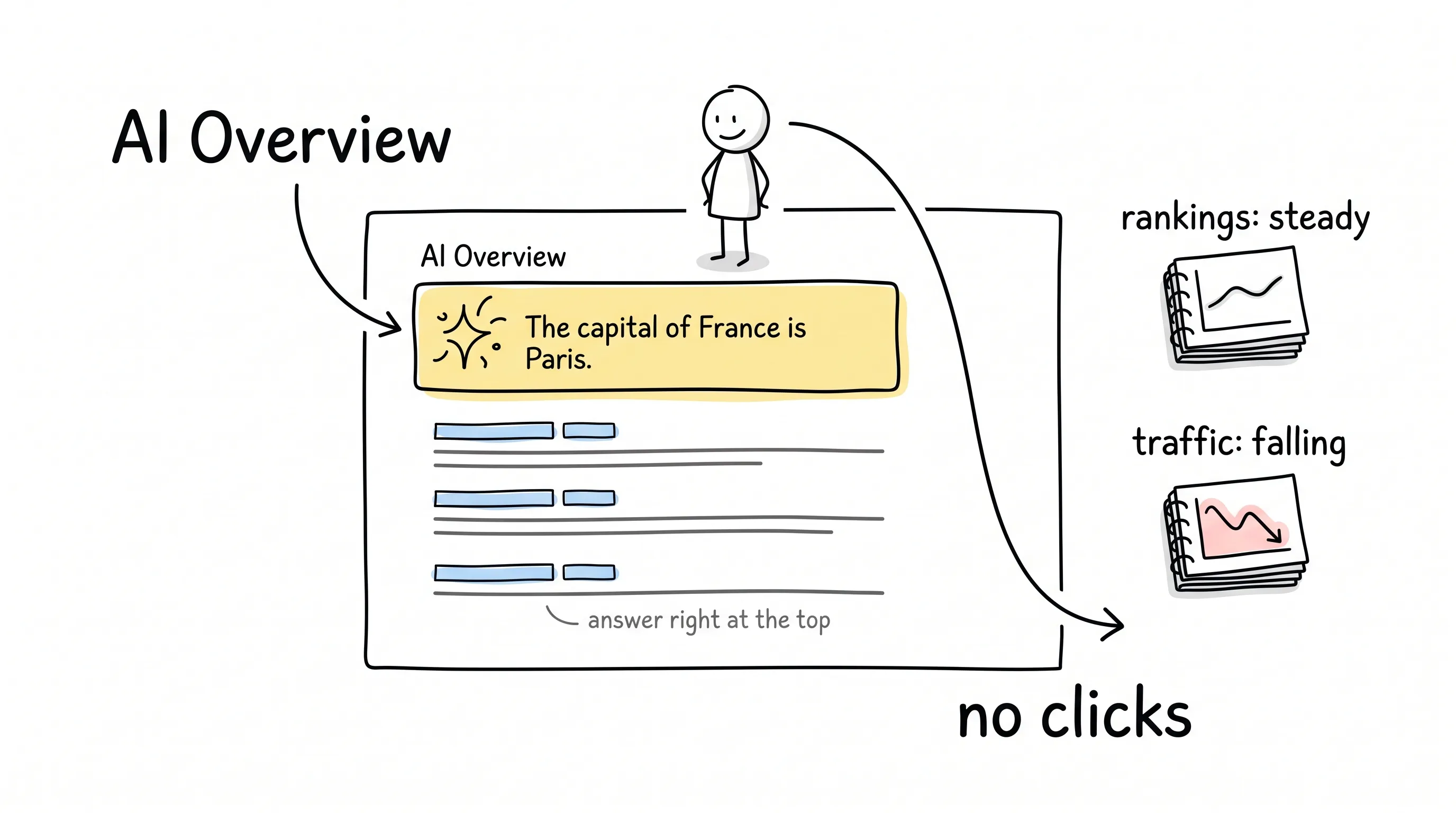
AI Overviews are Google using AI to blend content from sources across the web into a single direct answer, placed right at the top of the search results page.
Searching used to be like walking through a mall. You'd go store by store, compare the goods, and finally pick one place to buy.
Now? There's a greeter standing at the mall entrance. Before you've even stepped inside, he's told you everything you wanted to know. You listen, turn around, and walk away.
Yes—walk away.
Whether you ever walk into a store now depends on one thing: whether the greeter mentioned you. If he did, at least you've "heard of" that store. If he didn't, that store simply doesn't exist in your world.
And across this entire process, the user may never click through to a single website.
That's why so many sites are seeing their rankings hold steady while their traffic quietly drains away. The problem usually isn't your site. It's that users no longer need to click through at all.
Can Rankings Save You?
No.
Traditional rank-tracking tools measure your position in the organic search results. And that position has very little to do with where you stand in AI Overviews.
Think about how absurd this is: a page ranking fifth might get cited by AI Overviews every single day, while the page ranking first never gets mentioned once.
Because the logic of citation and the logic of ranking are two different logics.
Traditional tools go blind in a few more places, too.
For instance: which keywords trigger AI Overviews in the first place? Generally speaking, informational questions like "how do I..." or "why does..." trigger them often; transactional ones like "which one's cheapest" rarely. Which terms trigger and which don't directly determines where you should focus your effort.
Or: what if your competitors keep getting cited while you never are? A signal you can't see might as well not exist.
Good rankings are no longer a safety net. Solid rankings paired with sliding traffic—that awkward combination is, in all likelihood, AI Overviews stirring up trouble behind the scenes.
Tracking Starts with Opening a Ledger
So what do you do?
The short answer first: tracking AI Overviews isn't a matter of glancing at your dashboard every day. It's a matter of keeping a ledger.
Let me use an analogy. You open a store and want to know how business is really doing. What's the first thing you do? Take a full inventory of day one—stock, sales, foot traffic, all of it. That "day-one picture" is your baseline.
From then on, you record an entry every day. After a month of logging, you know what "normal" looks like. The moment something goes off, you spot it instantly. That "shape of normal" is your benchmark.
Applied to AI Overviews, the baseline is a structured snapshot: among your target keywords, which ones triggered an AI Overview? Of those that did, which cited your content, and which cited your competitors?
Without that snapshot, every change that follows is one you can't confidently call an improvement or a decline.
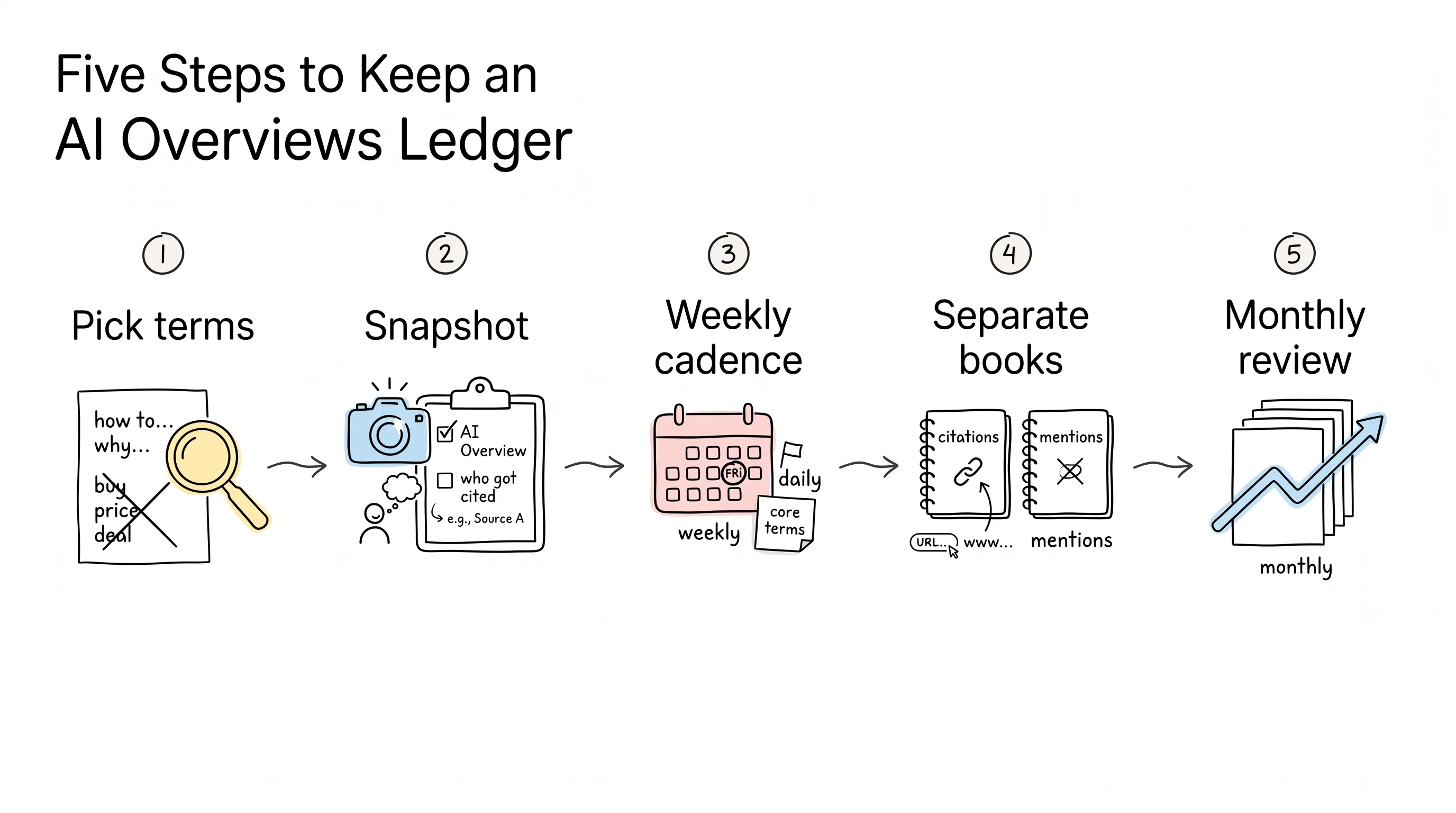
Here's how to actually implement it, broken into five steps.
Step one: pick your terms. List out the informational and how-to keywords relevant to your business, prioritizing the ones you already rank for. Sit the transactional terms out for this round.
Step two: take the snapshot. Run that batch of keywords and record which ones triggered an AI Overview, who got cited, and whether the cited source was a competitor. If you don't know where to start, try HubSpot's AI Search Grader—it's free, and it gives you a first look at what your brand currently looks like in AI search before you start keeping long-term books.
Step three: set the cadence. Once a week is a reasonable starting point for most teams. For your core head terms, or when Google is rolling out an algorithm update, tighten it to daily.
Step four: keep separate books. Citations with a link go in the citations column; mentions of your name without a link go in the mentions column. These two tallies must stay separate. Blend them, and the ledger is mush.
Step five: review monthly. Stack the weekly data up and look at it as a whole: are citations thinning out? Are competitors climbing? Which types of content keep getting cited? Spot the pattern first, then go change your content.
One Data Point Proves Nothing
Before you get too deep into ledger-keeping, I have to flag a trap that's remarkably easy to step in: a single observation tells you nothing.
A keyword that triggers an AI Overview today may not trigger one tomorrow. It's inherently jittery.
So how do you judge? Here are a few numbers.
For the same keyword, run it at least three or four times. Only when the result is stable does it count.
"Triggered an AI Overview" and "I got cited" are two independent events. Record them separately, judge them separately.
Date-stamp every entry. When Google updates its algorithm, the data gets choppy, and you need to be able to tell whether it's the algorithm stirring things up or your content genuinely slipping.
Finally, watch the trend, not the single point. One data point proves nothing; a pattern proves everything. Only sustained change over four weeks or more is worth acting on. A dip that bounces back within a week is fluctuation, not a trend—ignore it.
How Do You "Fish Out" an AI Overview?
If you want to observe this yourself, you first have to learn how to fish it out.
The secret fits in one sentence: write your query as a complex question.
Don't search "best conditioner." Try "How do I choose a conditioner for curly, fine hair?"
Why? Because "why" and "how to" phrasings are far more likely to trigger an AI Overview, while short, vague terms are far less likely.
And here's something many content creators haven't realized: what AI Overviews cite isn't necessarily your website.
Google increasingly loves citing content users create themselves—Reddit threads, YouTube videos, Quora discussions, third-party reviews on G2 and Capterra. Why? Because when a user asks "which one is actually good," the blunt word from someone on the front lines is more credible than the brand's official copy.
Go look at your target questions and see which Reddit threads and which videos are getting cited. Is anyone talking about your brand? Is the tone praise, or a roast? All of it goes in the ledger.
Sometimes you'll see a picture that stings: the page outranking yours gets no citation, while some Redditor's reply gets one. Savage—and true.
So should you go "work" these platforms proactively?
You can participate—but there are red lines. Speak where you genuinely have expertise; disclose who you are when disclosure is called for; and never spin up sock puppets to review-bomb yourself. If fake reviews get pulled into an AI answer, what you lose is more than one platform's reputation.
Five Metrics—and One Number You Can't Fully Count
The ledger is open. Which numbers do you watch? Five.
First, coverage rate: of the keywords you track, what share triggers an AI Overview? This number tells you how big the whole pie is, and you want to watch it rise and fall over time.
Second, mention frequency: how often do your name and your products appear in the body of AI Overviews, links or no links.
Third, citation coverage: what share of your keywords earn you citations with links. If mentions are plentiful but citations are scarce, it means the answer is borrowing your words without crediting your account. When that happens, it's worth digging into the page level.
Fourth, the distribution of cited pages: which few pages are absorbing all the citations? Having everything riding on one or two pages is both a risk and a lead. Go see what those pages did right—then copy your own homework.
Fifth, business impact. This one hurts the most, so I'll say it straight: right now, there is no way to calculate revenue directly from AI Overviews citations.
Google Search Console doesn't break out AI Overviews impressions and clicks as a separate category. GA4 receives no referrer parameter that tags traffic as "from AI Overviews." And mere mentions—exposure without a citation—leave not a trace of a traffic signal.
So how do you read it? You patch it together with proxy metrics: the organic click-through trend of your cited pages, shifts in branded search volume, referral traffic from the sites that mention your citations.
None of these amounts to causal proof. But when several indicators move in the same direction over the same period, they carry real reference value. Bring them to your boss, state the facts plainly, and hedge honestly—that candor actually makes you more credible.
Watch Competitors, Starting from a Fixed Sample
A competitor ranking fifth might be getting cited more than you. To understand where the gap is, you have to compare.
But comparison has a precondition that's remarkably easy to overlook: the sample must be fixed.
Pick 20 to 50 priority keywords that frequently trigger AI Overviews, and lock them in. From then on, every comparison round uses the same terms, the same cadence, the same scraping method. Use one batch today and a different batch next month, and your comparison is self-deception.
Compare what? Five things.
Each competitor's share of presence across that keyword set. How often each gets named in the AI Overview body—look at proportions, not absolute counts. Whether the cited sources are blogs, product pages, or third parties like Reddit. Whether what gets cited is long-form articles, tutorials, comparison pages, or data-backed reports. And the most brutal question of all: on which keywords are you absent while your competitor is present?
That last question is your content gap list. Take it apart one by one: what does the competitor's cited page have that yours doesn't? More complete? More data? Clearer structure?
Run this once a month, and a one-off audit becomes a long-term intelligence system.
What Kind of Content Gets Cited?
If I had to compress it into one sentence, it's this: answering one question thoroughly beats half-answering ten.
To unpack that, content that gets cited usually looks like this.
Clear structure. Tutorials written in numbered, step-by-step form; clean heading hierarchy so Google can lift out a precise passage. A direct, complete answer to the specific question beats sprawling coverage of a broad topic.
Deep and specific. If you have proprietary data, your own research, precise numbers, you're offering something no one else can copy. Repackaged common wisdom gets cited by no one.
Proven depth. Sites that have cultivated a field for years simply show steadier citation rates than sites without that accumulation. This is also the quality direction Google has stated explicitly.
Fresh. In fast-moving areas—AI, marketing tools, regulatory topics—old answers lose citations, so you have to maintain them actively.
Flip it around, and three types of content are basically hopeless: thin content that restates common knowledge; landing pages where conversion intent crowds out informational value; pages that make no sense outside their context.
When you get to the changing-content stage, the SEO tools inside HubSpot Marketing Hub can lend a hand—page structure, internal links, content completeness, it gives concrete suggestions on all of these. It can help your content become "more like something that would be cited," but it doesn't directly measure AI Overviews performance.
Don't Let Tracking Make You Anxious
Some teams tell me: we want to monitor this daily, but the more we watch, the more panicked we get—the data wobbles every day.
The problem is a failure to tier. My advice: three tiers.
Your core head terms—there are only about a dozen—check daily.
The second tier of mid-volume keywords, check weekly.
The third tier of exploratory keywords, along with the entire competitive analysis, check monthly.
And fit your tracking with a smoke alarm. Silent normally; loud only when something crosses the line. For example: your citation coverage on core terms drops more than 10% within a week; a competitor suddenly shows up in three or more of your priority keywords; a core term that's been rock-steady reads zero for two consecutive cycles. Only these three deserve pulling you away from whatever you're doing to go look.
Tune the thresholds loose or tight based on how volatile your own category is.
One more thing small teams most easily miss: someone has to own it. Who logs the data, who watches the alerts, who writes the monthly conclusions—it can be one person, but it must land on a named person. Tracking nobody owns ends as a pile of spreadsheets nobody reads.
Tracking itself produces nothing. What produces results is the loop of "publish, monitor, interpret, iterate": new content goes live and joins the tracking; data gets logged on schedule; patterns get surfaced on a rhythm; patterns become changes, and the changes get tested again.
This loop doesn't guarantee you'll be cited. What it guarantees is that every change you make has data underneath it.
Tracking Is the Starting Point, Not the Conclusion
Where's the hardest part of this whole process? It's restraining yourself—refusing to treat a tracking finding as a conclusion. It's the starting point of a hypothesis.
See a problem, guess at the cause first, then go verify. The usual causes fall into a few buckets for me.
The page discusses the topic but never directly answers the question. Fix: open the page with one direct answer up front, then expand into the details.
The competitor's cited pages have data and you don't. Fix: add your own data, research, and specific numbers.
The content is relevant to the question but simply doesn't appear. Fix: name the key entities explicitly and spell out how they relate to the topic.
The cited page uses numbered lists or a Q&A format and you don't. Fix: restructure your page to match the format getting cited for that target query.
And one bucket unrelated to content quality: the page has no links, no discussion—signals too weak. Fix: build the internal links, earn the external references, get promotion on the schedule.
Let me be blunt up front: all of these only raise the probability of being cited. Not one is a guarantee. What goes into AI Overviews is Google's call, and one algorithm update can reshuffle the whole board. When you set expectations with your team, say "improve eligibility"—never say "lock in a position."
Someone once asked: is there a way to "submit" a page into AI Overviews?
No. There is no submission channel of any kind.
What you can do is polish your content into a stronger candidate: answer the question thoroughly, make the structure clean, build up topical authority, keep things updated, fix what needs fixing technically. Then wait for people to link to it and talk about it. Every one of these efforts pays off more than once: organic search benefits, readers benefit, and the odds of a citation go up.
Doing this is investing in your content. Spending all day scheming to please the algorithm is performing. Performing runs on luck; investing runs on compounding.
On Tools, Let Me Be Honest
No single tool on the market can handle AI Overviews tracking end to end.
Here's roughly the lay of the land. Rank trackers like Semrush, SE Ranking, and Ahrefs have added AI Overviews detection—broad keyword coverage, but shallow citation detail, and mention-level tracking is essentially beyond them. Enterprise platforms like BrightEdge and Conductor go finer on data, but they're expensive and heavy to deploy. SERP-audit-leaning tools like Moz and Authoritas suit low-frequency deep dives, not daily watching. And if you truly have no tool, manually scraping search results isn't impossible—it's the most complete information, just labor-hungry and unstable.
So where does HubSpot fit? Let me be honest about it.
Website Grader is a one-time technical checkup—crawl-level issues, not a tracking tool. AI Search Grader is a free starting-point diagnosis, good for taking your first snapshot. The SEO tools in Marketing Hub cover the "fix your content" layer. Smart CRM can't see AI Overviews itself, but the shifts in branded search and lead sources that citations cause will eventually surface in these downstream reports.
In one sentence: HubSpot covers baseline diagnostics, content improvement, and downstream attribution. For truly scaled, daily citation tracking, you still need a dedicated tracking tool alongside it.
Choosing tools is like staffing a team: don't expect one all-rounder. A complementary combination is the right path.
Finally
Back to that friend from the beginning.
He later followed this method and built a baseline for the two dozen-plus keywords he cared about most. Three weeks in, he said something rather interesting to me: "I finally know where my traffic went."
The traffic wasn't lost. The way users get answers changed. Whoever understands this first adjusts first.
Tracking is the dashboard for that adjustment. But a dashboard doesn't drive the car for you—what decides how far you go is still the content itself.
Here's wishing your brand a permanent place in the greeter's recommendations.
Continue reading
Related articles

It's 2026: Stop "Buying" AI Tools for Your Marketing Team — Start "Hiring" AI Agents
This learn article explains how AI agents differ from standalone AI tools in marketing, outlines three agent categories — build-your-own platforms, CRM-native agents, and vertical tools — and covers use cases across SEO, social media, advertising, and reporting, plus criteria for choosing one.

What Is GEO? How Your Brand Gets "Mentioned" in the Age of AI Search
An explainer on GEO (Generative Engine Optimization) for e-commerce and DTC brands: how it differs from SEO and AEO, why AI answers shape brand visibility, and eight practices covering question-focused content, consistent brand messaging, structured pages, external evidence, comparisons, and AI mention tracking.

AI Is Already Making Decisions for Your Customers. Are You on the List?
A learn article explains GEO (Generative Engine Optimization): why AI-generated answers now shape which brands customers see, and how SEO fundamentals, entity clarity, citable evidence, and monthly measurement affect visibility in AI answers.