
What Is Generative AI Marketing? Let Me Explain It Over Dinner
An explainer article on generative AI marketing: what it is, its main benefits (personalization, efficiency, real-time adjustment), use cases from content generation to conversion, and pitfalls like accountability, security, accuracy, and data quality, with a McKinsey estimate and a vendor example cited.
A while back, I had dinner with a friend who runs a cross-border e-commerce business.
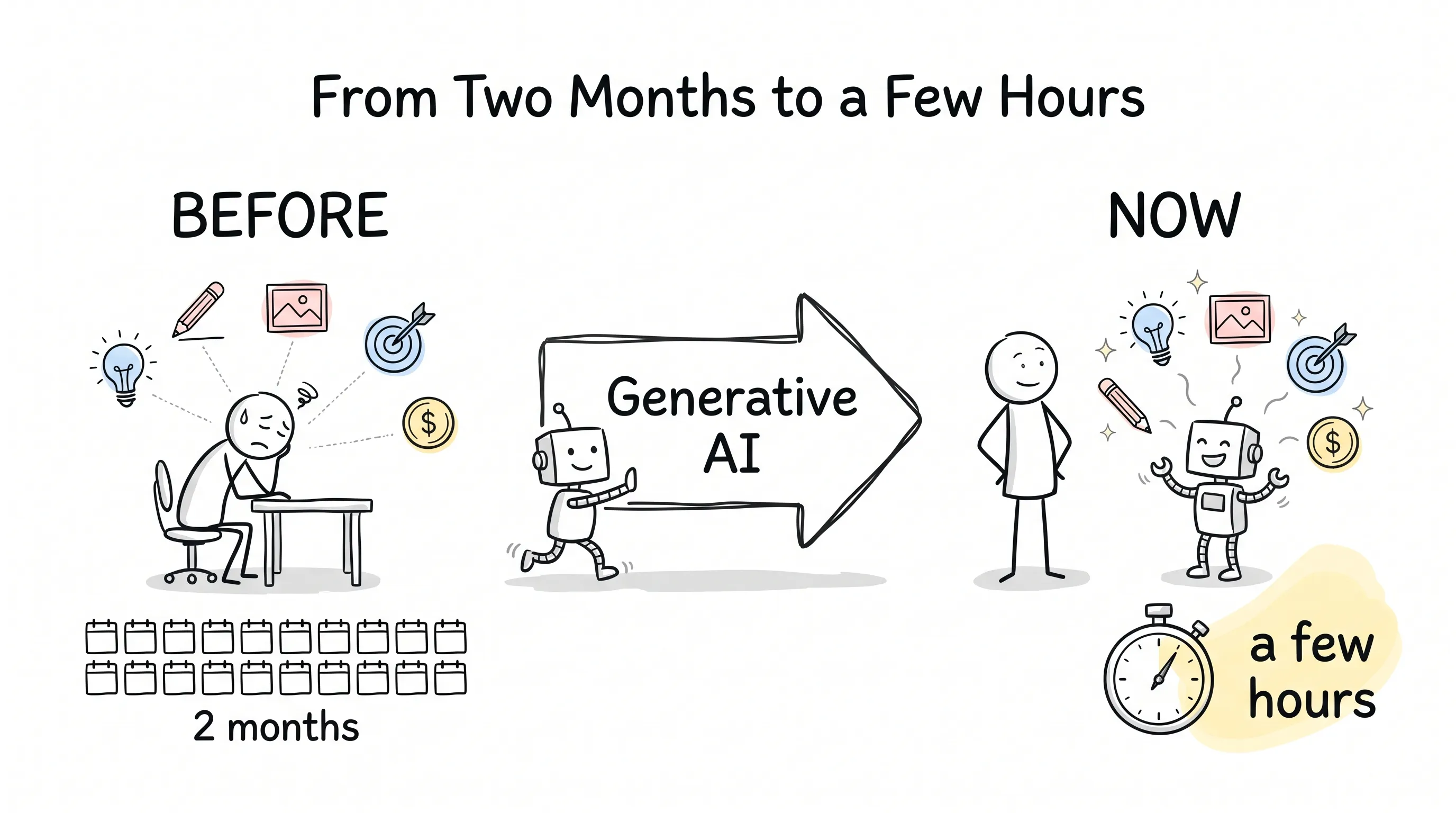
He had barely sat down before he sighed. I asked what was wrong, and he said: you know how much effort a single marketing campaign used to take us? Brainstorming ideas, writing copy, making visuals, picking audiences, tweaking the ad spend — one full cycle, and two months were gone. By the time we launched, the trend had already gone cold.
I said, so what about now?
He pulled out his phone and showed me his dashboard. The same set of tasks now takes days — sometimes just a few hours — to run a full cycle.
How? His answer was two words: generative AI.
That dinner genuinely shook me. On the way home, I turned it over from start to finish, and the more I thought about it, the more I felt this had gone beyond "swapping in a new tool." The way entire marketing departments work is going to have to change. So today, let me explain it in plain language you can actually understand.
First, Let's Do the Math
McKinsey ran an estimate: generative AI's boost to productivity could deliver $2.6 trillion to $4.4 trillion in value to the global economy every year. They analyzed 63 use cases before arriving at that number.
What does $2.6 trillion mean? Of the roughly two hundred economies in the world, the ones whose annual GDP exceeds that figure — you could count them on one hand. No more than ten.
And note: this isn't a futures bet. It's happening right now. And marketing is exactly where the benefits land hardest.
So What Is Generative AI Marketing?
What is generative AI marketing, exactly?
Put simply: you let AI handle the "repetitive, fiddly, template-driven" parts of marketing for you. From audience insight, to writing content and mapping journeys, to back-and-forth conversations with users — it can pitch in on all of it.
Marketing used to be an artisan workshop. Every image, every line of copy, had to be polished by the master craftsman's own hands. Now? It's as if the master took on a tireless apprentice. The apprentice does all the grunt work; the master just keeps watch over direction and taste.
A campaign that used to take months to craft can now have a new version ready in minutes.
What you save is time. But what's even more valuable is the room to experiment: where you used to get three tries a quarter, you now get thirty a day.
Where Is It Actually Strong?
The benefits are many, but honestly, three of them are worth the most.
The first is personalization. AI can take the records in your customer data platform (CDP) and serve every individual different content, different offers. Before, all you could do was shout at "a crowd of people." Now you can speak to "one person." And this plays out across the whole customer lifecycle, not in any single email.
The second is efficiency. Writing copy, producing assets, segmenting audiences — hand the repetitive labor to AI, and free up your people for the work that actually takes a brain: setting strategy, making judgment calls.
The third is real-time adjustment. A campaign used to launch like dropping a letter in a mailbox — once it was gone, all you could do was wait. Now AI watches the data, and when the wind shifts, it shifts with it. A trend breaks and it can chase it; a channel drifts off course and it can correct.
Put those three together, and that's what my friend was saying over dinner: two months, turned into a few hours.
What Can It Actually Do?
You might ask: I get the theory — but in day-to-day work, what jobs can it actually take off my hands?
I've lined up the approaches my friends are using, in the order a product travels from "being seen" to "being bought."
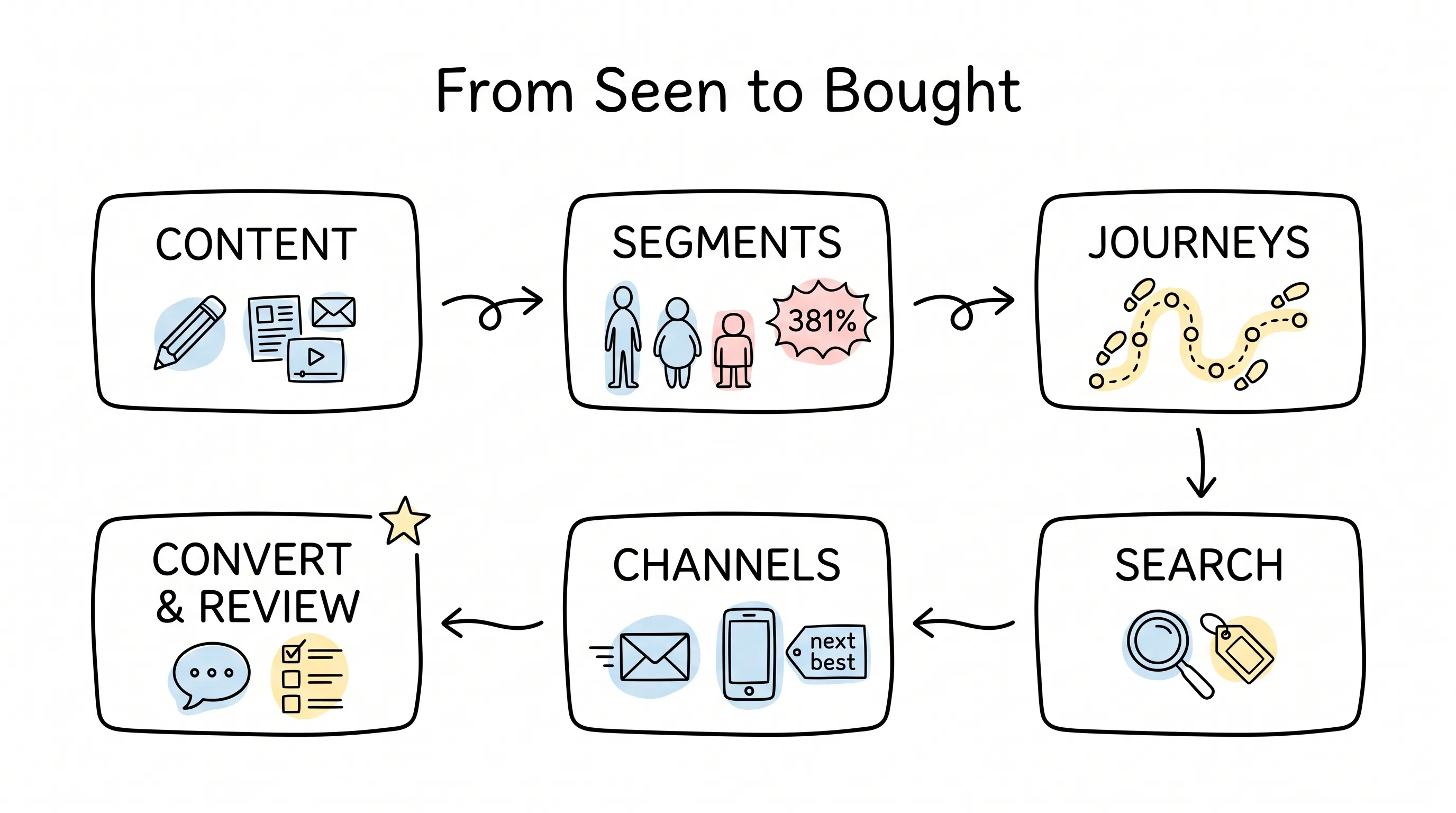
Before a product gets seen, content has to exist first. AI can generate emails, ad copy, social media posts, and product descriptions in batches from prompts — even turn a passage of text straight into video. And it writes with reference to your customer data, so it's not writing generically; it's writing straight at your target audience.
Content's ready — next, who should see it. AI automatically groups customers into segments by traits, behaviors, and preferences, and you use those segments for precise targeting. Insider One shared one of their own case studies: running Facebook ads with their predictive segmentation, the same budget produced a 381% lift in conversion rate.
381%.
On the same budget, that's the difference between someone spending a dollar and you getting nearly five dollars' worth of results.
Then come journeys. Based on each customer's behavior, AI can automatically string touchpoints, actions, and trigger timing into a personalized path. You can even have it "complete" the entire journey for you and just do the review. And going global? No problem — localization and multilingual adaptation, it can handle those in the same pass.
Once a product's been seen, comes the search. AI-powered on-site search can read a user's intent and browsing habits and put the most relevant items right in front of them. Insider One calls their on-site search product EUREKA — that's exactly what it does.
After search comes the question of where to reach people. Email, SMS, app push, WhatsApp… so many channels — which one to take? AI analyzes what stage each customer is at and which channels they habitually use, then recommends the "next best channel." Omnichannel marketing sounds wonderful; the hard part has always been picking the channel. That step now has an answer.
Last, conversation and review. When users arrive, chatbots, virtual assistants, and automated replies on WhatsApp can catch them and convert them in real time. And once a campaign wraps, if the numbers disappoint, AI digs into the performance data to find out why and offers suggestions — so your next round lands stronger.
You see — all along the way, from content to conversion, AI is there for nearly the whole ride.
But There's Always a Flip Side
Is it really that smooth? Not quite.
I have to warn you about a few pitfalls.
Accountability. AI is getting more and more autonomous — it generates the content, it makes the decisions — so when something goes wrong, whose fault is it? You have to think this through in advance. You can't let go of the reins completely.
Security. AI systems are connected to your customer data. The risk of your data leaking — or being manipulated — is real. The security measures that need to be there — not one of them is optional.
Accuracy. Models will deliver nonsense with a perfectly straight face. Test before you trust — never fire an AI's first-draft output straight at your users.
Data quality. Every trick AI knows is built on data. If the data is crooked, the faster it runs, the farther off course it goes. Garbage in, garbage out — in the AI era, that line hits even harder.
In one sentence: AI is the apprentice. The master is still you. The responsibility for sign-off is one you can't shake off.
So Which AI Should You Use?
By this point, you might be asking: there's a pile of tools on the market — how do I pick?
Let me use Insider One's approach as an example. Their AI is called Insider One AI — the patent is still pending — and it blends large language models with machine learning (prediction, conversation, generation, and the like) to cover every link in building the customer journey.
Their philosophy: don't let marketers burn their time on low-value repetitive execution. Put experience creation on "autopilot," step back, and spend your energy on the brand and on making customers happy. The goals for results are explicit too: purchase rate, conversion rate, average order value, product discovery — all of it has to line up with business objectives.
Tools vary wildly, but the standard for judging them comes down to one question: does it genuinely do the work for you, or does it just hand you one more toy you now have to babysit?
Finally, Back to My Friend
Dinner was nearly over when I asked him: so what keeps you up now?
He thought for a moment and said: he was worried the data his AI runs on wasn't good enough — and that he wasn't learning fast enough.
See — tool problems are easy to solve. People problems are the hard ones.
The craft of marketing has never changed at its core: understand people, move people. What's changed is only the speed of getting the work done. Whoever gets comfortable with AI first gets to pull a clear step ahead in the speed of turning "an idea" into "done."
And the ones left behind — they usually didn't lose to a competitor. They lost to time.
Here's wishing you the day AI starts pulling the night shift for you.
Continue reading
Related articles

It's 2026: Stop "Buying" AI Tools for Your Marketing Team — Start "Hiring" AI Agents
This learn article explains how AI agents differ from standalone AI tools in marketing, outlines three agent categories — build-your-own platforms, CRM-native agents, and vertical tools — and covers use cases across SEO, social media, advertising, and reporting, plus criteria for choosing one.

Did the Money You Spent on AI Marketing Ever Come Back?
A guide to measuring AI marketing ROI across three layers: ad reports, sales pipeline, and the financial ledger. Covers metrics such as ROAS and CPA, eight dashboard metrics, industry benchmarks, and common measurement mistakes.

How to Pick a Creative Automation Platform: First, Figure Out What These Eleven Actually Do
A learn article sorts eleven creative automation platforms — including Bannerflow, Celtra, Smartly.io, and Storyteq — into four functional groups and proposes five evaluation questions covering publishing reach, automation depth, ease of adoption, team fit, and verifiable evidence.