
AI Marketing Daily · 2026-10-13
Daily AI marketing digest covering Meta's disclosed ad-AI stack and new ad features, Perplexity's exit from ads, a five-step GEO checklist, zero-click tactics, agentic AI in CRM, B2B tool roundups, influencer case data, and GenAI governance guidance.
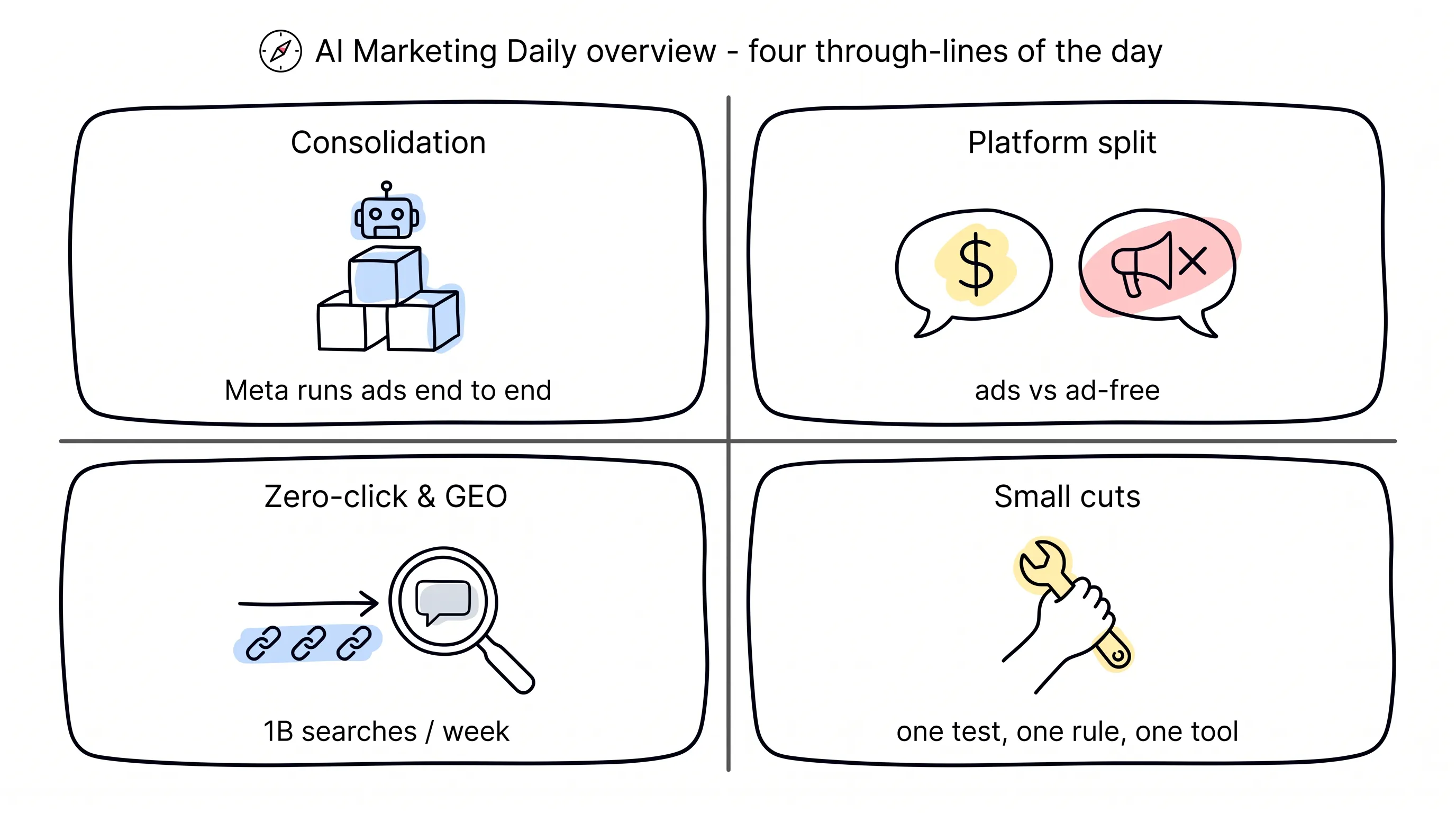
Today's through-line is consolidation. Meta is laying its cards on the table — showing the technical foundation of its ad machine to the world, from creative generation and retrieval infrastructure all the way to the agents that close deals for brands. Automation now runs the entire chain, end to end. Meanwhile, the platform ecosystem is splitting apart: Perplexity has formally walked away from ads, and an ad-free camp is starting to take shape. On the traffic side, ChatGPT's one billion searches per week are making zero-click a reality, and GEO and AI recommendation lists have become the new contested ground. Eleven items today — not many, but every one of them is something you can act on Monday morning.
🎯 Today's Top Story
Meta lays its ad-AI cards on the table, and the deal-closing agents are already rolling
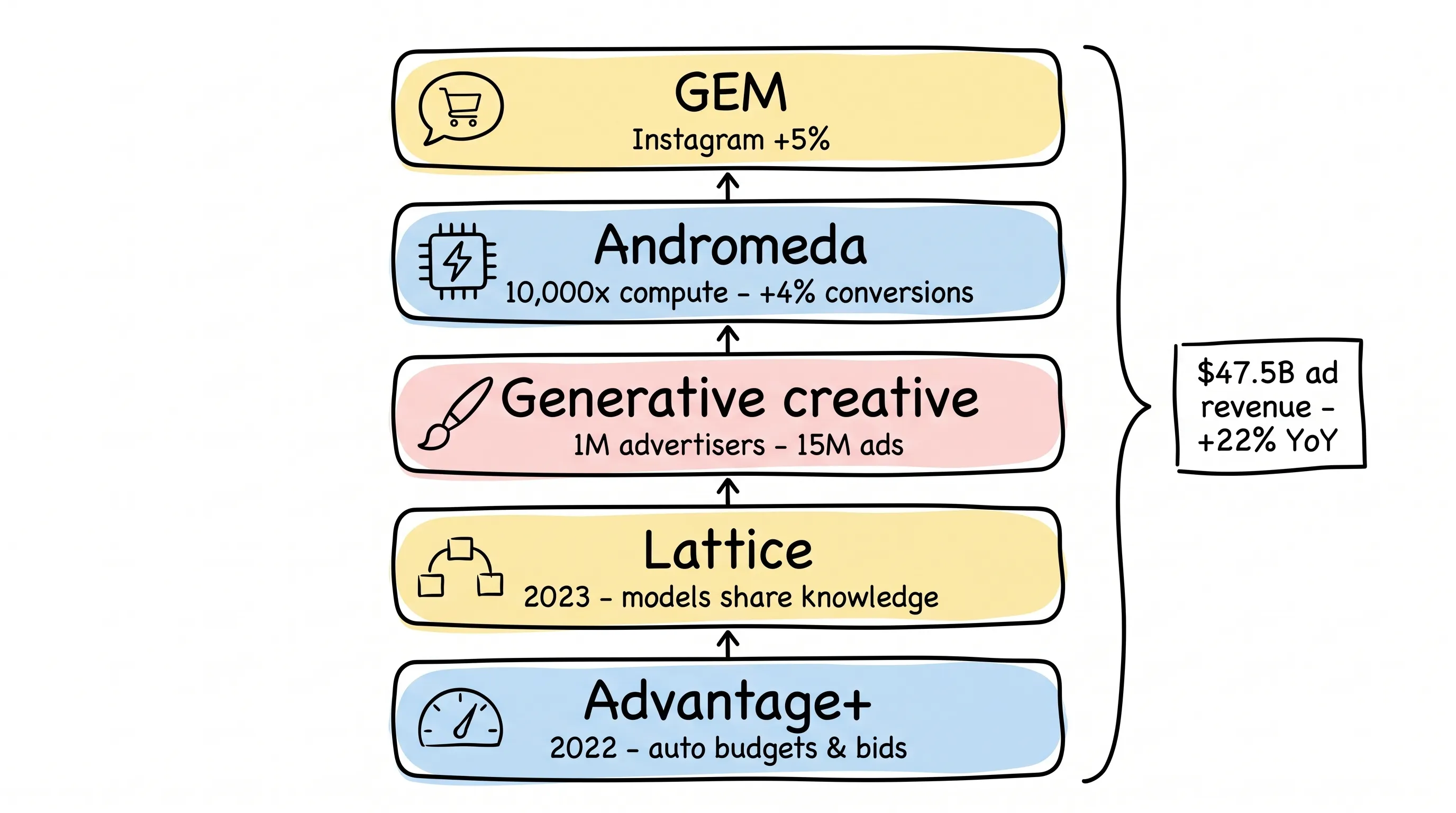
Fast Company ran a long-form interview with Matt Steiner, Meta's VP of monetization infrastructure, along with several other product executives — the first time the five technical breakthroughs behind Meta's ad system have been explained layer by layer. The first layer is Advantage+, launched in 2022, where machine learning watches around the clock to see which creative sets and which audiences are performing, then automatically shifts budgets and adjusts bids. Steiner's explanation is blunt: machine learning models don't get tired. This layer saved Meta's life after Apple tightened iPhone tracking — transfer learning was used to reconnect Meta's own app data with advertisers' conversion data.
The second layer is Lattice, released in 2023, which uses transfer learning to let models that used to work in silos share knowledge with each other — the model predicting clicks helps the model predicting purchases get more accurate. The third is the generative creative tooling, launched in May 2024; within one month, more than one million advertisers had used it to generate 15 million ads. The explosion of creative crushed the retrieval system, which is where the fourth layer comes in: Andromeda, a compute upgrade co-designed with Meta's in-house MTIA chips and NVIDIA's Grace Hopper superchips. Compute was scaled up to 10,000 times the original, and conversion rates on Facebook mobile feed and Reels rose 4% as a result. The fifth layer is GEM, released in April, which uses large-model-style sequence learning to predict your entire purchase journey — one person may be walking several purchase paths at once. Instagram conversions rose about 5%, and Facebook feed and Reels improved 3% in Q2. On the Q2 earnings report, all of this adds up to $47.5 billion in ad revenue, up 22% year over year.
The weight of this story is that Meta executives have put the tech stack and the performance numbers on public display — something they rarely do. Advertisers used to see Advantage+ as just a black-box button: put money in, wait for results. Now you can see exactly which problem each layer is solving. The platform has 3.43 billion monthly active users, and where this machine goes is essentially where the industry goes; understanding it is more useful than reading any industry forecast.
The impact for marketers is concrete — a string of new features is landing fast. Virtual try-on is in testing: users upload one photo and see how the clothes in the ad look on them. AI-generated CTA stickers are replacing the cookie-cutter Shop Now button; Helen Ma, Meta's VP of product management, puts the lift at a 50% to 200% boost in CTR, on the grounds that the stickers are fun and feel like products. AI soundtrack generation creates custom music matched to the ad content, and AI voiceover produces multilingual versions. Persona-based image generation works like an atmosphere switch: same pair of headphones, but a style shot for the fashion crowd, a sound-quality shot for audiophiles, a comfort shot for frequent travelers — all from a single product base image, fully automated. A new Creator Discovery API on Facebook lets brands search creators by keyword and view audience profiles and average engagement rates. And one step further: starting December 16, conversations with Meta AI — an assistant with more than one billion monthly users — will feed into ad targeting.
The bigger move is Business AI. Its lead, Clara Shih, positions it as a sales agent: it picks up from feed ads, moves into DMs and onto the brand's website, and manages everything through pre- and post-sales. The selling point is that it works out of the box: Shih cites the MIT study finding that 95% of enterprise GenAI pilots produced no measurable business impact, pointing out that most companies don't have a machine learning team to assemble these parts themselves. And the ads and posts a brand has accumulated on Meta's platform over the years are ready-made training material — no need to hire consultants and spend millions training a bot from scratch; the model reads your business directly from your historical content.
Three things you can do this week. First, put AI CTA stickers into your next test round — a 50%-and-up CTR lift is worth validating with a small budget now rather than waiting for full rollout. Second, redraw the division of labor on your creative team: humans supply the ideas and judge why a video moves people; the machine takes over variant enumeration and every other chore nobody loves — that's exactly how Steiner framed the human role. Third, smaller brands should seriously evaluate whether Business AI can replace a line item for consultant-built customer-service bots — but think through the data boundary first: chat histories will enter targeting, so compliance review must happen before launch. One counterintuitive note worth recording: Krassimir Karamfilov, Meta's VP of ad products, was candid that many advertisers use the products suboptimally — plenty of people are still setting parameters manually and running tests by hand. The platform has aligned its systems to how advertisers measure value; it's the usage habits that haven't caught up.
The executives repeatedly stressed that the tools are built for people to use, and that agencies and creative teams are still in the equation for now. But the endgame Shih relayed is written without apology: brands come to Meta, upload their product catalogs and business goals, and everything after that runs on full autopilot with the Advantage+ family plus a business agent. The window on hands-on campaign-ops jobs is closing; creative judgment and channel strategy haven't been taken away yet. Move your team's skills toward those two while they still carry value — that's the timetable this story hands to everyone.
🔗 Further reading: Read the full article
🏷 LLM Developments
Perplexity walks away from ads for good, and AI platforms split into a monetization camp and an ad-free camp
JumpFly's monthly roundup strings five February events into a single storyline. On February 18, Perplexity confirmed it was exiting ads entirely, citing user trust. It had been among the first platforms to experiment with AI ads in 2024, began pulling back late last year, and is now openly done for good. The timing is exquisite: just days earlier, OpenAI had launched ads on ChatGPT's free tier and Go tier, and a little over a week before that, Anthropic had run a Super Bowl spot mocking chatbots that wedge ads into your answers. The AI platform world has thus split into two camps — one monetizes through ads, the other bets users will pay for quiet. Perplexity's official line: a search tool stands on user trust, and wedging ads in alongside the results makes both hard to keep. Several other moves are worth noting. Google disclosed that in Q4 2025 advertisers used Gemini to generate nearly 70 million creative assets, 3x year over year; Veo 3 has moved into Ads Asset Studio; and apparel brand Rhone pushed image-to-video into live campaigns. Automation is also reshaping the agency job model: in Triton Digital's January survey of 100 ad executives, agency-side respondents reported that AI agents are starting to take over the strategy-to-execution pipeline end to end. ByteDance released Seedance 2.0 on February 10 — text, image, audio, and video as inputs, 60fps output, top scores on camera control in independent evaluations, with the official claim that it compresses a creative team's full day into five minutes. The NYT reported that brands have started actively managing their image inside chatbots: Kantar data shows 24% of AI users already let assistants make purchase decisions, and Digital Marketing Institute finds 44% of people who have used AI search now treat it as their primary gateway.
The NYT item deserves its own paragraph. Stacy Simpson, CMO of Athenahealth, discovered that her company's profile inside chatbots was citing outdated information from obscure sources — and the bot never recommended Athenahealth in relevant queries at all. A new product category is thus taking shape: AI visibility services that help brands monitor, audit, and influence how large models describe you. The essentials are unglamorous: updated content, reviewed profiles, third-party coverage, and structured data determine how AI cites you.
💬 Time to shake up your channel review. The ad-free camp will only grow — don't park your budget on a single gateway. One thing you can do today: type your brand name into ChatGPT, Gemini, and Perplexity and ask about it once each. However the AI describes you is your reputation; write down the gap between that and reality, and the to-do list writes itself. Also keep a close eye on the ad formats in ChatGPT's free tier — it's a new placement frontier, and small budgets should be used to map out its auction logic first. The roundup covers February, but every channel call in it still holds today.
🔗 Further reading: Read the full article
🏷 Content & Traffic
A GEO checklist: first let AI crawl you, then get AI to cite you
AdEdge lays out a five-step practical roadmap for GEO (Generative Engine Optimization), built on one premise: the ranking logic has changed. AI-generated answers need to cite you, and simply holding a first-page slot has depreciated. Move one, format content the way AI reads it: open with a 50–70-word TL;DR answer box that answers the question directly, give the answer before the details, break the body into lists, and add FAQPage and HowTo structured data — in effect, turning the page into an answer warehouse AI can disassemble easily; the industry calls this an Answer Hub. Move two, accumulate trust: write author bios that make credentials clear, attach a data source to every claim, keep the brand name, address, and social links consistent across every platform, so AI recognizes you as one and the same reliable entity. Move three, rewrite keywords as conversational long-tail questions, and build topical authority with content clusters and pillar pages — far easier to cite than ten scattered pages. Move four, a technical self-check: confirm via robots.txt that you aren't blocking GPTBot or Google-Extended, keep pages fast and HTML clean, and don't bury key content inside JavaScript. Move five, change your KPI: use Generative Appearance Score to track how often your brand gets cited in AI answers, and reverse-engineer the pages being cited now — then build a more complete version to displace them. The author adds one judgment: this shift is faster and deeper than the one more than 25 years ago, when digital search displaced the Yellow Pages. Wait for AI answers to fully settle in users' minds before acting, and the positions will be gone.
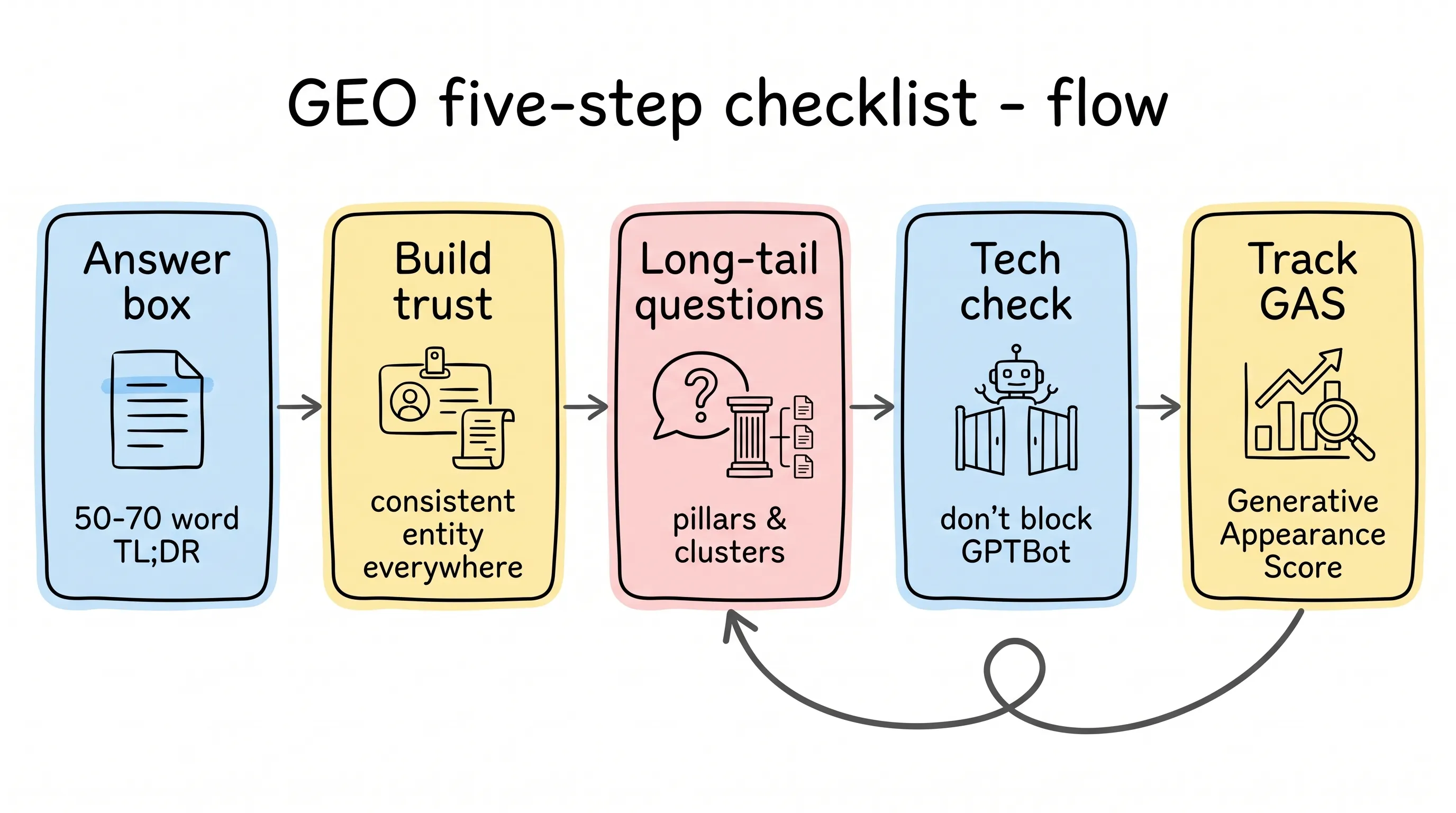
💬 You can run this checklist today. Step one takes ten minutes: open your robots.txt and confirm the AI crawlers aren't blocked — plenty of teams blocked them without knowing, and are running naked through the AI era for it. Step two: search the five questions you want to be cited for, see who's being cited now, and build a more complete page modeled on that structure. The structure, depth, and format of the currently cited pages are the grading rubric itself. Citations are the new ranking, and the earlier you board, the cheaper the ticket.
🔗 Further reading: Read the full article
ChatGPT runs one billion searches a week, and zero-click tactics start collecting rent
A 2026 content-marketing video from YouTube creator Wes McDowell makes one call: search, recommendation, and conversion all happen inside platforms now, and clicks are getting scarcer. He calls it zero-click marketing. The evidence: ChatGPT now processes more than one billion searches per week — ask which accountant suits an online-course business and the AI names three firms right in the conversation, no link click required. On the tactical level, he offers a few plays worth stealing. Co-marketing to borrow audiences: use YouTube's official collab publishing feature to co-release content with complementary channels of 10k–50k subscribers in your niche, borrowing the trust of their audience directly; he suggests a list of 10 to 20 names and one collab a month. AI tool-shaped lead generation: nobody wants another PDF checklist. Write down the three problems your clients struggle with most, have ChatGPT or Claude produce a small immediately-usable tool in half an hour — a psychotherapist builds a breathing-guide app, a sleep coach builds a feeding calculator. The critical move is not to mention it once at the end of a video but to demo it live inside the content; his numbers have email conversion jumping from 1% to 10% and even 15%, with the tool itself becoming the content — every demo is organic funnel. The video also teases one controversial tactic that half the industry calls garbage, saved for those willing to watch to the end.
💬 Small service teams should steal the tool play first. Write down your clients' three biggest headaches, pick one, and have AI build a small tool that works without a login. Demo it live in your video, with an email capture form behind it. Cost: one evening. Validation window: one week. That beats ten more blog posts. Queue up the collab play alongside it — a list of 10 to 20 names and one per month is plenty; scale to your capacity. One footnote: Goldman Sachs projects the YouTube creator economy will double by 2027 — the window on this lane is still open.
🔗 Further reading: Read the full article
🏷 Marketing Tools
Agentic AI enters CRM, and the first use case worth stealing is suppression rules
Tenon lays out how agentic AI is reshaping CRM personalization. The dividing line between rule-based automation and autonomous agents: agents can handle scenarios you never pre-mapped, adjusting channel, content, and timing on their own from real-time signals. The article argues the ceiling on enterprise personalization isn't the model — it's the data: too many systems run on copies that survived the last sync, copies drift, and only native records carry real value. The most tangible example is service-context-driven marketing: when an account has an open ticket, ABM (account-based marketing) and promotional touches pause automatically; when the ticket closes, a recovery or upsell flow triggers. A customer waiting for their machine to be repaired should not be getting a promo email — an agent can intercept that. Another line item worth counting is the hidden cost of vendor sprawl: a single suppression-rule update currently takes days to move between MAP (marketing automation platform), CRM, compliance, and BI, and five-plus systems running in parallel is the norm. The rollout path is conservative and concrete: pick one high-friction process — say, post-event follow-up — define the suppression rules and response-rate metrics first, and let the agent run inside guardrails. The data-side claim is worth hearing too: unified first-party operational data is the precondition for agentic personalization; service tickets and approval flows, those operational traces, need to live alongside marketing data — data scattered across systems can't feed a decent agent. Evaluation metrics follow the pilot: beyond response rate, watch one more — how long each lead takes to handle once the agent replaces the manual work. The article cites McKinsey, IDC, and Deloitte as backing, but its position is stated plainly: Tenon is a ServiceNow-native vendor; the methodology transfers, the product conclusions deserve a discount.
💬 Don't rush to deploy agents — pilot with suppression rules first. This week, have ops inventory every hard-coded logic point in your nurture flows, pick one that should react to post-sales status, and wire up a suppression rule. What you save is the repair hours and complaints after missed or wrong sends, and you'll see the change within two weeks. B2B teams can lift this directly, and if it underperforms you roll back — the downside is one rule.
🔗 Further reading: Read the full article
A 12-tool B2B AI marketing roundup where the publisher ranks itself first
ZoomInfo Pipeline released its 2026 B2B AI marketing tool evaluation, covering 12 tools and framed on five capability categories: data-driven targeting, workflow automation, predictive analytics, content optimization, and campaign intelligence. The list includes 6sense, Demandbase and its GTM agent product Agentbase, HubSpot, Salesforce Marketing Cloud's Einstein, Marketo, Gong, Clay, Jasper, Semrush, Surfer, and Grammarly — with ZoomInfo itself ranked first. Two signals worth recording. One: tool form is shifting from feature-stacking to agentic execution — Agentbase and ZoomInfo's GTM Workspace both let agents take on whole blocks of work like account research and outreach drafting. Two: Copilot-style features drive a customer-reported lift of about 25% in pipeline. The included case study is Brandlive: 18,000-plus leads and $1.05 million in revenue in six months. The article hammers one precondition repeatedly: personalization must plug into a clean data stack, or predictive accuracy fails entirely. Each tool's review notes its fit and main strength: ABM points to Demandbase and 6sense, revenue intelligence to Gong and ZoomInfo, content optimization to Semrush, Surfer, and Grammarly — you can lift this taxonomy directly as your selection framework.
💬 Treat it as a selection index, not a verdict. The publisher ranked itself first, and the ABM claims for 6sense and Demandbase deserve third-party evidence before you commit. The real takeaway is that one precondition: on a dirty data stack, every tool's predictions spin their wheels. Fix the data first, then talk tooling — reverse the order and you're burning money.
🔗 Further reading: Read the full article
Budget share falls from 9.1% to 7.7%, and a GenAI use-case scorecard becomes a must-have
RevvGrowth's roundup organizes GenAI marketing use cases into ten categories — from content production, personalization, and ad creative to dynamic pricing, email optimization, and video/audio generation — each with cases and tools attached. The most solid numbers: Michaels used GenAI personalization to cover 95% of email campaigns, with CTR up 25%; a GenAI ad collaboration between Mars and Amazon delivered a 4.3% lift in sales; Grammarly's AI lead scoring lifted paid conversion by 80%. The pressure-side data is just as complete: Gartner puts marketing budgets as a share of company revenue down from 9.1% in 2023 to 7.7% in 2024, while McKinsey finds 66% of GenAI-adopting marketing and sales organizations reported revenue growth — the evidence chain linking budget compression to forced efficiency is complete. The article ships a 1-to-5 scorecard for use cases, scored on business impact, implementation difficulty, brand risk, time to results, and cross-department coordination, plus post-rollout tracking of time saved per asset, personalized-conversion lift, and falling acquisition costs. Its governance advice: build a prompt library with a pre-approved dataset to guard against hallucination, and run the hybrid mode — AI draft plus human refinement — which works best. The 2026 trends section bets on three things: multimodal marketing, brand-specific LLMs, and creative Ops teams; the market-size citation is Grand View Research's 25%-plus CAGR to $82.2 billion by 2030.
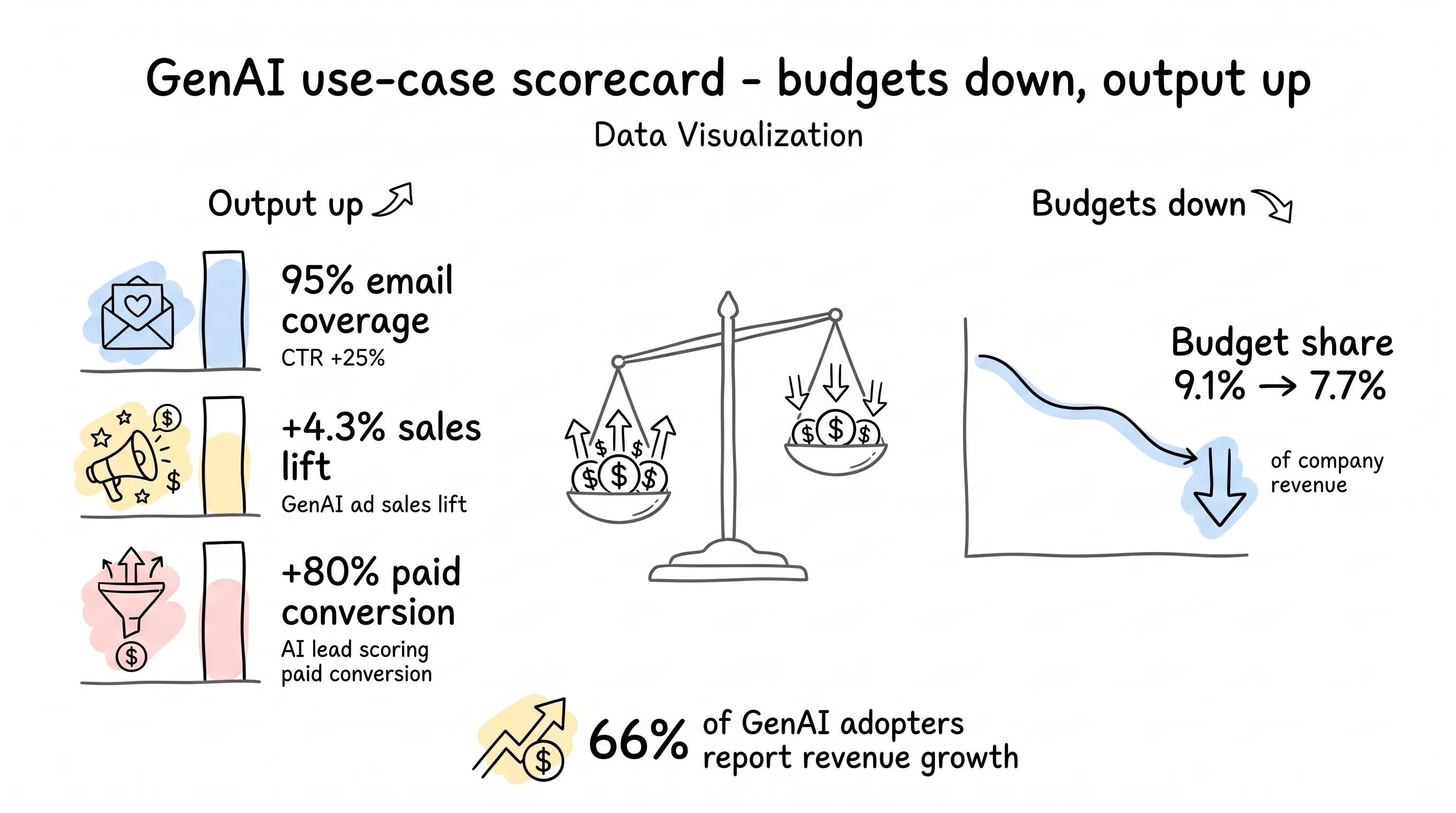
💬 Budgets are shrinking while output targets rise — the answer lives in this scorecard. This week, have your team score every AI use case they're running, cut anything with a time-to-results longer than one quarter, and concentrate effort on the two proven high-return points: email personalization and lead scoring. The Michaels play has the lowest barrier to entry — do that one first; talk about the rest after it works.
🔗 Further reading: Read the full article
🏷 Case Studies
A directory of 24 companies, and 88% of marketers are already using AI
Built In updated its directory of companies in AI marketing and advertising, covering 24 with use cases spanning from chat-based response to agent-driven execution. It opens with SurveyMonkey's statistic: 88% of marketers already use AI tools in their daily work. Several profiles in the directory deserve a closer look: EliseAI uses AI agents to handle tenant and medical-industry inquiries; Affectiva applies emotion AI to diagnose creative before spend; GumGum's Verity uses computer vision to read page context before deciding where an ad lands; Agentio turns creator advertising into automated buying; and Movable Ink's Da Vinci represents another layer still — autonomously continuing to optimize send timing and content combinations even after the email goes out. The list also includes Jasper's 100-plus marketing-specific agents and Google's responsive search ads as infrastructure-grade cases, plus Runhappy, which built an omnichannel personalization commerce agent threading recommendations, outreach, and ordering into one line. The reading order matters, too: start with agent-execution (EliseAI, Agentio, Movable Ink), then creative diagnostics (Affectiva), and finish with contextual placement (GumGum) — stacked together, the three layers trace AI marketing's evolution from 2023 to 2026. From chat to programmatic to agent execution, this directory has essentially mapped the full spectrum of AI marketing's forms.
💬 Flip through it as a catalog, not a report. There are no failure cases and no performance comparisons; the value is rapid pattern-matching: find the company among the 24 whose form is closest to your industry, look at who they sell to and how they charge, and you've gotten a free competitive scan. Half an hour is enough.
🔗 Further reading: Read the full article
Persado's 450% CTR for JPMorgan: a ceiling case worth filing
Kadence's roundup leans on older cases, but several numbers are worth filing. JPMorgan Chase signed a five-year deal with Persado for AI-generated ad copy, with CTR improving by up to 450% versus traditional copy — still the most famous upper-bound figure for AI copywriting. Coca-Cola's Create Real Magic, built with Bain and OpenAI, opened creative tools for users to co-create assets, betting on participation and community. Mint Mobile used ChatGPT to write scripts for an experimental ad; the spread performed well but never formally launched, leaving the conclusion that AI copy still needs human guardianship over brand voice. The article also draws a useful distinction: AI marketing is AI making the placement and personalization decisions, while AI-generated advertising is AI generating the assets themselves — the two should be evaluated against different standards. The closing risk list names training-data bias, the authenticity balance, and data privacy, with the through-line that creation can be handed to machines but judgment must stay with humans.
💬 450% is a ceiling case, not a baseline. It's persuasive enough as material to push AI copy into a regular testing schedule; it is not budget justification — your own data has to do that talking. Set one rule for the team: AI copy runs A/B on a small budget, and the human final-review gate never comes down.
🔗 Further reading: Read the full article
AI brands funding creators: $300,000 in 90 days is a real path
On October 6, House of Marketers updated its comparison of 18 influencer-marketing agencies serving AI brands, scored on its own six-dimension HoM Score covering brand portfolio, case transparency, ROI metrics, and more. First place is itself, a perfect 5.0; runner-up Influential scores 4.4. The background numbers: more than 212,000 active AI companies exist worldwide, of which 62,000-plus are AI startups; 57% of brand and agency buyers list creator partnerships as their top advertising priority for 2026. The case numbers are more useful than the rankings: Stickerbox reached more than $300,000 in revenue in 90 days on creator distribution, selling out four times; Artisse landed 18,000 installs through TikTok and Instagram collaborations with 30-plus creators at a $2.50 CPI and eight million total video views; Hint secured 1,500-plus paid conversions with 16 custom videos at a $30 CPA; and Influential uses IBM Watson to match creators by psychographic profile, with $2.5 billion in cumulative creator-commerce GMV across the TikTok Shop ecosystem, focusing on 30–45-second shoppable content. NeoReach's back-to-school TikTok campaign for NVIDIA contributed 3.3 million impressions and $266,000 in earned media value, with creators vetted through its creator database plus fake-follower detection. SAMY's Shinebuzz platform connects to a library of 120 million creators and is running its own AI virtual-influencer project — it's the first to try mixing synthetic and human influencers in one media plan.
💬 Discount the rankings, read the numbers on their own. The $2.50 CPI and $30 CPA are two baselines you can lift directly into campaign planning math, and the AI consumer brand that scales on creator distribution in 90 days is a proven path. When picking an agency, weight case transparency and third-party verification at the very front of the rubric — whoever gives themselves a perfect self-score gets downgraded one tier first. Don't let the rankings steer you.
🔗 Further reading: Read the full article
🏷 Risk & Governance
GenAI risk in three segments — governance comes before adoption
Adverity's governance framework piece hands you two coordinate systems. The first splits AI capability in marketing into five layers: automation handles repetitive tasks, perception mines insights from existing data, prediction makes quantitative estimates, prescriptive recommends the next move, and generative produces new content. Get GenAI straightened out against other AI before you even talk about risk. The second breaks LLM risk into three segments — input, model, output: the input segment covers data security and privacy plus data quality; the model segment covers bias and toxicity — whatever's in the training data is what the model becomes; the output segment covers sensitive-information leakage, copyright infringement, and hallucination — the ones that most often make headlines. The core claim is hard-line: data governance precedes adoption; with poor data quality, GenAI output is necessarily poor. The five-layer split has one particular use: many teams mistake automation scripts for their AI strategy, when that's only layer one. The article also flags a low-barrier entry point: let GenAI take over the dull work — data collection, cleaning, transformation — and pour the freed-up marketing team time straight into creativity and judgment; that's the easiest place to prove value. Two directional calls: GenAI will amplify the value of intent data and improve production of dynamically localized content, so material costs for multilingual markets keep falling. On the investment side it cites IDC's forecast of GenAI spending rising from $16 billion in 2024 to $143 billion in 2027 — the money is pouring in, and the teams with unfixed gates are the ones that get hurt first.
💬 Before your team adopts any GenAI tool, ask three questions per segment: what data goes in, and is it compliant; whose foundation model does training or fine-tuning use; and after output is generated, who reviews it. If you can't answer all nine, don't open the gate yet — governance debt eventually becomes a brand incident, and marketing is the one that pays the bill.
🔗 Further reading: Read the full article
💡 Today's Synthesis
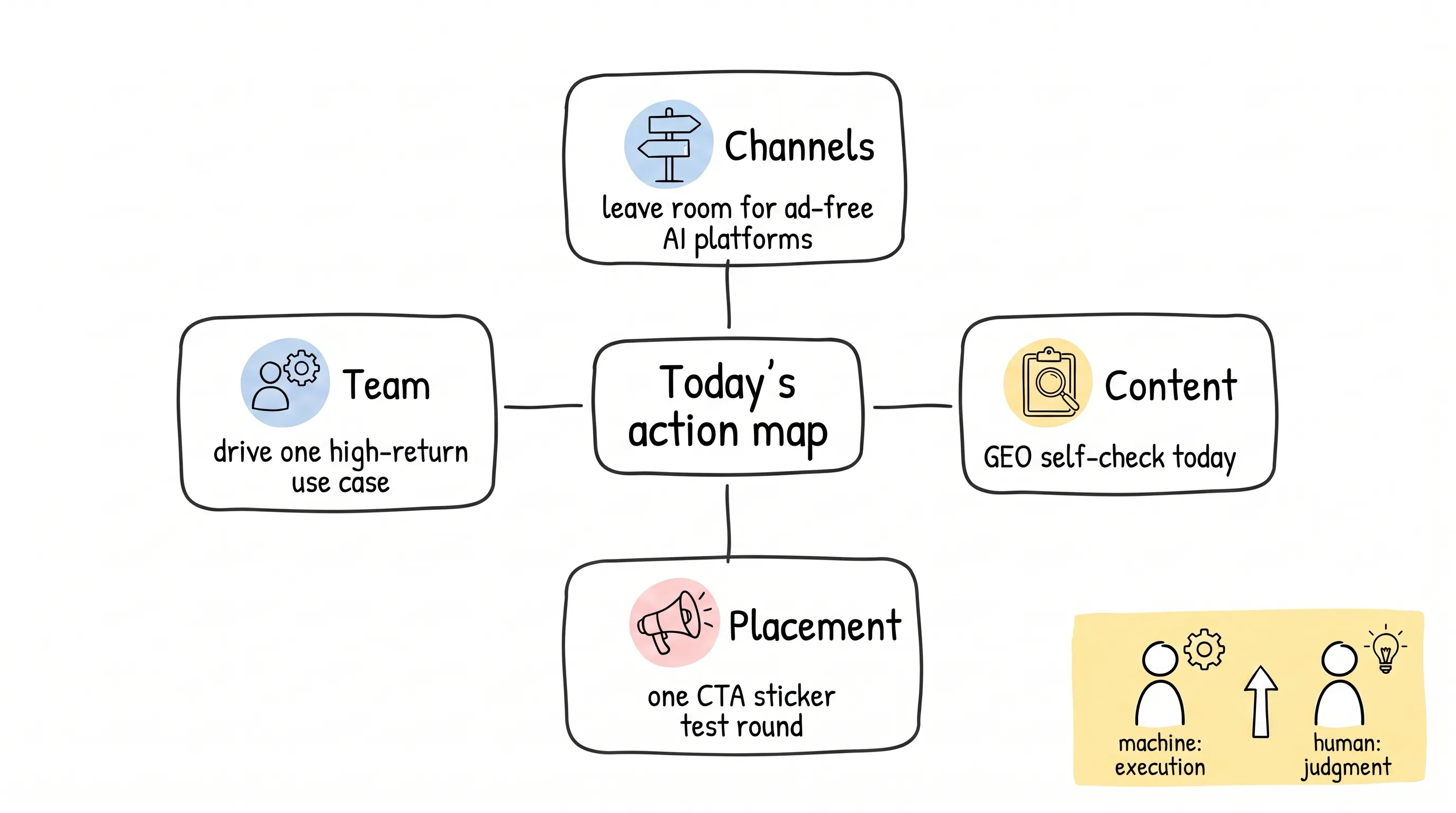
Read today's 11 items together and there's only one through-line: AI marketing has moved from the tool-trial stage into the consolidation stage. Meta's exposed tech stack shows that automation now forms an unbroken chain from creative generation through retrieval infrastructure to deal-closing agents, and the endgame is brands only uploading product catalogs. JumpFly's record of the platform split, Wes McDowell's zero-click, and AdEdge's GEO checklist assemble into the same fact: the interface where users get answers is shifting from the search results page to conversation, and what brands compete for is being cited by AI — ranking high in a list of links has receded to second place. The tool and case items give the other side: budget share is contracting while output demands rise, and every play that has actually landed is a small incision — one suppression rule, one AI mini-tool, one round of CTA sticker testing; not a single one requires a big-project approval. So today's action list is short: on channels, leave room for the ad-free AI platforms; on content, finish the GEO self-check today; on placement, run one round of AI CTA sticker tests; on the team, pick one high-return use case and drive it through. A final reminder: risk governance sits at the end of the list — low position, not low weight — and the more you wire agents into placement and deal-closing, the more the data boundary must be drawn before the gate opens. One more contrast worth stating: Meta's machine handles variants and execution while Steiner reserves for humans the new ideas and the judgment, and the answers across today's tool items are strikingly consistent — the machine takes over the execution layer, and the human's position moves up one level; the ones who move slowly get squeezed out first. So don't read today's 11 items as 11 unrelated news bits — they are three views of one re-drawn division of labor: how placement closes out, where the traffic went, and which layer humans should stand on. Few items today, but density is high — worth reading start to finish.
Continue reading
Related articles
AI Marketing Daily · 2026-11-22
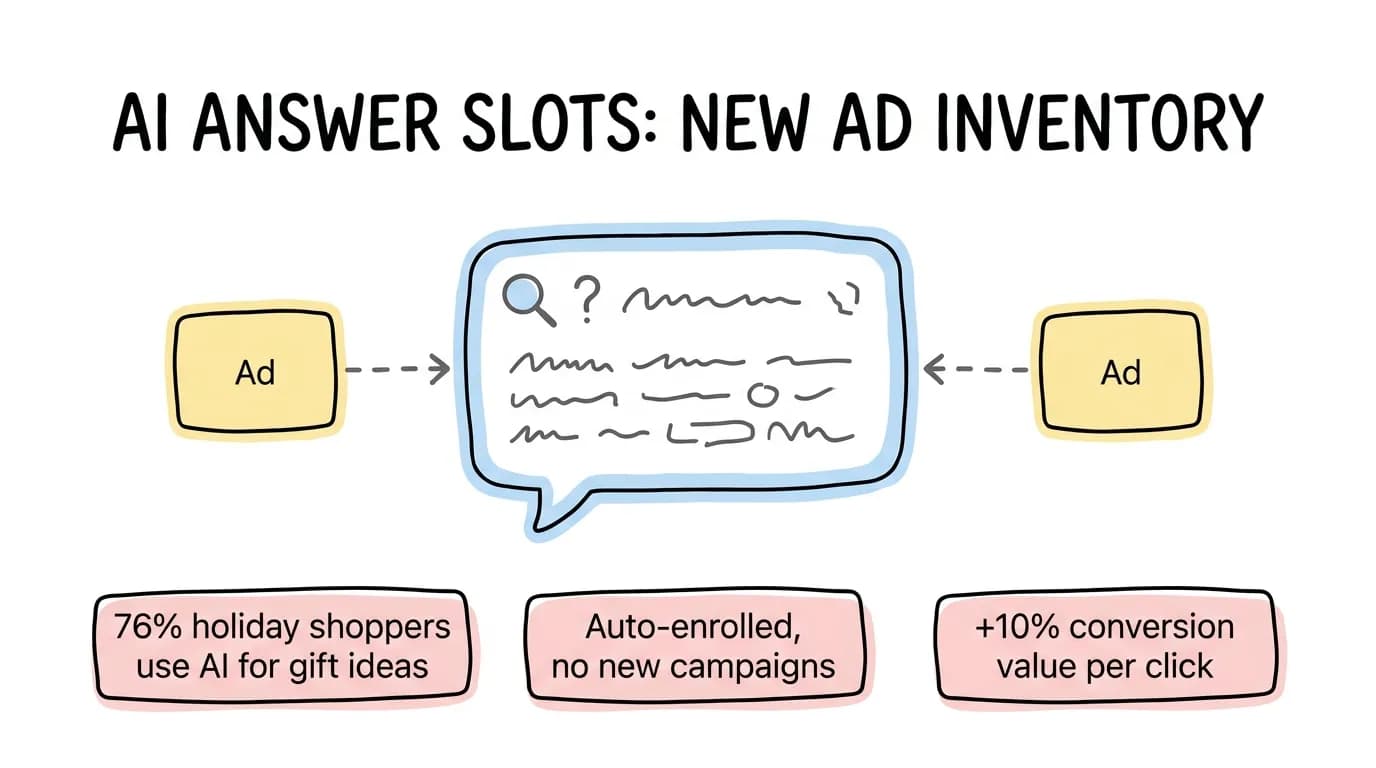
AI Marketing Daily for 2026-11-22 rounds up 20 items led by Microsoft opening Bing AI Overviews to ads and Google expanding AI Mode ads to ten countries, plus GEO guides, ad automation delegation guidance, AI Overviews CTR data, and a legal-risk checklist for AI-generated creative.
AI Marketing Daily · 2026-11-21
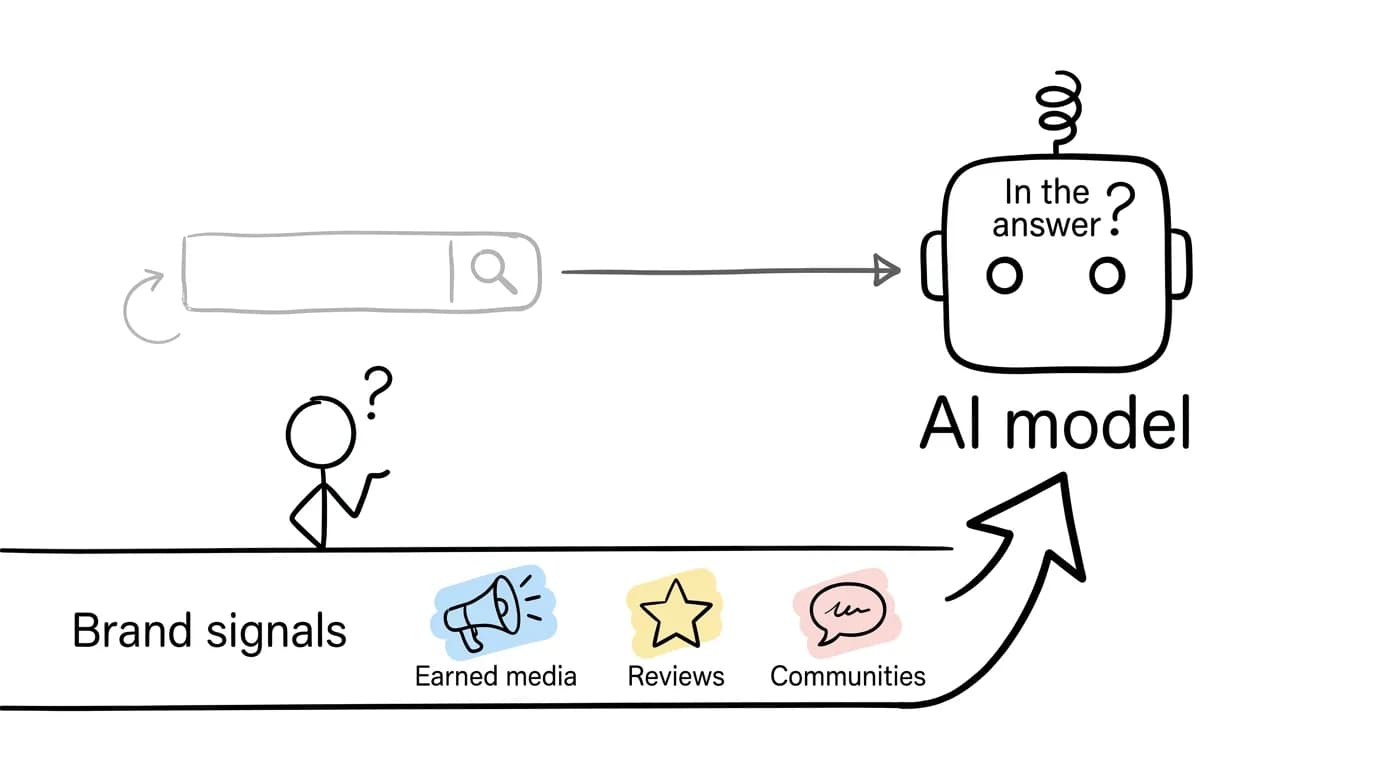
A November 21, 2026 AI-marketing daily covering AI search visibility, GEO methods, Google AI Mode ads expanding to ten countries, Meta's pre-Black Friday changes, agentic shopping, and industry adoption and ROI data.
AI Marketing Daily · 2026-11-20
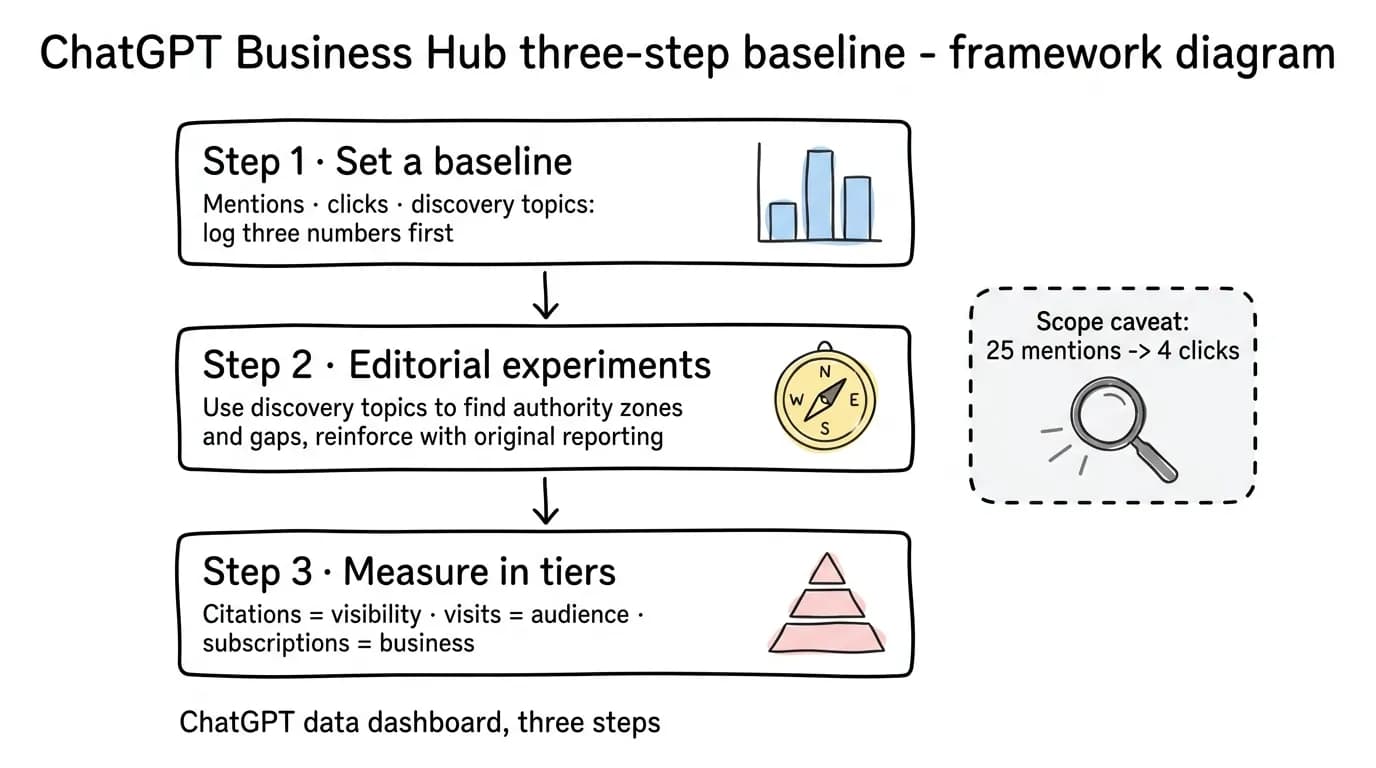
AI Marketing Daily for 2026-11-20 rounds up 19 items centered on measurement: OpenAI's ChatGPT Business Hub dashboard, EU rules for agent-mediated purchasing, Meta pausing four AI terms, and B2B data on shortlists and the dark funnel, each with action advice.