
Budgets Down, Workloads Up: What Keeps Marketers Standing
An overview of how marketing teams apply generative AI as budgets shrink and output demands rise, with case examples across email personalization, ad creative testing, chatbots, pricing, and content production, plus notes on hallucination, data quality, and a layered rollout approach.
A while back, I had dinner with a friend who works in marketing.
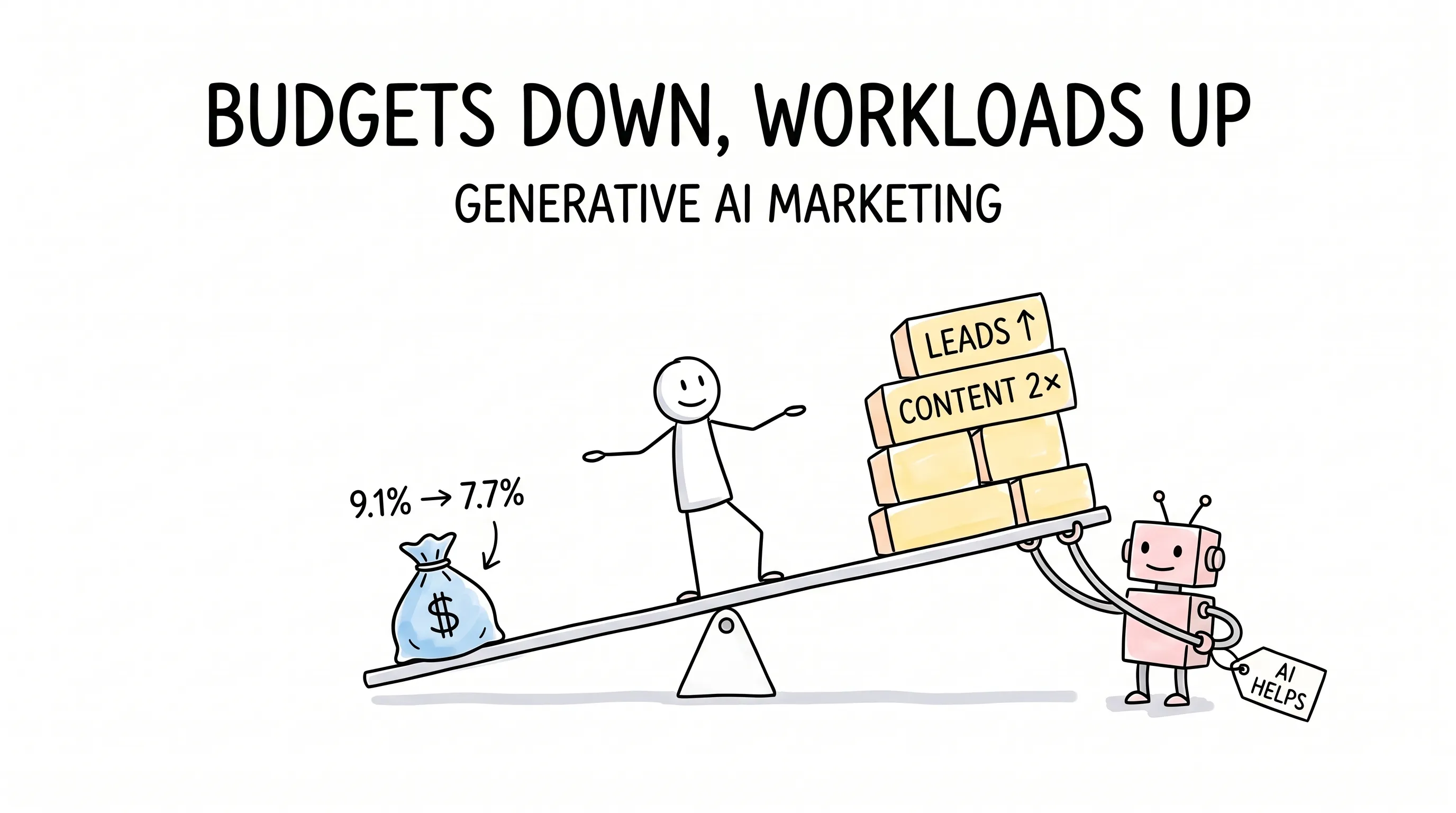
He'd just come out of the budget meeting and looked grim. His words, verbatim: the boss said the money's getting cut, but leads can't drop, content output still has to double — and ideally you'd "come up with something fresh for growth" while you're at it.
I laughed when I heard that. He isn't alone. Gartner has a figure for it: marketing budgets as a share of company revenue were 9.1% in 2023, and down to 7.7% by 2024.
The money is shrinking; the expectations keep climbing.
How do you solve that? Many marketing teams have landed on the same answer: generative AI.
What Exactly Is Generative AI?
Let's put the jargon in plain English first.
What is generative AI? It's this: you tell it "write me a promo email aimed at existing customers," and it churns out three versions before you finish your coffee; you say "this quarter's ad budget is 500K — how should I split it," and it hands you a full allocation plan. Drafting copy, making images, writing captions, cutting video, setting prices — it can lend a hand with all of it.
Put simply, it's not a chat toy — it's production capacity.
How Common Is This Already?
You might think this is a game only the big players are playing.
It's not. McKinsey has the data: among organizations already using generative AI in marketing and sales, 66% reported revenue gains in the second half of 2024 — and 8% of them saw gains above 10%.
Look at the agency side too. Birdeye put out an agency-industry report in 2024: 87% of agencies are using or testing generative AI, and 75% of them plugged it in only within the last two years.
What does "within the last two years" mean? It means once this crowd caught on, they didn't hesitate again.
McKinsey has another number: 71% of enterprises now use generative AI in at least one function. And marketing is usually the department that jumps in first.
AI in the marketing department is no longer an experiment — it's standard equipment.
A Few Use Cases I've Seen Firsthand
Numbers alone feel hollow. So let me tell you a few things that actually happened, and you can feel how this is changing the business of marketing.
The first story is about email.
Michaels, the U.S. craft-supplies chain, uses generative AI to personalize email. A promo email going out to a million people used to say the same thing to everyone; now 95% of the emails are generated individually by AI, based on each person's purchase history and browsing behavior.
The result? Click-through rate rose 25%.
Doesn't sound like much? Think about it: this is growth you get without adding headcount or budget. One email at a time, that's real money over a year.
The second story is about ad spend.
Mars — the company behind M&M's and Snickers — ran a promotion with Amazon. Creative assets were mass-generated by AI from consumer data, so different audiences saw the images and copy that actually held their attention.
When the campaign wrapped up, sales were up 4.3%.
Behind that 4.3% is a change in efficiency: two creative versions tested per week used to be the norm; now it's dozens a day, and whichever runs best gets the added budget. Media buying has gone from a gamble to an experiment.
The third story involves chatbots.
Drift's AI customer service catches a visitor the moment they land on the website, figures out within a couple of exchanges whether they're just browsing or really want to buy, and pushes the right content their way. A marketer on Reddit ran the numbers: after adding this kind of bot, customer-service queue times dropped 70%. There's another figure: 67% of enterprises say chatbots lifted their sales, and 57% say the investment is small while the returns are very real.
Lead capture used to be a form sitting there waiting for people to fill it. Now it's a conversation that screens as it chats.
The fourth story is about pricing.
You've surely experienced Uber's surge pricing: when demand for rides spikes, prices rise automatically, drivers hear the price and flock this way, and the algorithm bends supply and demand back into balance.
Marketing works on the same principle. Tools like Wiser watch demand and competitors and adjust prices in real time. For marketers, price itself is the most honest piece of copy.
The fifth story I lived through myself.
We helped Everstage, a SaaS company in sales compensation, build a content engine: AI produces the first drafts, humans make the calls, with Ahrefs and Clearscope handling topic selection and optimization, and tools like Jasper and Copy.ai lending a hand on the assembly line. Long articles came out one after another — ranking well on Google, and often cited as answers by AI search engines like ChatGPT and Perplexity.
There's also a social-media marketer who said on Reddit that his small team had no manpower to post daily, so they rely on AI to split long articles into short pieces and send them out; engagement rose 40% compared to the all-manual days.
Video is the same. A tool like Synthesia needs no studio and no team — input the copy and out comes a presentable video. Consider that 82% of internet traffic today is video. Small companies used to be priced out of the game; not anymore.
The last story is about whom the money should go to.
The most expensive waste in marketing is spending money on people who won't buy. Neil Patel said something to the effect: marketing's biggest expense isn't content, isn't service — it's ad spend. If AI could tell you sooner which ads to pull the plug on, the savings would be staggering.
Salesforce's Einstein, 6sense, and tools like them do exactly this: they read through all the historical behavior, engagement, and buying signals, score every lead, and tell you who is most likely to open their wallet.
Grammarly applied this approach to lead scoring, concentrated the sales team's firepower on high-quality leads, and paid conversion rate rose 80%.
Eighty percent. That stopped being a time-saver a while ago.
Oh right — personalization goes one level finer. Adobe's Sensei generates different creative assets for B2B marketing based on each prospect's industry, role, and buying stage. Or take Clay: it pulls ideal-customer data through CRM and LinkedIn, so the email's greeting, phrasing, and subject line are one set per person.
Machines do the repetitive work; humans make the judgment calls. Nearly every case I've seen eventually arrives at this sentence.
But There's Always Another Side
Time for some cold water.
The first pitfall is hallucination — the AI making things up with a straight face. Large language models sometimes fabricate information that sounds convincingly factual. Ask it to write a product introduction, and it may invent a feature that doesn't exist. Bake that into your marketing materials and send it out, and what gets hurt is the brand.
The second pitfall is data. What AI eats, it spits out. If your customer data is a mess, its output is a mess. The more mature teams now build their own prompt libraries and "pre-screened datasets," letting AI touch only checked materials.
The third pitfall is the public faceplant. A marketer on Reddit told the story of his own mishap: an AI-generated marketing email went out carrying info about a product long discontinued — and nobody caught it until after it was sent. AI won't act as your gatekeeper; it's only in charge of speed.
Then there's one more layer: ethics. Research in academic journals notes that as AI content multiplies, so do worries about privacy and algorithmic bias. So should you tell the reader "this video was made by AI"? My view: yes. Hiding it gets exposed sooner or later; saying it builds trust instead.
So How Do You Actually Roll It Out?
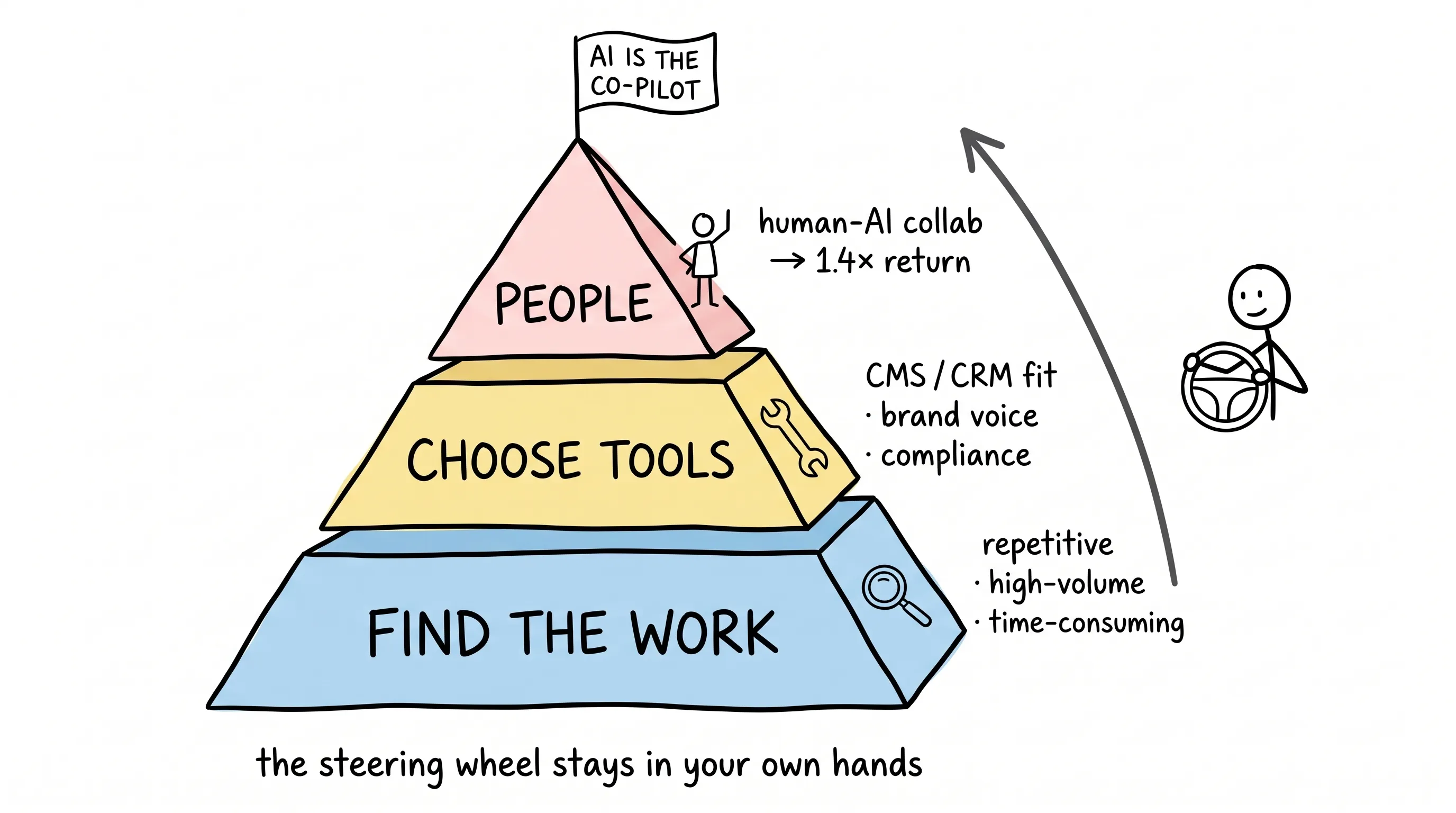
Don't rush to buy tools. Rolling this out, as I see it, happens in three layers.
The bottom layer is finding the work. Lay the whole marketing process out and look it over, from brainstorming topics to publishing to post-mortems, circle the steps that are repetitive, high-volume, and time-consuming, and pilot them in a small scope first. Gartner's recommendation is the same play: write out your AI-ready workflows clearly first, then scale up step by step.
The middle layer is choosing tools. Whether a tool is any good comes down to three things: can it plug into your existing CMS and CRM; can it be trained into your brand's own voice; does its data compliance pass muster. In industries like healthcare and finance, that last one is non-negotiable.
The top layer is people. A BCG report stuck with me: companies that do human-AI collaboration well can achieve 1.4 times the return on invested capital of everyone else. Where's the difference? It's in whether people know how to use it. Teach the team to write good prompts, let them create alongside the AI, and have humans set the tone at the end.
AI is the co-pilot — the steering wheel stays in your own hands.
How Do You Decide Whether to Go Ahead?
There are thousands of tools out there, and not every one is worth reaching for. Here's a dumb-but-effective method: for each candidate use case, ask yourself five questions and score each 1 to 5.
One: is the business impact big? Does it bring leads, revenue, or genuinely saved time?
Two: is it easy to roll out? Does it run along your existing process, or do you have to tear things down and start over?
Three: is the brand risk high? Could it say the wrong thing, or sound unlike you?
Four: how long until it shows results?
Five: will your colleagues in legal and tech actually cooperate?
Once the scores add up, the answer floats out on its own: do the high-return, low-risk ones first. Email subject-line testing, splitting long content into short pieces — the fast, steady wins, knock them out first.
After going live, watch three numbers: how many hours saved per piece of content, how much conversion rose from personalization, how much customer-acquisition cost dropped. If the numbers don't move, the road is wrong.
McKinsey estimated: companies investing in AI can lift revenue 3% to 15% and sales ROI 10% to 20%. The money is there; it just depends on whether you pick it up.
A Look Ahead
In the coming years, a few things are worth watching.
One is multimodal. Text, images, video, and audio are being woven by AI into the same campaign. Tools like Hedra can already let small teams produce video that used to take serious money.
Two is voice. Podcasts, interactive audio ads — AI-generated audio content will keep growing.
Three is brand-specific models. Companies are already mulling it over: simply take your own data and language style and train a model that only understands you, so the output always carries your house voice.
Four is creative operations. Teams no longer compete on who can draw; the competition is who can direct AI, iterate on ideas fast, and save the humans for the moment that's truly valuable.
How big is the pie? Grand View Research predicts the AI marketing market will grow about 25% a year, reaching $82.2 billion by 2030.
One Last Thing
Remember that friend from the dinner at the start? A while later, I sent him one line back.
Gartner has an analyst named Mary Mesaglio, and she puts it bluntly: generative AI is sitting at the peak of the hype cycle (where expectations peak before reality catches up), and plenty of people will throw money and time at it without thinking. Don't let the heat push you around; first get clear on what you want AI to do for you.
I passed those words along to him, word for word.
New tools come out every week; you'll never finish the chase. Return to your own team, your customers, your brand voice, and find one or two places that genuinely save time and genuinely show results — starting there matters more than anything.
Here's my wish for you: don't chase the trend, and the trend will come find you.
Continue reading
Related articles

It's 2026: Stop "Buying" AI Tools for Your Marketing Team — Start "Hiring" AI Agents
This learn article explains how AI agents differ from standalone AI tools in marketing, outlines three agent categories — build-your-own platforms, CRM-native agents, and vertical tools — and covers use cases across SEO, social media, advertising, and reporting, plus criteria for choosing one.

Did the Money You Spent on AI Marketing Ever Come Back?
A guide to measuring AI marketing ROI across three layers: ad reports, sales pipeline, and the financial ledger. Covers metrics such as ROAS and CPA, eight dashboard metrics, industry benchmarks, and common measurement mistakes.

How to Pick a Creative Automation Platform: First, Figure Out What These Eleven Actually Do
A learn article sorts eleven creative automation platforms — including Bannerflow, Celtra, Smartly.io, and Storyteq — into four functional groups and proposes five evaluation questions covering publishing reach, automation depth, ease of adoption, team fit, and verifiable evidence.