
Rankings Intact, Clicks Gone: GEO and the New Playbook for Search in the AI Era
A learn article explaining why rankings survive while clicks vanish in AI search, plus a five-step GEO playbook for earning citations from AI Overviews, ChatGPT, and Perplexity.
A few days ago, a friend of mine who runs an independent online business came to me, utterly deflated.
He showed me his dashboard: his keywords still sat in the top three on Google's first page, yet traffic had dropped by nearly half.
He asked: is the algorithm targeting me?
I told him: you didn't do anything wrong. You're just still playing the previous version of the game.
Now when you search for something, Google often doesn't hand you ten blue links first anymore. It has AI write up an answer and serves it to you straight. ChatGPT and Perplexity go further — AI answers the entire conversation. Users read the answer, feel their problem is solved, and leave. Without clicking into any website.
Think about it: when users searched "how to choose a CRM," they used to click into your page and browse around. Now AI wraps it up in three sentences. Out of ten searches, few people still bother to click through.
Rankings intact, clicks gone.
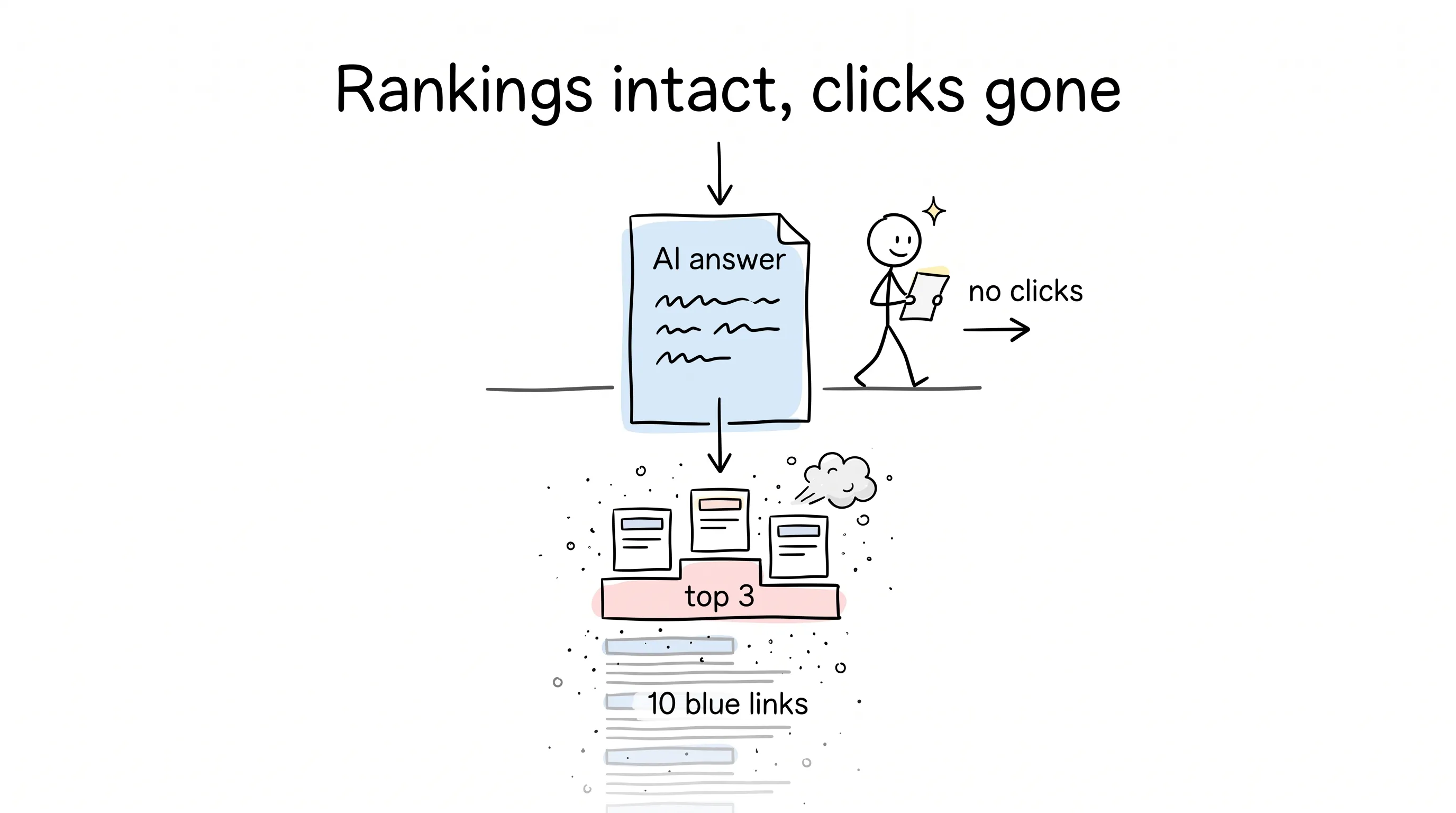
Behind this is a shift in how search success gets judged: in the past, you competed for users to click on you; now, you compete for AI to cite you. When AI assembles an answer, whether it's willing to cite your content has become the new lifeline.
Hence a new term: GEO.
What exactly is GEO?
GEO, Generative Engine Optimization. Simply put, it's a set of methods for getting AI to "fall for" your content: tune how the content is written and how the site is built, so that generative engines like AI Overviews, Gemini, ChatGPT, and Perplexity are willing to cite you when assembling answers.
Think of it as the sequel to SEO. SEO gets you a spot on Google's results page; GEO gets you a spot inside AI's answers. Behind both spots lies traffic.
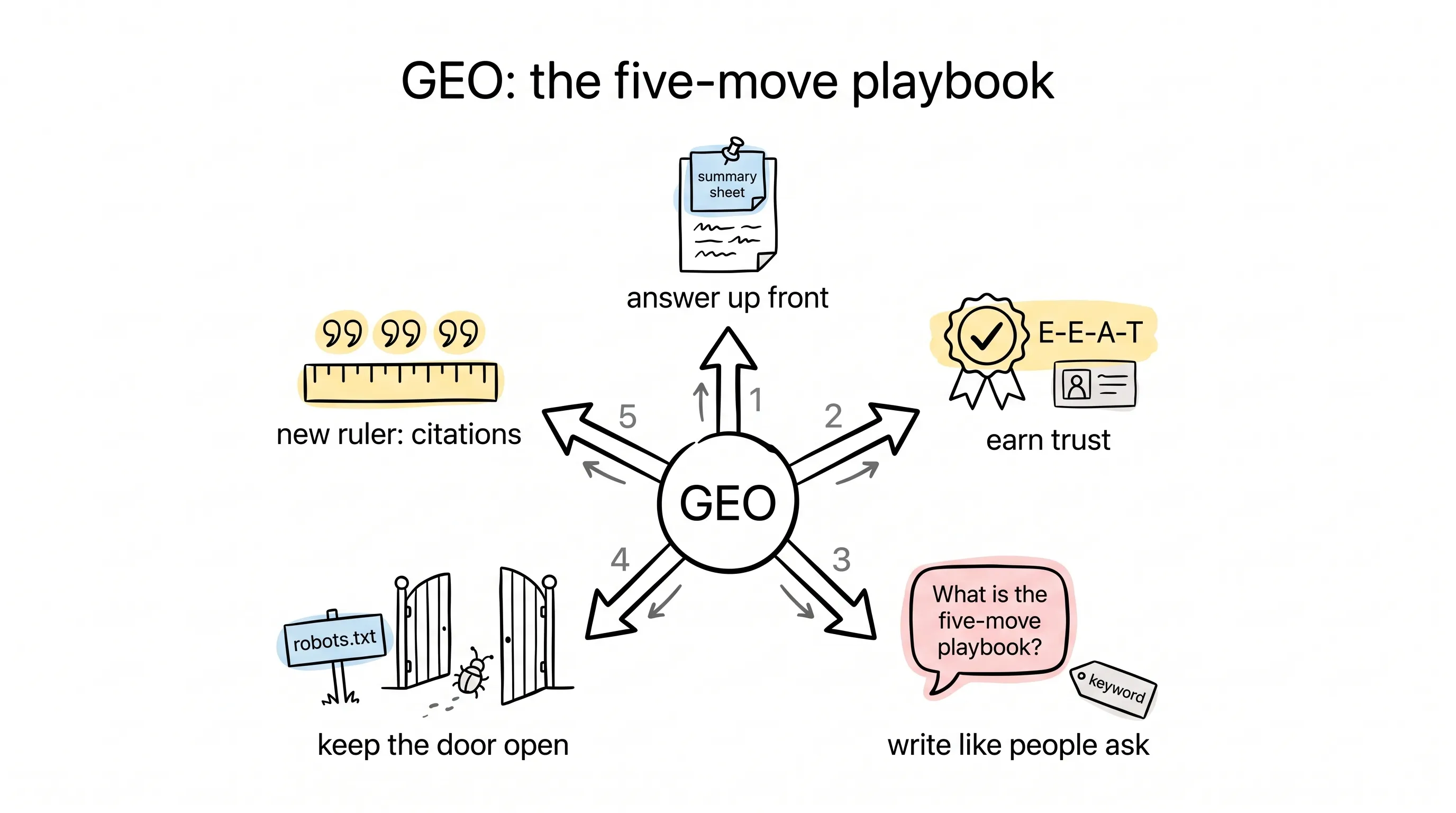
How do you pull it off? I've broken the playbook into five things. Let's take them one at a time.
1. First, Make Your Content Instantly Legible to AI
How does AI read a web page?
Not the way people do. A human follows your narrative, feeling out your buildup and rhythm. AI is a scanner: what it rummages through a page looking for is clear, verifiable facts.
So your content has to be organized to be scan-friendly.
First, put the answer up front. No suspense, no slow build. Open with a 50-to-70-word summary that answers the core question head-on, then unfold the details. It's like walking into a restaurant that posts its signature dishes by the door, instead of making guests comb through the whole menu.
Second, break up the format. AI favors lists and bullet points. Use H1, H2, H3 to slice complex topics into clear small blocks — don't write several-hundred-word walls of text without a paragraph break.
Third, put structured data to work, especially FAQPage and HowTo schema. This is like planting signposts on your page that tell Google, in plain sight: here are the questions, here are the answers. For AI Overviews, that's a strong signal.
2. Make AI Dare to Trust You
This one may be the most critical of the five.
The logic by which AI picks citation sources is the same logic Google's ranking systems use to pick websites: credible ones first. This is E-E-A-T (Experience, Expertise, Authoritativeness, Trustworthiness). In the era of generative search, these four count for more than ever.
How do you put it into practice?
Attach authors to your content. Authors need proper bios that spell out who they are and why they're qualified to talk about this. Anonymous pieces — AI doesn't like citing them.
Back every claim with evidence. Data, case studies, ideally research sources — cite high-authority ones, like .gov, .edu, or major studies. And if you have original data or an exclusive survey, even better, because nobody else has it.
One more thing many people overlook: keep your identity consistent across the web. Your brand name, address, phone number, and social accounts must say the same thing on Google Business Profile and every directory site out there. AI has to first confirm "you are you" before it can get to "I trust you."
It's like a background check. If your record contradicts itself front to back, even the strongest credentials get a question mark.
3. Write the Way People Ask, the Way People Talk
The way users talk to AI is completely different from the way they type into a search box.
Before, they typed two words: CRM features.
Now they ask AI a whole sentence: when a digital marketing company picks a CRM, which features should matter most?
So your keyword strategy has to follow suit.
Write more question-shaped content around "who, what, why, how." Google's People Also Ask section and the various question-keyword tools can help you mine real questions.
And write the way people actually talk — conversational, no jargon pile-ups. Instead of writing "CRM features," write "how a digital marketing company picks a CRM."
Also, don't publish scattered one-off posts. Build a circle of interlinked articles around one topic, all funneling into a pillar page. Let AI see at a glance: on this topic, you've dug the deepest. The one who digs deepest is the easiest to cite.
It's like wanting to be recognized as an expert in a field: you can't just dabble here and there. You have to dig in one spot until you hit water.
4. The Foundation Is Still the Foundation — Don't Lock Your Own Door
By now you might be thinking: all that old technical SEO stuff — can it be tossed?
Quite the opposite. The foundation hasn't changed; a tenant named AI just moved in upstairs.
Pages need to load fast and run smoothly on mobile. AI Overviews favors pages that open in a blink.
The single most critical item: check your robots.txt. Crawlers like GPTBot and Google-Extended are how the major language models fetch content and pull real-time answers. Block them at the door, and you've locked your own storefront — then wonder why no customers walk in.
Keep the code clean too. AI reads you through HTML; don't bury key content inside a pile of complicated JavaScript. Write your titles and descriptions clearly.
5. Swap in a New Ruler
Finally: how do you know whether you're doing well?
The old ruler — click-through rate — of course still matters. But judged by it alone, you'd think you were done for. GEO has new ways to measure.
Watch one number: how often your brand gets cited or mentioned in AI answers. Dedicated tools can monitor this. The more you show up, the more AI treats you as a source it trusts.
Here's a homespun trick too: take the questions you care about most, search them yourself, and see who AI is citing right now. Take that cited page apart and study how it organizes answers, how deep it goes, how the formatting is laid out. Then build a page that is, objectively, more complete and better — and wait for the next round of picks.
Oh, and keep the content fresh. AI favors the fresh and drops the stale: regularly give your top pages new data, new cases, an updated date, so it knows you're alive.
This wave may be moving faster than when the internet first spread out twenty-five years ago. The people who hesitated back then spent years catching up.
So while it's early, run your content through these five moves. Every step you take is reserving your seat for the next era of search.
Remember that friend from the beginning? Last week, after he finished fixing his first batch of pages, the traffic curve on his dashboard started to bend upward.
May you always be the one who gets cited in this new search.
Continue reading
Related articles

It's 2026: Stop "Buying" AI Tools for Your Marketing Team — Start "Hiring" AI Agents
This learn article explains how AI agents differ from standalone AI tools in marketing, outlines three agent categories — build-your-own platforms, CRM-native agents, and vertical tools — and covers use cases across SEO, social media, advertising, and reporting, plus criteria for choosing one.

What Is GEO? How Your Brand Gets "Mentioned" in the Age of AI Search
An explainer on GEO (Generative Engine Optimization) for e-commerce and DTC brands: how it differs from SEO and AEO, why AI answers shape brand visibility, and eight practices covering question-focused content, consistent brand messaging, structured pages, external evidence, comparisons, and AI mention tracking.

AI Is Already Making Decisions for Your Customers. Are You on the List?
A learn article explains GEO (Generative Engine Optimization): why AI-generated answers now shape which brands customers see, and how SEO fundamentals, entity clarity, citable evidence, and monthly measurement affect visibility in AI answers.