
AI Advertising Has Reached a Fork in the Road: Five Things from Early This Year That Keep Growing on Me
The article examines five AI advertising shifts: Perplexity ending ads while OpenAI adds them, automated campaign tools displacing manual media buying, AI-generated creative at scale, AI video production such as Seedance 2.0, and managing how AI assistants describe your brand.
A while back, an old friend who has spent ten years buying media took me out to dinner. Before the dishes even arrived, he let out a sigh: after all these years in the trade, he had suddenly realized that the platforms now do for advertisers everything he used to be paid to do.
I told him not to sigh. What he had run into was a reshuffle of the advertising industry — big enough to matter, small enough to survive.
Over that dinner, I walked him through five things. Today, I'm walking you through them too.
1. The Fork in the Road for Advertising
This past February, Perplexity made it official: no more ads, and no plans to bring them back.
You might find that odd. What kind of platform pushes ads away? This one did. Perplexity was among the first AI platforms to experiment with advertising — it started testing back in 2024, then gradually pulled back. By February of this year, the company had shut the door for good: there is no restart plan.
The timing is telling. Just days earlier, OpenAI had switched ads on in ChatGPT's free tier and its Go plan (ChatGPT Go is OpenAI's low-cost subscription tier). And a little over a week before that, Anthropic ran its Super Bowl spots — ads that read almost like a wink at the very idea of a chatbot stuffing ads into your conversation.
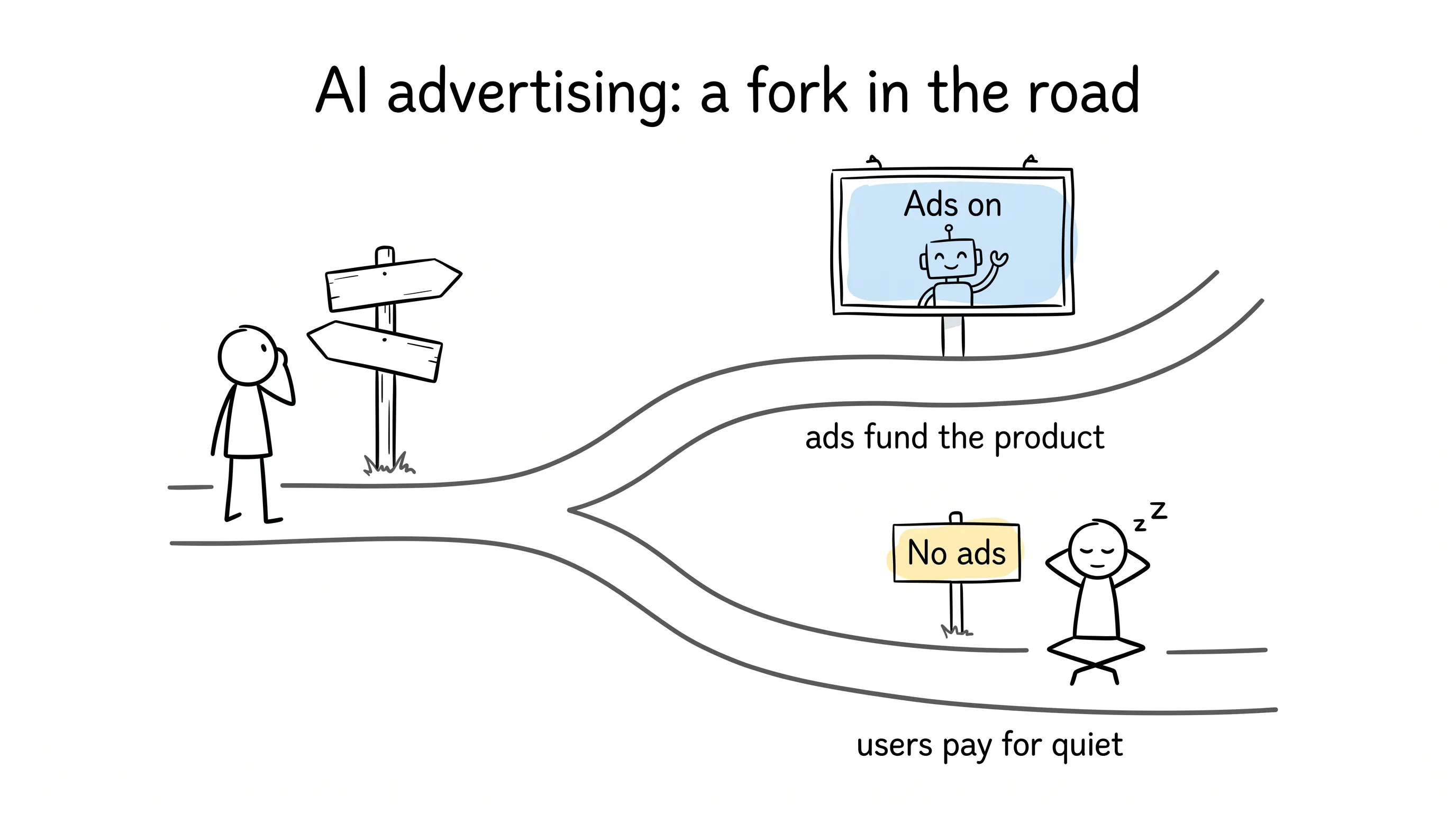
So there you have it: the same AI ecosystem has split into two paths. One funds the product with advertising. The other bets that users will pay for peace and quiet.
Every time the two paths split further, paid advertising loses another patch of ground it can reach.
Does that mean Perplexity is a lost cause for advertisers? Not quite. It doesn't sell ad slots, but it still mentions brands in its answers. Brands with frequently updated content, solid reputations, and clean structured data will still get brought up — naturally.
The ad slots are gone. The audience is not.
2. Where Did the Media Buyers Go?
What does "running ads" even mean anymore? The picture that used to come to mind was someone hunched over a dashboard, tweaking bids, adjusting targeting, and scheduling creatives.
That picture is getting harder to find.
Google's Performance Max and AI Max, along with Meta's Advantage+ (these are Google's and Meta's fully automated campaign types), no longer "offer" automation — automation is simply the default. Bidding, audience finding, creative assembly, placement — they handle the whole chain end to end.
So what are people for?
Making the calls. In January, Triton Digital surveyed a hundred advertising executives, and many described the same discomfort: AI agents can now carry work all the way from strategy to execution, and traditional staffing and account-management models are feeling the squeeze. Another number has stayed with me: among people who have used AI search, 44% already treat it as their primary search tool.
That is exactly what my friend was anxious about.
But I wanted to hand him a different lens. AI can execute, but it can't set your business priorities, can't read the unwritten rules of your industry, and certainly can't replace the judgment you earned account by account, through hard knocks. Push it one level deeper: if every advertiser runs the same tools with the same default settings, the only place left to build an edge is strategy.
Execution is depreciating. Judgment is appreciating.
3. The Last Differentiator Is Creative Work
Once AI takes over the media buying, the one area where advertisers still get the final say is essentially the creative.
How hot is this battlefield? Google disclosed a number: in Q4 2025 alone, advertisers used Gemini to generate nearly 70 million assets inside AI Max and Performance Max — triple the year-ago quarter.
Seventy million assets. What does that tell you? AI-generated creative has gone from "something early adopters try" to "something everyone uses."
And the tools keep leveling up. Veo 3 has landed in Ads Asset Studio, sitting alongside Nano Banana — one prompt, a few minutes, and you get footage close to broadcast quality. Rhone, an athletic apparel brand, has already put image-to-video to work in live campaigns.
Don't mistake this for one-click money printing, though. However handy the tools, you still need to understand your brand, know your direction, and feed in a brief worth reading. But the math has changed: a video used to get stuck on money and time; now, testing ten concepts can cost less than shooting one used to.
With the bottleneck gone, the contest moves to who dares to try more and who iterates faster.
4. Five Minutes to Do a Full Day's Work
Before you've digested the third thing, the fourth arrives.
On February 10 of this year, ByteDance released Seedance 2.0, positioned in blunt terms: an AI video platform for marketers, filmmakers, and e-commerce sellers — production-ready the moment you open it.
What makes it different from the last generation? AI video used to mean a lone, disconnected clip. Seedance 2.0 can shoot an entire ad: product reveal, lifestyle scenes, call to action — with coherent, continuous shots. A single prompt or one product photo is enough to start.
The specs are aggressive too: text, image, audio, and video can all serve as input at once, at up to 60 frames per second; in independent evaluations, it ranked first for camera-movement control. The launch went viral in China. ByteDance's own framing: what a creative team used to spend a full day on now takes five minutes.
What matters most to me is who built it. ByteDance owns TikTok, one of the fastest-growing arenas in social advertising, and sooner or later Seedance will roll out across the ad platforms.
What does that mean? The production gap between small advertisers and big brands is being filled in. A presentable multi-shot commercial no longer requires a production budget only the big brands can afford.
The tools are at the door. Brands that start building their AI video pipelines now will head into peak season holding an extra card.
5. What Do You Look Like in the Eyes of AI?
The last thing is one I suggest you test today.
Open ChatGPT, Gemini, or Perplexity and ask: in this industry, which vendors are worth recommending? See whether it mentions you — and if it does, whether what it says is what you'd want it to say.
Why go through this exercise? Because chatbots have become the new influencers.
In February, Stacy Simpson, CMO of the healthcare software company athenahealth, found that when various AIs talked about her company, the information was outdated and the sources obscure — and for some questions, they didn't mention athenahealth at all.
Even if you never tend to the version of you that lives inside AI, it keeps growing. What it grows into is not up to you.
Where do the models assemble these impressions? News coverage, review sites, your own website, third-party databases, industry directories. How clean and how current those places are directly determines how an AI introduces you to someone who has just asked for a recommendation.
And so a new trade has sprung up: specialists who monitor, audit, and repair a brand's image inside large language models.
Money is following. Kantar's data for this year: 24% of AI users are already willing to let an AI assistant make purchase decisions for them. That number moves in only one direction.
The old homework was getting your search results onto page one; the new homework is getting AI to understand you — and to want to recommend you.
Back to That Dinner
By the time we finished eating, my friend had stopped sighing.
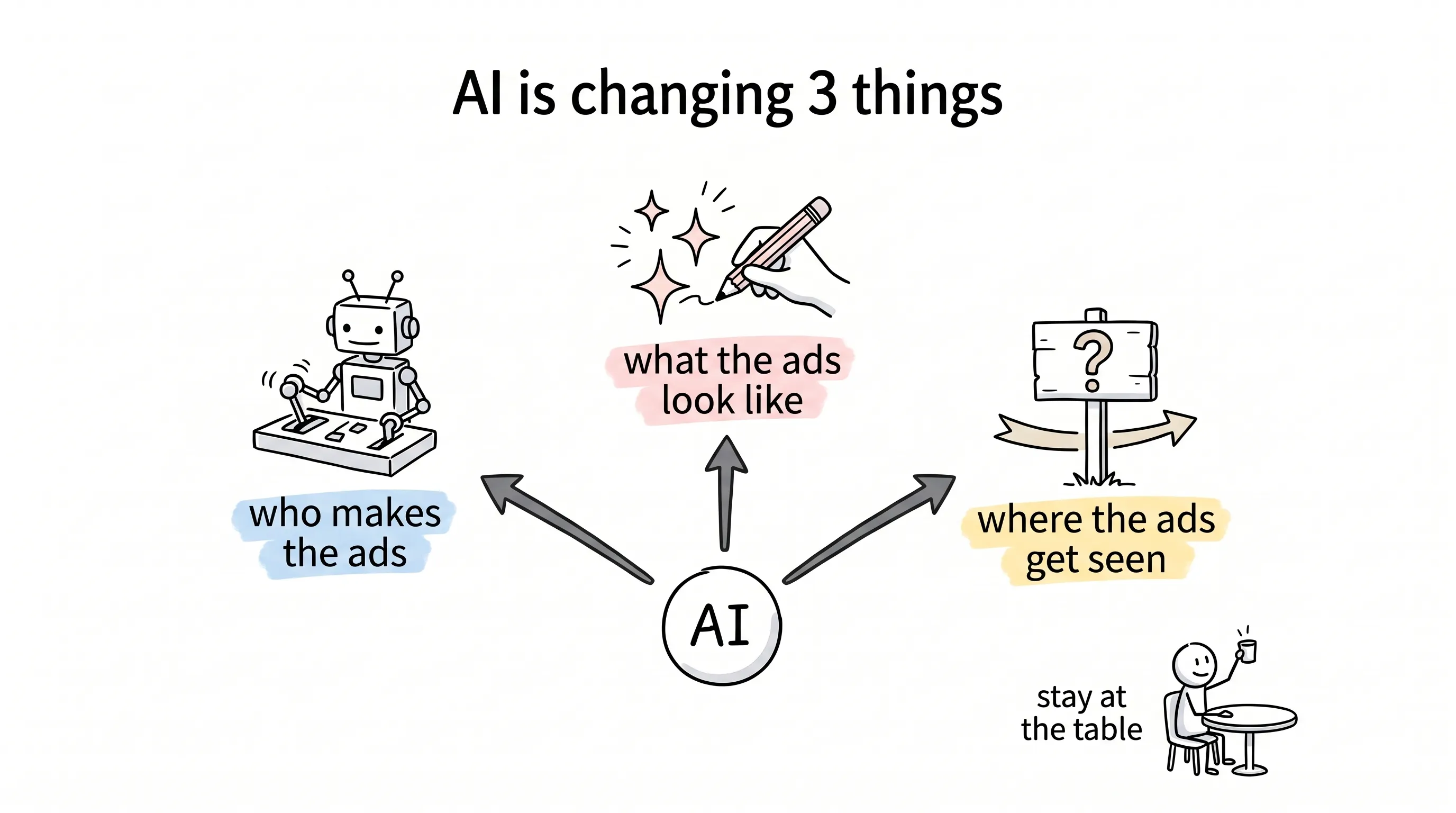
These five things look scattered, but they point in one direction. AI is changing three things: who makes the ads, what the ads look like, and where the ads get seen. And the ones building the tools are often the very ones collecting the auction fees. The referee and the players increasingly look like one team.
Some things don't change: know your users, show up where they are, and give them something worth clicking.
Only one thing changes: where they are. The answer to that question shifted this year, and it will probably shift again next year.
Whoever keeps answering it stays at the table.
Here's to you staying at the table, too.
Continue reading
Related articles

What Is GEO? How Your Brand Gets "Mentioned" in the Age of AI Search
An explainer on GEO (Generative Engine Optimization) for e-commerce and DTC brands: how it differs from SEO and AEO, why AI answers shape brand visibility, and eight practices covering question-focused content, consistent brand messaging, structured pages, external evidence, comparisons, and AI mention tracking.

AI Is Already Making Decisions for Your Customers. Are You on the List?
A learn article explains GEO (Generative Engine Optimization): why AI-generated answers now shape which brands customers see, and how SEO fundamentals, entity clarity, citable evidence, and monthly measurement affect visibility in AI answers.

Google Is Stuffing Ads Into AI Search: These Recent Stories Are Really One Story
A news roundup linking recent AI marketing stories—Google adding ads to AI Mode, Amazon's Ads Agent, ChatGPT image updates, a UK startup tracking brand mentions in AI answers, and an AI ransomware warning—arguing that control over ad data and visibility is shifting toward platforms.