
In 2026, the Rules of Getting Customers Changed: Five Content Plays That Are Taking Off
A learn article on the zero-click shift in customer acquisition, covering five content plays: YouTube collab interviews, AI-built lead tools, visibility in AI recommendations, AI video testimonials with disclosure, and building a personal brand.
A few days ago, I spent an entire day behind closed doors with a group of friends who do content marketing. When I came out of that room, I tore up my own 2026 customer-acquisition plan and rebuilt it from scratch.
Why? Because several of the things we discussed pointed to the same shift. And most people haven't caught on to it yet.
It's called "zero-click."
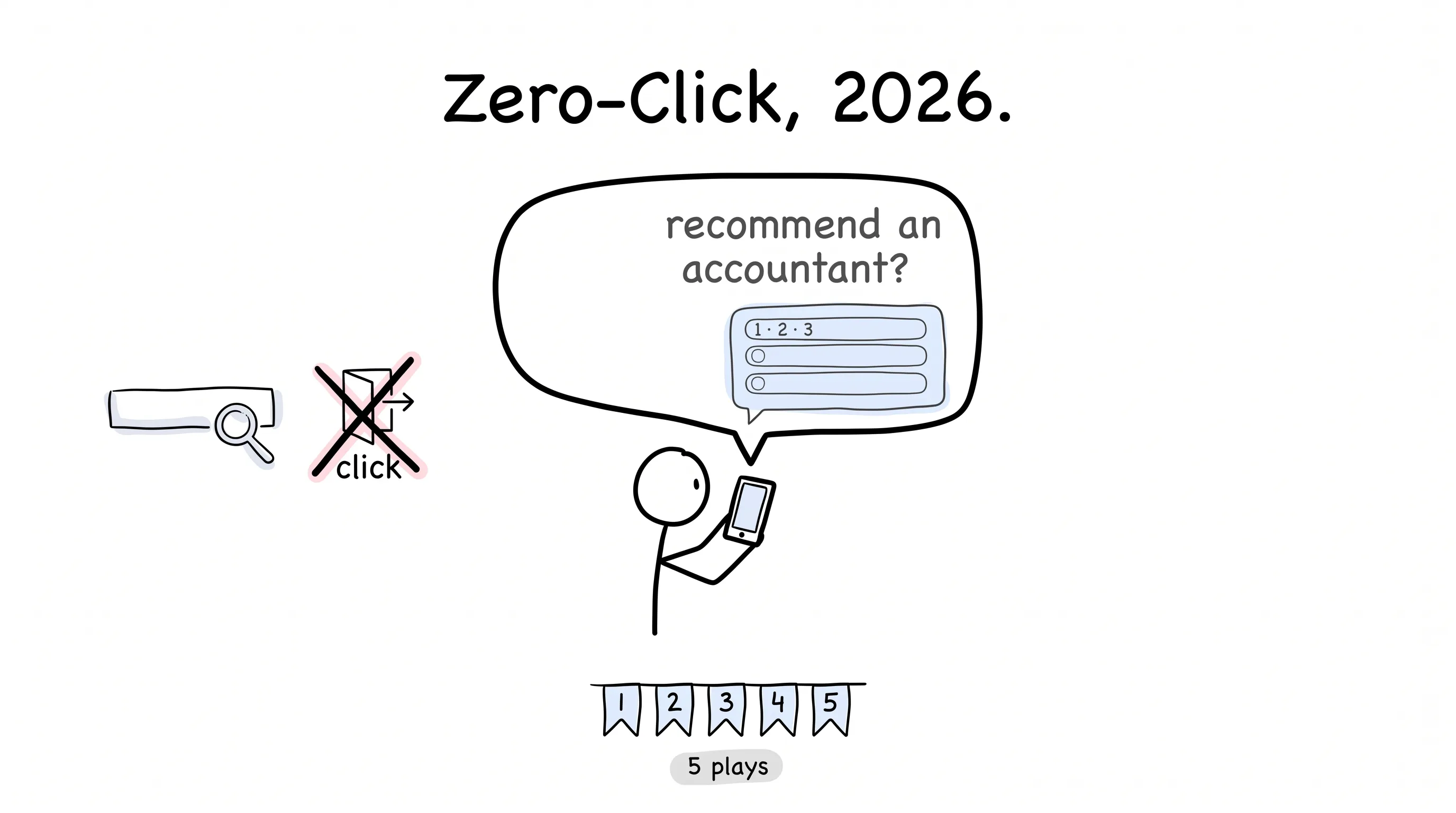
What is zero-click?
It means: wherever people ask a question, that's where they get their answer. They don't leave.
You search Google, and the answer sits right at the top — are you still going to click the third result? Rarely. You ask ChatGPT "can you recommend an accountant," and it gives you three names directly. You never visit a single website. You scroll short videos, watch the whole thing, see the services on offer, maybe even book the person right there in the comments — and the entire time, you never leave the app.
That is zero-click. They can get what they need without ever clicking.
A lot of people panic when they hear this: so my website, my SEO — was that all a waste?
Hold on. My read is exactly the opposite: this isn't a crisis. It's the biggest opportunity in years.
Why? Because the platforms have turned "browsing" into "asking." And every question demands an answer, and someone has to supply that answer. If you simply move with this trend, the same content can reach far more customers than it used to.
So how do you actually do it? Five plays. Let me take them one at a time.
Play #1: Borrow other people's audiences to launch your own channel
Where to start? Let's start with YouTube.
Goldman Sachs put out a report predicting that YouTube's creator economy will double by 2027. What does that tell you? The pool isn't saturated yet. Not even close. You still have a window to get in before it gets truly crowded.
But getting in comes with an old problem: cold-starting a new channel is painfully slow.
Think about it: you talk to a camera for three months, and your view counts are still stuck in the triple digits. Meanwhile, your target customers have already gathered in your competitors' channels. Why on earth would you fish for an audience from zero?
That's right — borrow one.
YouTube launched a collab feature: two creators can publish the same video together, and it gets pushed straight to the home feeds of both creators' followers. On its face, this feature sounds unremarkable. But pair it with a specific play, and it becomes powerful. I've given it a name: the strategic podcast interview.
How do you play it? Three steps.
Step one: find experts in your field with anywhere from a few thousand to a few tens of thousands of subscribers. They don't need to be big-name creators. Two criteria matter: their follower count is in the same league as yours, and their audience happens to be your potential customers too. If you're a fitness coach, look for other fitness channels. If you're a home-organizing consultant, look for interior design channels.
Step two: invite them to a video interview. The pitch is simple: "I'd love to have you on to talk about your experience in this field." And relax — the vast majority will say yes. Who turns down more exposure? It's just one Zoom call; you can record it from home.
Step three — the most crucial one: when you publish, set your channel as the main channel.
Here's a detail most people don't know: the video gets pushed to both sides' followers, but the views and the watch time are credited entirely to the main channel. In other words, tens of thousands of their followers scroll past this video, and all the credit is yours.
Then, on the thumbnail, blow up the guest's face and put it front and center.
Why? Think about what their followers see when they scroll: a face they already know. They'll think, wait, isn't this the person I follow? They click in and find a stranger — who, as it turns out, is actually pretty good.
In that one moment, you've delivered an introduction that arrives pre-loaded with trust.
There's a real example. A coaching channel that normally pulled fewer than 200 views per video did one of these joint interview uploads with a bigger creator, and it shot to nearly 3,000 — seventeen times their average.
Strong.
And this thing compounds. Once a borrowed viewer finishes watching, the algorithm takes a note: this person likes this channel. Then it starts pushing your other videos to them too.
You're effectively converting someone else's trust into your own subscribers, little by little.
Here's your action item: make a list of ten to twenty people in your industry whose audiences you can borrow — openly, legitimately. Close one of these collabs every month. A year from now, you'll thank yourself.
Play #2: Stop giving away PDFs — use AI to build a tiny tool
You've borrowed an audience. The next step is lead capture: turning onlookers into a list you can reach again and again.
And whenever there's a list, there's email. Plenty of people think email is antiquated. It's the opposite: to this day, email is the single most profitable content format for small businesses. Bar none.
So how do you get someone to hand over their email address? The traditional move is a "lead magnet" — a guide, a checklist. But who's short on PDFs these days? People download them and never read them.
Flip the thinking: stop giving people something they'll read later, and give them something that solves their problem right now.
What does "solves it right now" look like? A little tool.
Say you're a speaking coach, and your clients' biggest fear is the camera. You build a web app: open the webcam, practice as if recording a video, get scored in real time. Your speaking pace, your pauses, how many times you said "um" — it counts everything. Practice until the nerves are gone.
Ten years ago, something like this meant hiring an outsourced team, starting at several thousand dollars. Today? You tell ChatGPT, Claude, or Gemini: "I need a tool that helps [such-and-such people] with [such-and-such problem]." It writes the code, you copy-paste it onto your website, and it works. You don't need to understand a single line.
I've tried it myself. Under an hour of back-and-forth, and something usable came out. Unbelievable.
The core action is just this: write down the three most painful problems your ideal customer has, pick one, and have AI build you a small app that solves it. A therapist could make a guided-breathing tool. A postpartum caregiver trainer could make a feeding calculator.
But there's a fork in the road on execution, and if you take the wrong fork it's all for nothing:
Don't just toss off "link's in the description" at the end of a video. Demo the tool live, in the video.
Someone has run the numbers on this: a passing mention converts about 1% to email. A live demo? It jumps to 10%, even 15%.
The tool IS the content. Every demo is customer acquisition that doesn't feel like selling. Add an email form, and you're done.
Play #3: Get AI to say your name in front of other people
Next up is the most urgent one of all — my advice is to start on it as soon as you're done here.
First, a number: ChatGPT now handles more than one billion searches a week.
When people ask AI "what kind of accountant should a company selling online courses hire," the AI doesn't hand over ten links. It gives an answer directly: these three are a good fit.
And just like that, names show up inside the conversation.
What if yours isn't on the list? Then, to this group of searchers, you don't exist.
The old SEO playbook doesn't work on AI. Stuffing keywords gets you nowhere. AI responds to a different set of things.
First: what other people say about you. Roundup and listicle articles — "the ten best design studios in your area," that kind of thing. AI treats these mentions as votes of trust. You can think of them as the new backlinks.
Second: how you stack up against your peers. On your own website, put comparison pages out there proudly: how we differ from this type of firm, laid out clearly. When AI sees you compared side by side with established players — and holding your own — it starts treating you as a legitimate option.
Third: how many directories you're in. Google Business Profile, review sites, industry catalogs — before AI makes a recommendation, it digs through these rosters everywhere.
Oh, and one more thing — something hopelessly old-fashioned that has never mattered more: five-star reviews.
The logic is simple. When AI picks whom to recommend, does it factor in "who has the best reputation"? Of course it does. So this year, treat collecting reviews as a serious, assigned task.
The businesses that figure this out first will occupy the good spots in AI recommendations and enjoy that position for years. The ones who catch on late will just wonder: why has the phone stopped ringing?
Play #4: The one everybody argued about
Now, the main event — the topic that had people at the closed-door session arguing until they were red in the face.
Some background first. On social media, the best-converting content usually isn't polished ads; it's ordinary people telling their own real stories — what's known as user-generated content (UGC). Its conversion runs about three times that of a business tooting its own horn.
Why? Because people trust real humans, not businesses.
Here's the problem. Real humans are busy. They don't want to be on camera. That thank-you video has been "coming" for six months — even if they rave about your service to anyone who'll listen.
So some businesses have taken a new path: use AI to conjure up people who look 100% real, and have them praise you. This used to be expensive and hard. Now, with tools like Sora 2, anyone with a ChatGPT subscription can generate it. Type in some text, and out comes an uncannily realistic "customer video." Post it on your site, on social media, use it in ads — whatever you like.
So where's the argument?
Let me state my position clearly: ads and testimonials are two different things, and that line does not move.
Hiring actors for an ad, paying influencers for sponsored posts — that's advertising. It's been an open secret since the radio era, and audiences know what's up. But no business would put an actor playing a fake customer into the "Customer Testimonials" section of its official website, right? That would be fraud.
So: inventing AI customers out of thin air and fabricating usage experiences that never happened is not a gray area. It is wrong. Don't do it.
But there is one use I believe holds up:
Take the real, hand-written five-star reviews you already have, and have an AI actor read them out on video. The words are the original ones. The story is a true one. All you've done is give genuine feedback a face and a voice.
And I would insist on adding one line of disclosure: real customer words, AI video portrayal. Tell the audience plainly.
That's not deception. That's helping real word-of-mouth adapt to a video-first era.
One warning, though: even if you do this perfectly clean, there's a cost. As AI videos multiply, the credibility of every testimonial video gets diluted — including the ones you shot that are 100% real.
Once that crack opens, the trust dam starts leaking. So what do you do?
Which brings us to the fifth play — the one I consider the most important.
Play #5: In an era when everything could be fake, be the real thing
AI has made it normal to be unable to tell real from fake. In times like these, what still holds up?
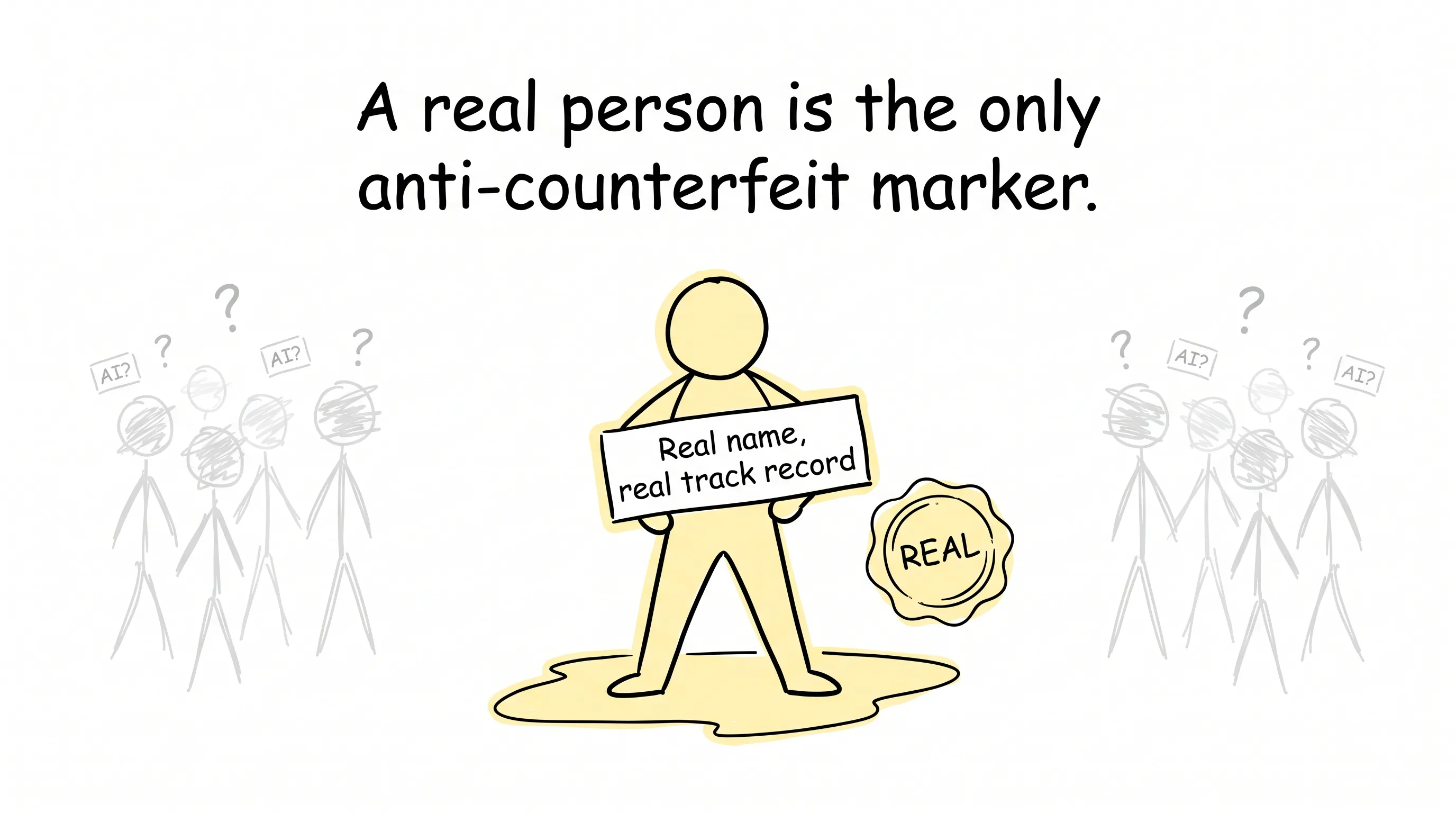
The answer is disappointingly simple: a long-term, real person with a name and a track record.
To put it bluntly: a personal brand.
When people come for you — for your name, your takes, the work you've been putting out year after year — then algorithmic recommendations become secondary, the AI's list becomes secondary, and even whether a given video is real or fake becomes secondary.
In an era where trust has sunk to rock bottom, being a real person isn't just a bonus.
A real person is the only anti-counterfeit marker.
In closing
On the way home the day the session ended, I turned one question over in my head: these five plays look wildly different, but underneath, they're the same thing.
Channels change, tools change — but what customers are ultimately looking for has always been an answer they can trust. Zero-click didn't kill trust. It just made trust harder to fake.
Tools can make the fake look real. Then you'd better make sure the real thing can stand up to scrutiny.
Here's to becoming the name that gets mentioned.
Continue reading
Related articles

When AI Does the Creative, Mistakes Come in Batches Too
A learn article on the risks of using generative AI for marketing creative across brand, legal, compliance, and operational layers, with case examples and seven practices for review, rights clearance, documentation, and vendor governance.
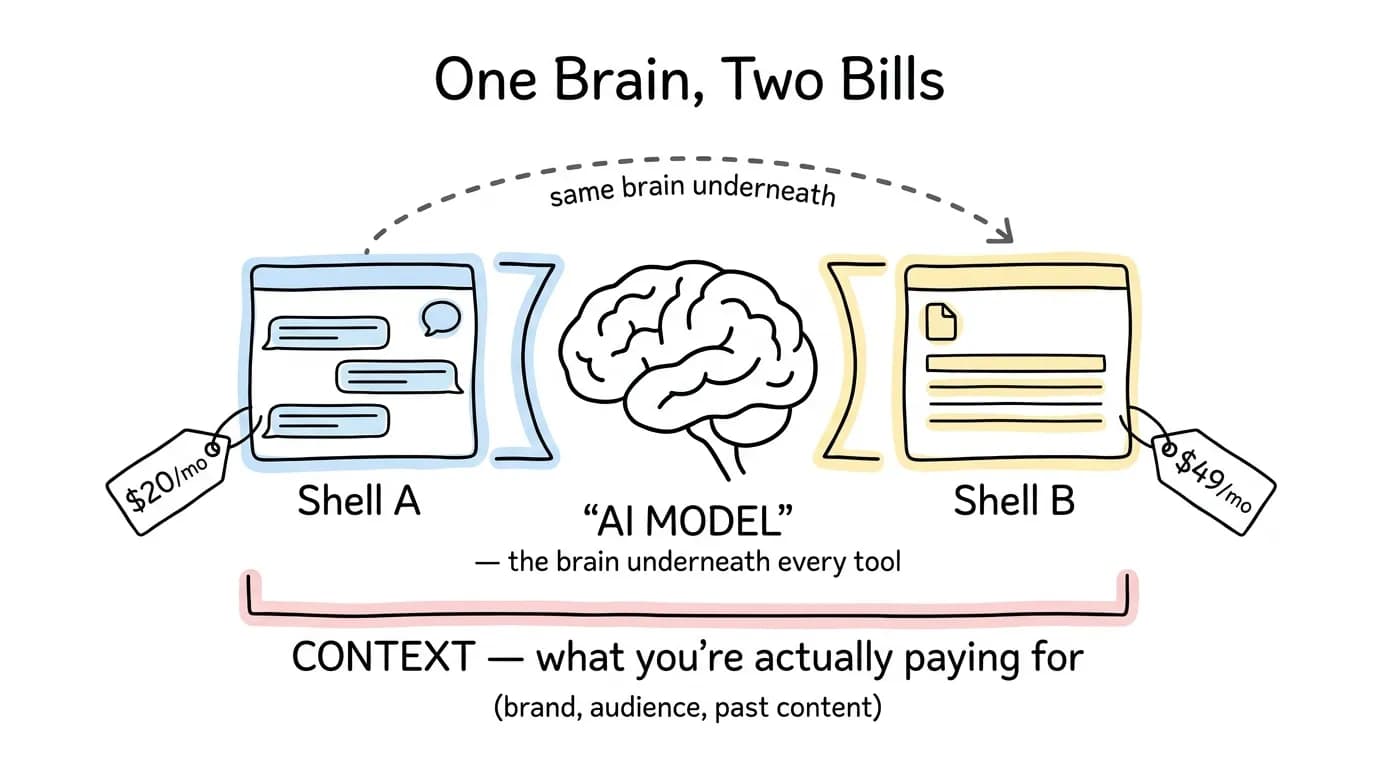
Which AI Should Your Startup Actually Use for Marketing?
A startup marketing guide explaining the difference between AI models and tools, sorting tools by job (writing, research, design, leads, email, video ads), and outlining a 30-day test plan for choosing them. It also covers generative engine optimization and budget trade-offs.
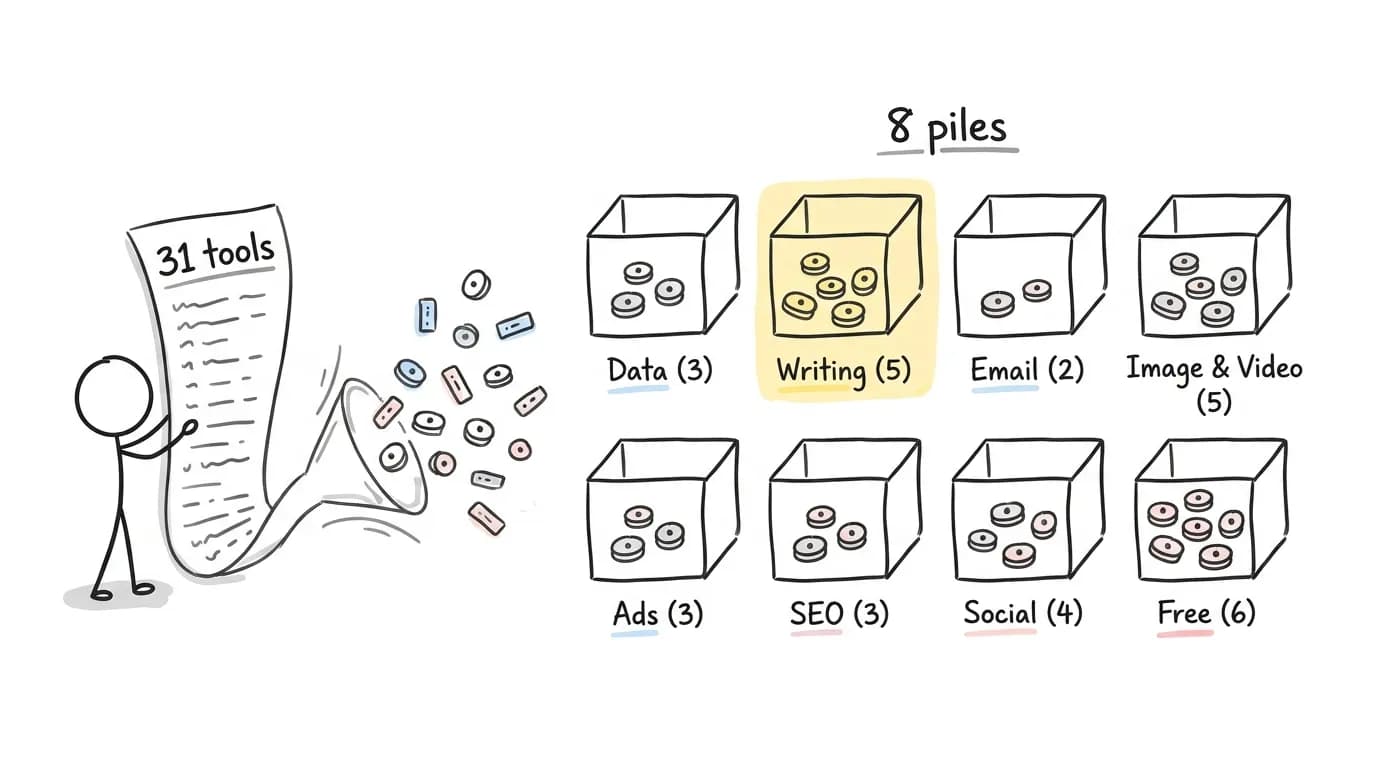
31 AI Marketing Tools, Reviewed One by One: How Exactly Should You Spend the Money?
A review of 31 AI marketing tools grouped into eight categories, covering data, content, email, video, ads, SEO, social, and free options, with guidance on choosing one strong tool for your most frequent task and testing free tiers first.