
One AI-Written Ad Line Lifted Click-Through Rates by 450%
A learn article on AI-generated advertising, opening with JPMorgan's reported 450% click-through lift from Persado copy, then covering Coca-Cola's 'Create Real Magic' contest and a Mint Mobile ChatGPT script test, plus concepts, benefits, risks, and adoption tips.
I stumbled on a number recently that stopped me in my tracks: 450%.
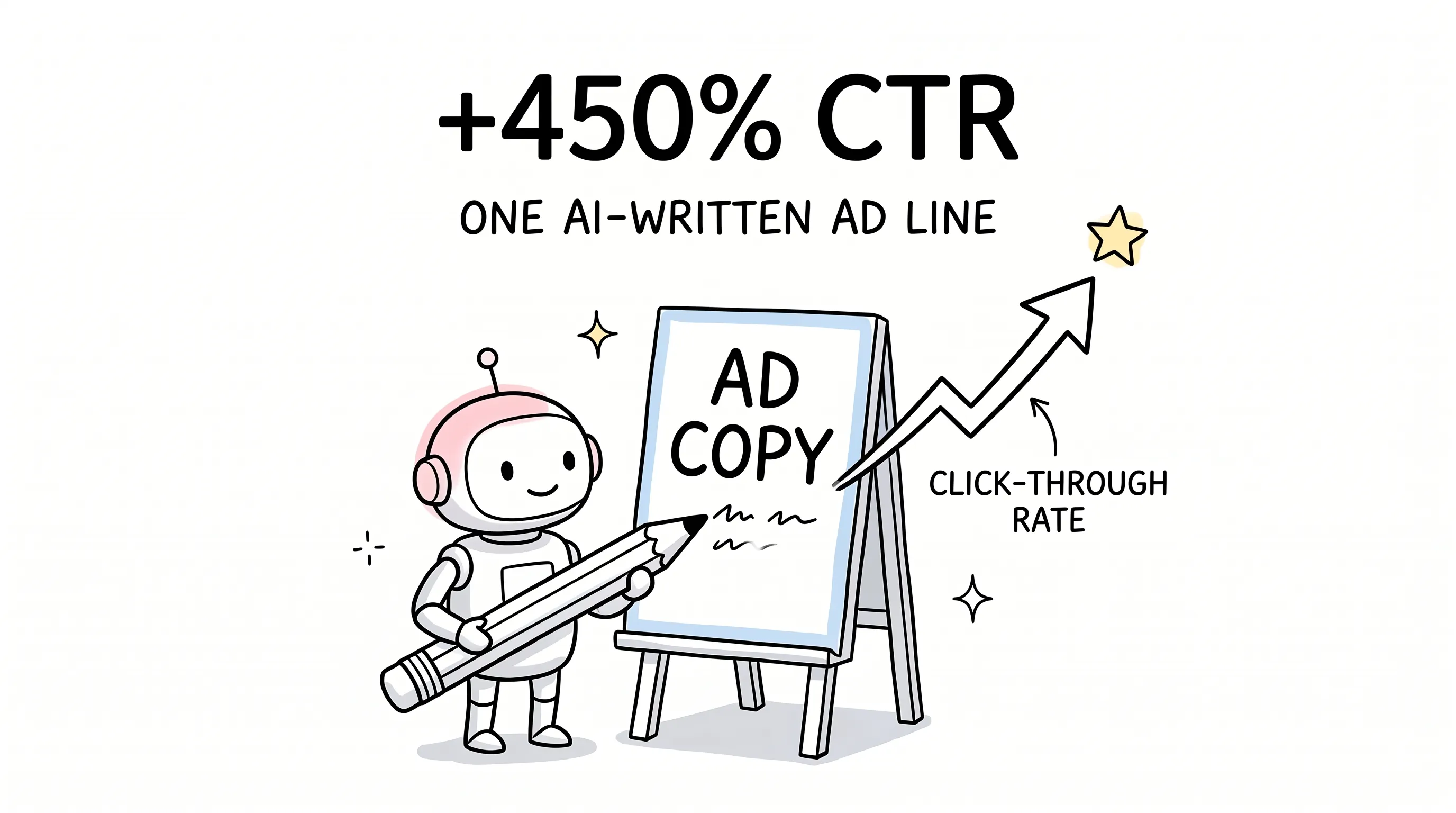
Not a stock price — that's the jump in ad click-through rate (CTR) at banking giant JPMorgan.
And what produced a lift like that? You might not believe it: ad copy written by a machine.
Story One: A Bank Signs a Copywriting Company
It starts with a company called Persado.
What is Persado? A firm that uses AI to generate marketing copy.
JPMorgan started using it to write ad copy on a small scale back in 2016. The trials worked, and in 2019 the bank went ahead and signed a five-year deal. The AI does two things: write entirely new ad copy, and take the bank's old, human-written copy and rewrite it. You've seen the result: click-through rates rose by as much as 450%. At the time, the bank was also planning to use the company's data capabilities to generate personalized copy for different audience segments.
Even a few-hundred-strong copywriting team pulling all-nighters couldn't match a result like that.
Makes sense, right? Don't rush to conclusions yet — I've got two more stories for you.
Story Two: Coca-Cola Opens a Century of Advertising History to AI
Coca-Cola is an elder statesman of the advertising world. Founded in 1892, it ran its first newspaper ad in 1896, and with every shift in media since — radio, television — it has been first in line.
In February 2023, it did something big: it formed an alliance with OpenAI and consulting firm Bain, and that same month launched a contest called "Create Real Magic". The rules were simple. Members of the public would use ChatGPT and DALL-E, combined with Coca-Cola's classic ads from years past, to create their own works — and the winners would be featured on Coca-Cola's official website.
Good grief. It amounts to opening up more than a hundred years of advertising treasure to internet users and AI everywhere, to play with as they please.
That contest is worth mining for three things.
First: when new tools arrive, use them. If a brand never gets in the game itself, it will never know how high the water line goes.
Second: let your customers join the creative process. Advertising is a brand shouting at its customers; a contest is customers shouting alongside the brand. Those are two entirely different feelings.
Third: lean on the best. Ally with the strongest technology companies, and the tools and the experts all show up at once.
Story Three: Funny — but It Sends a Chill Down Your Spine
In September 2023, Hollywood actor Ryan Reynolds — who also founded the mobile carrier Mint Mobile — asked ChatGPT to write an ad script for his company.
The result? The script was funny. But a little unsettling.
That script never actually ran as part of an ad campaign; Reynolds simply posted it on social media and YouTube. Even so, it set the whole internet buzzing — a wave of free publicity.
The most valuable lesson of this experiment hides precisely in the fact that it never ran: what AI writes is not the same as what you can publish. Brand voice and content quality still need human gatekeepers. Reynolds' own comedic human touch was the real reason that ad took off.
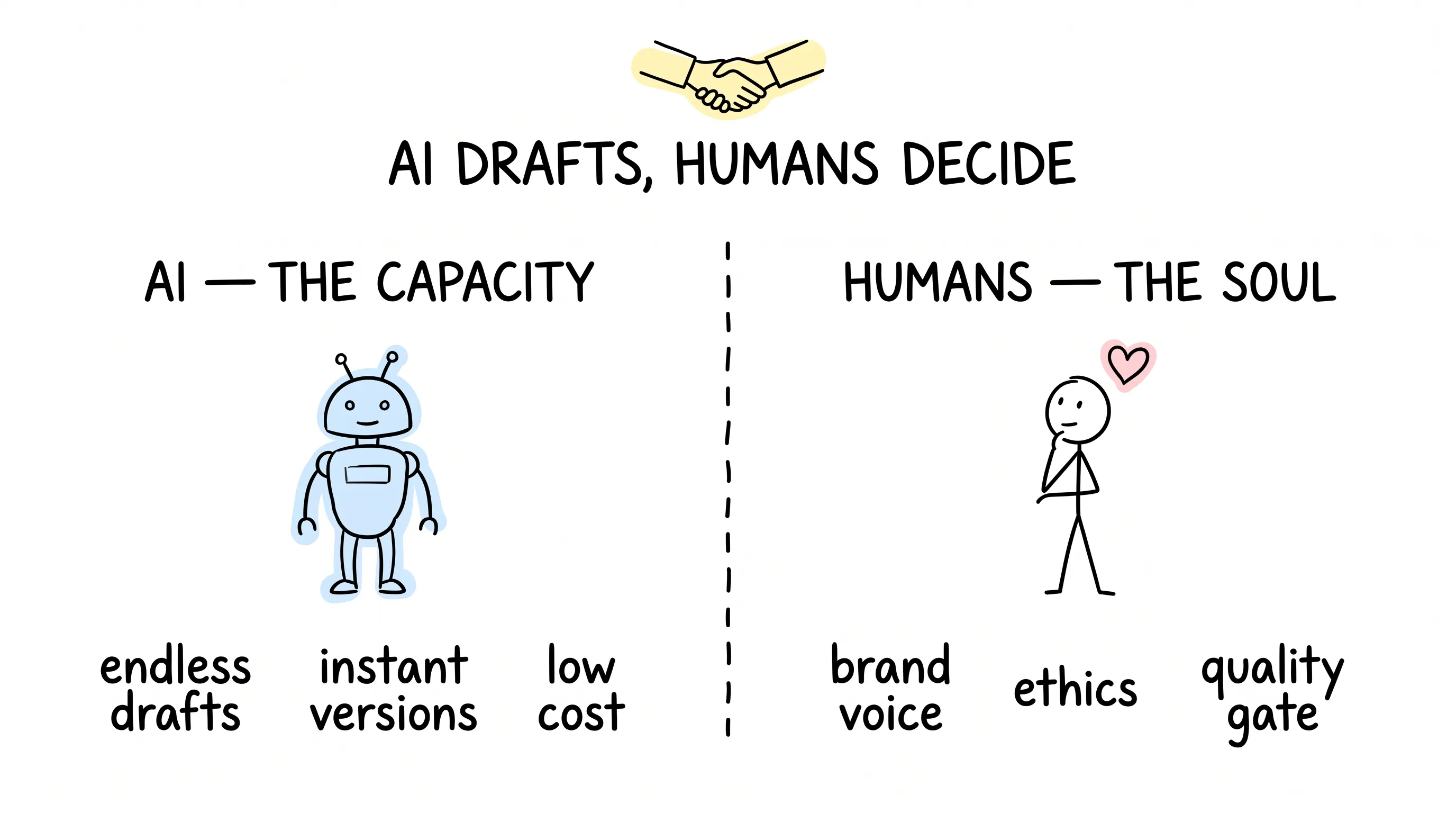
AI supplies the capacity. People supply the soul.
Three Stories Down — Now Let's Get the Concepts Straight
What is generative AI, exactly?
AI of the past looked. It looked at your purchase history and guessed what you'd buy next; it looked at your behavior data and judged fraud risk. It analyzed data and produced judgments.
Generative AI creates. Feed it oceans of text, images, audio, and it learns the patterns inside — then writes its own copy, paints its own pictures, composes music, edits video. ChatGPT, DALL-E — tools like these all belong to this lineage.
One analyzes; the other creates. One word apart — and a whole industry pipeline between them.
Two more terms get muddled in marketing circles: AI marketing, and AI-generated advertising.
AI marketing is the big umbrella: using AI to read your audiences thoroughly, tailor service journeys to each individual, automate the repetitive work, and tune every channel's performance to the optimum. All of this has been in service for years.
AI-generated advertising is the new recruit: letting AI produce the creative itself — copy, images, video, end to end. It has only really taken off in the last few years, and the Coca-Colas and JPMorgans were among the first to dive in.
So What's Actually Good About It? Let's Run the Numbers
First, the capacity ledger. Not long ago, producing a version of ad creative meant outsourced revisions going back and forth, measured in weeks. Now AI hands you a stack of versions overnight, and no two quite alike. Meta built an AI sandbox tool for its advertisers that auto-generates images and auto-crops them to every screen ratio. The faster you can experiment, the better your odds of colliding with a great idea.
Next, the cost ledger. Automating creative production saves real, hard cash. For the first time, small companies have a shot at matching the creative output of giants on a fraction of a giant's budget. The price of a seat at the table has genuinely dropped.
Finally, the personalization ledger. One-to-one personalization has gone from slogan to assembly line: AI uses each person's purchase history and browsing behavior to generate email copy and recommendations made just for them. When reach is precise, conversions and repeat purchases climb on their own.
But There's Always a Flip Side
Generative AI learns its patterns from training data — and every bias in that data, it takes in wholesale. Once biased copy goes out the door, it isn't just the content that blows up; it's the brand itself.
Then there's brand voice. That Mint Mobile script — funny but unsettling — is the reminder: there are several rounds of human review between what AI produces and what can truly stand for your brand.
And there's the boundary between personalization and privacy. Personalization runs on data; push the data use too far, and attentive turns into intrusive — trust evaporates on the spot.
The fix? It's almost embarrassingly simple: AI drafts, humans decide. AI sprints on capacity; humans guard quality, guard ethics, and guard the brand's spark.
What Marketers Should Do Right Now
A few pieces of advice I actually believe in.
- Start small. Among content production, personalization, and data analysis, pick the one with the fastest visible payoff and run it end to end first — don't try to rebuild your whole marketing department overnight.
- Get the team learning. The tools keep iterating; the skills have to keep iterating too. Don't wait until the team next door has gotten comfortable before you panic.
- Have the uncomfortable conversation up front. Write the rules of AI use down, line by line: data privacy, content review, red lines on bias.
- Run small experiments and let the data talk. Keep a control group for every campaign. What works, double down on; what doesn't, swap out.
Hyper-personalization, real-time generation that rides trending moments, conversational interfaces you can actually chat with — these are shipping one after another today. Even AI guides that walk shoppers through a virtual showroom are already showing up. The tools will only keep getting easier to wield.
Finally — Back to That 450%
450% is astonishing. But the JPMorgan executive who gave Persado the green light, the Coca-Cola brand team that decided to open the family silver, and Reynolds' eyes guarding the quality gate — those are the real variables behind the number.
The tools have pushed the door open. Whether you walk through — and how deep — is still up to the humans.
Here's to you — may you always be the one who knows which way to go.
Continue reading
Related articles

It's 2026: Stop "Buying" AI Tools for Your Marketing Team — Start "Hiring" AI Agents
This learn article explains how AI agents differ from standalone AI tools in marketing, outlines three agent categories — build-your-own platforms, CRM-native agents, and vertical tools — and covers use cases across SEO, social media, advertising, and reporting, plus criteria for choosing one.

Did the Money You Spent on AI Marketing Ever Come Back?
A guide to measuring AI marketing ROI across three layers: ad reports, sales pipeline, and the financial ledger. Covers metrics such as ROAS and CPA, eight dashboard metrics, industry benchmarks, and common measurement mistakes.

How to Pick a Creative Automation Platform: First, Figure Out What These Eleven Actually Do
A learn article sorts eleven creative automation platforms — including Bannerflow, Celtra, Smartly.io, and Storyteq — into four functional groups and proposes five evaluation questions covering publishing reach, automation depth, ease of adoption, team fit, and verifiable evidence.