
Meta Is Automating Advertising End to End — What's Left That's Yours?
An explainer on Meta's move toward fully automated advertising, covering five core systems — Advantage+, Lattice, generative creative AI, Andromeda, and GEM — plus Business AI, and arguing that while execution tasks get automated, strategy and original ideas remain the marketer's job.
A few days ago, I had dinner with an old friend who works in performance advertising. He took a couple of bites, put down his chopsticks, and looked worried.
He said, did you see that announcement from Meta last June?
I said, you mean the one where all advertising on the platforms gets handed over to AI, fully automated by the end of 2026?
He said, right. From the copy, to the images and videos, down to who sees each ad, when they see it, and how much money is spent — all of it run by machines. So tell me, is our industry done for?
I said, don't panic. First, let me walk you through what this machine actually looks like. Once you understand it, you'll know where you should stand.
First, Get a Sense of the Scale
Why is the whole industry staring at Meta?
Look at two numbers. Across its platforms — Facebook, Instagram, WhatsApp — 3.43 billion people worldwide use them, nearly half the planet. In Q2 2025 alone, ad revenue hit $47.5 billion, up 22% year over year.
Put that in perspective: the ecosystem that feeds on Meta's ads is counted in the millions of companies. When it shifts its weight slightly, the water temperature of the whole industry changes.
So it made sense that the ad world went into meltdown. Agencies are done for? Has the "AI slop-ification" of social media finally arrived in full?
All understandable. But after digging through their systems and studying them closely, my conclusion was the exact opposite of the panic:
This is not a disaster forecast. It's a product manual.
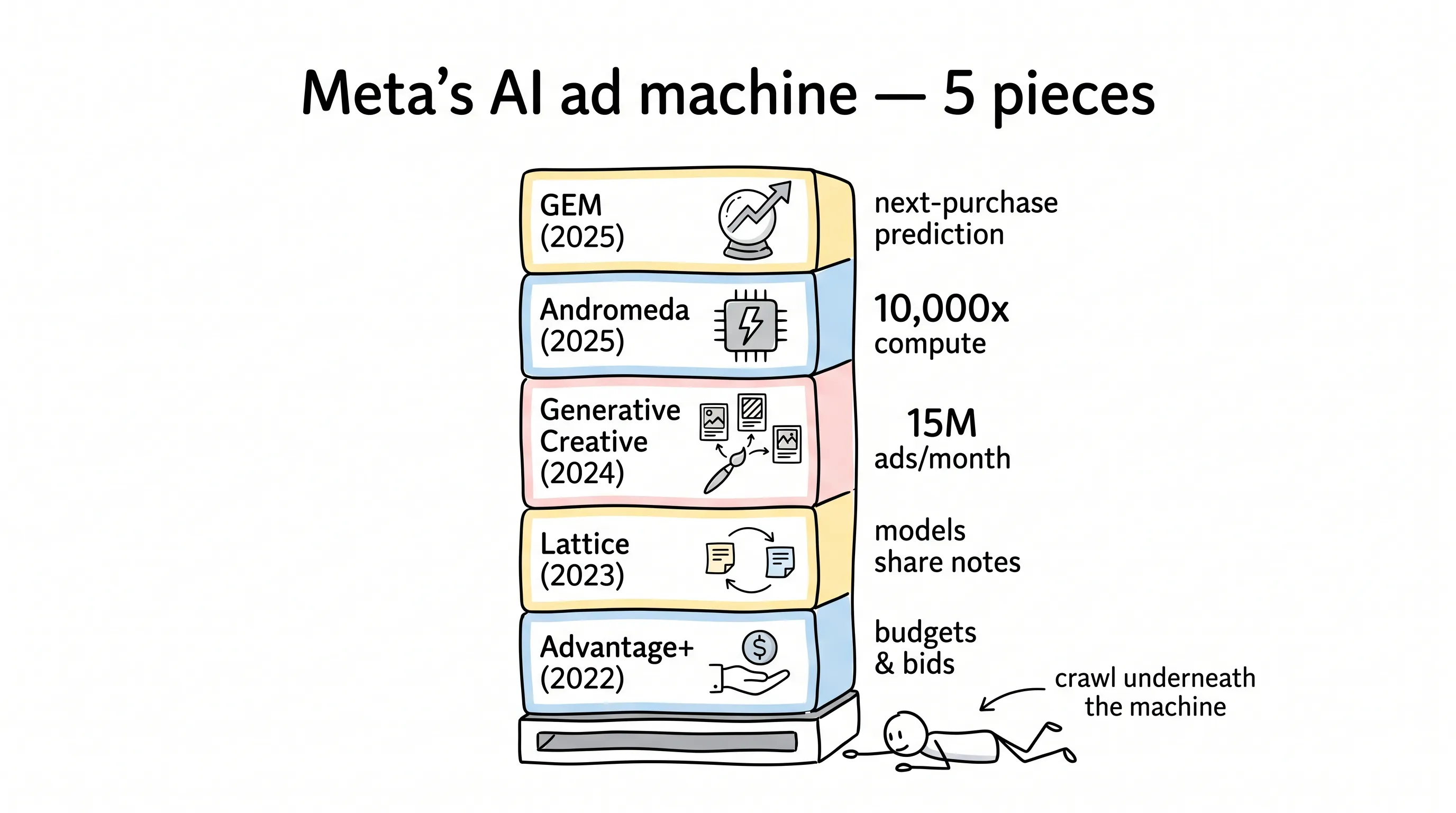
You first need to figure out how Meta actually views its relationship with the three parties — creators, agencies, brands. To see that, you have to crawl underneath the machine.
The Machine's Base: Five Big Pieces
A Meta VP in charge of monetization infrastructure has said it plainly: this ad system rests on five technologies underneath. The official language is a mouthful, so let me translate it into plain words, one piece at a time.
The first piece: the hand that manages the money — Advantage+, launched in 2022.
Its job is to hand the work of "babysitting campaigns" over to machine learning. How did you run ads before? You kept a team staring at dashboards all day: should this campaign get more budget? Do the bids need adjusting? At what time? Humans need sleep.
Advantage+ doesn't sleep. It watches around the clock for which campaigns are performing well and which audiences are buying, then automatically shifts budgets and adjusts bids, pushing performance toward its ceiling. That Meta VP put it bluntly: the key to this whole thing is that machine learning models never get tired.
By the way, it also once saved Meta's life. When Apple later tightened ad tracking on the iPhone, the data line between "saw an ad" and "bought something" was cut. Meta used transfer learning, combining its own platform data with advertisers' first-party data, and spliced that line back together.
The second piece: classmates who copy each other's notes — Lattice, announced in 2023.
Meta used to keep a bunch of small models that each did their own thing: one predicted who would click on ads, another predicted who would actually pay. Each learned separately, none of them talking to each other.
What Lattice does is get them teaching each other. What is transfer learning? A model finishes job A, then goes to do job B, and after finishing B, comes back and does job A even better. Doesn't that sound like the top student? After learning physics, math suddenly clicks too. Notes passed around in a circle, and the whole class levels up together.
The third piece, the one keeping creative people up at night: generative creative AI, launched in May 2024.
Give it one product photo and one line of copy, and it can spin out hundreds, even thousands, of versions: rewrite the copy a different way, swap in a whole new set of backgrounds, even draw a completely new image from scratch. And generating versions isn't the end — it throws them into testing itself, to see which version wins over which users.
How fast? Within one month of the tool opening up, more than 1 million advertisers had used it to make 15 million ads. Fifteen million ads! Do the math yourself — how many years would it take humans to do that by hand?
There's a haircare brand, Living Proof; after adopting generative creative, purchases rose 18% compared with its usual campaign strategy.
So what makes Meta believe machines can take over "creative" work? That VP has an especially honest line: what humans are best at is coming up with new ideas; but asking you to list a hundred variants of the word "buy" is pure torture — anyone who has to do it will break down. Machines take away the torture; the new ideas are left to you.
The fourth piece was forced into existence by the third: Andromeda, launched in December 2025.
With 15 million ads pouring in, a new problem arrived: too much inventory, shelves bursting, picking couldn't keep up — even the system searching for one suitable ad was slowing down.
Andromeda was a major renovation of software and hardware at once: co-designed with Meta's own MTIA accelerator and Nvidia's Grace Hopper chips, it raised computing power 10,000-fold. The result: ad matching is more accurate, users come across ads that are actually useful to them, and conversion rates on Facebook Feed and Reels rose 4%.
The fifth piece — the one I personally find most interesting — is GEM, launched last April.
Ad targeting in the past always had a bit of fortune-telling to it: guessing whether you'll click on the one in front of you.
GEM learned the core skill of large language models: predicting the next word. It takes all your ad browsing and purchase history as one sequence, and predicts what you'll buy next. The clever part is, it can see you're walking several purchase routes at the same time: comparing strollers by day, researching mechanical keyboards by night. Several routes running in parallel, it serves you different ads in parallel.
In Q2 2025, this model lifted Instagram ad conversions by about 5%, and Facebook Feed and Reels by about 3%.
Now that we've covered the five pieces, do you taste something else in them? Each piece stacks on the one before it, compounding like interest. Advertisers' operations get easier and easier, yet people sink deeper and deeper. The handier the tools, the deeper the trap.
Your Feed Is Full of These Tricks
The base is laid; the new features on the surface are the tricks. Here are a few you'll probably run into while scrolling your feed.
Virtual try-on. Meta is already piloting it with some advertisers: upload a photo of yourself, and you can see how that piece of clothing in the ad looks on you.
AI sticker CTAs. That stale "Shop Now" button under ads is being replaced by AI-generated stickers — maybe a product photo, maybe a logo graphic. Meta's VP of product said such stickers get 50% to 200% higher click-through rates, because they're fun and bring products to life. The trick showed up at last year's Cannes Lions, then opened up to more advertisers globally; Stories and Reels on Facebook and Instagram are all piloting it.
AI music and AI voiceover. The machine reads the ad content and composes an original track to match the product's tone; going global? It helps you translate and dub too.
Persona-based image generation. Selling headphones? From the same product photo, generate a "style-forward" version for the fashionable crowd, an "audio-quality" version for audio fans, a "comfort-all-day" version for business travelers. Same pair of headphones, a different look in every feed.
Creator search. Brands search for creators on Facebook by keyword, can view their audience profiles and average engagement rates, and pick a suitable spokesperson for themselves.
Meta AI assistant ads. This assistant has over 1 billion monthly active users, everywhere across Facebook, Instagram, WhatsApp, and Messenger. Starting December 16, 2025, your chats with the assistant will also feed back into what ads get pushed to you. From "serving you" to "serving the ads" — in one step.
A VP on Meta's ads product line has a saying: with this many platforms and billions of users, testing every ad variant by hand is fundamentally impossible. The value of AI is letting you run experiments efficiently, then converge on the play that actually works.
An advertiser complained that doing it this way felt out of control. His answer was direct: we've seen far too many "suboptimal uses". What we do is align the system with the way advertisers measure value.
Translated into plain words: don't fight it — the machine knows what you want better than you do. Uncomfortable to hear. But think carefully: that "way of measuring value" he mentioned refers exactly to the number you chase in meetings every day.
Meta's Hand Reaches Beyond the Feed
If you think Meta's ambition stops at the ad slots in the feed, you're not looking deep enough.
Not long ago it launched Business AI, a big move outside the feed: an AI agent that can lead you from an ad into private messages and chat with you all the way to placing an order; it can also be installed on the brand's own official website, handling customer service and taking orders.
Where's the confidence? The head of Business AI says: a brand's years of ads and posts on Meta are a hidden knowledge goldmine about that business. This AI doesn't have to learn you from zero. It flips through everything you've ever posted, and when it speaks, it sounds like you.
It has been living inside your business for ten years already — it just never picked up its work permit.
This move strikes at the pain point of a widely circulated MIT study: 95% of enterprise generative AI pilots never produce measurable business returns. Why? The infrastructure is too hard to build, and small and mid-sized businesses can't afford an AI team. Business AI's pitch is exactly: don't build it, use it directly. No need to spend millions of dollars hiring consultants either.
The Endgame Is "No One"
Don't be soothed by lines like "tools are made for people to use" and "agencies and creators are indispensable". I checked around — several Meta executives have been emphasizing exactly this.
It's true. But please add the second half of the sentence: at least for now.
The head of Business AI has relayed Zuckerberg's vision: in the future, merchants come to Meta with just two things — a product catalog and a business goal — and AI handles everything else, fully automatically.
That isn't the future. That's a countdown.
So what should marketers do?
My take: what gets automated this round is the "execution layer". Making variants, watching budgets, adjusting bids, running translations — admit it on these four; machines do them faster than you, and they don't sleep.
But there are two things machines can't take away yet: figuring out why a campaign makes people resonate, and coming up with the next idea nobody has thought of. Even Meta's own executives admit this is exactly where humans are strongest.
What gets automated was never creativity. It's every repetition pretending to be creativity.
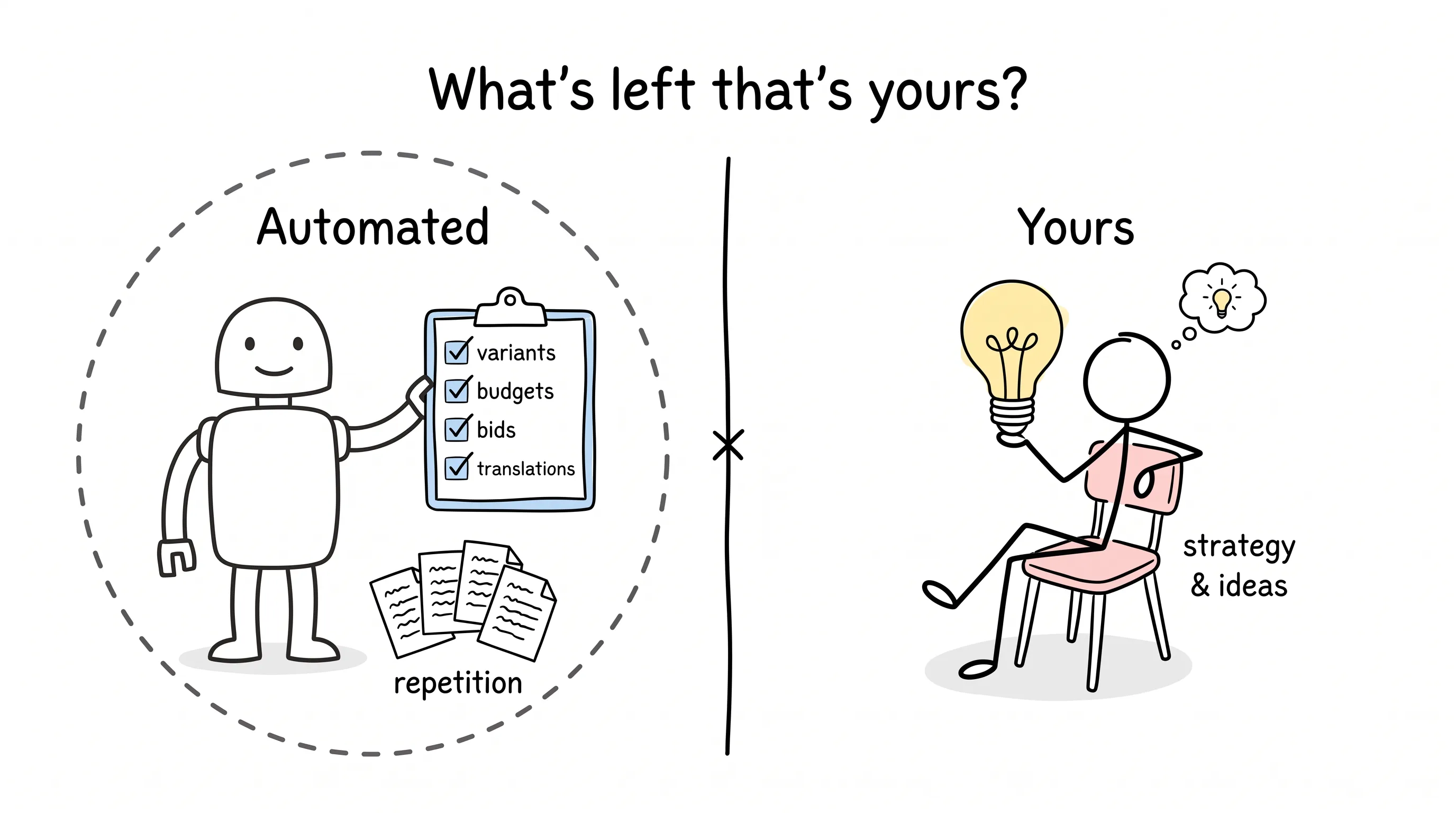
So don't compete with machines on the subjects they're best at. Use the tools to free up your hands, and throw every freed-up hour at the part machines can't do.
Back to That Dinner
Later, I asked my friend — have you made peace with it now?
He said, the machines watch the budgets, he keeps his eyes on strategy, and he actually calls clients more than before.
I said, that's exactly right.
And may you too have a chair no machine can take away.
Continue reading
Related articles

It's 2026: Stop "Buying" AI Tools for Your Marketing Team — Start "Hiring" AI Agents
This learn article explains how AI agents differ from standalone AI tools in marketing, outlines three agent categories — build-your-own platforms, CRM-native agents, and vertical tools — and covers use cases across SEO, social media, advertising, and reporting, plus criteria for choosing one.

Did the Money You Spent on AI Marketing Ever Come Back?
A guide to measuring AI marketing ROI across three layers: ad reports, sales pipeline, and the financial ledger. Covers metrics such as ROAS and CPA, eight dashboard metrics, industry benchmarks, and common measurement mistakes.

How to Pick a Creative Automation Platform: First, Figure Out What These Eleven Actually Do
A learn article sorts eleven creative automation platforms — including Bannerflow, Celtra, Smartly.io, and Storyteq — into four functional groups and proposes five evaluation questions covering publishing reach, automation depth, ease of adoption, team fit, and verifiable evidence.