
Agentic AI Is Rewriting Marketing Personalization — but the Foundation Matters More Than the Model
An explainer on agentic marketing: how AI agents differ from rule-based email automation, why data freshness limits agent decisions, and how governance and shared records shape personalization. It ends with advice to pilot one flow, such as post-event follow-up, with clear suppression rules and a success metric.
A few days ago, I had dinner with an old friend who runs marketing operations at a large enterprise.
He could barely sit down before the complaints started: budgets spent, tools bought, and yet in every meeting the boss asks the same thing — why does our personalization still look like a mass blast?
He pulled out his phone and showed me the configuration diagram of their nurture flow. Dozens of branches, nested layer upon layer, like a bowl of spilled instant noodles.
I asked him: who maintains all these branches?
"My team, of course," he said. "Changing one rule takes an approval cycle, and every change pulls on three or four other places. Before a quarter is out, the logic is completely stale."
I told him: what you're missing probably isn't a new tool. It's a pair of hands that can read the road on their own.
What Is Agentic Marketing?
Let's take the word apart first.
What is an agent? AI that can set its own goals, use tools on its own, look at the feedback, and adjust. Note that this is a different animal from the ChatGPT-style assist that drafts copy for you. With assistance, you make the decisions and it holds the pen; with an agent, you set the direction and it runs on its own.
So what is agentic marketing? Taking this self-running machinery and putting it inside the marketing workflow.
What does that look like once it's in? One comparison and you'll see it.
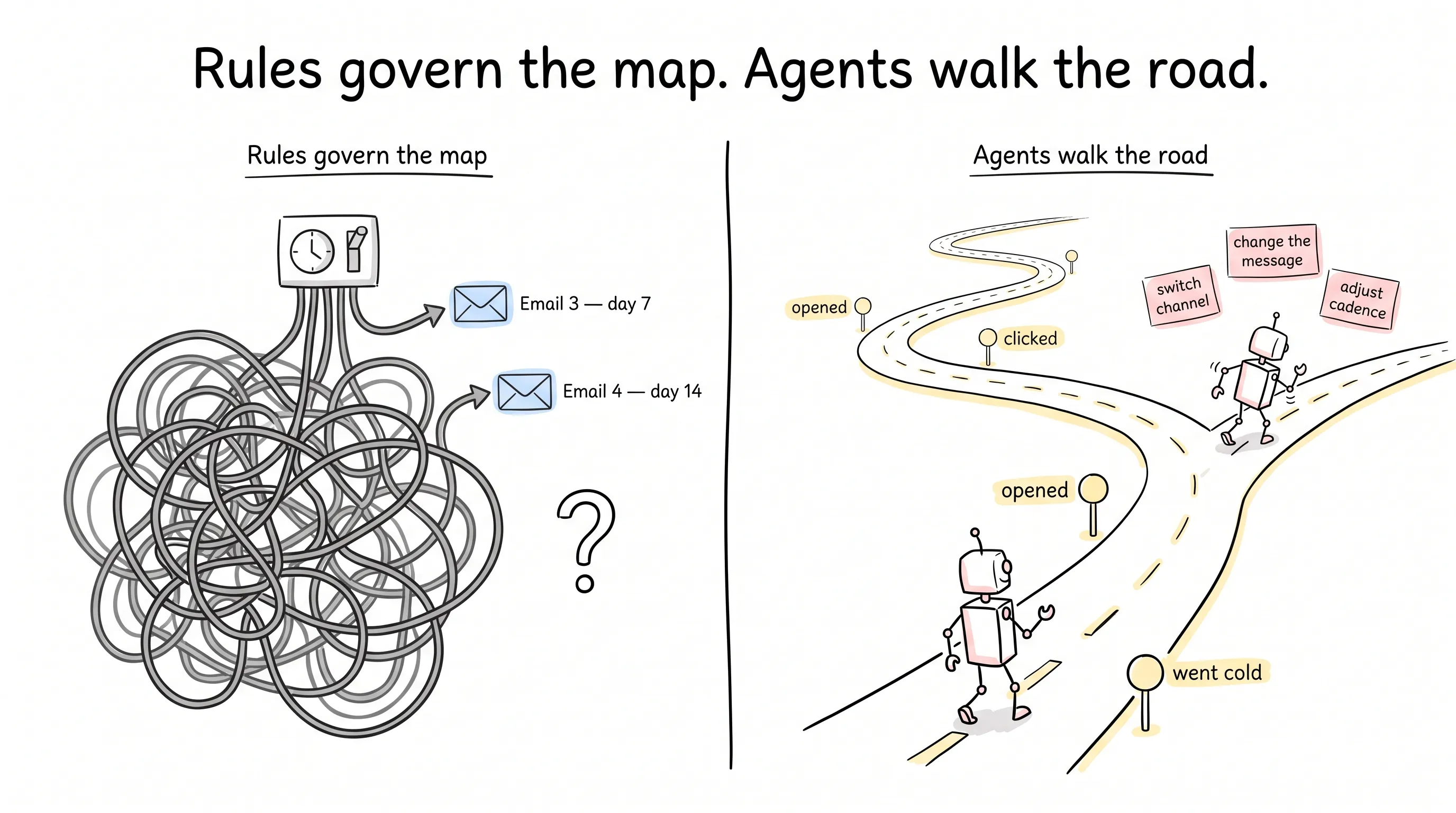
Traditional automation is like the timer switch on an air conditioner. When the clock hits the mark, it fires — no matter whether anyone is in the room. Email three goes out on day 7, email four on day 14; whether the recipient opened it, or read it to the end, simply doesn't appear anywhere on the flowchart.
An agent is like an air conditioner that can actually read the room. This prospect used to click open on sight last week; this week he won't even touch the subject line — the agent knows the temperature has changed, and it's time to switch channels, change the message, adjust the cadence.
Rules govern the map you've already drawn; agents walk the road as it changes in real time.
Why More Rules Mean Less Personalization
You might say: fine, I'll just add more rules then.
Think about it: at a multinational company, how many regions, how many product lines, how many approval gates? The ops team ends up tending dozens of branching logic sets, like keeping a pack of pets that need feeding every single day. One moment of neglect — a customer's intent shifts, their service status changes, the segment doesn't keep up — and the system sends anyway.
A mis-sent email isn't the scary part. The scary part is that you have no idea when it went wrong.
McKinsey research has made the call before: agents can automate a considerable share of the steps in a marketing workflow. In plain language, the path of maintaining rules by hand hits a wall at enterprise scale.
This has nothing to do with how hard your team works. This machinery can only carry so much.
An Agent's Ceiling Is the Data's Ceiling
Fine — so buy the smartest agent there is, and problem solved?
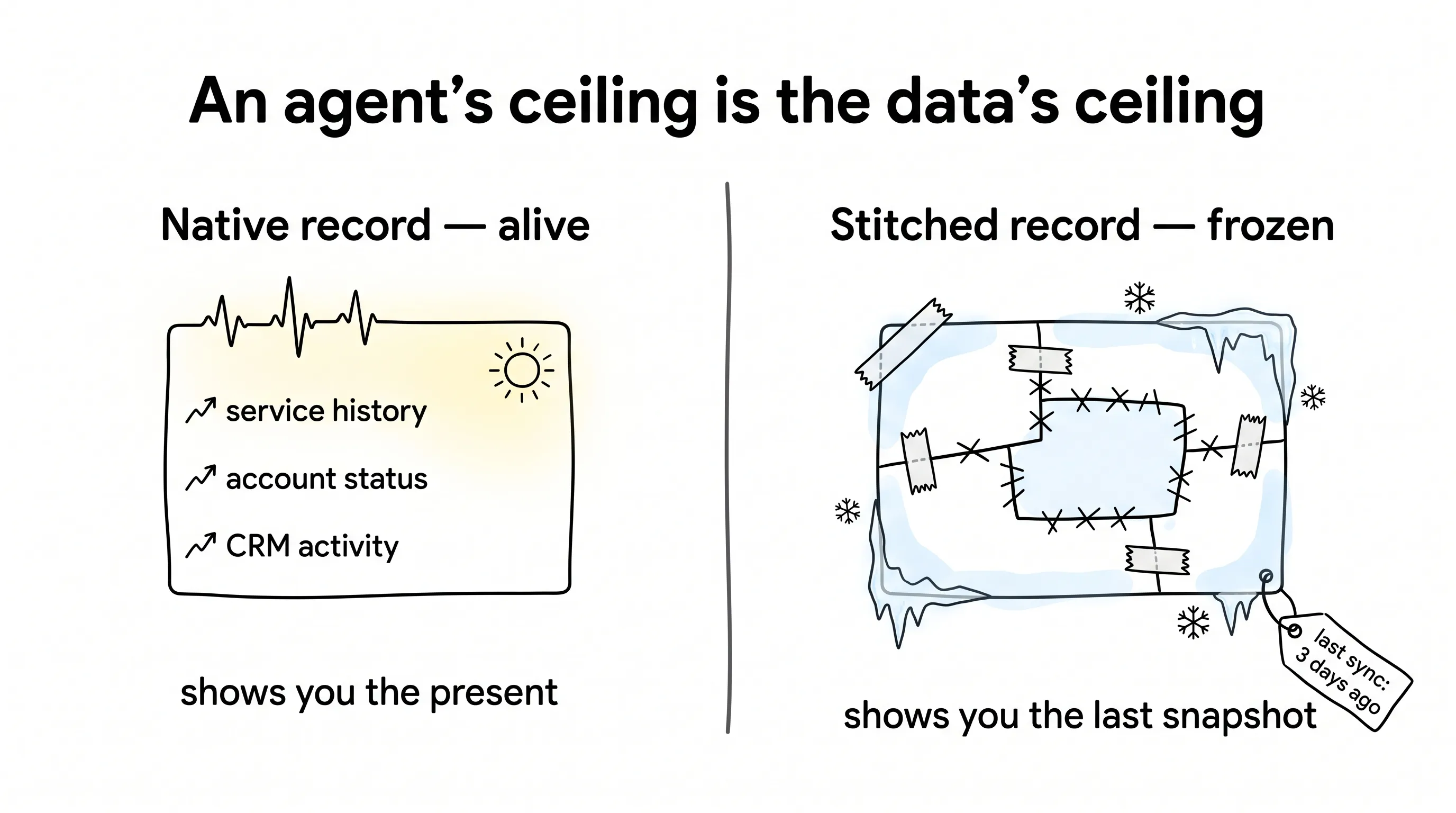
No. An agent's ceiling is the data's ceiling.
Lock a brilliant analyst in a back room, hand him a report that's three days old, and what can he possibly figure out? Agents are no different. However smart they are, if what they see is old data synced over, their decisions are day-old.
Same customer record — where it lives makes all the difference.
A native ServiceNow record is alive. Service history, account status, CRM activity — all growing in real time inside the same object, fresh every time you look.
A record stitched together from five or six systems is frozen. It reflects only the slice that "survived" the last sync.
One shows you the present; the other shows you the last snapshot. When the dust settles on personalization, what you're really competing on is where the data lives.
That gap gets magnified the most in service situations.
Picture this: one of your major customers filed an unresolved service escalation a few days ago. Right then, the marketing system's promo email lands in his inbox, "right on schedule."
How does that feel? My issue isn't even being handled, and you're already selling to me?
If marketing, service, and CRM data live on the same platform, that embarrassment never happens. The moment the ticket opens, marketing to that account pauses automatically. The moment it closes, outreach resumes — and you can even follow up gracefully: issue resolved, by the way, come see what's new.
No amount of marketing's own data could dream up a move like that. What it takes is the operational context of the entire organization.
Whether You Dare Let AI Run Free Comes Down to Governance
Beyond data, there's one more layer: governance.
Some people worry: if AI runs on its own in the marketing workflow, what happens when it veers off course? What about messages sent to the wrong people?
These are real concerns. That's why I value ServiceNow's current path so much: it embeds AI (Now Assist) directly into the platform's workflows, and permissions, approvals, and audit logs are capabilities the platform already has. In other words, everything the AI does is born inside the control system — traceable, accountable.
Letting AI off the leash means being able to account for it when something goes wrong.
IDC likewise frames agentic AI as a shift at the enterprise-architecture level, not a point-function upgrade. The way I read the math behind that statement: the wider the workflow coverage of the platform, the fewer interfaces you have to maintain, and the faster your campaigns run.
More Systems, Bigger Hidden Bill
Let's run another set of numbers.
I've asked a lot of enterprise marketing teams the same question: for one campaign, from audience selection, content review, and sending, to suppression and post-campaign review — how many systems does it cross?
The most common answer: five or more.
One update to the suppression list (a do-not-contact list) has to bounce between the marketing tool, the CRM, compliance review, and reporting — a wait that can stretch into days. Every handoff is another place where the chain can snap.
What's worse, the more systems there are, the more each system stores its own copy of the data. Give it enough time, and five copies can grow five different stories.
What you paid for the tools is the visible bill. How many copies of the data exist, how many syncs have failed, how far the definitions have drifted — that's the hidden bill.
But if marketing execution itself lives inside ServiceNow, the replication tax disappears. Shared records, shared approvals, shared security model — what the agent reads is exactly what's there.
Tenon is a marketing automation platform built on exactly this foundation. From ideation, to approval, to execution, one environment carries it through — no moving house midway.
Where Do You Start?
After all this, where does implementation start?
My advice: don't overreach. Pick the most painful process first.
Take post-event follow-up, for example. Once an online event ends, the ideation, segmentation, approval, and sending of follow-up emails often drag on for several days. Hand this flow to an agent to try: inside ServiceNow, based on CRM intent data, generate several segmented follow-up plans, clear the approvals, and go straight into build.
Before you start, nail down two things:
- Suppression rules. What conditions block a send — for instance, an account with an open ticket.
- A success metric. What reply rate counts as this flow working.
Let the agent get one flow working inside the guardrails first, then expand outward.
How do you tell whether it's working? I'd suggest watching two things: whether the segmentation is accurate, and how fast it reacts once intent shifts. And pay attention to one detail — after a signal appears, how long until the content catches up. This lag is often a landmine buried by synced data.
Toward the end of the meal, my friend asked me: what do you think is the most critical threshold here?
I said: not the model. Models get smarter every year.
It's the foundation. Whether your data is alive, or day-old.
Sounds mystical, but it's simple: whatever world you feed the agent is the marketing it hands back to you.
If the data doesn't move, intelligence is just decoration.
And may you untangle that bowl of spilled instant noodles soon.
Continue reading
Related articles

What Is an AI Marketing Agent? From "Using AI" to "Delegating to AI"
A learn article explaining what an AI marketing agent is, how it differs from rule-based automation, and which repetitive tasks such as lead qualification, reporting, and campaign monitoring can be delegated while humans keep key decisions.

Marketing Automation Is Shifting from "You Do It" to "You Say It"
This article explains how marketing automation is shifting from rule-based platforms that merely execute toward AI agents that plan, create, publish, and review campaigns, covering delegable tasks, underlying technologies, tool categories, adoption steps, and risks such as privacy and automating without strategy.

When AI Does the Creative, Mistakes Come in Batches Too
A learn article on the risks of using generative AI for marketing creative across brand, legal, compliance, and operational layers, with case examples and seven practices for review, rights clearance, documentation, and vendor governance.