
Why Is Influencer Marketing So Hard for AI Brands?
A learn article on why influencer marketing is difficult for AI brands, reviewing 18 agencies grouped into five playbooks: performance-driven, data-driven, culture-driven, full-service, and talent-management, plus practical notes on costs, timelines, platforms, and measurement.
A while back, a friend of mine who runs an AI app sent me a message in the middle of the night.
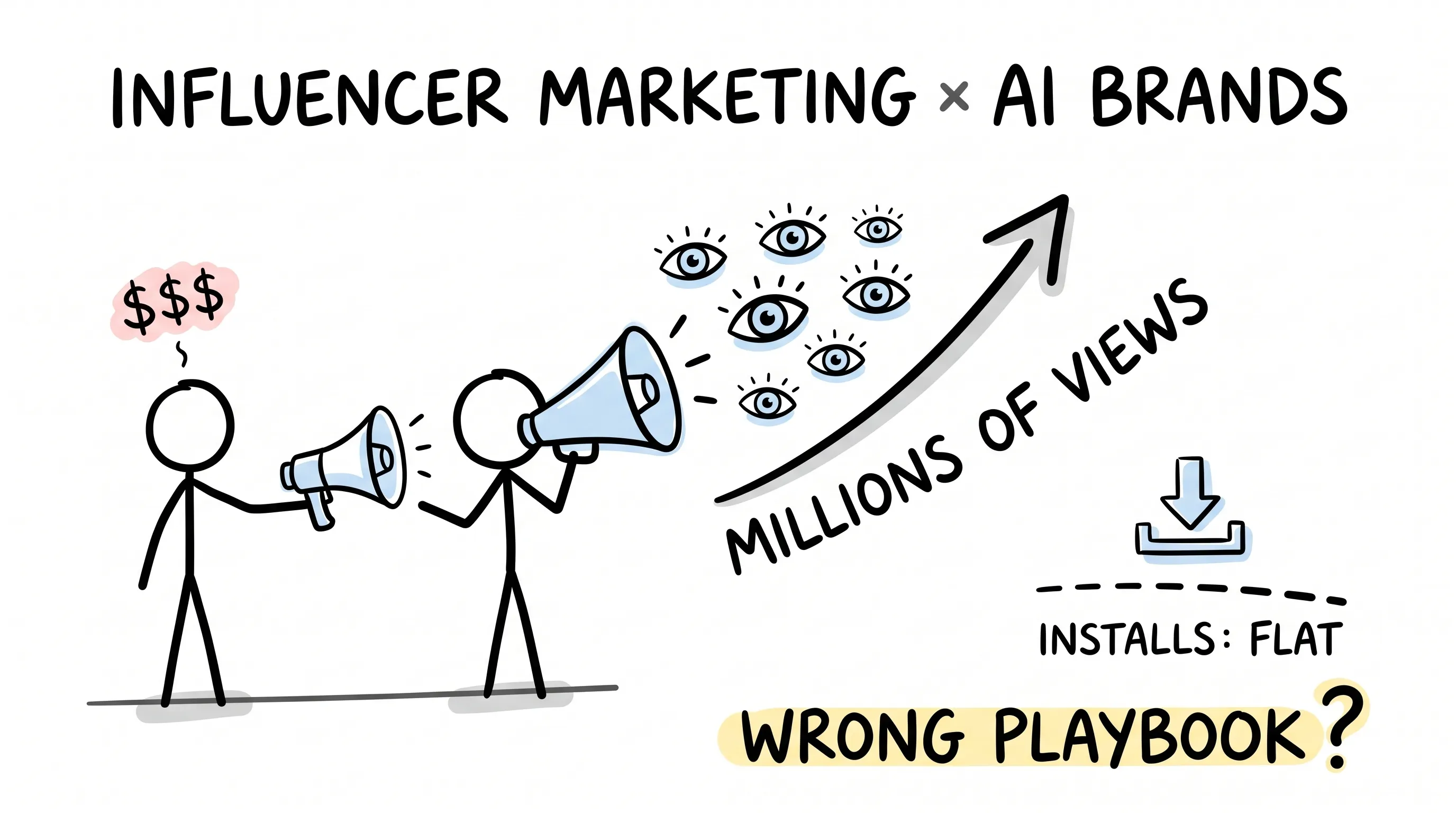
He'd burned through a budget in the hundreds of thousands, shot more than thirty influencer videos, and the view counts looked healthy — but the installs barely moved.
He asked me: did he just pick the wrong people?
I said: it's not necessarily the people. The whole playbook might be wrong.
Influencer marketing is harder for AI brands than for any other industry. Why do I say that?
Think about it: a snack brand working with creators can wrap it up in one line — it tastes good. Get the camera up close, snap, done.
An AI product? First you have to make people understand what you actually do. Go too shallow, and nobody feels anything. Go too deep, and the viewer has already scrolled away. Worse still, people are already on guard against AI marketing — they're sick of buzzwords like "disruptive" and "revolutionary." The harder you hype, the less they believe.
So a creator who hasn't been properly briefed can do more damage to an AI brand's credibility than doing no marketing at all.
And this difficulty isn't yours alone.
There are now more than 210,000 active AI companies worldwide, over 62,000 of them startups, with the industry growing more than 10% a year. In 2026, 57% of brands and agency buyers have put influencer partnerships at the top of their advertising priorities.
In plain terms: everyone is chasing the same pool of creators. And there were never many creators who could explain an AI product clearly in the first place.
So what do you do?
My advice is to go with an agency. But picking one is murkier terrain than it looks.
Recently I went through the 18 influencer marketing agencies most active for AI brands, scoring each on six dimensions: case-study library, case transparency, ROI data, professional depth, market presence, and client reputation, out of a possible 5.
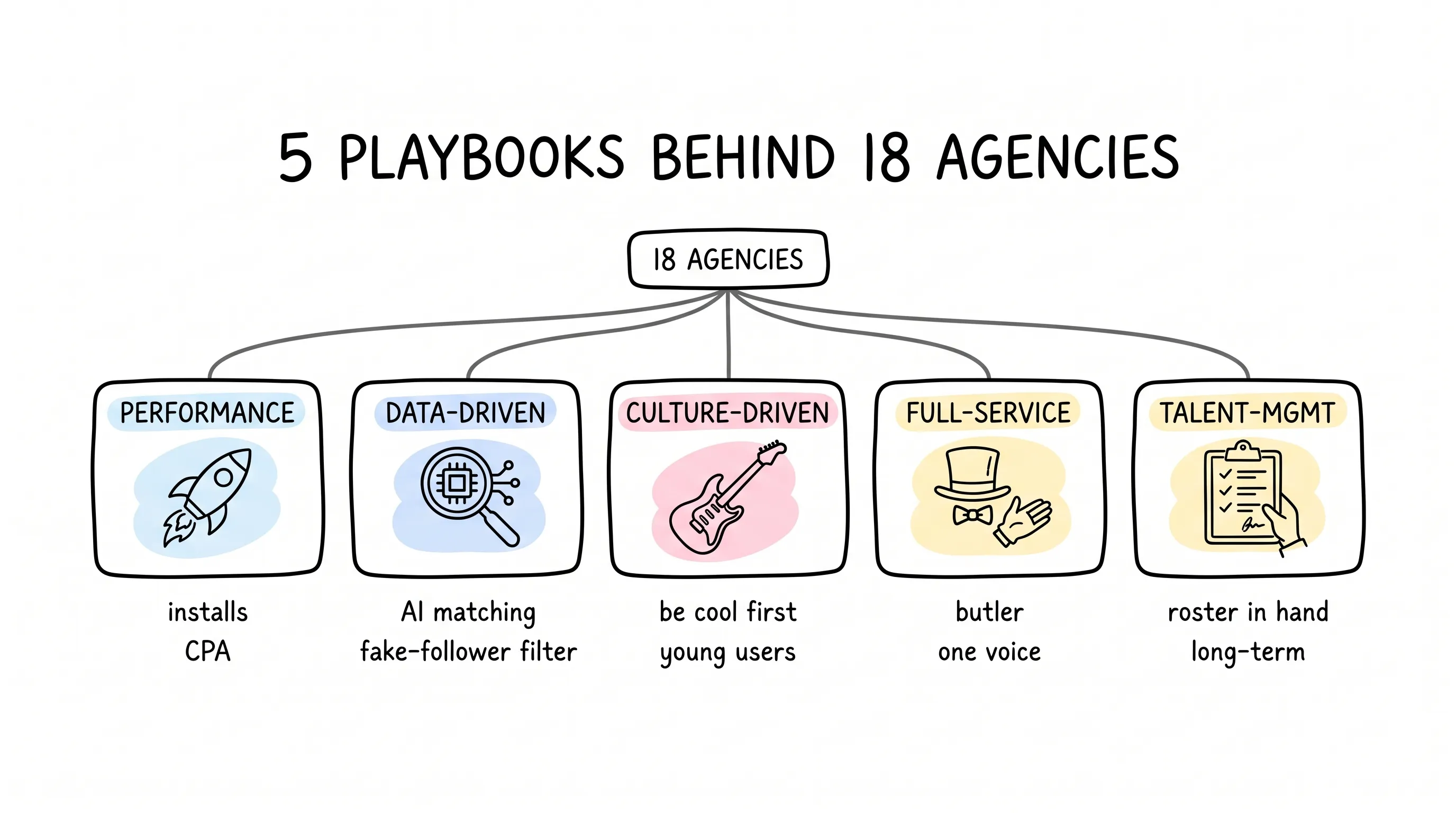
The scores are secondary. What's really interesting is that behind those 18 hide five completely different playbooks.
I'll go through them one at a time. Hold them up against your own situation, and by the end you'll know which kind to look for.
The First School: Performance-Driven — Installs and Acquisition Cost, Nothing Else
What's a performance-driven agency?
No fancy tricks, numbers only: how many installs, what an install costs, what a paying user costs.
The standard-bearer is House of Marketers, out of London — the highest-rated of the 18.
And it shows. Just how hard is the evidence?
Stickerbox, an AI consumer product that generates stickers from your voice. The launch campaign they ran brought in more than $300,000 in revenue within 90 days, and the product sold out four times.
A brand-new product. Three months. Sold out four times.
Artisse, an AI image-generation app: 30+ creators, 8 million video views, 18,000+ installs, at $2.50 per install.
Hint, an AI app: 16 custom videos, 200,000+ landing page visits, 1,500+ paid conversions, at $30 per paying user.
Hover Air: a network of 227 creators, 27.5 million organic views, plus another 2.6 million with paid amplification.
The ace up this agency's sleeve: its founding team includes early TikTok Europe staff, and its 75 people are spread across Europe, North America, Asia, Africa, South America, and the Middle East. They know the platforms inside out and can deploy around the globe.
Three more in this camp deserve a name-check.
inBeat, from Los Angeles. It can produce 300+ pieces of content a month, cut acquisition costs by 20% for the travel app Hopper, and lift ROAS (return on ad spend) to 3x for kitchen-appliance brand Hurom while cutting cost per sale by 70%. It manages upwards of $20 million in paid media a year and holds certifications from Meta, TikTok, Snapchat, and Google. The creative isn't guesswork — it's fed by ad performance data.
Acceleration Partners, from Boston, takes an even harder line: treat influencer marketing as an attributable revenue channel, period. Its proprietary APVision platform tracks the full chain to final purchase, from a single everyday post by a nano-influencer (creators with small, highly engaged followings) to celebrity collaborations. A partnership it ran for DIVI delivered 5.3x ROI. It brokers 1,500 brand-creator partnerships a year.
AdParlor, from New York, is an officially certified TikTok marketing partner. Since 2021 it has run 15,000+ campaigns and moved $650 million in ad spend. For TP-Link's TikTok Shop optimization: 2.5 million paid impressions, with CPMs (cost per 1,000 impressions) well below industry benchmarks.
Who is this school for?
In one line: AI companies whose KPIs are installs, paying users, and revenue — not "brand buzz."
The Second School: Data-Driven — Letting AI Find Your Creators
You might ask: do you really need an agency to find creators? Can't you just scroll the platforms yourself?
You can. But you'll quickly hit a problem: the ones with big followings don't necessarily get you, and the ones who get you don't necessarily have big followings.
The data-driven school exists to fix exactly that mismatch.
The standard-bearer is Influential, from Las Vegas, holding data on 3.5 million creators. Matching doesn't hinge on follower counts; it runs on psychological profiling built on IBM Watson — the creator's personality, values, and audience mindset all go into the calculation. This approach has generated over $2.5 billion in creator commerce revenue on the platform.
It's also a key TikTok Shop partner — it has even studied which content length converts best: 30 to 45 seconds.
Yes, that specific.
SAMY, headquartered in Madrid, covering 55 markets, runs its proprietary Shinebuzz platform against a pool of 120 million creators. It doesn't just find people; it tracks each creator's actual performance and separates the fake-engagement crowd from the ones who really move product. Interestingly, it also builds AI virtual influencers — an internal project called Helen AI. On pairing real creators with virtual ones, it has hands-on experience.
NeoReach, from San Francisco, runs on two tracks: a platform plus a managed service. Its back-to-school TikTok campaign for NVIDIA delivered 3.3 million impressions and more than $260,000 in media value. One more detail: fake-follower detection. An AI brand's worst fear is paying for fake traffic — this feature is essentially a filter that screens out those pitfalls before you spend.
The Influencer Marketing Factory, from Miami, has run campaigns for Nike, Gymshark, HelloFresh, Amazon, and Universal Music. Double-certified by TikTok, with a proprietary tracking pixel plus a multi-touch attribution model. Its core logic comes down to one thing: every dollar a creator brings in must be traceable to where it came from.
Who is this school for?
Established AI companies with real budgets, where the data has to reconcile with the financial statements.
The Third School: Culture-Driven — Make Young People Think You're Cool First
But there's always a flip side.
For some AI brands, the problem right now isn't conversion — it's that nobody is even looking their way. That's when you need the culture-driven school.
SocialChain, from London, works directly with TikTok's official music channel — it has run accounts like @MusicOnTikTok, and seven campaigns delivered 232 million video views. Its red-carpet interview series pulled engagement 242% above benchmark. Even LinkedIn UK, a B2B brand about as buttoned-up as they come, hired them for a TikTok makeover — and it worked. In 2023 they took home a UK social media award.
Coolr, also from London, 150+ people, counts Samsung and L'Oréal among its clients. Its most viral case was for the soda brand Tango: it co-created a rap with grime artist Millie B, and the product sold out nationwide. Their philosophy is one line: creators should be storytellers, not ad slots.
Duncan Channon, from San Francisco, averages a 72% completion rate on influencer videos. Its organic TikTok campaign for e.l.f. Cosmetics was, at the time, the most successful organic big-brand TikTok campaign on record. Looking back, it wasn't luck — it was a methodology of "find the cultural moment, match the creator." It also carries $1 billion of media-buying experience, so content that performs organically can be amplified again with paid spend.
5WPR, from New York, has spent 25 years on lifestyle brands with beauty and fashion roots, and is good at wrapping hard tech inside a lifestyle narrative. Monthly budgets start at $15,000.
Seed Marketing, still in London, pushes the idea further: influence has already shifted from individual creators to communities. Over 15 years it has built a community network of students and young people; half its team is under 26; it has worked with Lululemon, Spotify, New Balance, Adobe, and Revolut, and its peer-to-peer network once sold more than £3 million worth of tickets.
Who is this school for?
Consumer AI brands that first need to establish a "this thing is kind of cool" perception among young users, and only then talk conversion.
The Fourth School: Full-Service — Big Brands Need a Butler
If your operation is already big and influencer marketing is just one channel among many, what you actually need is a butler.
Open Influence, from Los Angeles, is a veteran of 12+ years in the business that has served LinkedIn, Subway, AT&T, and Huggies. Its strength is multi-platform orchestration: audiences on Instagram, TikTok, and YouTube consume technical content differently — the messaging needs separate tuning, but the brand has to be one voice.
VaynerMedia, from New York, 1,000+ people, handles everything from creator audits and affiliate strategy to full campaign execution. Pepsi, Duracell, and Chips Ahoy! are clients; its Duracell campaign — "I buy my own batteries now" — even won a media relations award from PRDaily. Companies with annual marketing budgets of $1 million and up: it can take them on.
Village Marketing, also in New York, has worked with Coca-Cola, HelloFresh, and Mars, champions "people-first" creator relationships, and was once named by Business Insider as one of the hottest influencer marketing agencies in the industry.
Who is this school for?
Mature brands. Those who want it handled, want one consistent voice across platforms, and aren't short on budget.
The Fifth School: Talent-Management — They Already Hold the Creators
This last school runs on a different business model: they already hold a roster of signed creators.
Clicks Talent, from West Hollywood, has 500+ signed creators, a cumulative 1.47 billion TikTok views, and an average engagement rate of 6.5%. The playbook is interesting: competition-style campaigns where its own creators compete against each other — whoever's content performs best takes the reward, forcing everyone to actually think instead of phoning in their deliverables. Its Amazon Music campaign: 90 creators, 2.6 million views, 170,000 likes. There's also a niche service — custom earworm jingles, starting at $15,000. It can also run guaranteed-delivery campaigns, settled on actual views, from $15,000.
Genflow, from London, signs top-tier creators with followings from the millions to the tens of millions outright — Senada Greca (fitness), Ali Abdaal (productivity), Iman Gadzhi (business education). Its logic is long-term relationships: creators who have already banked trust in lifestyle, productivity, and business content bring your AI product into their everyday content naturally. What you're buying isn't one ad — it's a continuous stretch of trust.
Who is this school for?
Brands that want to bind top creators long-term and weave their AI product into lifestyle content.
A Few Practical Questions, Answered While We're Here
By this point you probably have a few very practical questions. Straight answers:
How much does it cost?
Per campaign, generally $5,000 to $50,000+; monthly retainers most commonly run $10,000 to $25,000. Top celebrity creators are a separate conversation.
How long until results?
2 to 4 weeks for engagement and awareness numbers; real conversion usually takes 2 to 3 months, because AI products have long decision cycles; brand equity, 6 to 12 months and up.
Which platforms?
For B2B AI, LinkedIn first; for consumer AI, TikTok and YouTube; for real-time word of mouth in tech circles, X still owns the conversation. Don't expect one platform to do it all.
How do you measure success?
Follower count doesn't count. Look at demo requests, whitepaper downloads, webinar registrations, qualified leads — then go deeper with attribution modeling to connect creator touchpoints to closed deals.
Hire an individual or an agency?
For small campaigns, freelancers are cheaper. For a real AI product launch — creator vetting, content compliance, cross-platform scheduling, data analytics — an agency's value lives in exactly those invisible places.
One Last Thing
Back to my friend.
He later changed his question. No longer "which creator is most popular," but "which creator actually uses AI tools themselves."
The results actually turned around.
These 18 agencies each have their own specialty, but in the end it comes down to one line:
The endgame of influencer marketing isn't getting creators to introduce your product. It's getting them to actually use it.
The AI market moves fast. This principle won't change anytime soon.
Here's hoping you find the person who genuinely uses your product, too.
Continue reading
Related articles
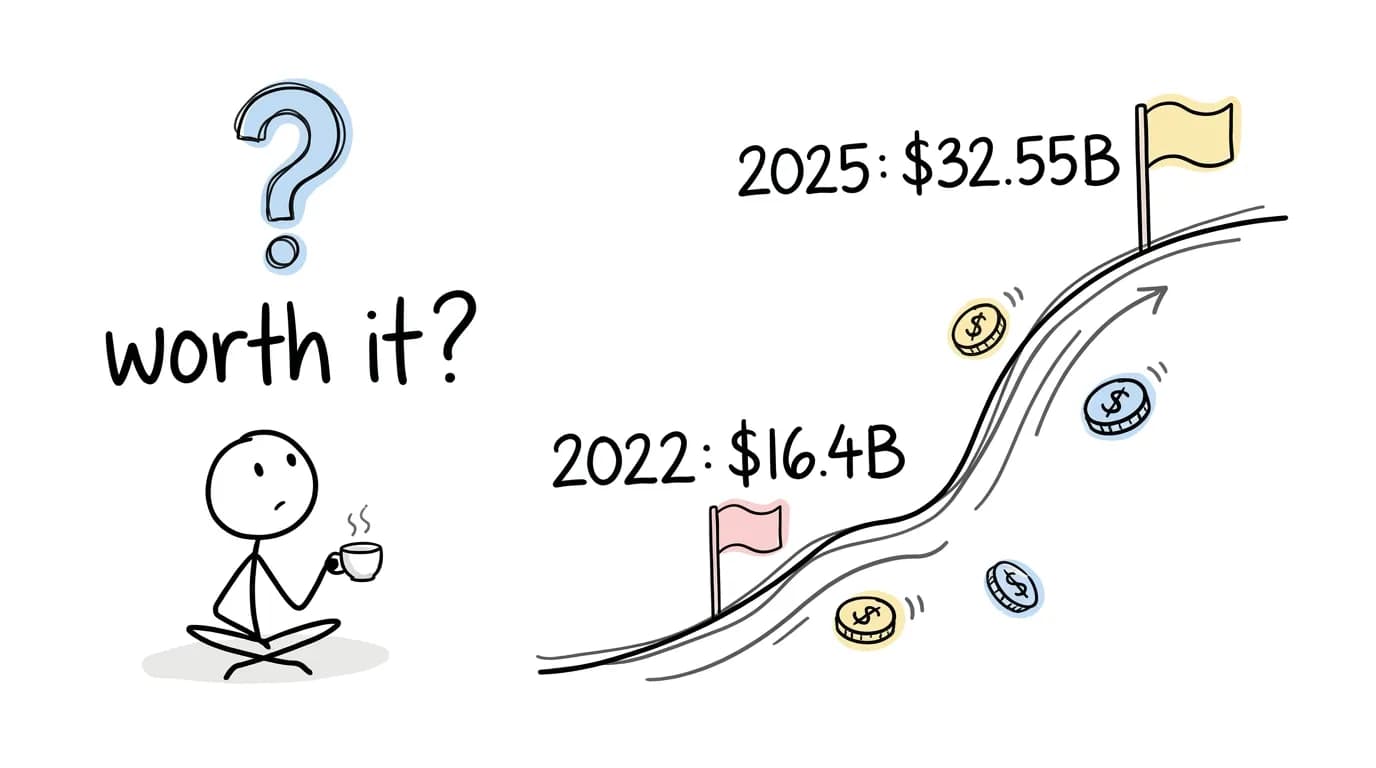
Is Investing in Influencers Actually Worth It? I Broke Down These Dozens of Numbers and Ran the Math for You
A learn article that compiles industry data on influencer marketing, covering market size, ROI measurement practices, nano versus mega creator pricing and engagement, platform budget allocation, AI tooling, and ad disclosure compliance.
The EU Is Handing the Pause Button Back to You
The EU's draft Digital Fairness Act targets dark patterns, addictive design, undisclosed influencer ads, silent subscription renewals, and game spending by minors, while keeping dynamic pricing legal but banning drip pricing; fines could reach 6% of annual turnover.
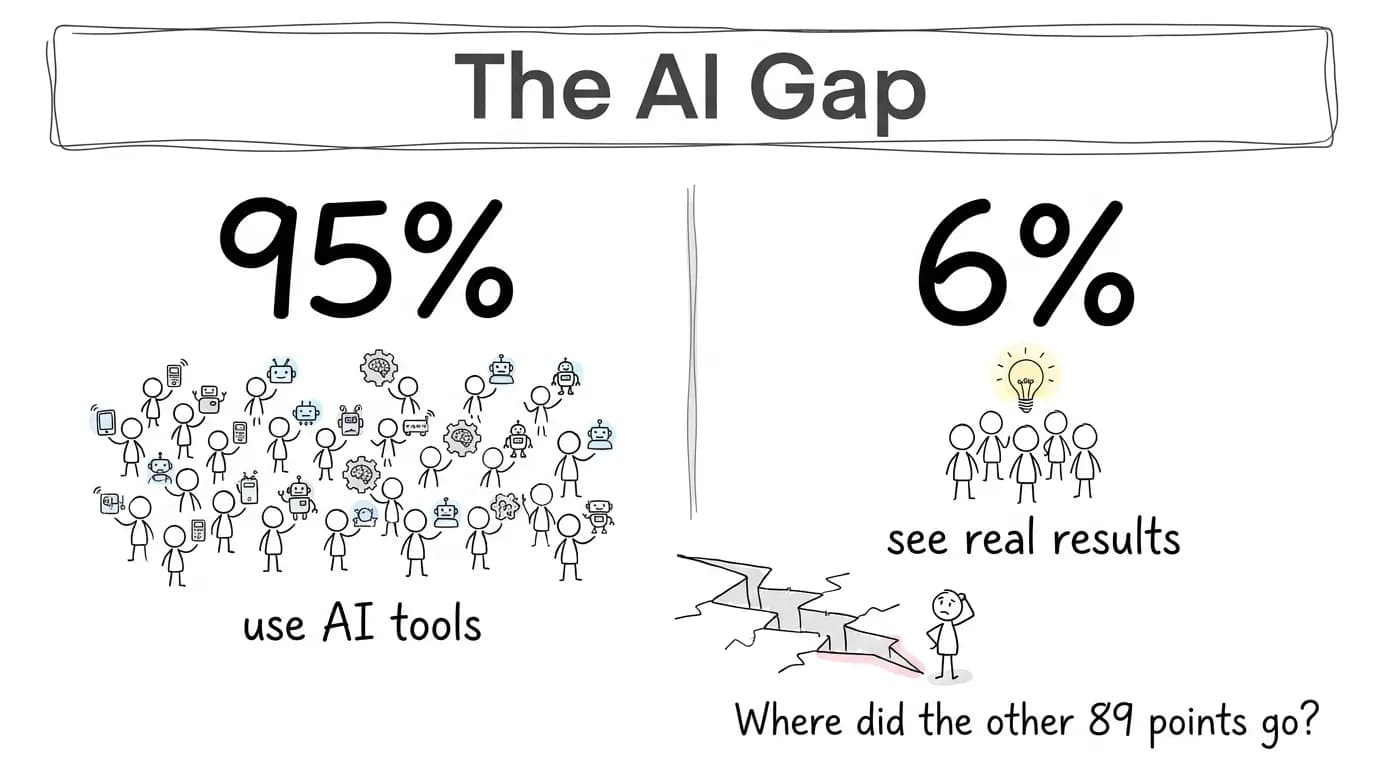
95% of Companies Use AI. Only 6% See Real Results. What's the Gap? Kolsquare's New Report Nails the Answer
A recap of a Kolsquare webinar on AI in influencer marketing, covering adoption gaps, AI-labeled content engagement, AI influencer limits, and generative engine visibility. It also outlines four practical moves for 2027 planning.