
AI Marketing Daily · 2026-10-26
Daily AI marketing briefing covering Kantar's 2026 trends on agentic commerce, a University of Toronto study on AI search citations, and comparisons of GEO, Meta ads automation, and B2B email tools, plus AI marketing case collections.
Today's ten reports all point to the same thing: AI is taking over the discovery stage. Kantar has written agentic commerce into its ten trends for 2026, a University of Toronto study confirms that AI search favors third-party media, four tool comparisons map out the vendor landscape, and two case collections put hard ROI numbers on the table. For marketers, the test has changed: brands now have to persuade both human readers and AI engines. Today's briefing is organized along three tracks — AI model news, marketing tools, and industry data — each with actions you can put to work right away. It's about a 20-minute read; focus on the top story and the three tool comparisons, then go do its two baseline actions.
🎯 Today's Top Story
Kantar releases ten marketing trends for 2026: beyond attention, brands must win over AI agents
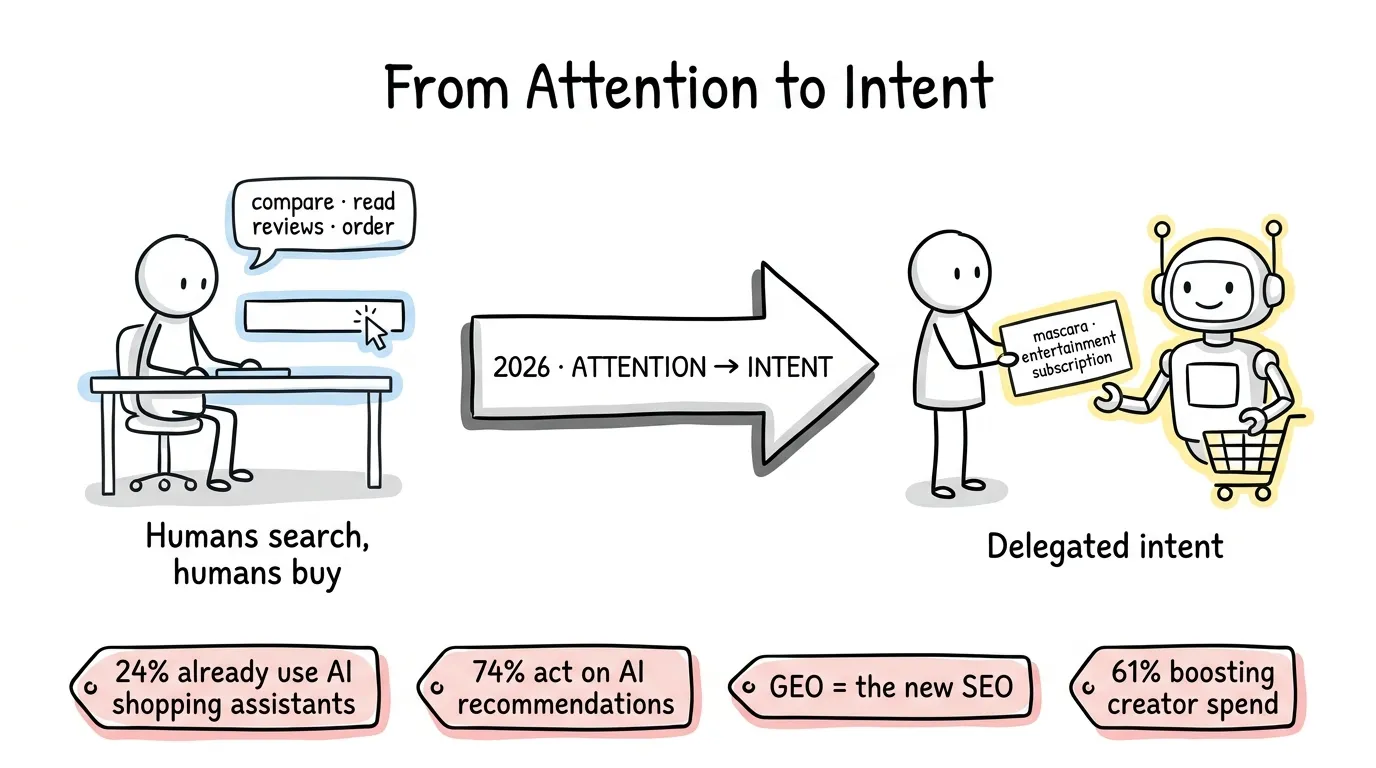
Kantar, a leading global research firm, has released Marketing Trends 2026, an annual read-out for CMOs that lays out ten trends for the year ahead — and the first one is "from attention to intent." Its core judgment: AI agents will show up at scale in 2026. Consumers will hand their intents — buying mascara, subscribing to entertainment — over to agents to execute, and as crypto gets built in, those agents will grow more and more autonomous. Kantar's own survey data shows 24% of AI users already use AI shopping assistants — agentic commerce is now business as usual. OpenAI has announced that its browser will integrate AI agents, and consumer behavior is shifting from "humans search, humans buy" to delegated intent. Kantar's Chief Insights Officer Jane Ostler puts it plainly: brands that accelerate their AI visibility strategies in 2026 will be better positioned for growth. Marketers must make their brands serve non-human consumers while still winning over humans through traditional channels — empathy and emotion still have a role to play in agentic transactions.
The other nine trends are just as data-backed. AI brand building: 74% of AI assistant users regularly act on AI recommendations, and GEO (Generative Engine Optimization) gets called out as the new SEO — brands must produce clear, structured, machine-readable content so the models know who you are and what you sell. Synthetic data for audience enrichment: Kantar's own synthetic data hits 94–95% accuracy against ground truth, and digital twin technology will bring clearer guardrails and use cases — though the industry admits it isn't fully ready. AI-native creative decisions: AI systematically predicts which ad will grab attention, stir emotion, and move purchase intent and long-term brand equity, and in 2026 agentic optimization suggestions will let marketers fine-tune dynamically based on historical performance. Small-joys economics: 36% of consumers will take on short-term debt for small everyday treats. With weddings, childcare, and homeownership drifting further out of reach, people have started celebrating inchstones (tiny life milestones) — divorce parties and post-layoff diamond purchases included — and social commerce closes the loop from demand creation to fulfillment in seconds, keeping this trend alive. Experiment-driven growth: over the past 20 years, brands willing to disrupt themselves — Apple, Amazon — created $6.6 trillion in brand value. Innovation has to be brand-led, not technology-led. Inclusive marketing: 65% of consumers value diversity and inclusion, up from 59% in 2021 — the anti-DEI noise isn't stopping that broader trend. Retail media: there are now more than 200 retail media networks, delivering 1.8x the results of digital advertising and nearly 3x the purchase intent. A net 35% of marketers plan to increase spending in 2026, and shoppable ads on connected TV (CTV) and streaming will go mainstream next year. Creator marketing: a net 61% plan to increase investment, yet only 27% of creator content is strongly tied to the brand, and coherent cross-channel creative matters 2.5x more to success than it did a decade ago. Micro-communities: Chinese brands using knowledge-sharing micro-communities achieve 25% higher marketing ROI, and nearly 40% of consumers trust recommendations from micro-communities as much as those from friends.
This report carries weight because of where it comes from. Kantar is a top global brand-research firm, and Blueprint for Brand Growth is its empirically refined brand-growth methodology. The old CMO growth formula was reach more people and win attention; this report rewrites it as: persuade more humans and get more AI agents to choose you first. It's the first time a leading institution has tied AI visibility directly to brand growth — with data to back it. If the models don't know you, they won't recommend you; if you're not recommended, you get optimized out. One line from the report is worth writing on a whiteboard: the strongest brands are the ones shaping the story AI tells. Those that fail to differentiate will drown in a sea of near-identical answers.
The implications for marketers fall along three lines. Content: machine-readable material — product specs, service details, guides, tutorials — is rising in value and must be broadly retrievable by agents. Brands need to get the structure right on recipe and how-to content so the models understand what your brand means before they're asked. Budget: with a net 35% increasing retail media spend and a net 61% increasing creator investment, both must be measured on ROI and brand metrics. Impressions and likes no longer count as a passing grade, and creator partnerships need to move from one-off executions to long-term creative platforms. Organization: synthetic data, AI ad testing, and brand building in the algorithm era all demand new skills. Kantar itself warns the industry isn't fully ready, so internal capability building needs to be scheduled ahead of time — responsible data practices, rigorous testing, and new roles, all of them.
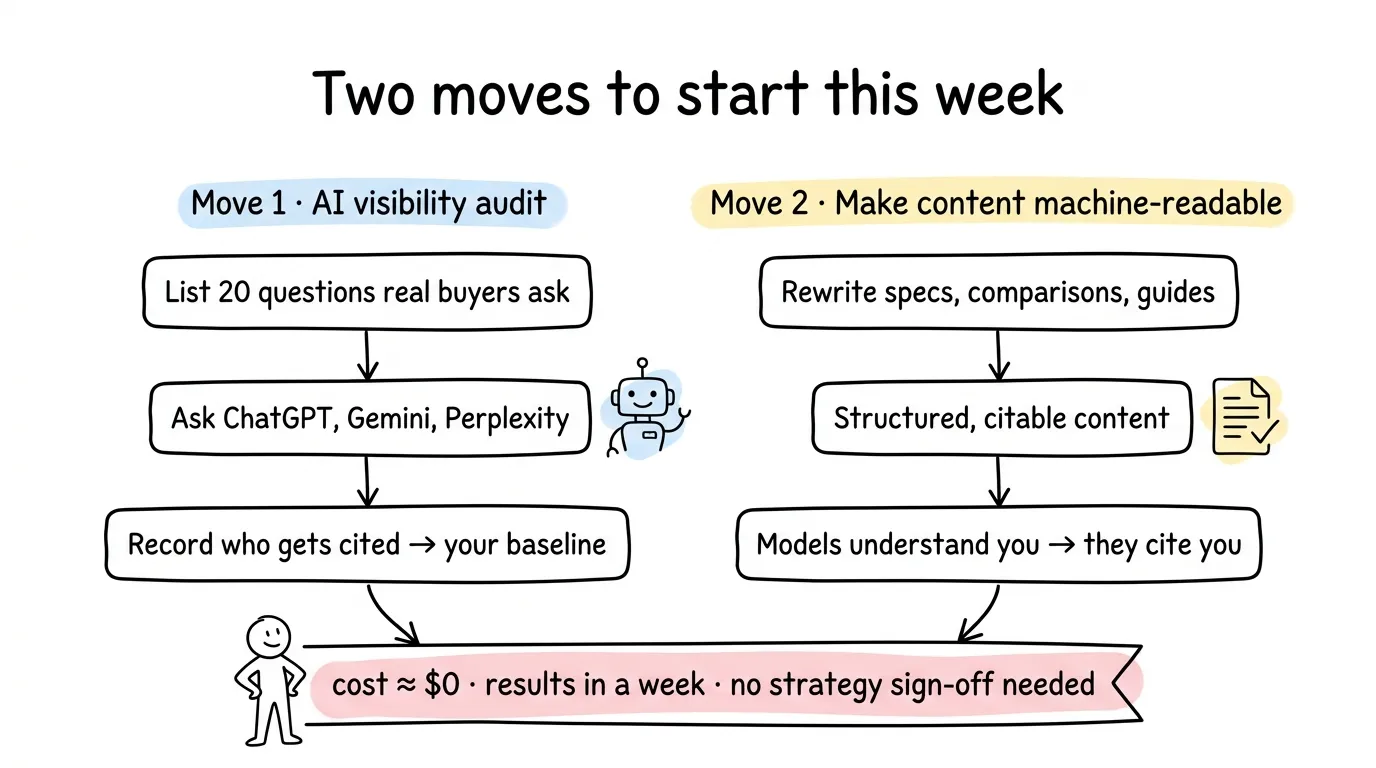
How to use this? Three steps. Step one: run an AI visibility audit this week. List 20 questions real buyers actually ask, throw each one at ChatGPT, Gemini, and Perplexity, and record who gets cited and where your brand ranks — that's your baseline for next year. Step two: rewrite your hero product's specs, comparisons, and usage guides into structured, citable content — the models have to understand you before they can cite you. This step costs no budget and takes a quarter or two to show results, so the earlier you start, the better. Step three: hold the human channels. Brand preference is still decided by people, so keep investing in attention channels — content, creators, retail media — with budgets measured on the twin metrics of ROI and brand health. Don't lose the humans while chasing the agents.
My take: Kantar has written out the 2026 exam question clearly — the answers, you still have to write yourself. Agentic commerce will penetrate more slowly than most expect, but the fight for AI visibility has already started, and those who move first gain a structural advantage. Watch the growth rate on that 24% figure — once it crosses 40%, the positioning of brand websites has to be rewritten. What worries me is the in-between state: most teams will stall at "discussing AI strategy" and never start. The visibility audit and content structuring are precisely the two things that don't need strategy sign-off — you can start this week. Teams that start now will be sitting much more comfortably this time next year.
🔗 Further reading: Read the full article
🏷 AI Model News
University of Toronto study: AI search systematically favors third-party media
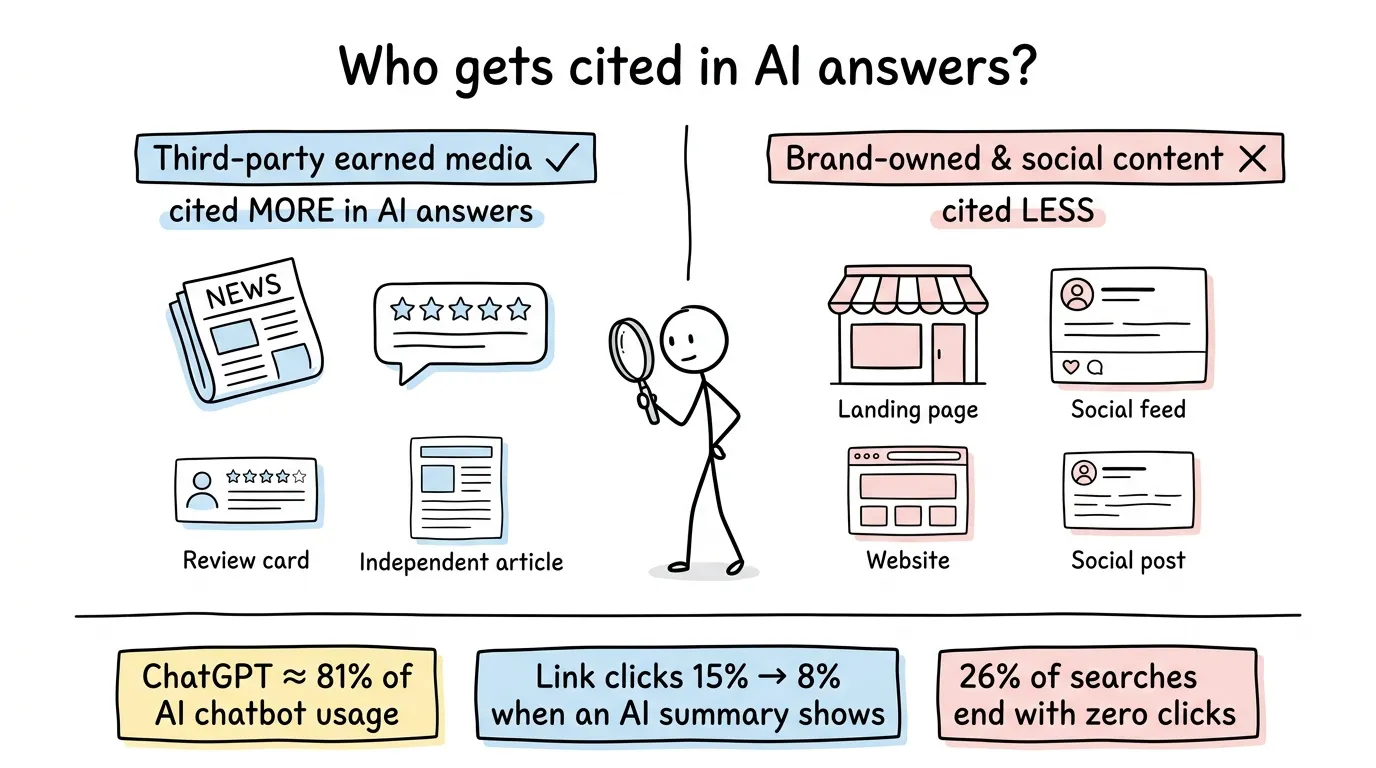
arXiv paper 2509.08919 (University of Toronto team, published September 2025) did something rare in the GEO field: a large-scale controlled experiment. The team compared the source structures of engines like ChatGPT, Perplexity, and Gemini against Google across multiple verticals, languages, and paraphrased phrasings. Key finding: AI search systematically favors third-party earned media (reviews and independent coverage) in its citations — brand-owned and social content get cited at noticeably lower rates. Google's source mix, by contrast, is far more balanced. The engines also differ significantly from each other in topical diversity, freshness, cross-language stability, and sensitivity to paraphrasing — you can't run one piece of content against every engine. The study also confirms a big-brand bias: niche brands are naturally disadvantaged in AI answers and have to hedge with third-party coverage. Sites that do well at traditional SEO are not necessarily equally visible in AI search — the two visibility logics are not the same.
The paper also carries background numbers worth remembering: as of July 2025, ChatGPT held roughly an 81% share of global AI chatbot usage, and Perplexity about 8%; Perplexity disclosed 780 million monthly queries in May 2025; and Pew's field research found that when Google shows an AI summary, link click-through drops from 15% to 8%, with about 26% of such searches ending with zero clicks throughout. The team also built a query taxonomy from top posts in five AI communities on Reddit; of the 12 question categories, shopping and purchase support is an explicitly retained one. Users are already having AI compare prices, analyze reviews, and haggle over car deals — some walk into dealerships negotiating with AI-compiled data in hand. Citability means every claim in your content can be backed up: with data, sources, and qualifications in place, the model dares to repeat you in its answers. Pages that are vague get skipped. The paper's strategic agenda has four items: design content for machine-scannability and citability; build AI-perceived authority with earned media; set strategy per engine and per language; and for niche players, actively break through the big-brand bias.
💬 Don't treat AI visibility as SEO overtime. Run the baseline this week: pick 20 questions buyers would ask, test which sources each engine cites, then decide where the budget goes. Prioritize PR and review resources — third-party coverage feeds AI answers better than your own landing pages.
🔗 Further reading: Read the full article
Neil Patel podcast field test: AI agents overloaded with tasks degrade fast
Marketing School (Eric Siu and Neil Patel, June 17, 2026, 22 minutes with a full transcript) delivers hands-on feedback from real use. The two field-tested four agents — Hermes, OpenClaw, Codex, and Claude Code — plus three MCPs (Model Context Protocol servers): HeyGen, Riverside, and Beehiiv. The most valuable lesson: overload an agent with tasks and it degrades fast. Once the context fills up, it starts "losing track" of what it's supposed to do — insisting it can't do things it plainly can. The right approach is splitting tasks and fork-and-remix: Eric forked the GitHub repo of Picasso, the team's in-house creative agent (bulk image generation with brand guidelines and a designer in the loop), dropped it into Codex, and remodeled it into a cold-outreach tool — generating a few rounds of on-brand, compliant ad creative for target customers like Salesforce before sending cold emails, then using Hermes to finish the build. One clean pass, end to end. Their usage philosophy is having agents beget "agent children," and this generation of coding agents — Codex and Claude Code — performs reliably.
On subscription value, per dollar ChatGPT feels more heavily subsidized than Claude Max. They also warn that token costs are quietly eating into company budgets, calling for token routing and usage governance. The episode also covers the winners list from Anthropic's IPO, hardware vendors like Dell riding the memory-demand boom from large models, Karrot's personalized LinkedIn ads, and how selling AI services is an entirely different business from the traditional agency model of billing hours.
💬 Set team rules: one agent, one job — the moment tasks pile up, split them. Fork instead of writing from scratch; retrofitting an existing repo saves half the hours. At month end, pull the token bills for each subscription, reconcile them, and cut the seats nobody fully uses.
🔗 Further reading: Read the full article
🏷 Marketing Tools
SE Ranking updates its GEO tool comparison: 11 tools head-to-head as zero-click searches hit 68%
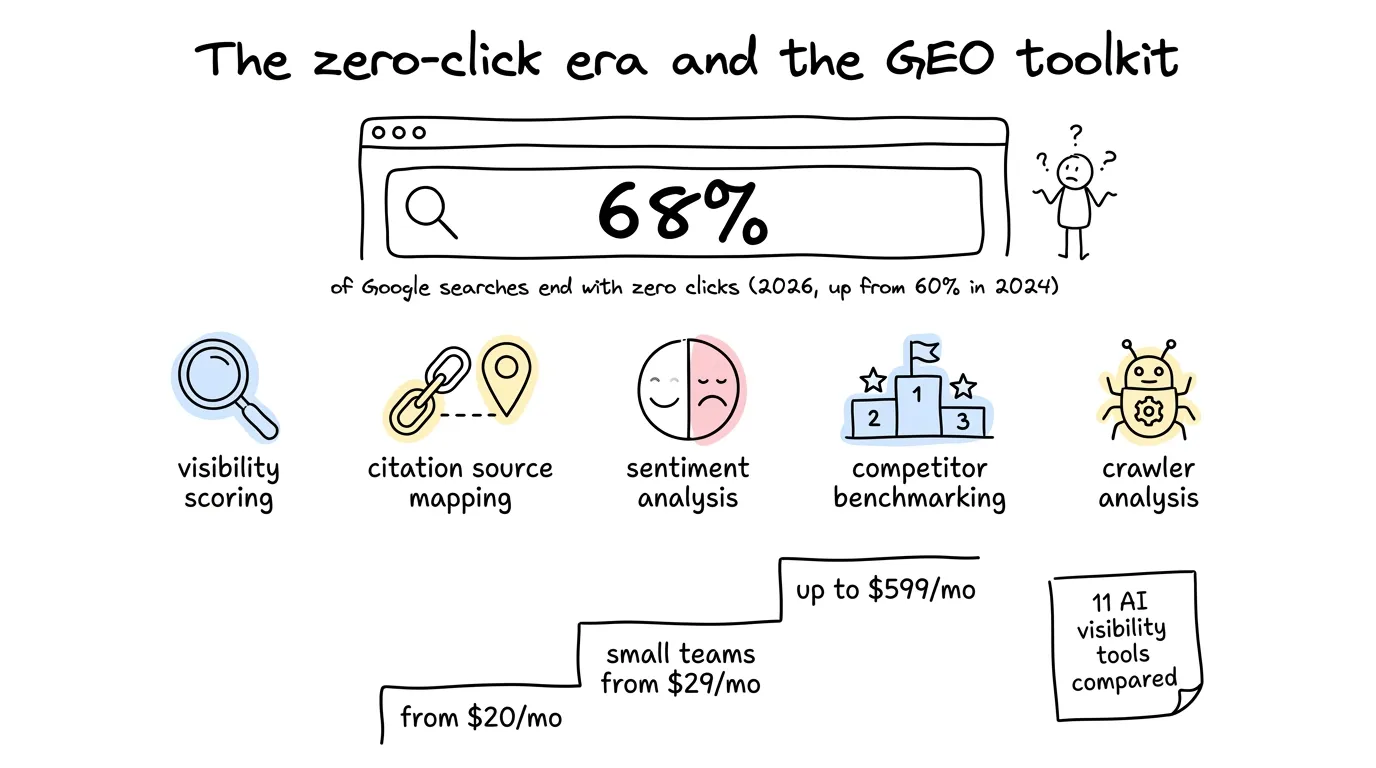
The GEO tool comparison that SE Ranking's Visible updated in October 2026 opens with SparkToro's zero-click research: in the first four months of 2026, 68% of Google searches ended with zero clicks, up from roughly 60% in 2024 — users are shifting to getting answers straight from AI. Showing up in Google AI Overviews, ChatGPT, Gemini, and Perplexity is now a brand survival issue. The piece draws the boundaries between four concepts — SEO, AI SEO, AEO (Answer Engine Optimization), and GEO — and cites Google's official documentation as the counterweight: optimizing for generative AI is still essentially SEO, no special schema or new file types needed; the practice hinges on citation density and factual density. The core is a comparison table of 11 AI visibility tracking tools (SE Visible, Rankscale, Writesonic, AthenaHQ, Otterly, Scrunch, HubSpot AEO, and more), covering platform coverage, visibility scoring, citation source mapping, sentiment analysis, competitor benchmarking, crawler analysis, and pricing and trials. Prices run from Rankscale at $20/month to GetCito at $599/month; small teams can start with Otterly at $29/month.
The methodology is spelled out too: weighted scoring across five dimensions — platform coverage 30%, data quality and citation depth 25%, actionability 20% (tools that only report numbers without fix recommendations get docked), workflow integration 15%, and price 10%. A few details: SE Visible captures real AI answers rather than simulations; Writesonic's sentiment analysis only arrives at the $499/month tier; GetCito is open source and self-deployable, with a free plan for hands-on teams; and Rankscale's G2 reviews admit the interface is on the complex side but call it the best value available right now. The capability list for GEO tools has essentially converged on five items: AI visibility scoring, citation source mapping, sentiment analysis, competitor benchmarking, and crawler analysis — showing which AI crawlers have visited your site.
💬 On a tight budget, start with Otterly at $29/month and first solve the zero-to-one question of whether you're being cited at all. In vendor selection, put citation source mapping first — AI citations lean on third-party media, so you need to know who's being cited. Don't overpay for a $599 luxury dashboard.
🔗 Further reading: Read the full article
Meta ads automation: 13 tools compared — approval workflows and audit trails become the deciding factors
A comparison updated by Adsap on October 14, 2026, puts 13 Meta ads automation tools head-to-head, with dimensions more actionable than the usual listicle: what each tool can automate, whether changes need human approval, whether actions are auditable (who changed what), price, and weaknesses. The free baseline is Meta's own automated rules and Advantage+: up to 250 rules per account, executed automatically the moment conditions are met, no approval step, one condition per rule; Advantage+ handles audience, placement, budget allocation, and creative combinations automatically — the decision power sits with Meta, not you. The approval dimension splits clearly: Ryze, Adsap, and Adspirer default to review-then-run, with each proposal listing the specific changes to approve, approve with notes, or reject; most AI media buyers (Madgicx with partial approvals, Adstellar with draft mode) default to auto-execution. Audit trails are missing from most tools — a hidden risk in agency settings.
Only four can automatically raise budgets and turn ads on: Meta's official rules, Birch, Madgicx, and Adstellar — Adsap's rules can only pause or alert. The piece sorts automation into four categories: rule engines (Birch, AdEspresso), AI media buyers (Madgicx, AdAmigo, Ryze, Adstellar), bulk launching (Rapid Ads, AdManage, Adsap), and assistant connectors (Adspirer, Meta's official Ads MCP). On pricing: Birch starts at $49/month, Madgicx at about $45/month, Make's free tier includes 1,000 credits per month, and Adspirer's free tier allows 15 tasks per month. Selection comes down to three questions: will changes wait for me, can I trace who changed what afterwards, and can the tool only shut budgets off or also turn them on? Note that the author's own product, Adsap, is among those compared — credibility takes a slight knock.
💬 Use the official free rules up to the 250-rule cap before even talking about paid tools — many accounts never max out this step. For agency selection, make approval workflows and audit trails hard requirements: any tool that can't tell you who changed what gets cut, because when something goes wrong, the accountability becomes unexplainable.
🔗 Further reading: Read the full article
B2B AI email tools roundup: active-learning platforms become the dividing line
EmasterLabs published a 2026 roundup of B2B AI email marketing tools (10 tools) on May 21, 2026. The selection framework has real practical value: traditional platforms are passive — templates plus scheduled blasts — while AI tools are active learning systems, where open rates and click patterns feed back into the next send, with predictive subject lines and copy automatically differentiated by role. B2B's peculiarity lies in long decision chains and multiple stakeholders, so tools must personalize along three dimensions — role, industry, and funnel stage. The email a logistics company's CMO receives should differ from a financial firm's IT manager's from subject line to body, and AI turns that differentiation into automation. The piece cites one number: B2B decision-makers receive over 120 emails a day. The deliverability engineering trio: smart send times, domain warm-up, and spam-filter avoidance; compliance automation (GDPR, CAN-SPAM, unsubscribe handling, list hygiene) is already standard. The author also does the efficiency math: an AI-drafts-humans-edit-and-approve workflow speeds up copy production by more than 60%.
The tools sort by use case: HubSpot as the all-in-one (marketing, sales, service, and data unified, with smart content blocks that auto-vary by recipient profile); Klaviyo for prediction (forecasting customer lifetime value and churn risk, with silent users automatically flowing into win-back sequences); ActiveCampaign for long-chain nurturing (predictive send times set per contact); Seventh Sense focused on send times (a layer on top of HubSpot or Marketo, with B2B teams reporting open rate lifts of 30% to 50% visible within the first two campaigns); and Instantly and Lemlist for cold outreach (rotating multiple sending accounts, automatic domain warm-up, first-line personalization). The article also flags a commonly overlooked pitfall: if the CRM isn't connected, sales will re-pitch people marketing has already converted, and the buyer experience collapses on the spot — two-way sync is a hard requirement. Note this is an SEO-style listicle with the author's own service included, so depth is limited.
💬 Don't rush to switch platforms. If you're already on HubSpot or Marketo, layer on Seventh Sense and run two campaigns — open-rate results come fast. For cold outreach, set up Instantly or Lemlist separately, on dedicated sending domains; don't mix it into your main domain and drag its reputation down.
🔗 Further reading: Read the full article
Salesforce Marketing Cloud Personalization profile update: how the real-time golden profile mechanism works
ATDb's product profile, updated October 22, 2026 (AI-drafted, citing 16 sources), breaks down how Salesforce Marketing Cloud Personalization works. Lineage: Boston-based Evergage was acquired by Salesforce in February 2020, renamed Interaction Studio, then took its current name in the Winter '23 release in November 2022. The mechanism runs in three steps: streaming behavioral data (clicks, browsing, purchases) builds a real-time golden profile for each visitor, with anonymous visitors and known customers stitched into the same identity chain; Einstein AI powers next-best-action recommendations, triggered campaigns, and A/B and multivariate testing; and delivery spans web, email, mobile, and apps. Two differentiators: bidirectional data sharing with Data Cloud plus cloud-native integration with Commerce and Service clouds, with open APIs for third parties; and support for open-time email rendering — content dynamically rendered at the moment the email is opened, based on the recipient's context at that instant, something content locked at send time can't do. It has 26 ecosystem connectors and targets large enterprises (retail, finance, travel, media, B2B). This is a database entry with no news value — use it as background material for CDP (customer data platform) selection.
💬 This is selection background, not news — bookmark as needed. Large enterprises deeply tied to the Salesforce ecosystem can go straight into evaluation. Everyone else should self-check one thing first: can your CDP build profiles in real time and trigger on the spot? That's where the gap is widening.
🔗 Further reading: Read the full article
🏷 Industry Data
Hashmeta compiles 10 AI marketing cases with real numbers
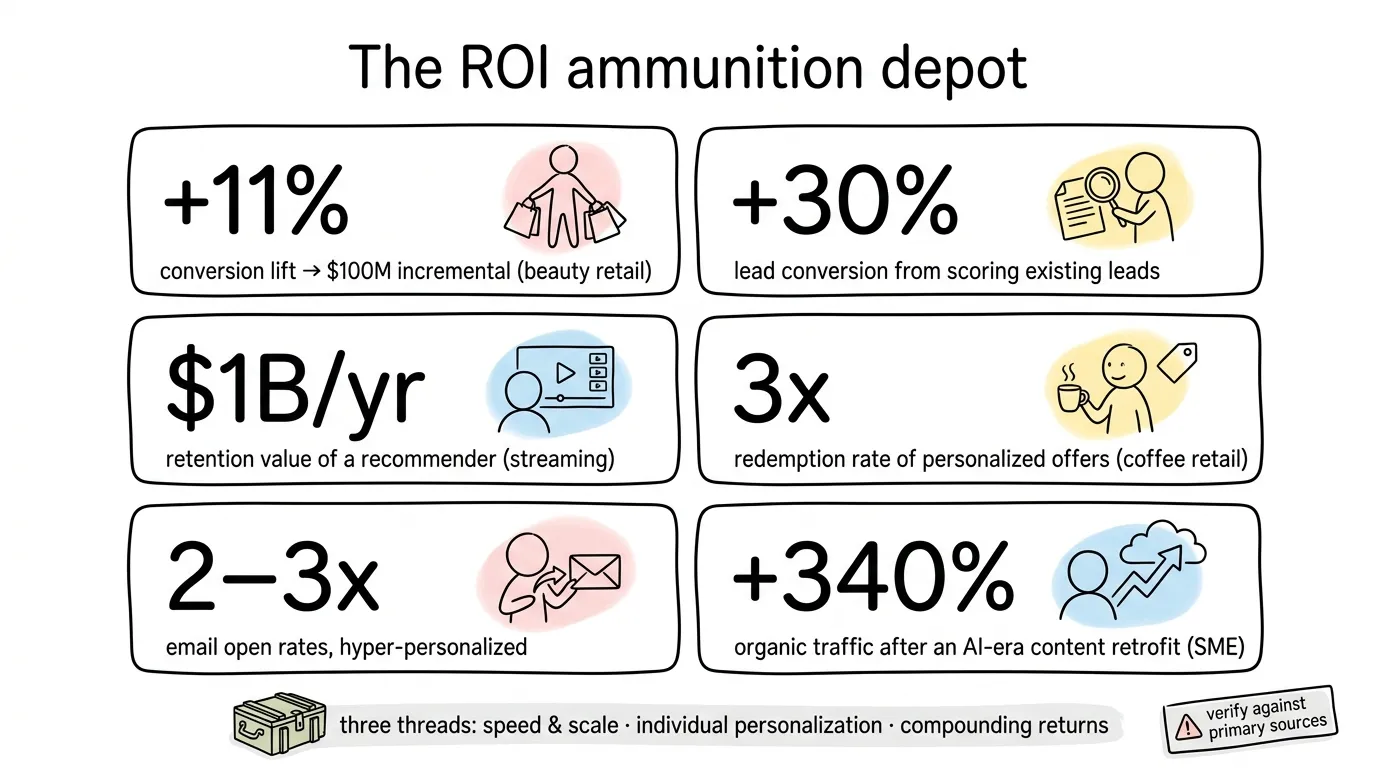
Hashmeta published a case collection on April 17, 2026, consolidating scattered public ROI figures into comparable benchmarks: Sephora's personalization engine drove an 11% conversion lift, worth roughly $100 million in incremental revenue; Coca-Cola used GPT-4 and DALL-E to cut creative production time in half — and when you're running campaigns across dozens of markets at once, that speed is what makes localization iteration possible; HubSpot's AI lead scoring lifted lead conversion 30%, by ranking existing leads rather than generating more; Alibaba's AI copywriting engine processes 20,000 lines per second, with variants clicking 8% higher than human-written ones — winning through sheer test volume; Unilever cut CPA (cost per acquisition) 25% through programmatic optimization, proving that continuous tuning of existing budgets is still the ROI mainstay; Spotify's hyper-personalized emails get open rates 2 to 3 times the generic version; Chase Bank's AI copy more than doubled click-through rates in testing; Starbucks Deep Brew's personalized offers redeem at 3 times the rate, with the system running for years on real transaction data; and Netflix's recommendation engine carries roughly $1 billion a year in retention value — there, the recommender is the retention strategy itself. The last entry is the agency's own Singapore SME client: after retrofitting content and technical SEO for the AI era, organic traffic rose 340% and qualified lead conversion rose 58%. The author distills three common threads: speed and scale, individual-level personalization, and compounding returns — the models keep getting more accurate as data flows in, and the gains snowball. Note this is an agency blog; some figures are second-hand compilations and the last entry is a soft plug, so verify against primary sources before citing.
💬 Use this page as the ammunition depot for budget arguments — but filter out the last entry first. When reporting upward, borrow the peer numbers: retail, cite Starbucks and Sephora; CPG, cite Coca-Cola and Unilever; finance, cite Chase. Other companies' public numbers are the easiest page of evidence you can put in any proposal.
🔗 Further reading: Read the full article
upGrowth publishes 7 source-verified AI brand cases: if results weren't published, it says so — no inventing
upGrowth published an AI brand strategy case collection on August 26, 2025, with an approach you rarely see in case-study writing: every case is annotated with primary sources such as press releases or engineering blogs, places where brands didn't publish results are explicitly declared as unreported rather than invented, and facts are listed separately from the author's interpretation. Five big brands, each with its own play. Coca-Cola's Create Real Magic launched March 20, 2023, built jointly with OpenAI and Bain. Creators made images using signature assets like the contour bottle and the polar bear, top works ran on digital screens in Times Square and Piccadilly Circus, and more than 30 creators later joined the Real Magic Creative Academy in Atlanta — reach data was never published. Nike simply acquired the predictive analytics company Celect in August 2019, buying the ability to forecast "which shoe will sell well in which city and when," and added a NikeAI beta to its US iOS app in August 2024. Netflix has personalized the cover art for every title per member since 2017, using contextual bandits (algorithms that learn while choosing) to select images; officially, key decisions are still made by content executives, with models only assisting judgment. Starbucks' Deep Brew runs on Microsoft infrastructure, handling offers, inventory, and scheduling; Rewards membership grew 15% to 17.6 million, but the report does not attribute that growth to Deep Brew. Sephora's Virtual Artist (powered by ModiFace) supported over 1,000 blush shades for virtual try-on and AI color matching as of June 2017. Two of its own clients made it into AI search answers: Vance's Google AI Overviews visibility rose from 12% to 89%, average ranking moved from 8 to 1, and monthly organic traffic grew from 1,800 to 5,600; Fi.Money became the go-to authority for smart savings questions. The article also offers a measurement framework for brand AI adoption: watch five metrics — engagement lift, customer lifetime value, adoption speed, sentiment shift, and competitive differentiation — all benchmarked against the pre-AI baseline. The companion tools are sorted by capability: predictive analytics with IBM SPSS Modeler, competitive intelligence with Crayon, and sentiment listening with Brandwatch.
💬 What makes this piece valuable is the posture: build your case library exactly this way — tag every number with a primary source, and if there's no data, say there's no data. Small brands should study the Vance entry: the jump from 12% to 89% came from answering payment-query questions clearly and consistently. Even a small budget can make it into AI Overviews' citation list.
🔗 Further reading: Read the full article
Indian agency publishes an AI SEO and social media trends overview: use it as a mental checklist, not as a data citation
A trends overview updated by Arinfotech (an agency in Jaipur, India) on October 3, 2026, covers four tracks: AI SEO, GEO, AEO, and social media search. The points are correct but all at the common-sense level: AI is rewriting the entire SEO workflow — keyword research, content creation, competitive analysis, and performance measurement all get faster — yet human verification remains irreplaceable, and technical, finance, and medical topics especially need human review. Search behavior is becoming conversational — users pose whole-sentence questions instead of typing keywords, and one long article covering a cluster of related questions works better than repeating the same phrase throughout. Social platforms (Instagram, YouTube, Pinterest, LinkedIn) are becoming search and research gateways: users discover and get sold on products on Instagram, check videos on YouTube, and finally land on the official site — search and social strategies must be connected. AI content supply is exploding, making original, high-quality content scarcer; and personalization must move in step with privacy transparency. There's no exclusive data or case study anywhere in the piece — it's an entry-level trends read, and what it has going for it is fairly recent updates and full coverage.
💬 Use this as the team's mental checklist, not as a data citation. The one line worth real effort: plan search, content, and social as a single funnel. If three teams each write their own plans, a big chunk of budget will quietly leak away — and who covers the shortfall? Nobody.
🔗 Further reading: Read the full article
💡 Today's Big Picture
Lay today's ten reports side by side and only one throughline remains: the gateway to attention is moving — from the search box to AI answers, from human readers to agents. Kantar wrote it into its ten trends for 2026 with data; the University of Toronto's controlled experiment proved the mechanism (AI citations favor third-party media); SE Ranking's zero-click figure (68%) sized it; and three tool comparisons plus two case collections answer the how, the cost, and the return. What's worth noting is how today's reports corroborate one another: Kantar says GEO is the new SEO, the arXiv paper proves the bias mechanism behind AI citations, SE Ranking's tool table lays out the full monitoring toolkit, and the upGrowth and Hashmeta cases supply return figures from both ends — small-business structured content retrofits on one side, big-platform personalization systems on the other. Research, tools, and cases rarely line up on the same day — it signals that AI visibility has moved from the concept stage into the execution stage. A second, quieter thread is budget discipline: Adsap's comparison makes approvals and audit trails the selection threshold, the Neil Patel episode is doing the token-cost math, and Kantar reminds that creator investment must be measured on ROI and brand metrics. The more automated the tools, the tighter governance needs to be — in 2026, the teams that blow up will mostly blow up on the automated parts nobody was watching.
The exam question for marketing teams in the first half of next year is now clear: where does your brand rank on AI's citation list, and does the agent pick you when it places orders on the user's behalf? Two things you can start today: first, run an AI visibility baseline using 20 buyer questions to test each engine; second, rewrite your hero product's specs and guides into machine-scannable content. Both cost nearly nothing and produce results within a week — better value than waiting for next year's planning cycle. Human attention still has to be bought, and AI citations still have to be fought for. Only brands that hold both are safe; the ones guarding just one end will feel the pain first next year.
Continue reading
Related articles
AI Marketing Daily · 2026-11-22
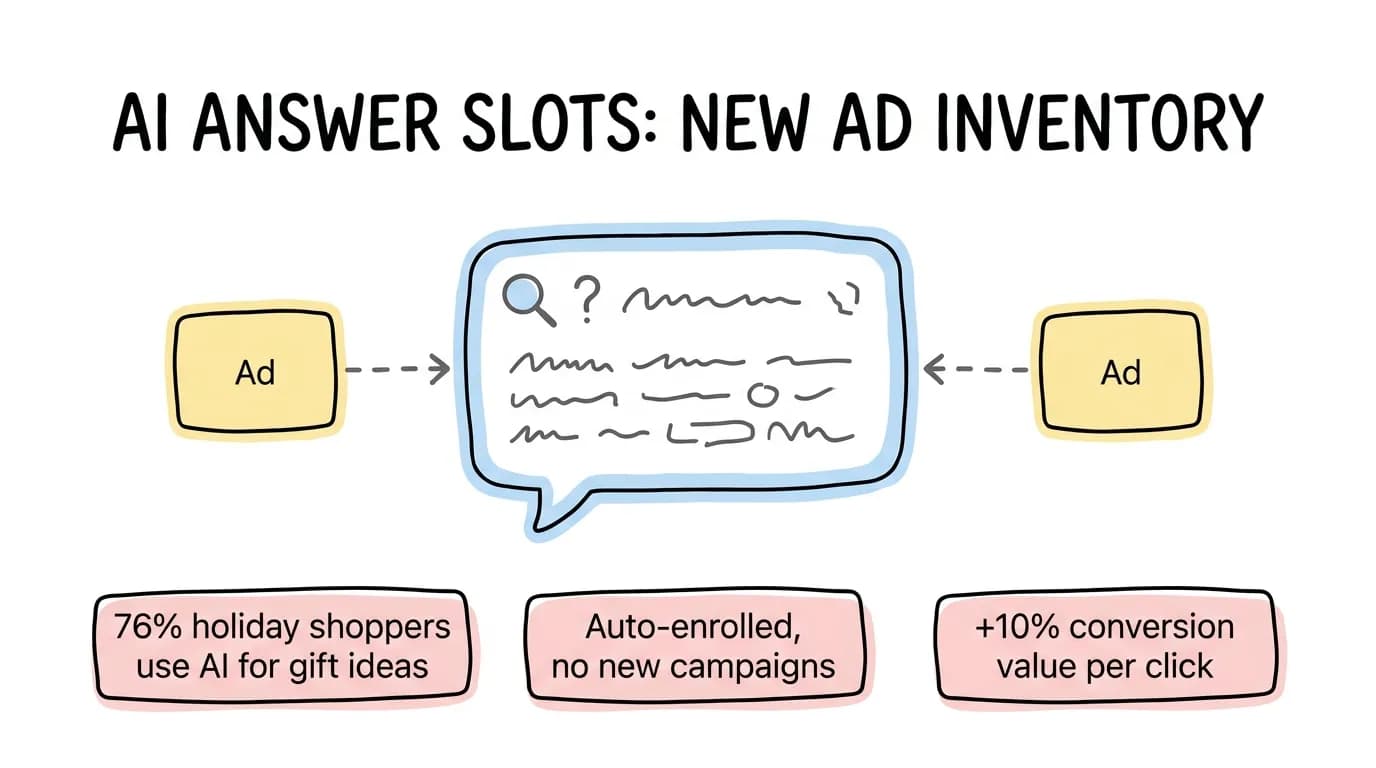
AI Marketing Daily for 2026-11-22 rounds up 20 items led by Microsoft opening Bing AI Overviews to ads and Google expanding AI Mode ads to ten countries, plus GEO guides, ad automation delegation guidance, AI Overviews CTR data, and a legal-risk checklist for AI-generated creative.
AI Marketing Daily · 2026-11-21
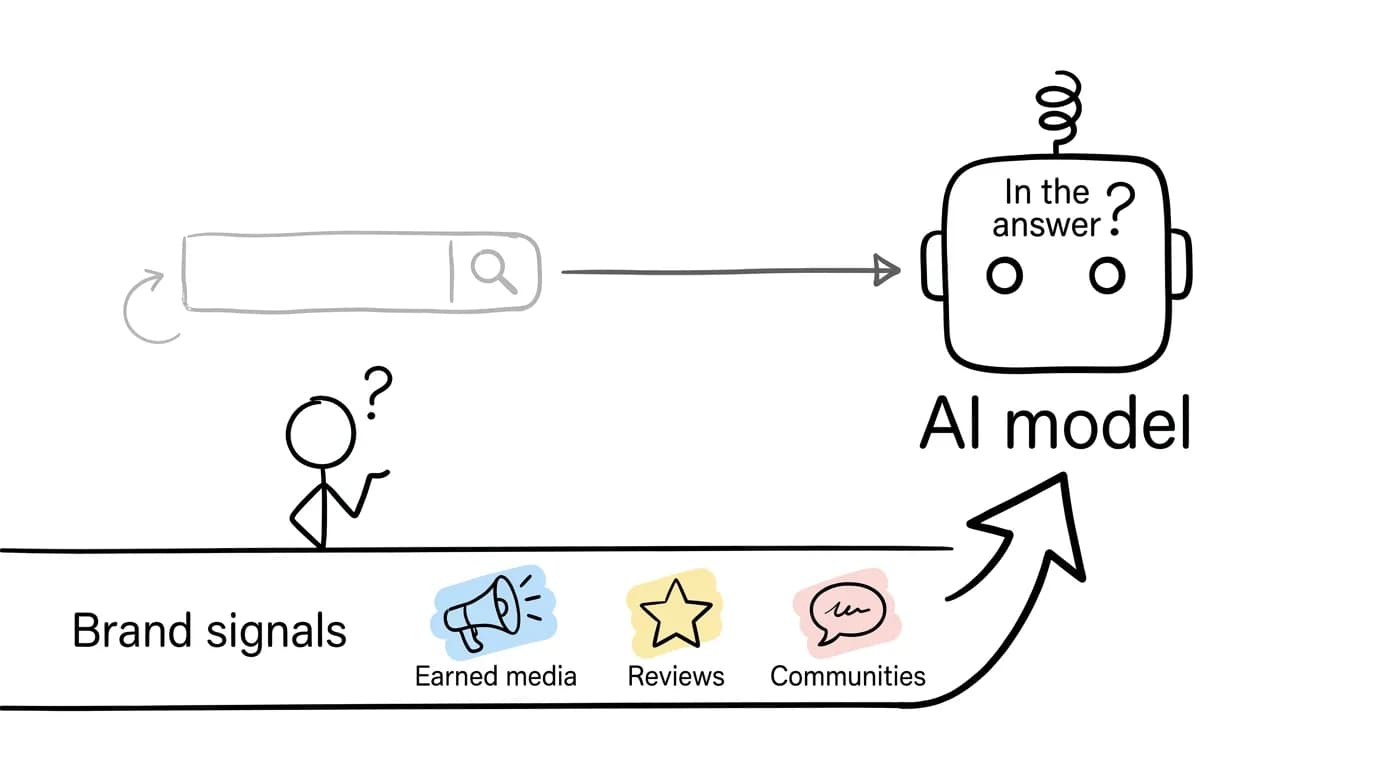
A November 21, 2026 AI-marketing daily covering AI search visibility, GEO methods, Google AI Mode ads expanding to ten countries, Meta's pre-Black Friday changes, agentic shopping, and industry adoption and ROI data.
AI Marketing Daily · 2026-11-20
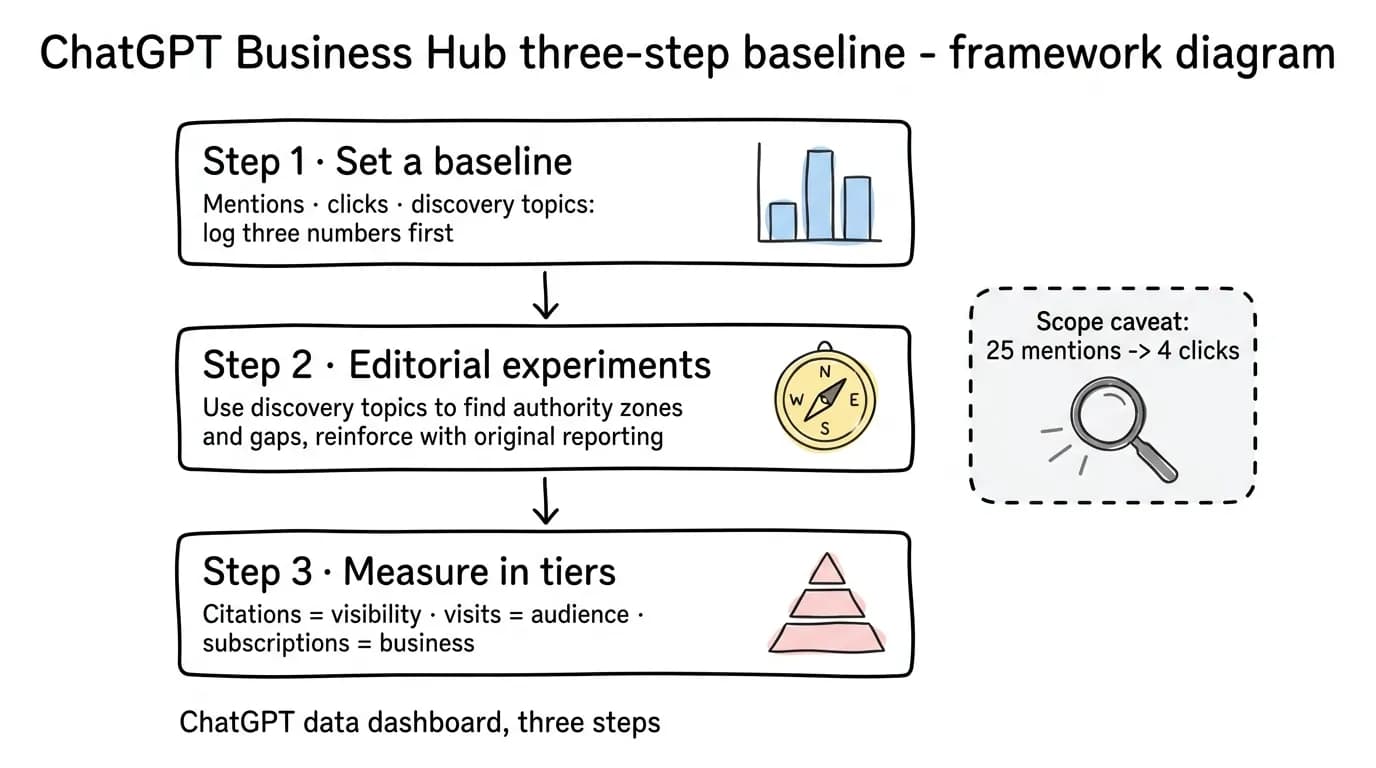
AI Marketing Daily for 2026-11-20 rounds up 19 items centered on measurement: OpenAI's ChatGPT Business Hub dashboard, EU rules for agent-mediated purchasing, Meta pausing four AI terms, and B2B data on shortlists and the dark funnel, each with action advice.